Search

Adventures in the Villa

Month

October 2018

2018-10-06 – WBCCI 2018 Southwest Adventure Caravan – Day 49 – Albuquerque International Balloon Fiesta

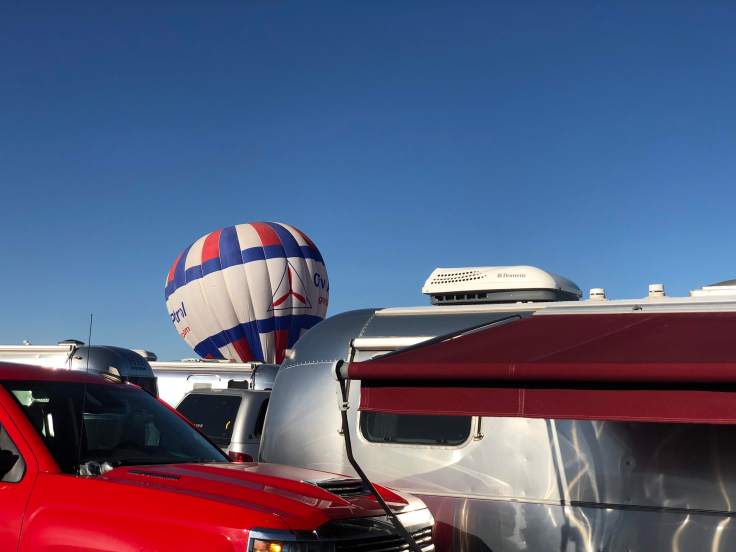
We were up at 0 dark thirty to see the commotion on the field…

img_9608

There are about a dozen or so balloons outfitted to fly at night; these are the “Dawn Patrol”.  They go up and report back on wind currents and other issues the balloonists might encounter…

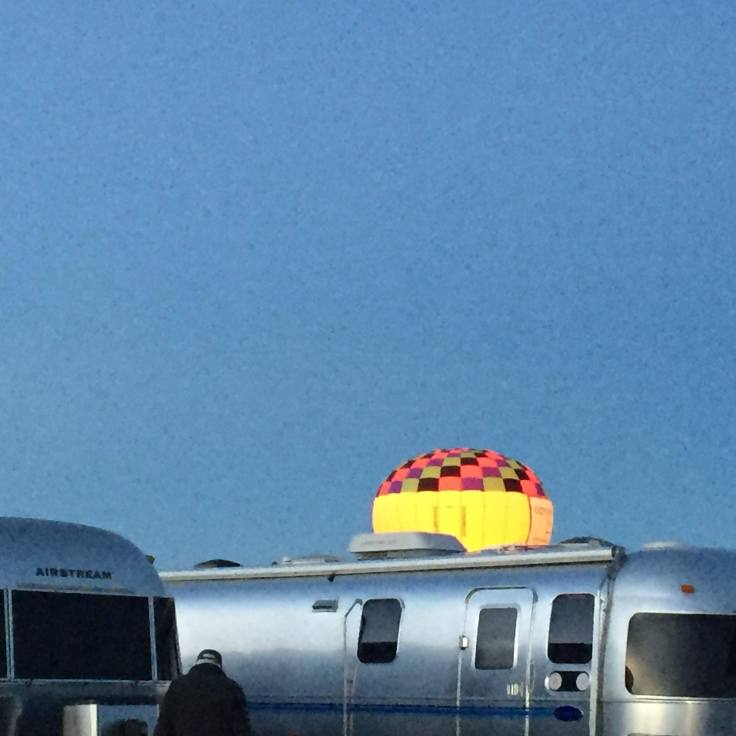
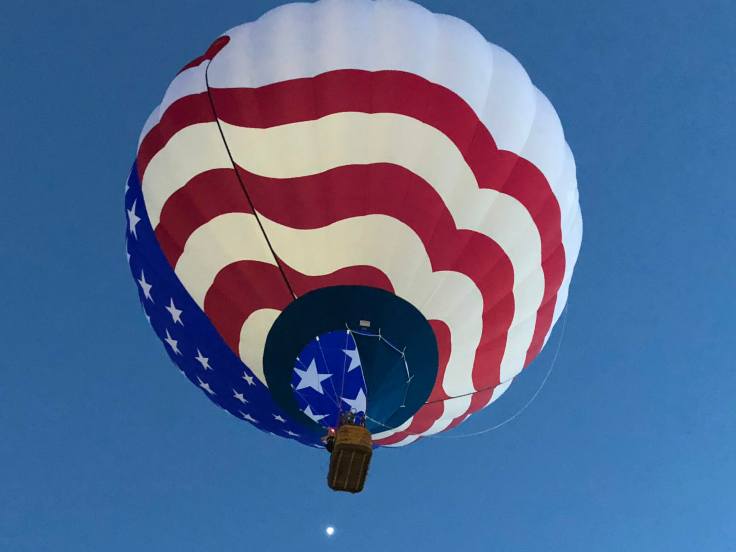
At about 6:00 am they fired their burners and lifted off:

img_6197img_9616img_9619img_6199img_6201

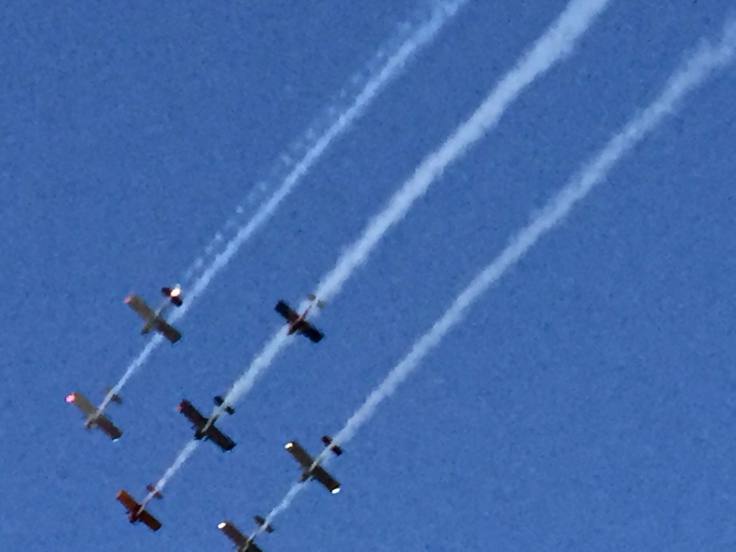
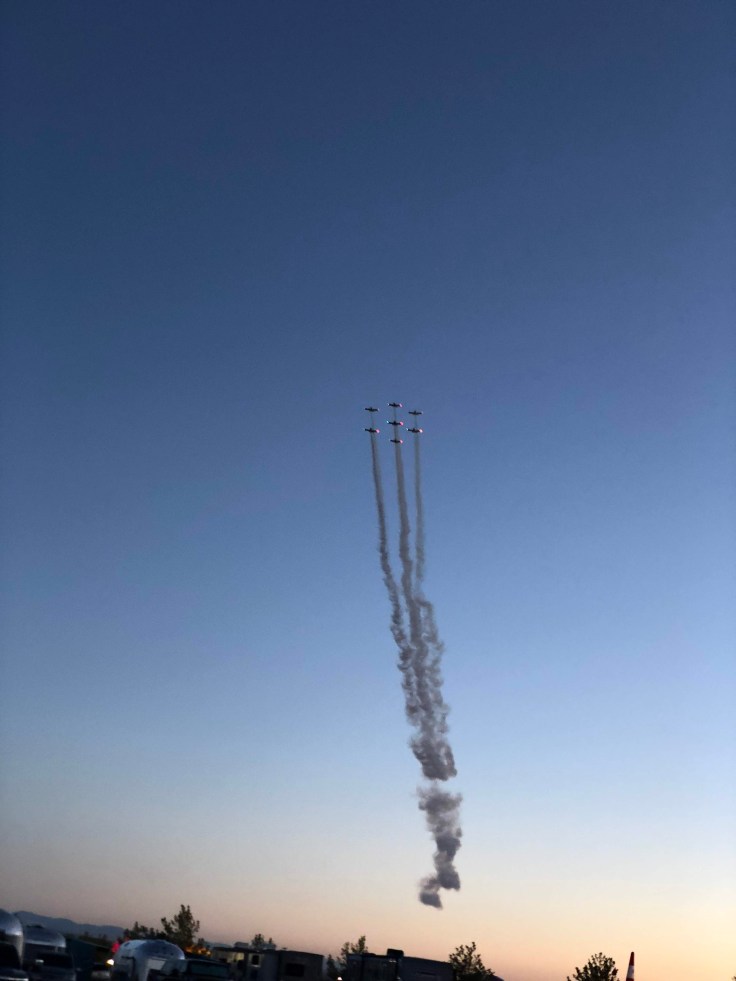
At 7:00 am the “Mass Ascension” begins… But first we have a flyover of some vintage airplanes…

img_9624img_6220img_6222

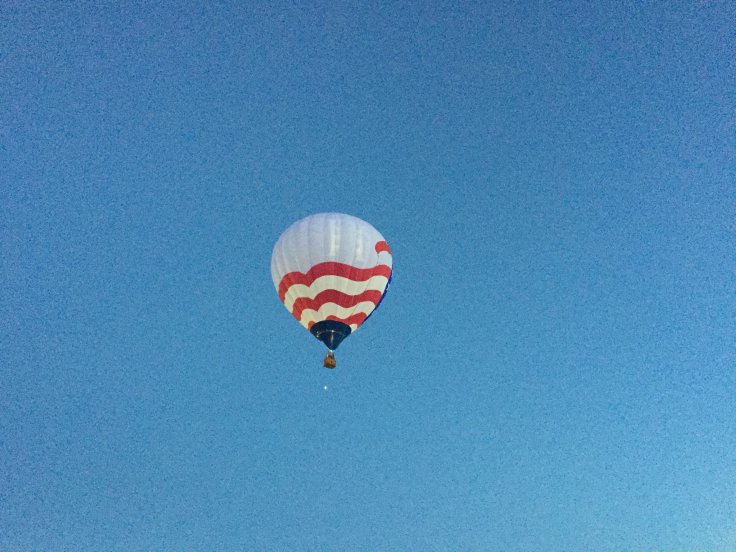
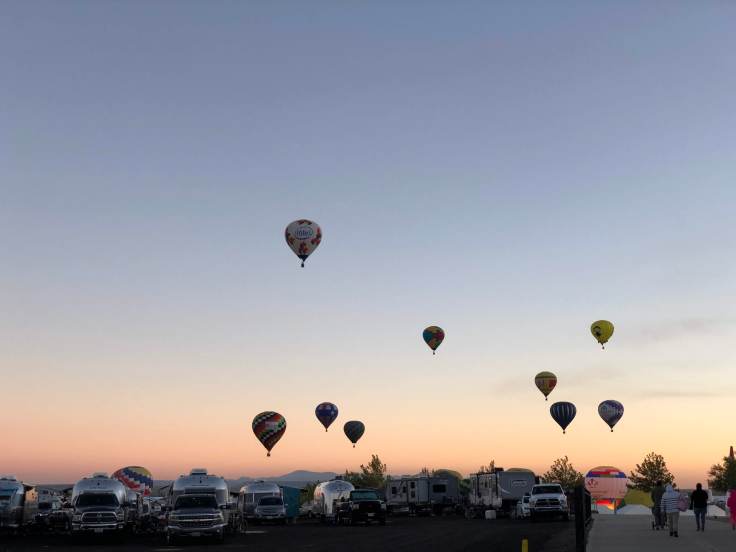
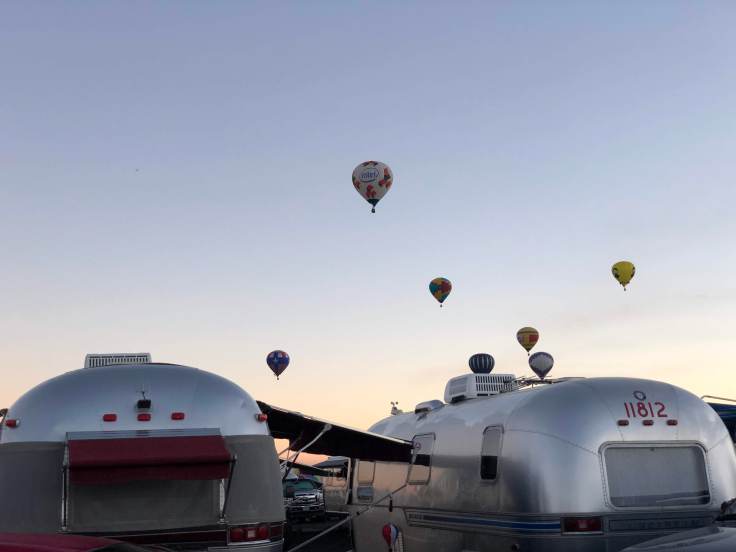
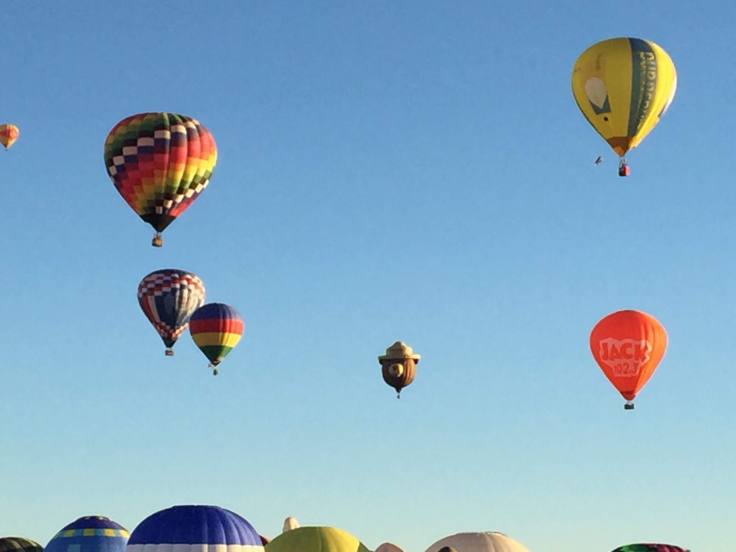
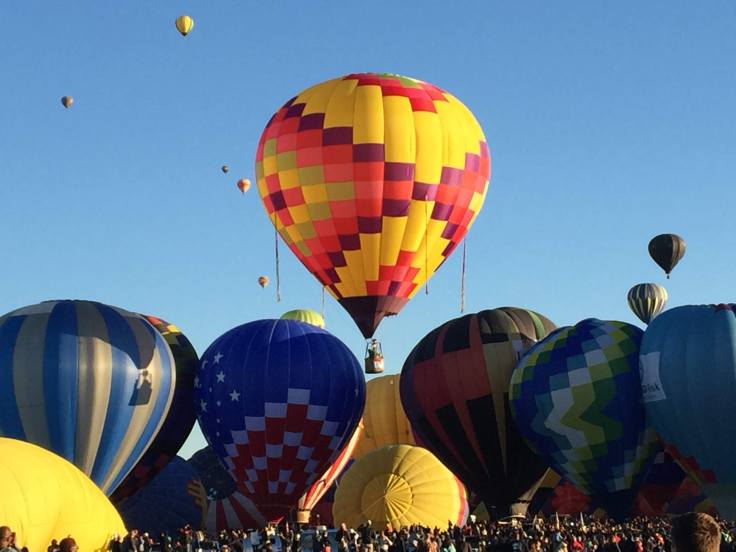
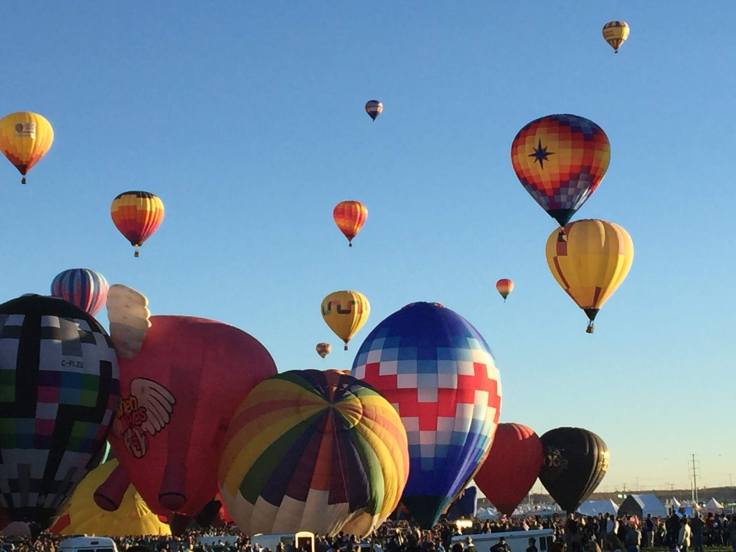
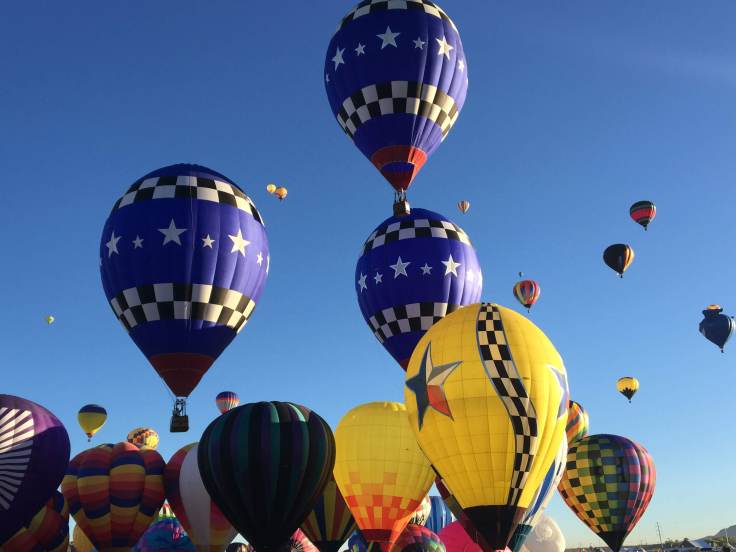
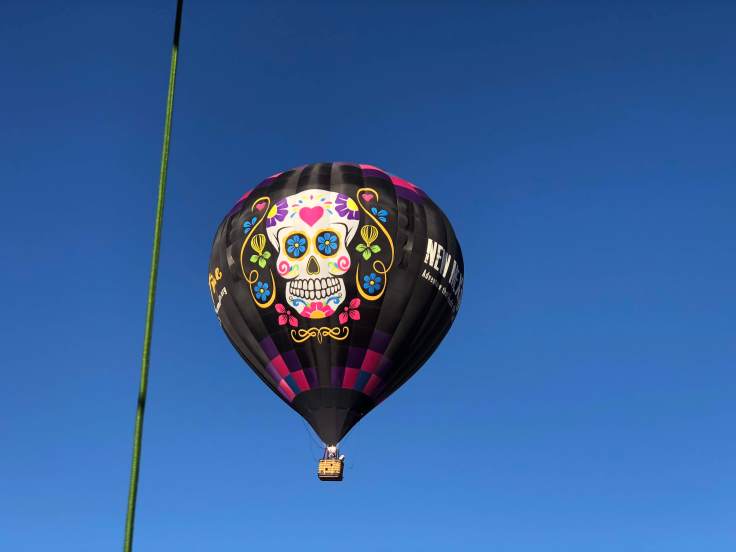
One by one the balloons ascend until the sky is filled…

img_62151img_6209img_9623img_9630img_9631img_9632img_9642img_6240img_6241

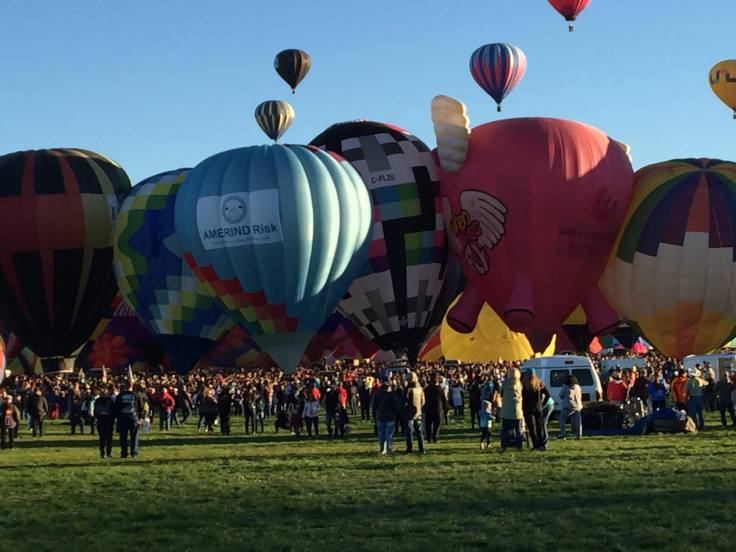
You can even walk on the field and get up close and personal with the balloons as they are about to launch…

img_6242img_6243img_6244img_6246img_6250img_6259img_9671img_9678img_9681img_9673

Some balloons don’t make it very far…

img_9688

And then, just like that, they are gone… By 9:00 or so the ballooning for the day is over…

img_9690img_9691

We walked amongst the hundreds of vendors selling atrocious looking foods (Pork Chop on-a-Stick?) and cheap but expensive “souvenirs”…

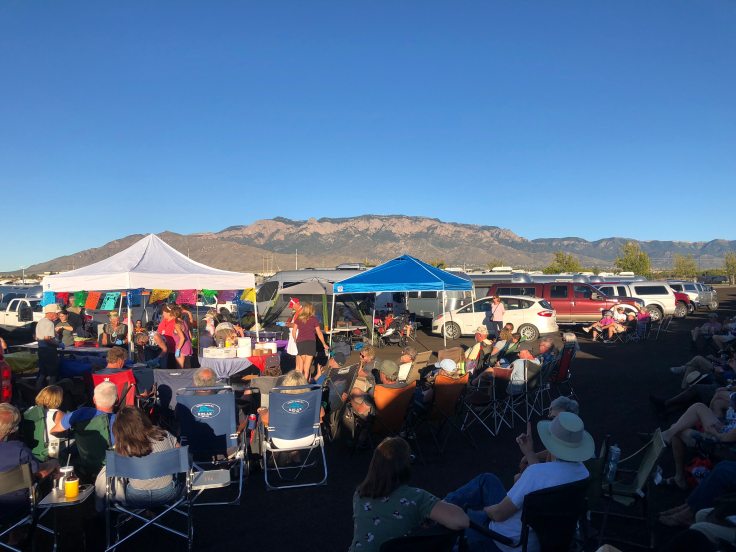
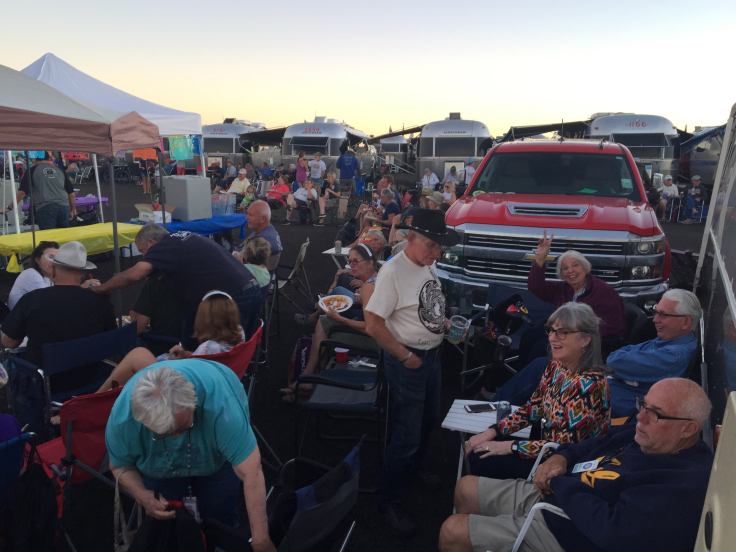
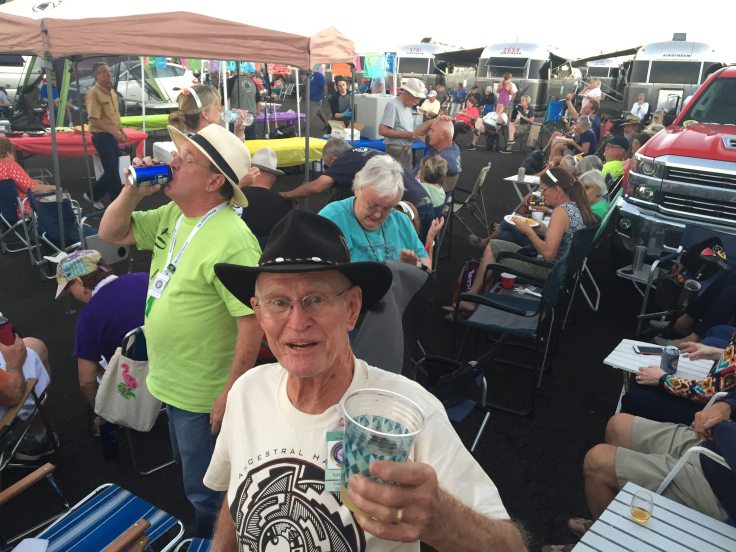
This evening we had another gathering right in front of The Villa, but this time there were only about 100 people and it was just “Happy Hours”

And an enjoyable time was had by all…

2018-10-05 – WBCCI 2018 Southwest Adventure Caravan – Day 48 – Convoy to the Albuquerque International Balloon Fiesta

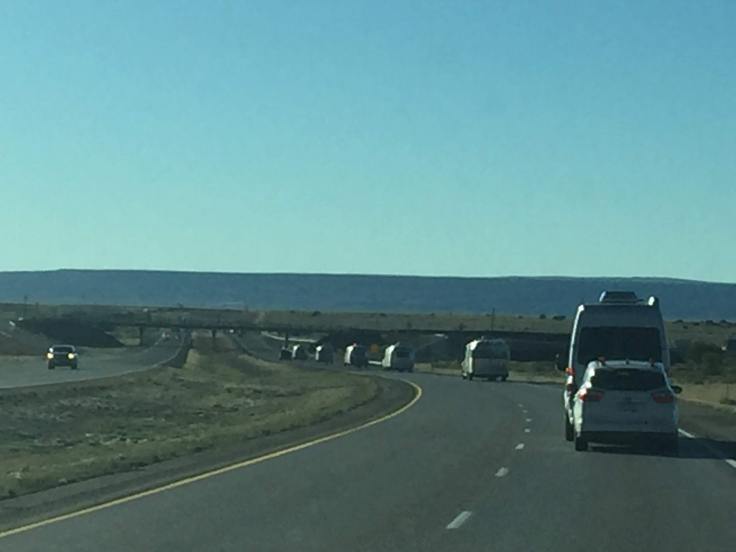
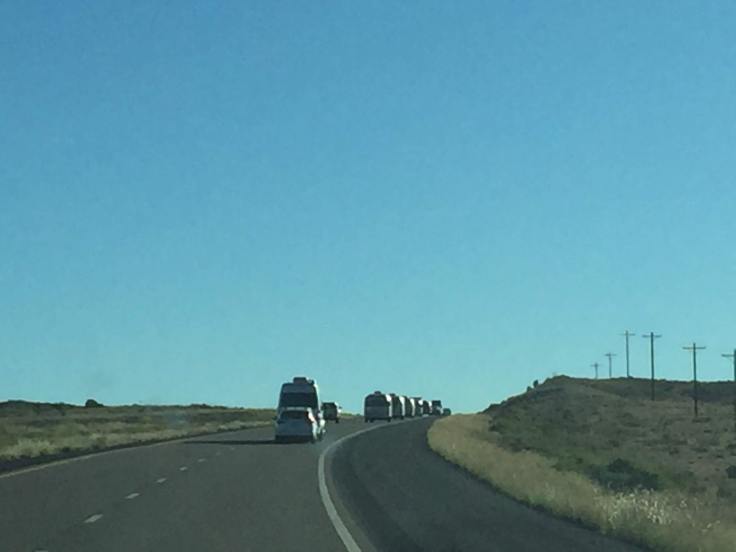
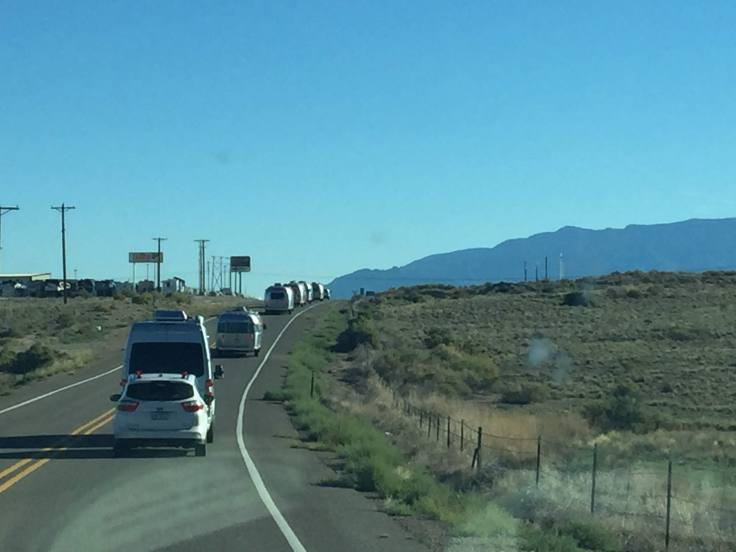
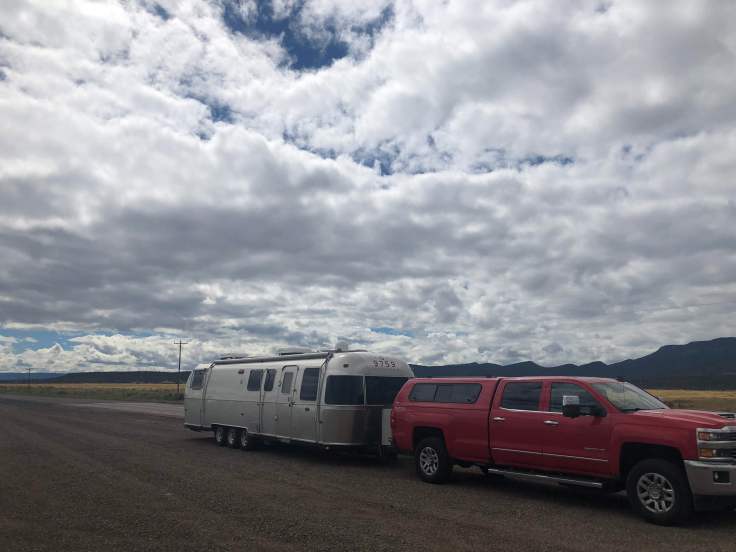
We were up early, disconnecting, and getting ready to roll.  At 8:00 the lead driver of our convoy of 15 Airstreams rolled out of his site and we all rolled in behind him.  At 8:15 we headed out towards the freeway…

img_6171

After about an hour we exited the freeway and drove the frontage road to Camping World, the staging area for Airstreams entering the Balloon Fiesta Grounds.

img_6173

img_6176

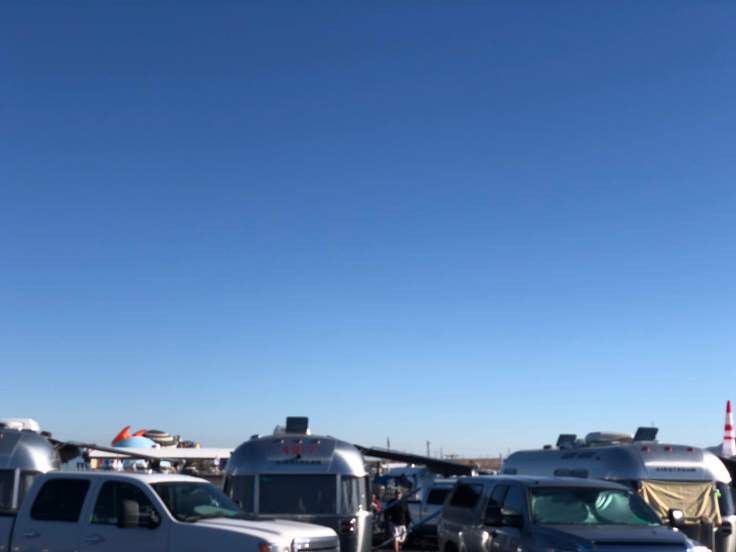
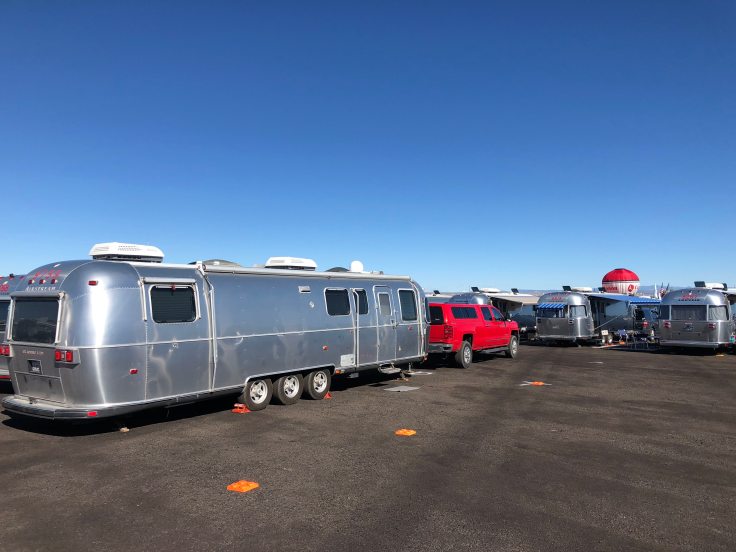
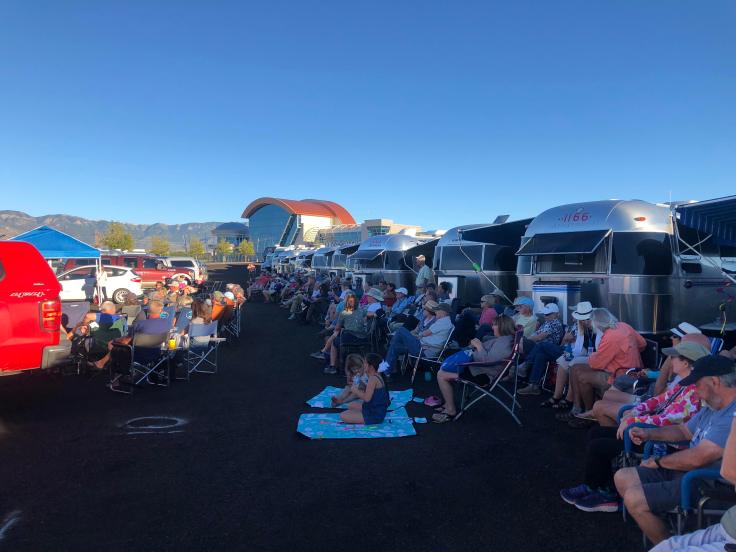
Right on schedule, the pilot car pulled in front of our convoy and we convoyed in for the last 10 miles or so.  When we arrived at Balloon Fiesta grounds we were directed in, and we parked in order of our arrival – no picking of spots allowed.  However, by some happy coincidence, we were parked directly facing the “plaza”, the open space reserved for our evening activities…

img_9593

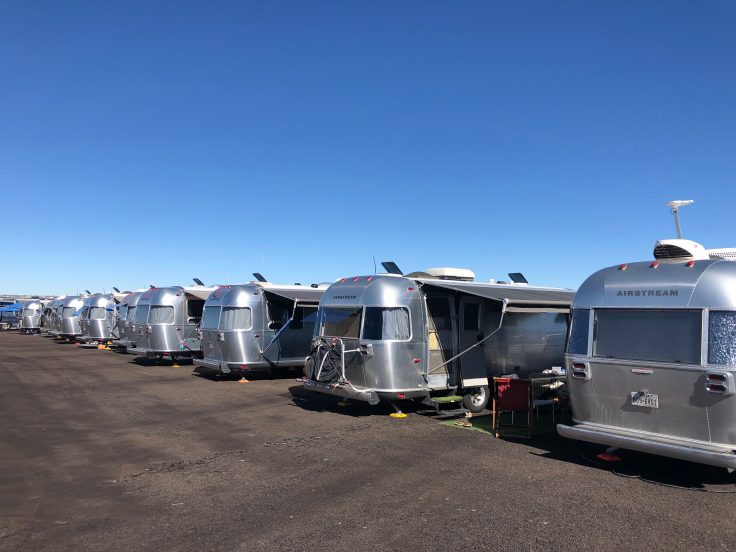
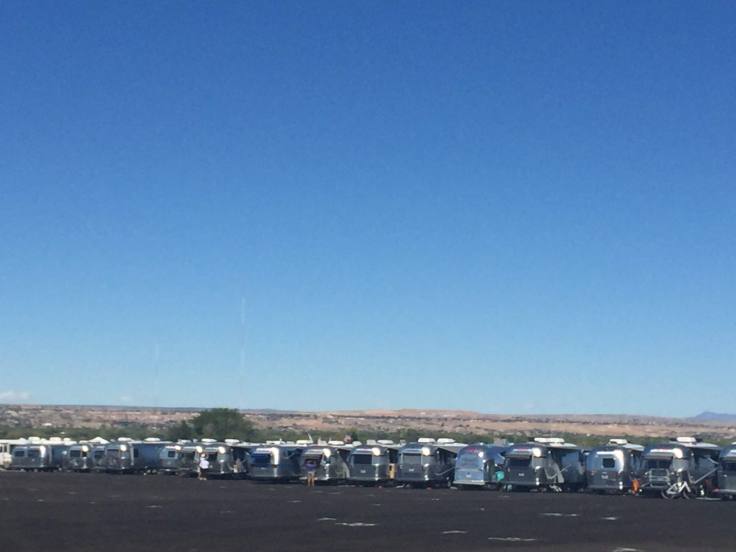
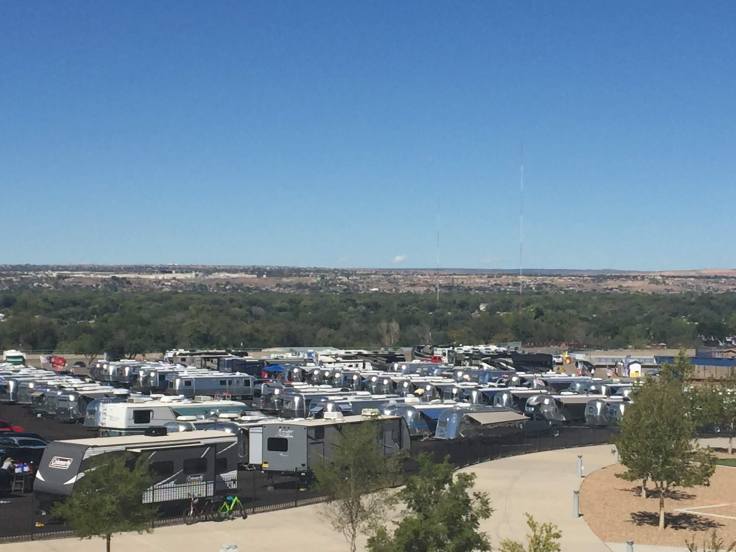
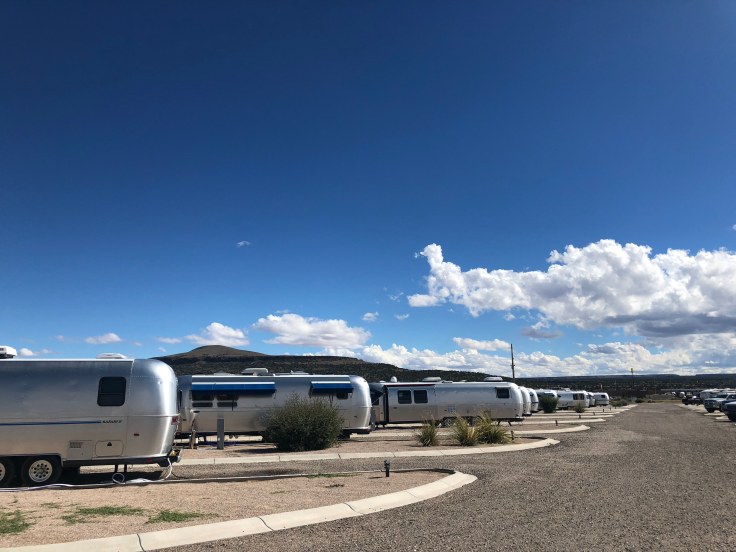
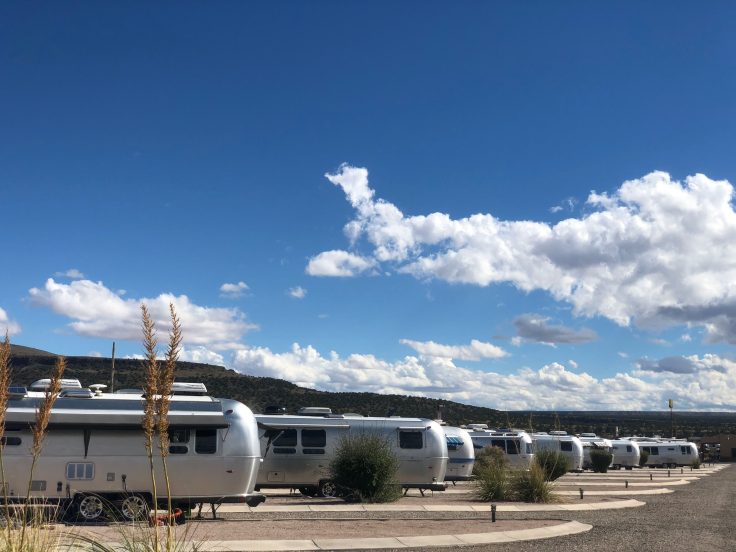
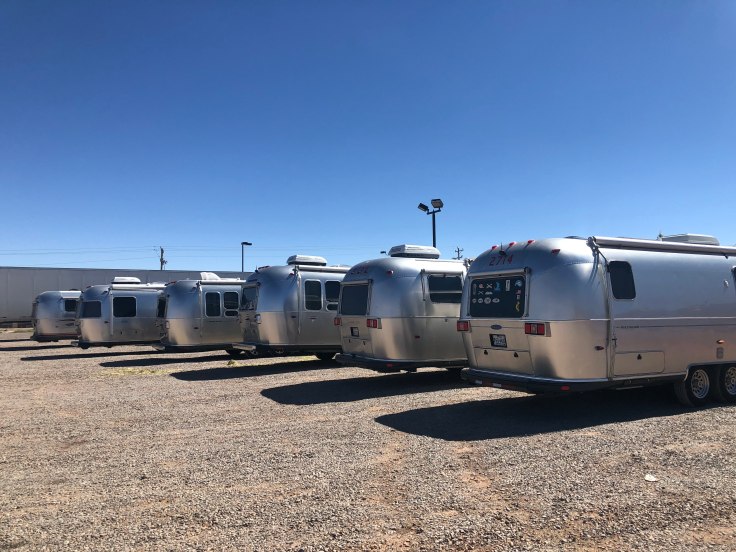
Including our caravan of 30 Airstreams, there are 150 Airstreams parked in this “VIP” parking area…

img_9594img_6180

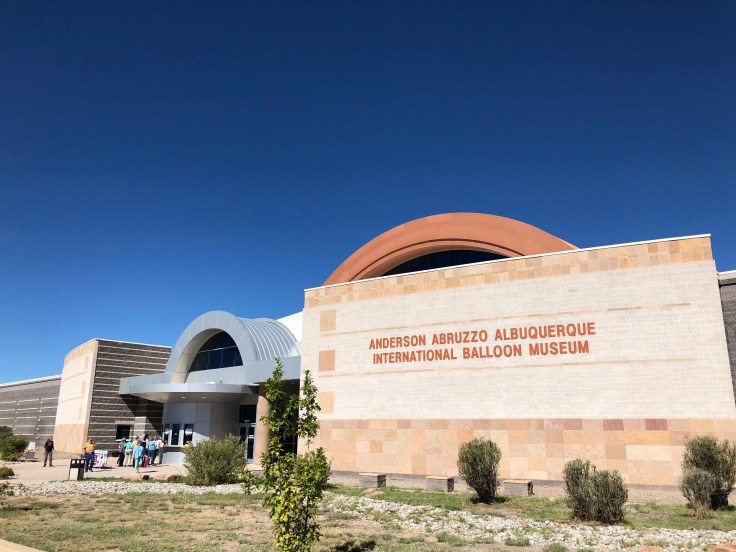
With no hook-ups there is little to do to set up, so we walked to see the Balloon Museum…

img_9598

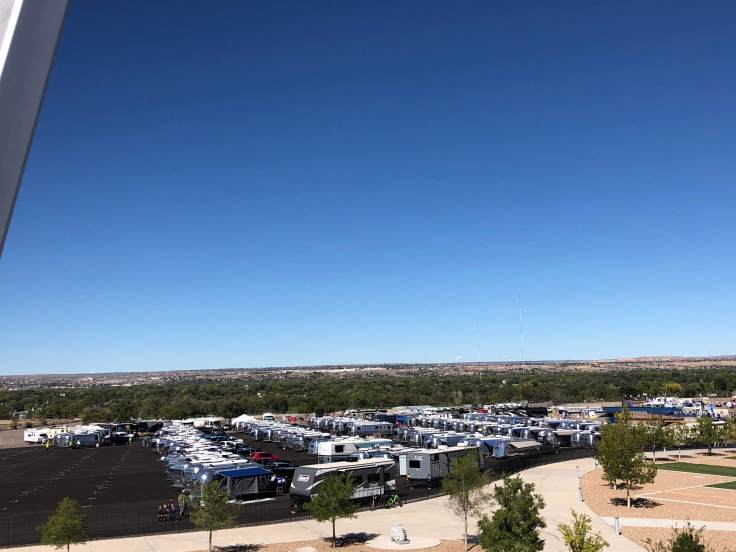
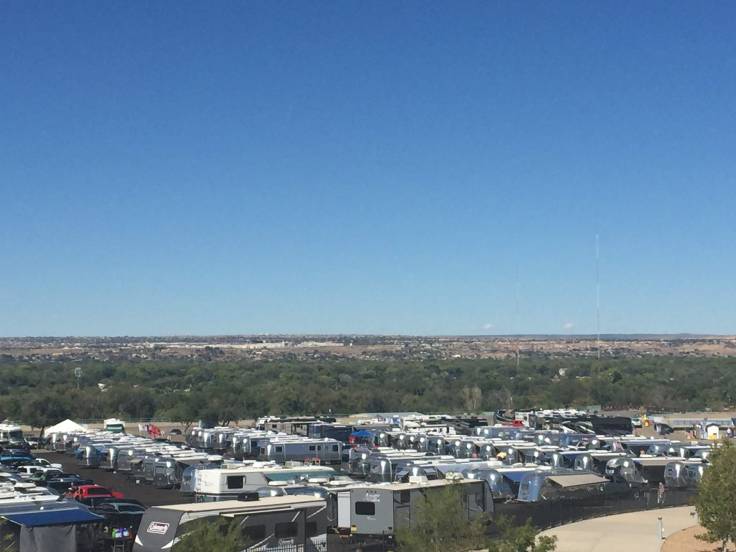
The museum was mobbed with thousands of school children, but it did offer great overviews of the Airstreams…

img_6183img_9600

We could also see out over the main field where the 600 or so hot air balloons will be setting up…

img_6189

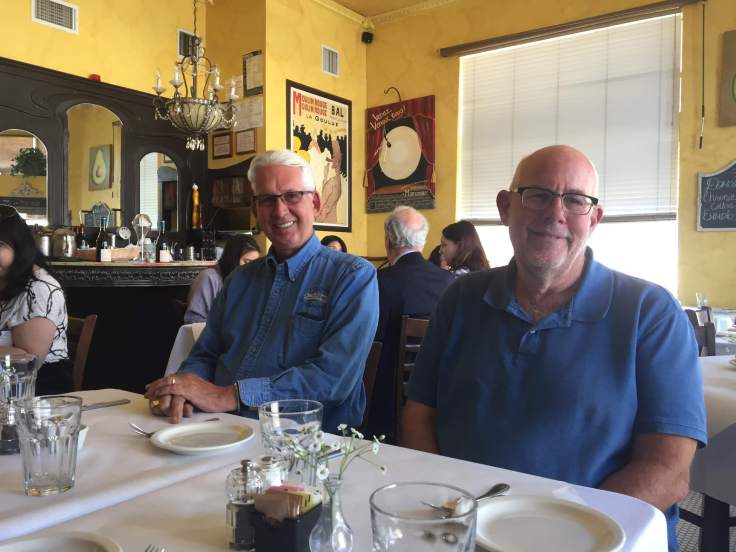
After that, we headed to downtown Albuquerque for a wonderful lunch at El Troquet, a tiny French bistro just dripping with charm…

img_6191

After lunch we walked a bit on Central Ave., the route of Historic Route 66.  Lots of new shops, bars, and restaurants are here and it is quite a lively spot…

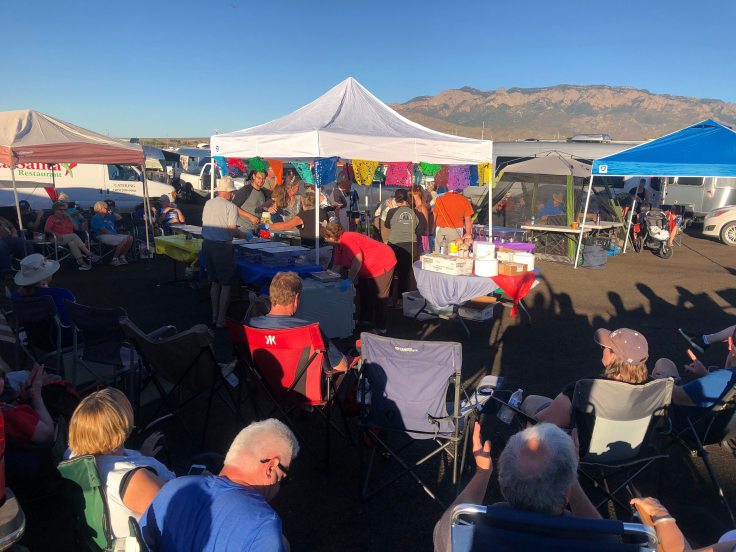
We returned to the Villa, where Happy Hours and Dinner were soon in full swing…

img_9604img_9605img_9607img_6192img_6193

Just dinner with our closest 300 friends… Above is our caravan leader, Jay.  His job is just about done…

After dinner more socializing continued.  At 8:00 there were fireworks out on the balloon field…

And an enjoyable time was had by all…

2018-10-04 – WBCCI 2018 Southwest Adventure Caravan – Day 47 – Cubero, New Mexico and Sky City Pueblo at Acoma

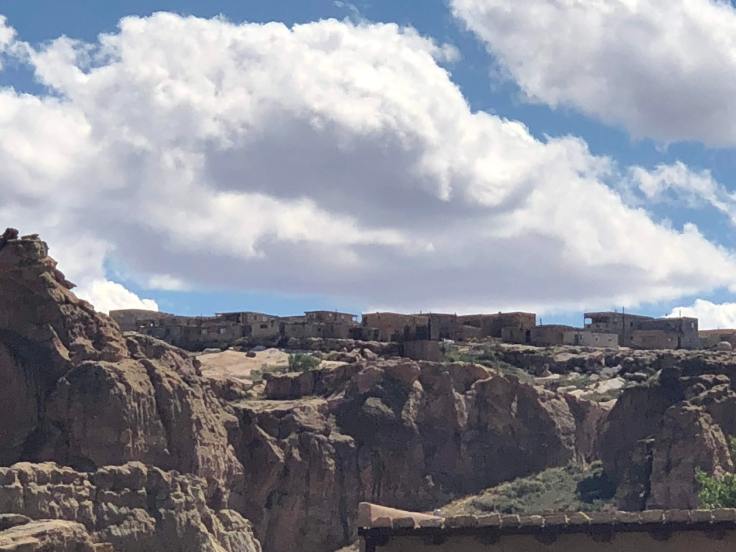
This morning we headed out to see the Pueblo at Acoma, called Sky City…
img_9591

Acoma Pueblo is an Indian pueblo approximately 60 miles west of Albuquerque.  Four villages make up Acoma Pueblo: Sky City (Old Acoma), Acomita, Anzac, and McCartys.   Today we are visiting Sky City – Old Acoma, a National Historic Landmark.

The Acoma people have continuously occupied this general area for over 2,000 years, making this one of the oldest continuously inhabited communities in the United States (along with Hopi, Zuni, and Taos pueblos). 

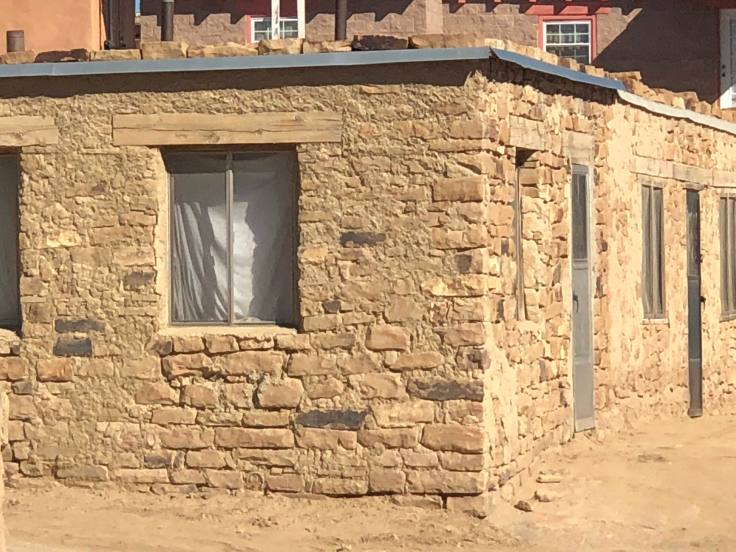
The Acoma people say that the Sky City Pueblo was established in the 11th century, with stone buildings as early as 1144 on the Mesa indicating as such, due to their unique lack of Adobe in their construction, proving their antiquity.  These old buildings are native stone with mud mortar, covered with a straw-and-mud plaster.

The Pueblo is situated on a 365-foot mesa, surrounded by a (relatively) fertile valley.  The isolation and location of the Pueblo has sheltered the community for more than 1,200 years.  They sought to avoid conflict with the neighboring Navajo and Apache peoples.

In 1540, Coronado’s expedition became the first non-native visitors to Acoma.  While their first encounters were not particularly friendly, they did share food; Coronado’s men left on friendly terms.

Their next encounter was not so friendly.  Hostilities ensued when the Spanish Conquistidors attacked Acoma, resulting in many lives being lost on both sides.  The Spanish called for reinforcements, and they ended up taking many men and women as prisoners; they were deemed to be quilty of these hostilities and they were sentenced to 25 years of slavery.  In addition, the men each had their right foot cut off.  The Acoma lived under the Spanish rule until 1598.  This dark period of Acoma is known as the Acoma Massacre.

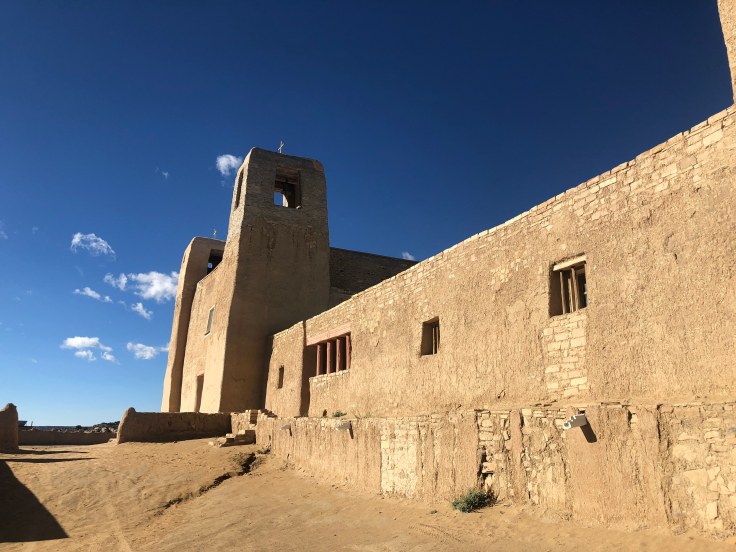
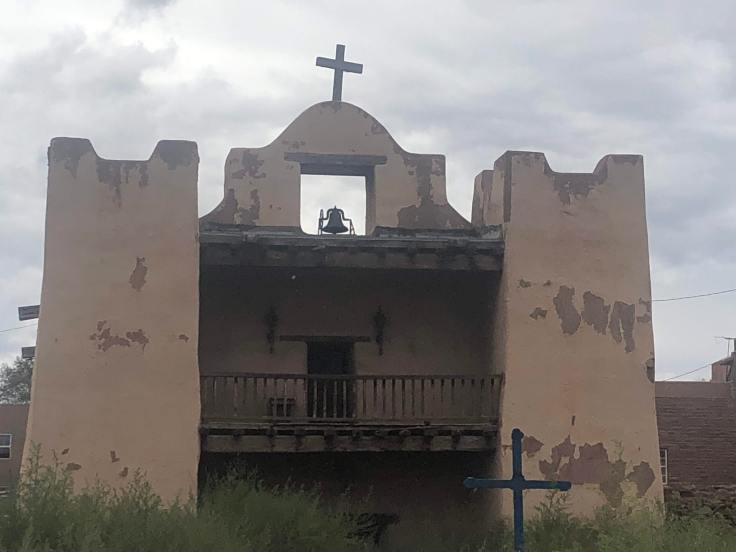
However, the survivors of the Acoma Massacre rebuilt their community between 1599–1620… Between 1629 and 1641 Father Juan Ramirez oversaw construction of the San Estevan Del Rey Mission Church.  The Acoma were ordered to build the church, moving 20,000 tons of adobe, straw, sandstone, and mud to the mesa for the church walls.  Ponderosa pine was brought in by community members from Mount Taylor, over 40 miles away.  The 6,000 square feet church has an altar flanked by 60 feet high wood pillars. These are hand carved in red and white designs representing Christian and Indigenous beliefs.  The Acoma know their ancestors’ hands built this structure, and they consider it a cultural treasure to this day.  In contrast to what we saw in Zuni, the Acoma have kept this church in good repair over the years.

In 1680 the Pueblo Revolt took place, with Acoma cooperating with the other Pueblos in planning, organizing, and fighting against the Spanish.  The revolt brought refugees from other pueblos to Acoma.  Those who eventually left Acoma moved elsewhere to form Laguna Pueblo near by.

During the nineteenth century, the Acoma people, while trying to uphold traditional life, also adopted aspects of the once-rejected Spanish culture and religion.  By the 1880s, railroads brought increased numbers of settlers and ended the pueblos’ isolation.

In the 1920s, the All Indian Pueblo Council gathered for the first time in more than 300 years. Responding to congressional interest in appropriating Pueblo lands, the U.S. Congress passed the Pueblo Lands Act in 1924.  Despite successes in retaining their land, the Acoma had difficulty during the 20th century trying to preserve their cultural traditions.  Protestant missionaries established schools in the area, and the Bureau of Indian Affairs forced Acoma and other Indian children into boarding schools.  By 1922, most children from the community were in boarding schools, where they were forced to use English and to practice Christianity.  Several generations became cut off from their own culture and language, with harsh effects on their families and societies.

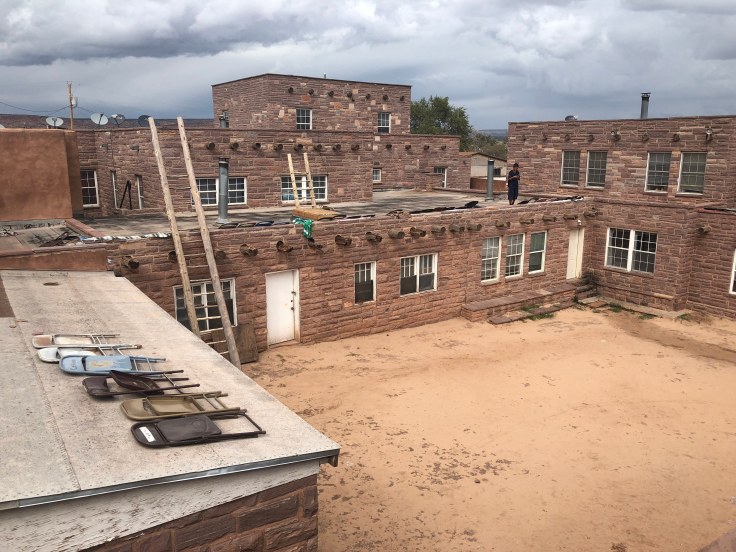
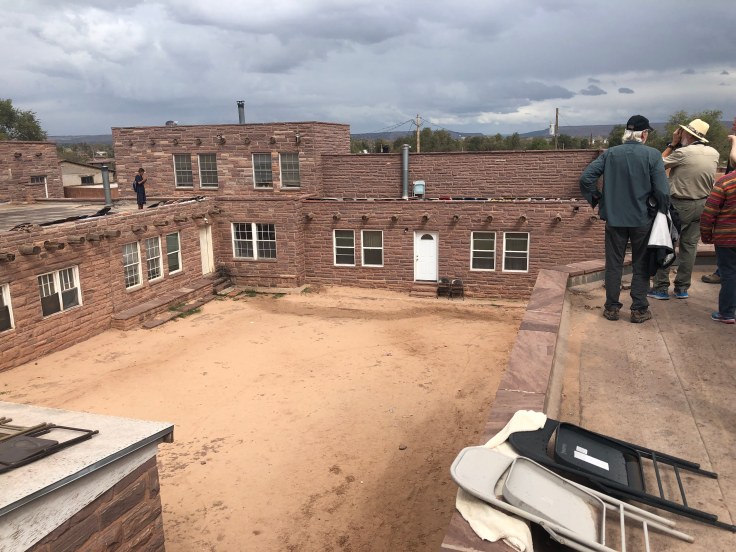
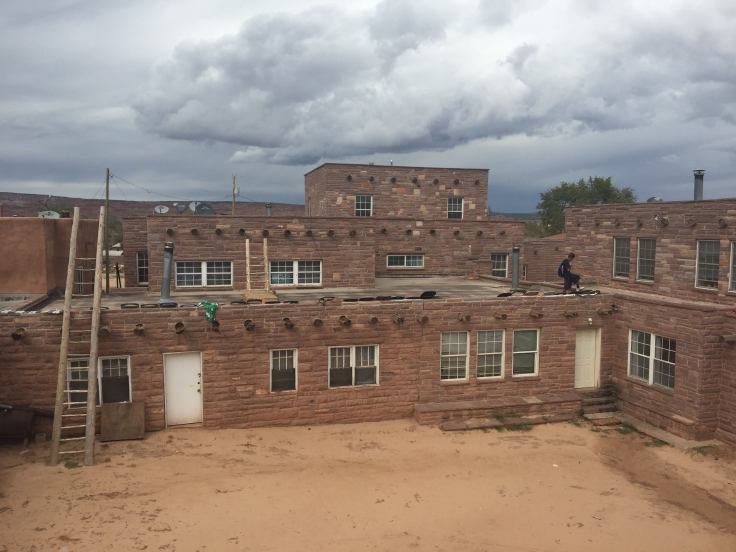
Today, about 300 two- and three-story houses stand on the mesa, with exterior ladders used to access the upper levels where residents live.  Access to the mesa is by a road blasted into the rock face during the 1950s.  Approximately 75 or so families live permanently on the mesa, with the population increasing on the weekends as family members come to visit and tourists, some 55,000 annually, visit for the day.

Acoma Sky City Pueblo has no electricity, running water, or sewage disposal.  A reservation surrounds the mesa, totaling 600 square miles.  Tribal members live both on the reservation and outside it.  Contemporary Acoma culture remains relatively closed, however.  According to the 2000 United States census, about 5,000 people identify themselves as Acoma.

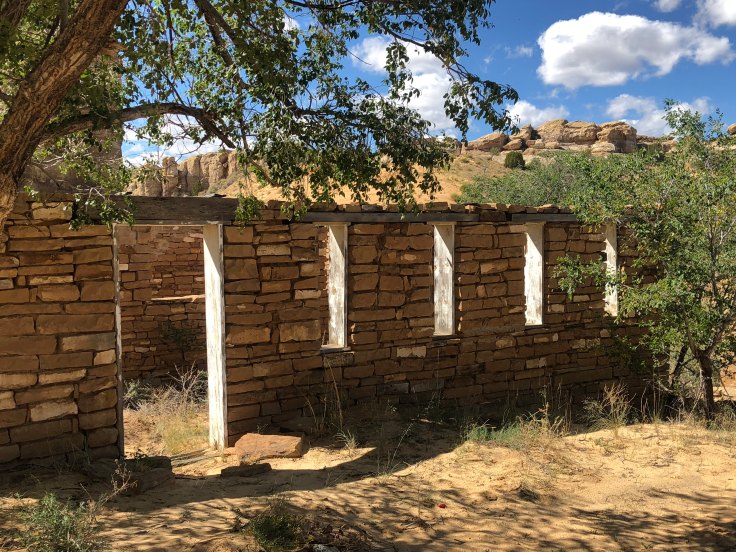
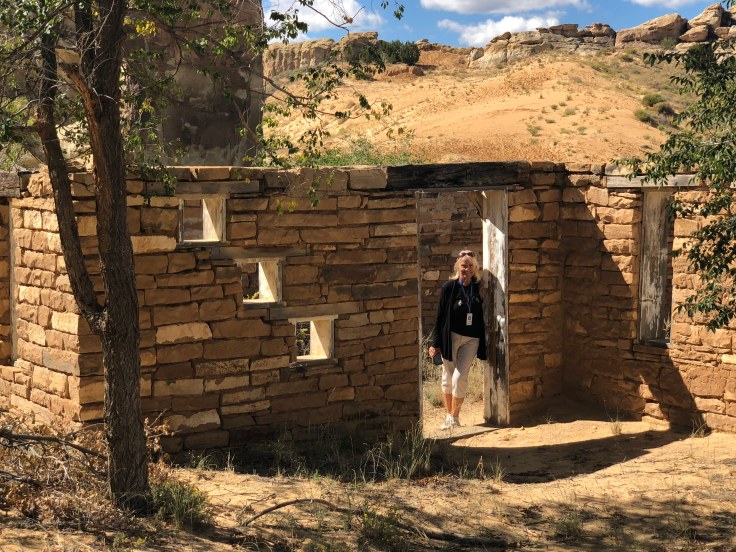
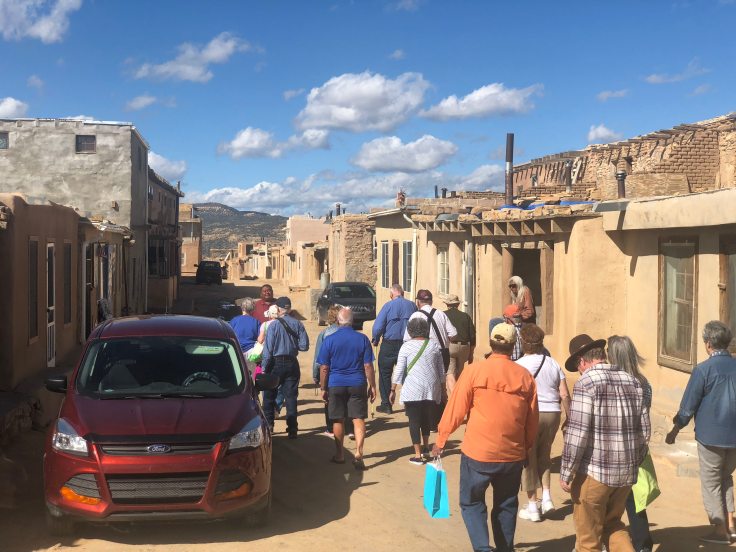
We drove about 20 miles across back country roads to get to Sky City.  All along the route we saw ruins of ancient buildings, all built of native stone and all in various stages of disrepair.  Some were next to brand new houses, and some were over run with weeds…  We have not seen this landscape before…

img_6162

img_61591img_9589img_9583img_9582img_9580img_9579

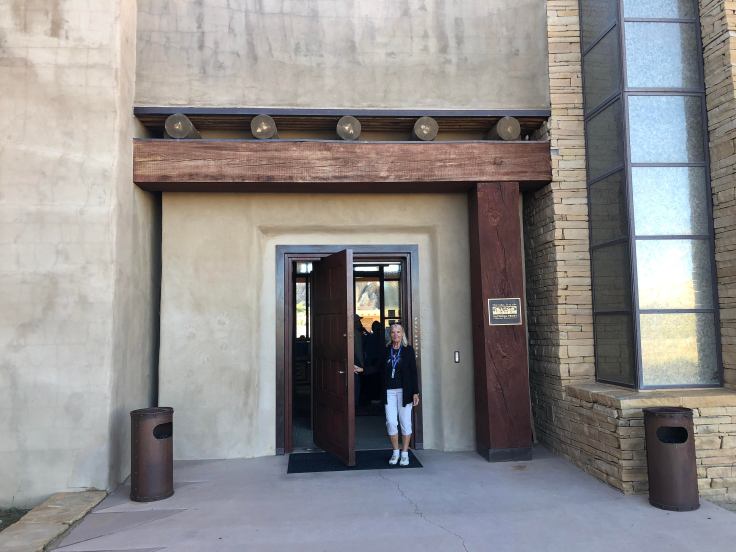
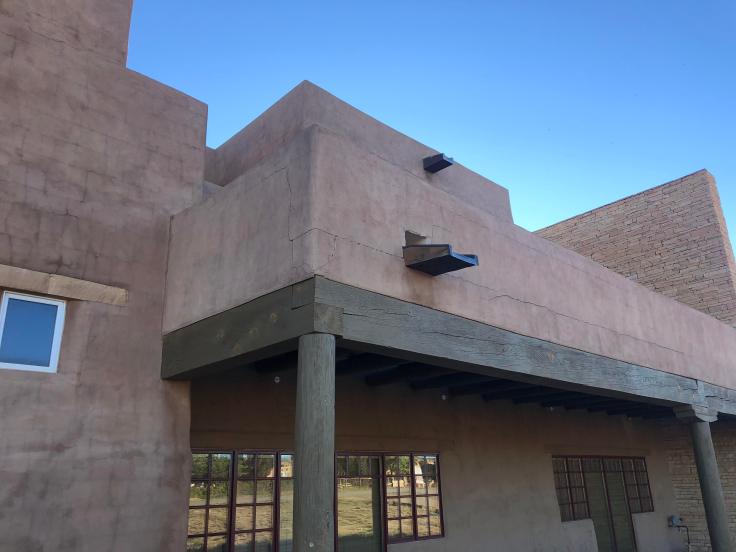
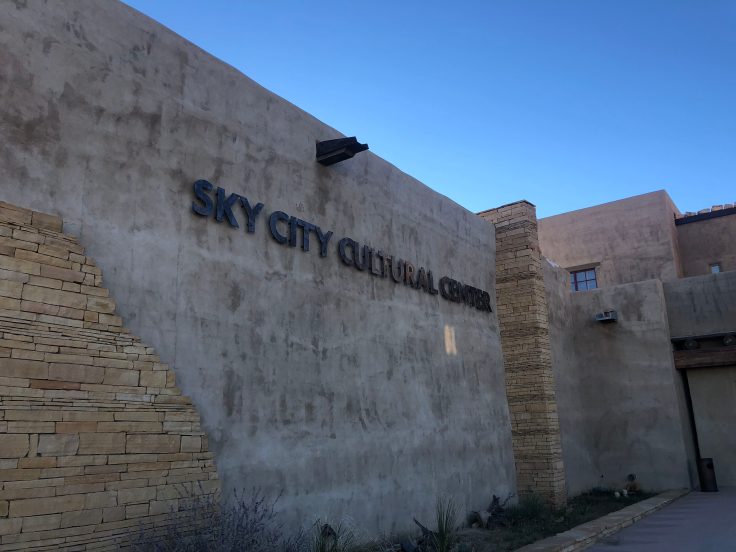
We met in the Acoma Visitors Center.  It is the best piece of architecture we have seen on this trip.  The front of the building, and the interiors, are very contemporary, although traditional forms are used in modern ways.  Around the back is a ceremonial plaza, where the design is much more traditional.  It was a treat to see a building this nice here…
img_9476img_9477img_9478img_9485img_9479img_9481img_9482img_9483img_9486

OK, so it wasn’t perfect…

img_9484

We boarded a bus and were driven to the top of the mesa, where our tour began.  We saw St. Stephen’s Church, and the adjoining cemetery.  No pictures are allowed inside the church or in the cemetery.

img_6090img_9493

Note that the vigas are not only authentic and functional, but the ends are carved, and the beams are hand-hewn to be rectangular, not round…

img_9491

Scuppers, hand-carved from one piece of wood…

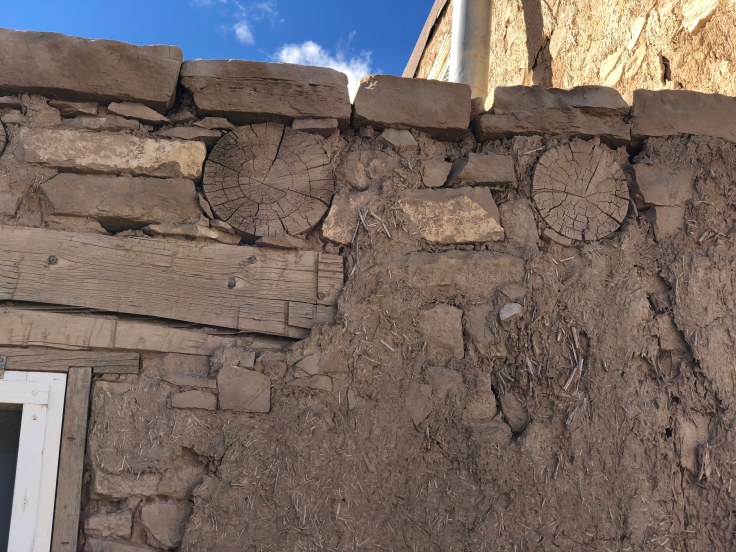
img_9505The buildings atop the mesa range from some original 12th century buildings, plus buildings from the 1500s and 1600s.  They have been added onto over the years, so we can see buildings with parts built from the 1940s, 1960s, and 1980s also… It was VERY interesting.
img_9502

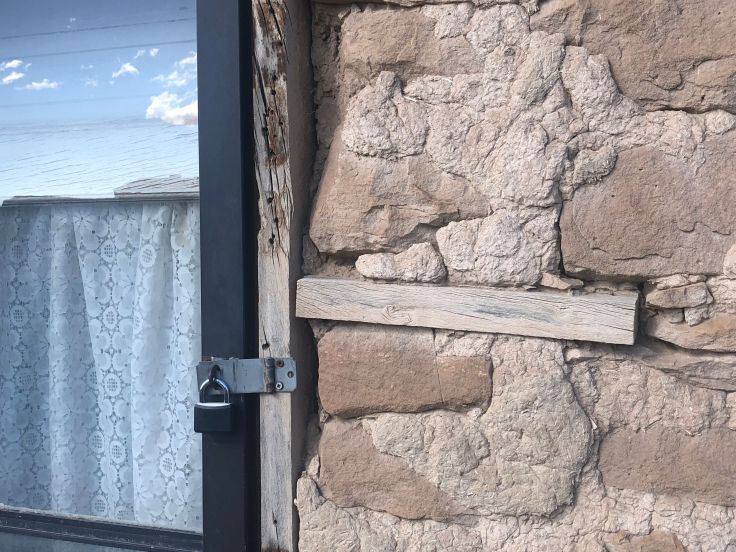
Mud and straw “plaster” covers the ancient stone… It needs to be re-done about every 5-7 years…

img_9506img_9512img_9518img_9517

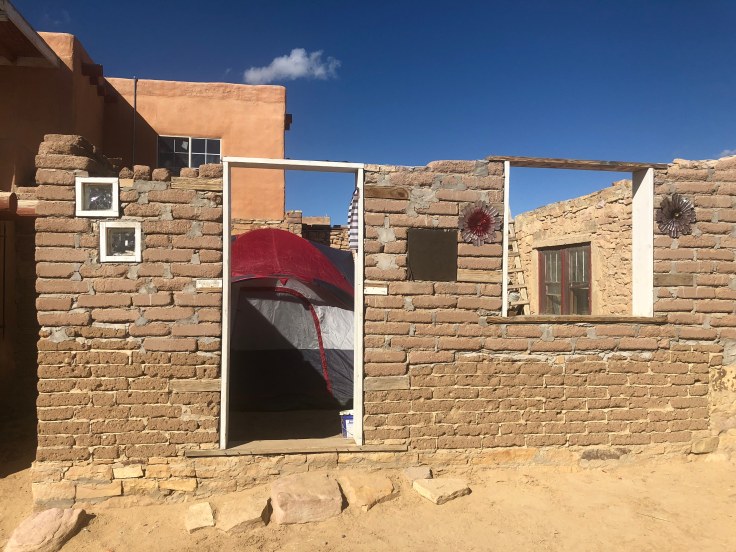
Some structures are in the process of restoration and/or reconstruction.  According to one of our caravaners who has been here several time in the past 10 years, the Pueblo is looking better and better every year.  The money from the casino is being spent to improve the Pueblo…
img_9520

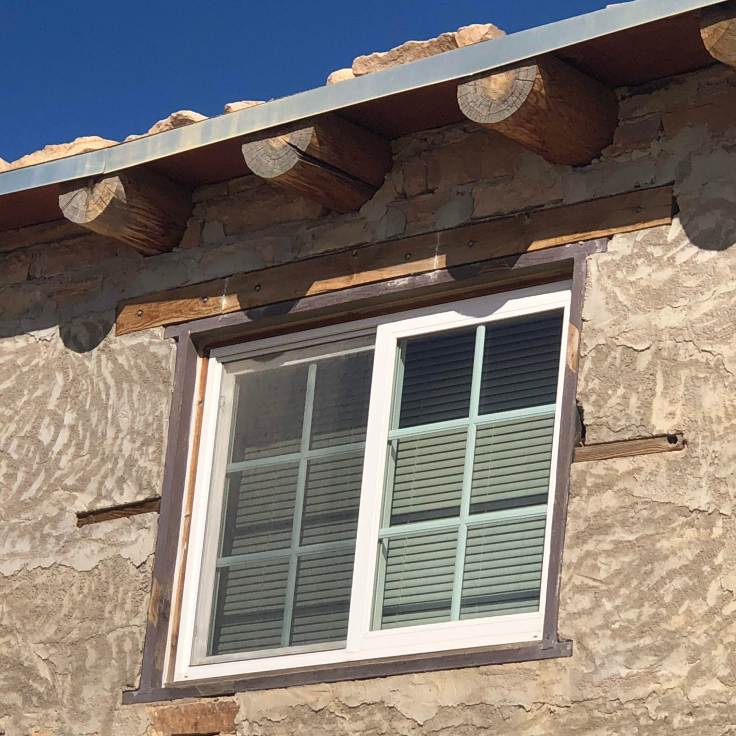
They do cover the vigas now with sheet metal…
img_9528

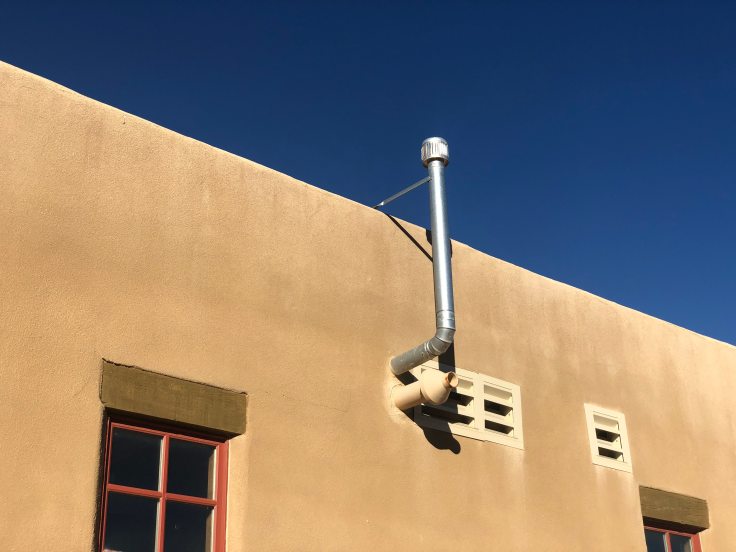
You read above how there is no running water or sewer.  Water is brought up to the mesa in tank trucks.  Most houses have propane for heat, cooking, and/or lights.  Wood is also used for cooking and heating.  As for sanitary facilities:  The mesa is surrounded with two-story, solar powered, waterless and composting outhouses…

img_9548

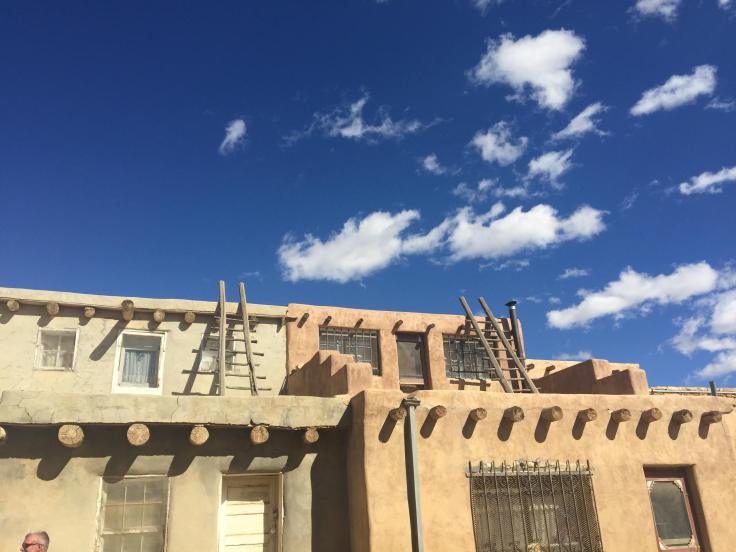
We walked through the oldest part of the Pueblo.  These houses were originally built in the 1100s and the 1200s, although they have been remodeled and expanded many times over the years.  The original houses were three stories – on the ground floor there were no doors and windows.  The ground floor was accessed via internal stairs or ladders, and the area was used for storage.  The second level was accessed by a ladder from the ground to the second floor.  The living quarters were located on the second floor, with the roof of the ground floor storage areas used as a terrace.  The third floor contained the cooking facilities.  Since heat is generated here, and hot air rises, having the cooking areas on the top floor kept the other areas of the house cooler.  This arrangement allowed security, in that ladders could be drawn up to the “terrace” to prevent intruders from accessing the house…

img_6125img_6124img_9546

As any good architect knows, in desert climates in the northern hemisphere houses should be oriented to the south for maximum control of, protection from, and use of solar heat gain from the sun.  Here we see a world famous architect demonstrate a south-facing front porch…
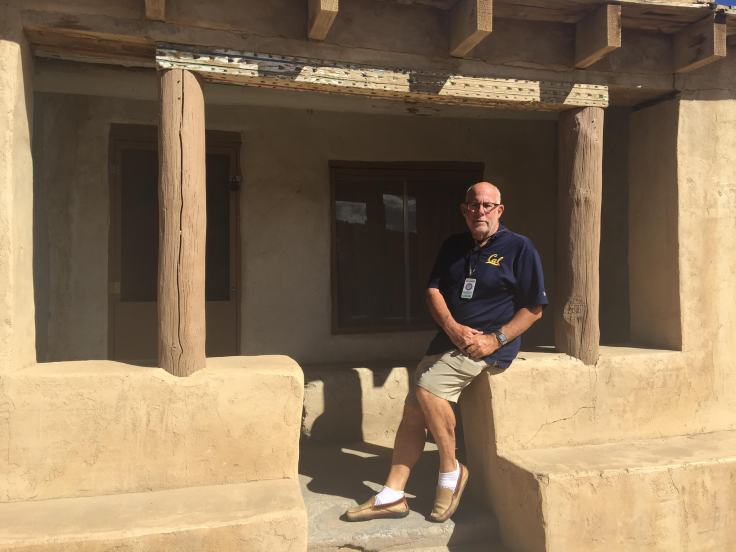
img_6118img_9544

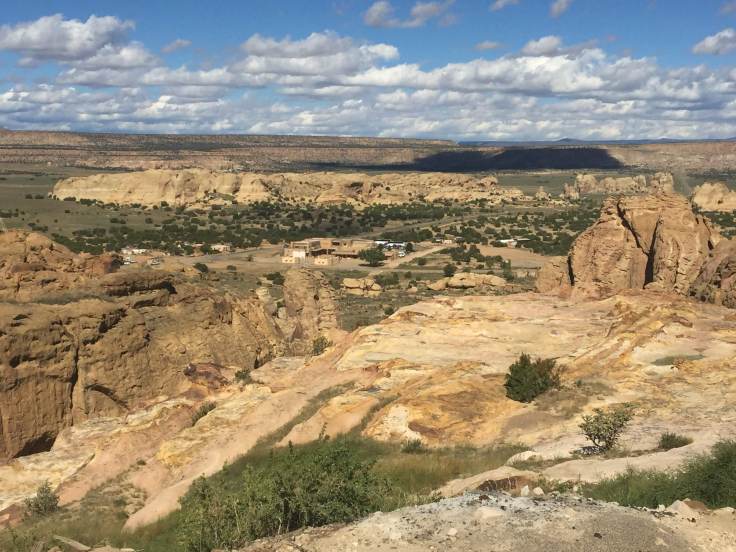
The mesa offers many fine views of the surrounding valleys and other rock formations…
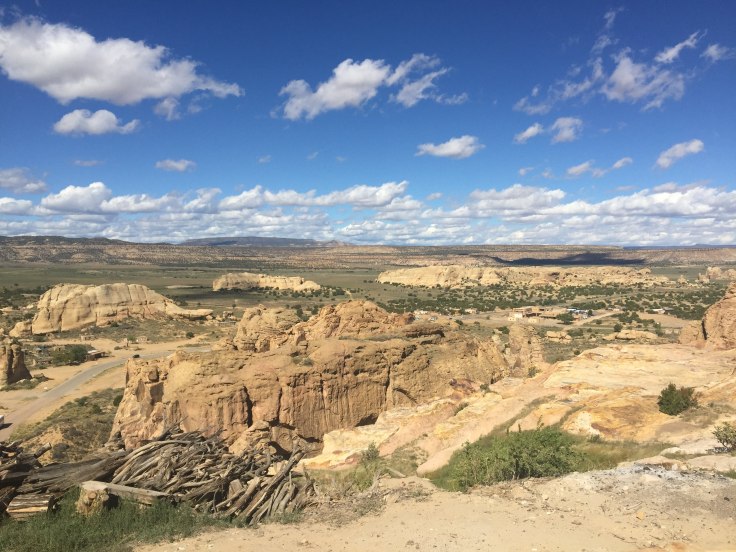
img_6129img_6130img_6132img_6134

There is a mesa a few miles away from Sky City, which was the original site of the Acoma Pueblo.  They had only been living there a few years when a violent lightning storm destroyed the only access to the mesa.  Fortunately for most of the Acoma, they were away tending their fields and hunting game.  Unfortunately for the two women atop the mesa, they were trapped. Rather than starve to death, they jumped to their deaths… The Acoma have never been back to the mesa since, and they rebuilt their Pueblo at the location where we now stand…

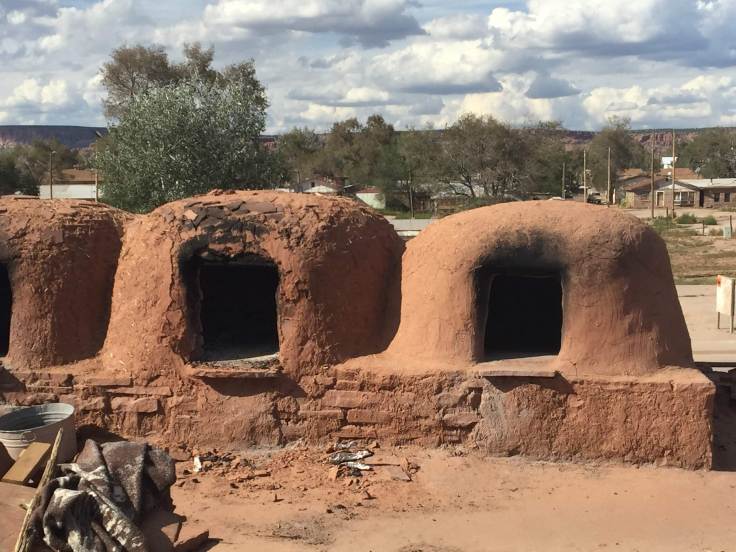
One of the traditional ovens being fire-up…

img_9562

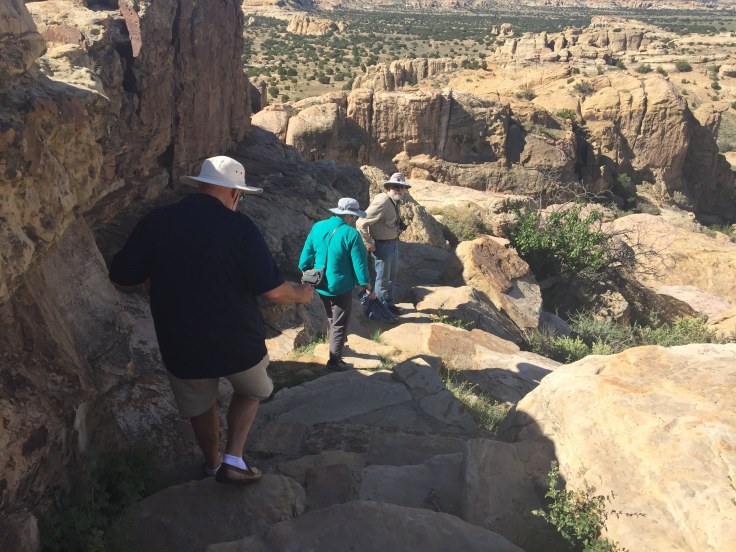
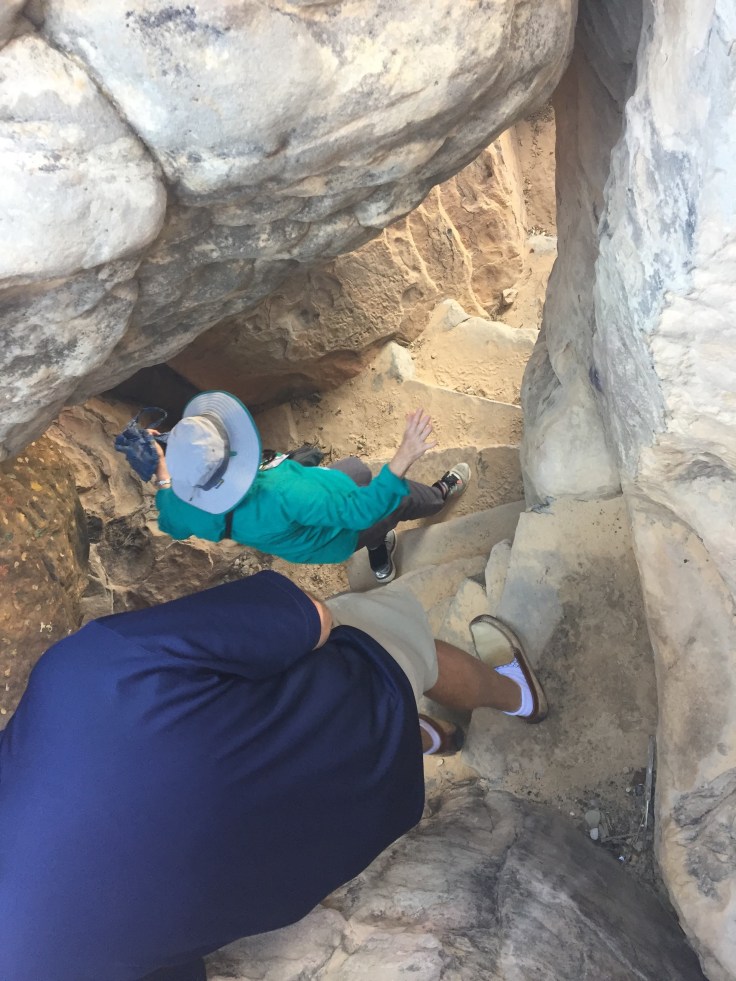
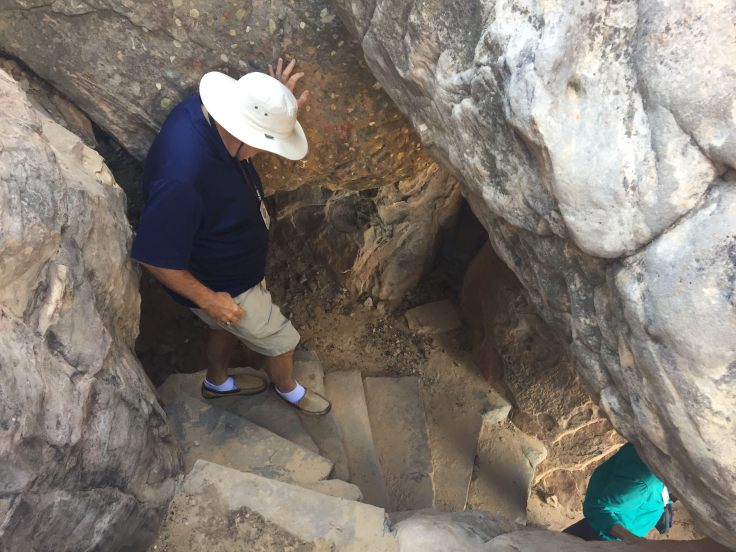
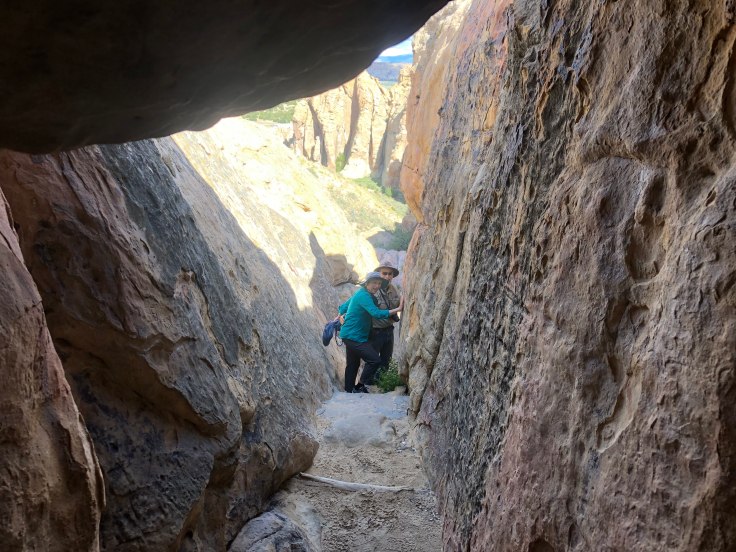
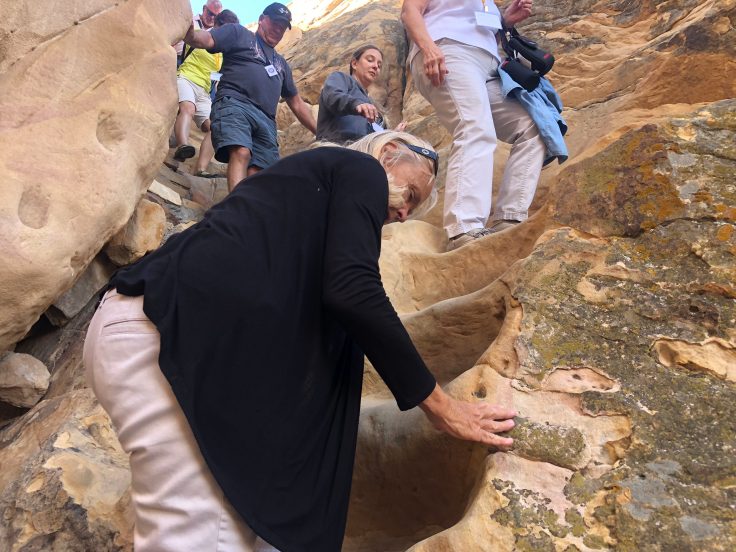
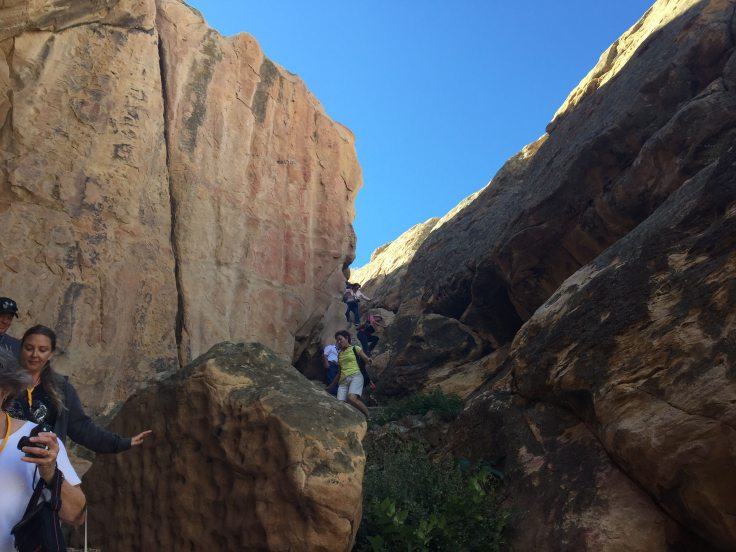
At the end of the tour, the lazy people headed for the bus.  We hearty types walked down steps carved into the rock in the 12th century, sometimes needing to use the hand-holds cut into the walls of stone.  It was a great trek!  Until the 1950s this was the only way to get to and from the Pueblo…

img_9563img_6137img_6139img_6140img_9564img_6142img_6143img_6144img_9566img_6146img_6147img_6148img_6155

We returned to the visitors center, had a New Mexican lunch of tacos and enchiladas, Christmas style… We drove back to The Villa…

In the evening we held our LAST drivers meeting.  Tomorrow we convoy the 60 miles or so to Albuquerque to park at the Balloon Fiesta… The fiesta starts Friday and runs for nine days.  We will be staying four nights, leaving Tuesday.

Since we must be ready to go tomorrow at 8:00 am, we did much of our hitching up after the drivers meeting.  Lynda cooked a pizza for dinner…

And an enjoyable time was had by all…
2018-10-03 – WBCCI 2018 Southwest Adventure Caravan – Day 46 – Traveling from Gallup to Cubero, New Mexico

Another travel day… These days are my favorite – driving down the highway, watching the scenery, going places that we’ve never been before… Today we took the long way around, choosing to drive the back roads for three hours instead of the interstate for two hours…

img_60681img_60691img_60701img_94631

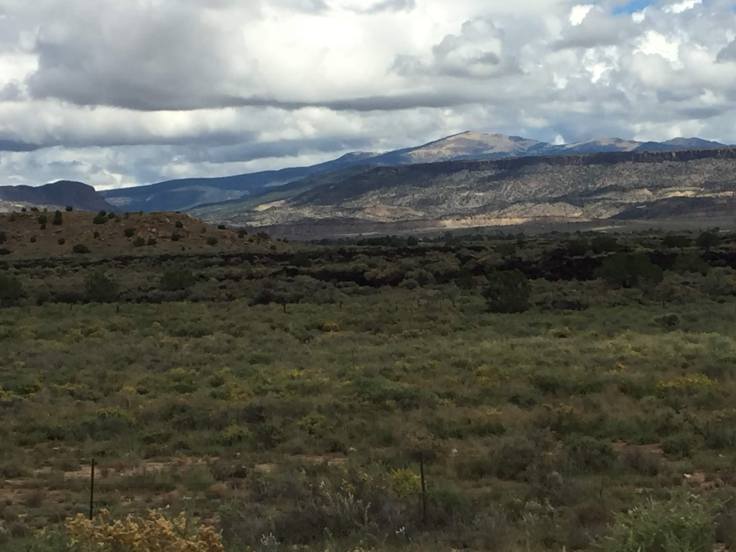
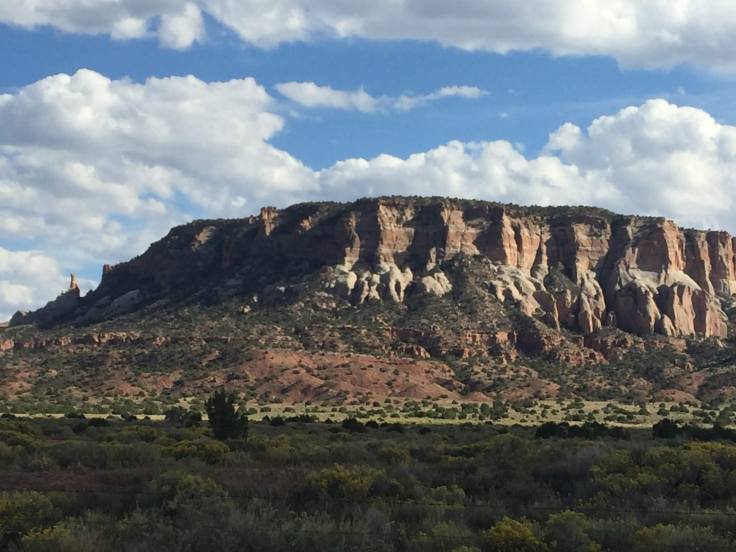
We drove south from Gallup, towards El Morro National Monument, then through El Marpais National Monument.  This area is very volcanic, yet the mesas still exhibit interesting rock formations…

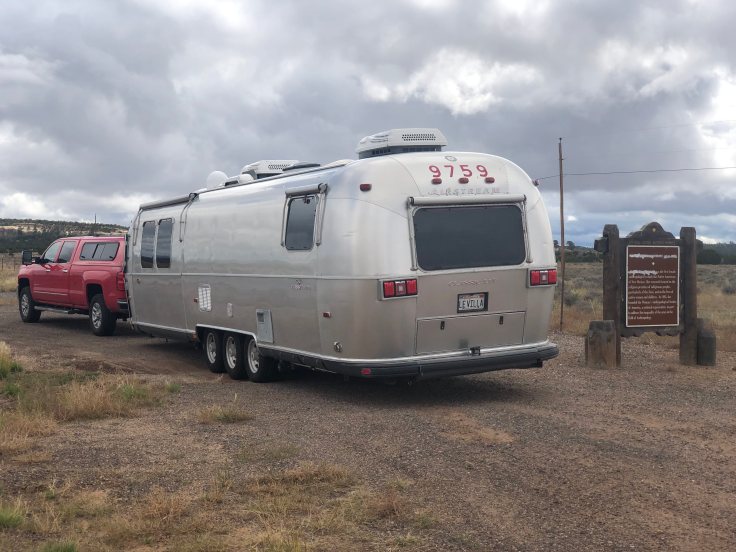
We stopped at a few historic markers…

img_94611img_94641img_94651img_94661

The road eventually turned east, then northeast, where it intersected with the 40; about 20 miles later we were at Cubero, site of the Sky City Casino, Hotel, and RV Park.  Sky City is the name for the Pueblo at Acoma, where we will go tour tomorrow…

img_60751img_60761

We had an easy time setting up in a very modern, but very bleak RV park.  Naps, then Happy Hours, and dinner ensued…

img_94671img_94691img_94701img_94711

As Happy Hours were transitioning to Dinner we were hit by a sudden thunderstorm, followed by a rainbow…

img_9475

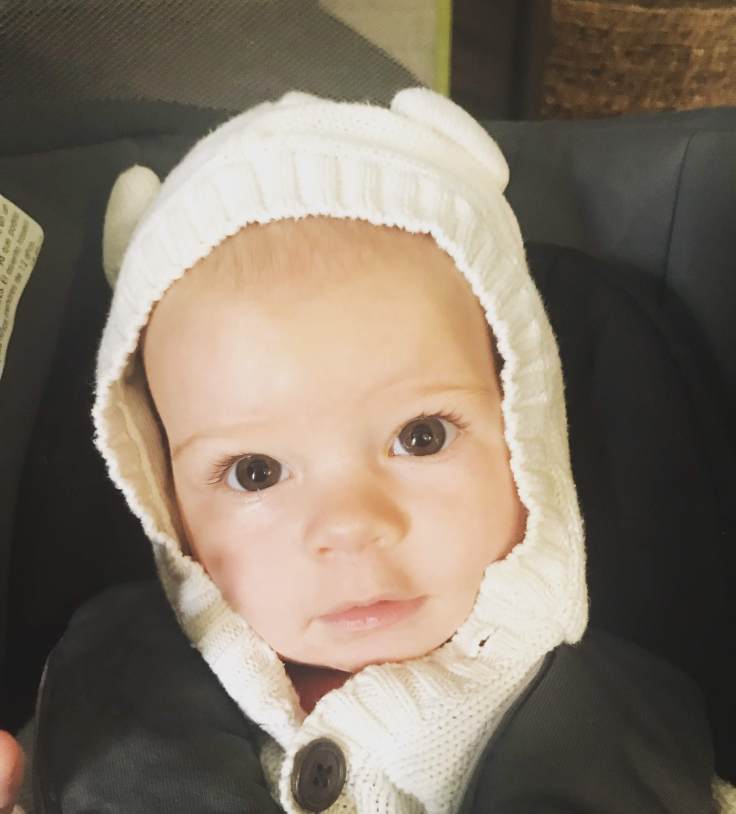
News flash!  This morning it dropped below 70 degrees in Los Angeles, and rain MIGHT happen.  Erin quickly dressed Evelyn in all her winter clothes:

img_9460

And an enjoyable time was had by all…

2018-10-02 – WBCCI 2018 Southwest Adventure Caravan – Day 45 – Gallup, New Mexico – and the Zuni Pueblo…

The caravan traveled to the Pueblo of Zuni today…

We arrived at the Visitors Center and had the usual confusion as to where to park 15 or 20 pick-up trucks…

img_9340

Once we were all at the visitors center we all left.  We drove about one mile to a typical house in the Zuni village… Note the exterior appears to be unfinished – exposed concrete block, unprotected particle board, no paint…

img_9342

But inside we found a very modern house; there was a modern kitchen and a room large enough to feed lunch to 60 people!

They served us salad, bread baked in their traditional adobe ovens, posolle (a beef soup or stew), and our choice of peach cobbler or apple pie for dessert.  Very nice!

img_9341

After lunch we returned to the visitors center where we heard the history of the Zuni people.  He condensed it to only 10 hours (or so it seemed… It was actually about 1 1/2 hours…)

img_9343

img_9344

The speaker was a native to Zuni, who had an interest in the history and archaeology and anthropology of his people.  He left Zuni after high school to attend Stanford; he returned to become the local expert in all things Zuni.  He has excavated parts of the pueblo 70 feet down to find remnants of the ancient village…

We then drove back again to the center of the Middle Village, and we learned more of the history of the pueblo…

img_9347

As I mentioned a few days ago, the Spanish built the church – Our Lady of Guadalupe – in 1620, only to see it destroyed in the Pueblo Revolt in 1680.  It lay in ruins until it was rebuilt in 1960, but today it is in sad shape.  Plans are underway for a full restoration…

img_93461

Note the overgrown cemetery in the church yard…

img_93451img_9349img_9350

The Spanish left in about 1800 as the American frontiersmen started arriving in the west.  However, the frontiersmen showed little interest in Zuni, and the Zuni continued to live totally alone and isolated for over 100 years.  The “modern era” caught up with them in the early 1900s and the community continued to thrive, although in their traditional, non-modern ways.

These buildings were built from the 1940 – 1960 and they continue to be added to today.  This is “modern” wood frame construction, with ancient stones taken from other ruined buildings, made into veneer, and installed on the wood frame.  This courtyard, as I said before, is used for religious ceremonies… The roofs and the courtyard will hold over 2,000 people during these ceremonies…

img_9351img_9352img_9353img_6051

The history we heard here in the village was much more interesting than what we heard in the visitors center, and we left with new knowledge of the Zuni people.

This evening we had a drivers meeting, sharing ice cream, an Airstream tradition…

img_9457 And an enjoyable time was had by all…

2018-10-01 – WBCCI 2018 Southwest Adventure Caravan – Day 44 – Gallup, New Mexico…

img_9333

The figure above is “Kokopelli”, and this image is all over the Southwest USA; in fact, this caravan uses it as the caravan logo.  The oldest images of Kokopelli appeared between 750 and 850 AD.

There are lots of stories of Kokopelli being a fertility deity, holding forth over childbirth, or being an agricultural deity, or being in charge of livestock… My favorite story is this:

A little man named Kokopelli used to travel to the various villages of the Southwest long ago.  He carried a bag of corn seed on his back, and he taught the people to plant corn.  At night, while the people slept, Kokopelli roamed the corn fields, playing his flute.  The next morning, villagers would arise to find the corn four feet tall, and there would be no sign of Kokopelli.  Also, many of the young women of the village would be found to be pregnant…

Today I tried to get caught up on my this blog; the only activity was to visit another Trading Post and learn, again, about the practice of Pawn, and to have the opportunity to buy rugs, pottery, and silver and turquoise jewelry.  No thanks.  Lynda went along with another couple; I stayed and tried to find good internet access, with little luck.

Lynda and the others returned about 5:00 pm.  It was raining, and many people had gone out to dinner.  We stayed in and had a quiet evening…

Tomorrow we return to the Pueblo of Zuni; this is the sacred Zuni Mountain…

img_6049

And an enjoyable time was had by all…

2018-09-30 – WBCCI 2018 Southwest Adventure Caravan – Day 43 – Gallup, New Mexico – Hot Air Balloons and the Zuni Pueblo…

Today is the day!  Hot Air Balloons!

We drove in the dark to meet at Red Rock State Park, just east of Gallup.  We met up with the balloon pilots and their crews.  There will be 6 balloons going up today.  Weather conditions are perfect!

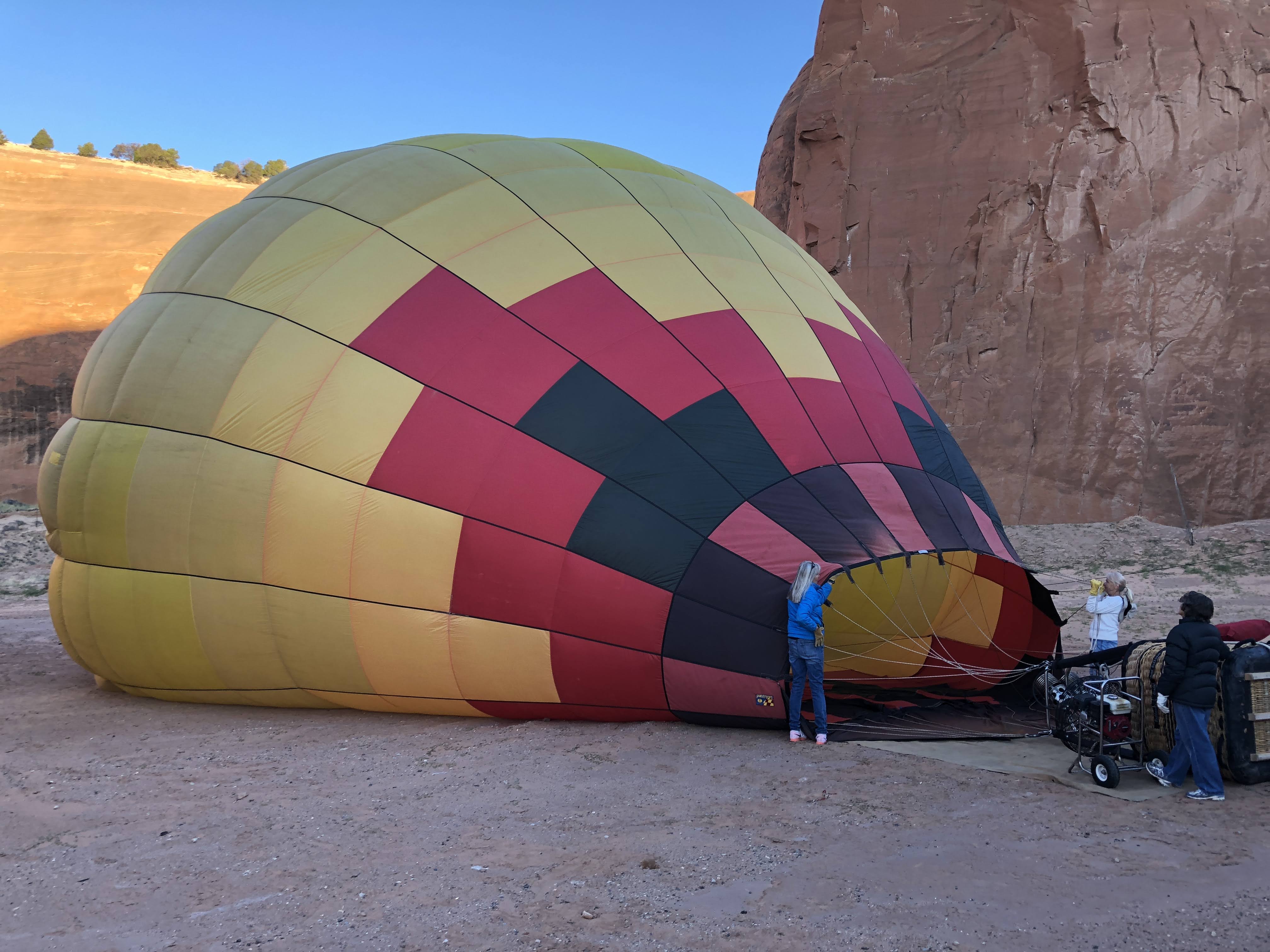
We drove around to the launch site, in the first of several canyons we would be seeing today.  Then the work of setting up the balloons begins.

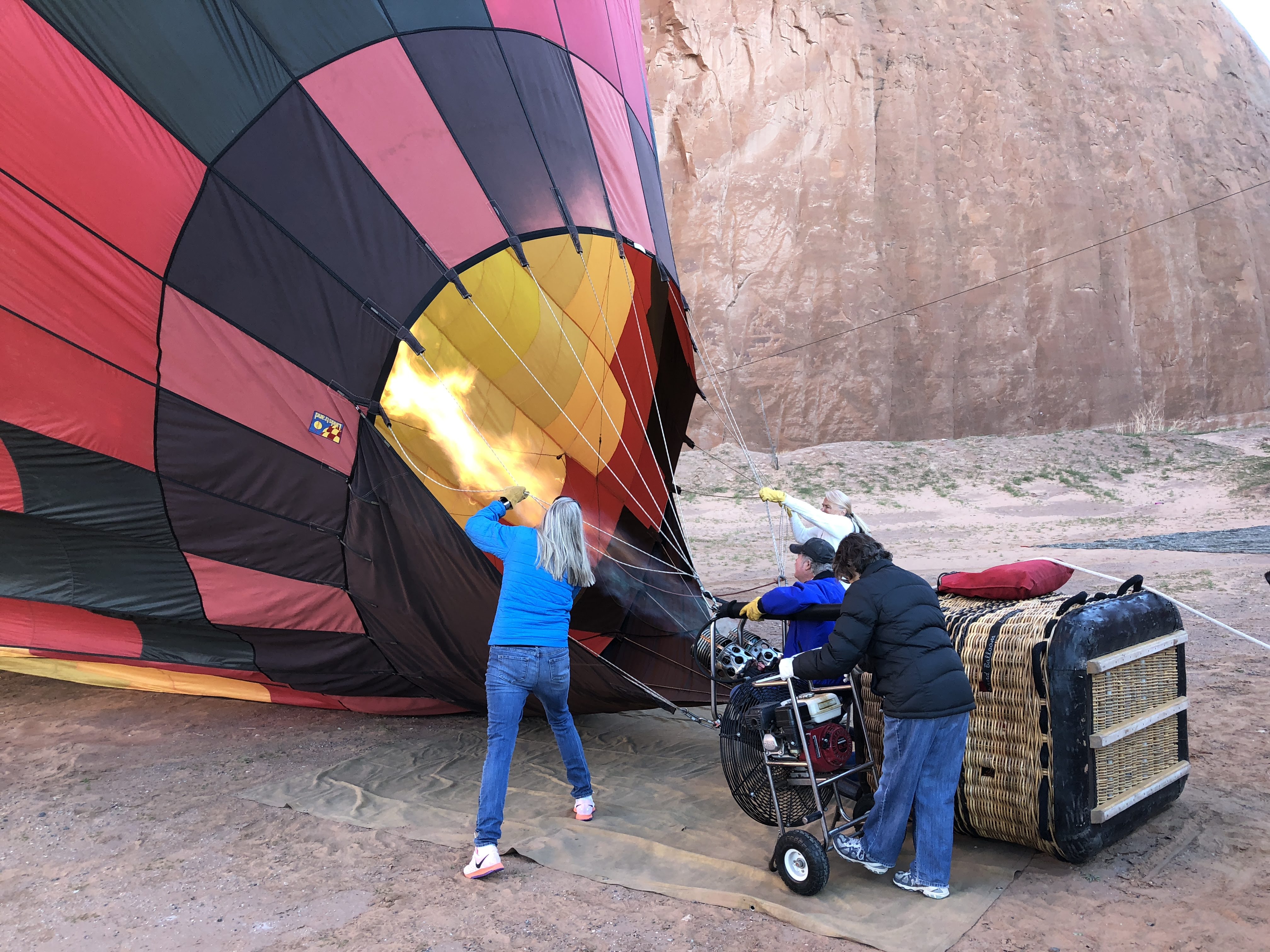
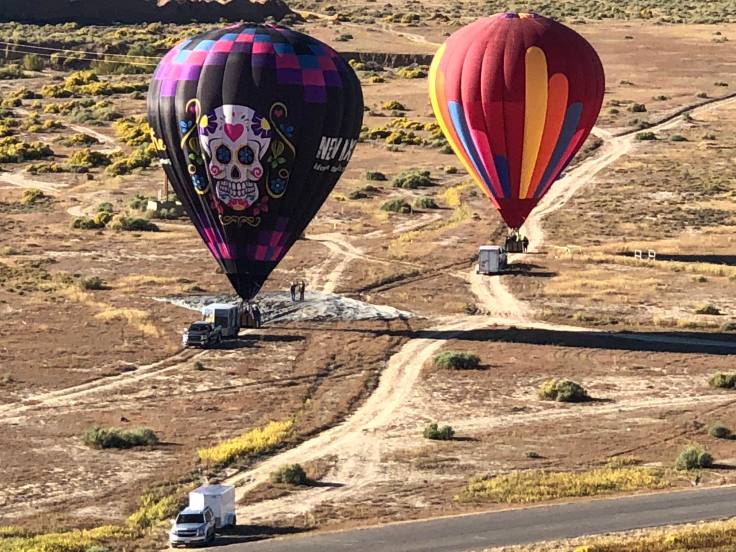
The basket is assembled, and the burners are installed and tested…

img_9081

The balloon is inflated with a large, loud fan…

img_9106

The the burners are fired and the air in the balloon is heated…

img_9124

As the air in the balloon gets warmer the balloon rises…

img_9131

We all climb in the basket and away we go!

img_1357

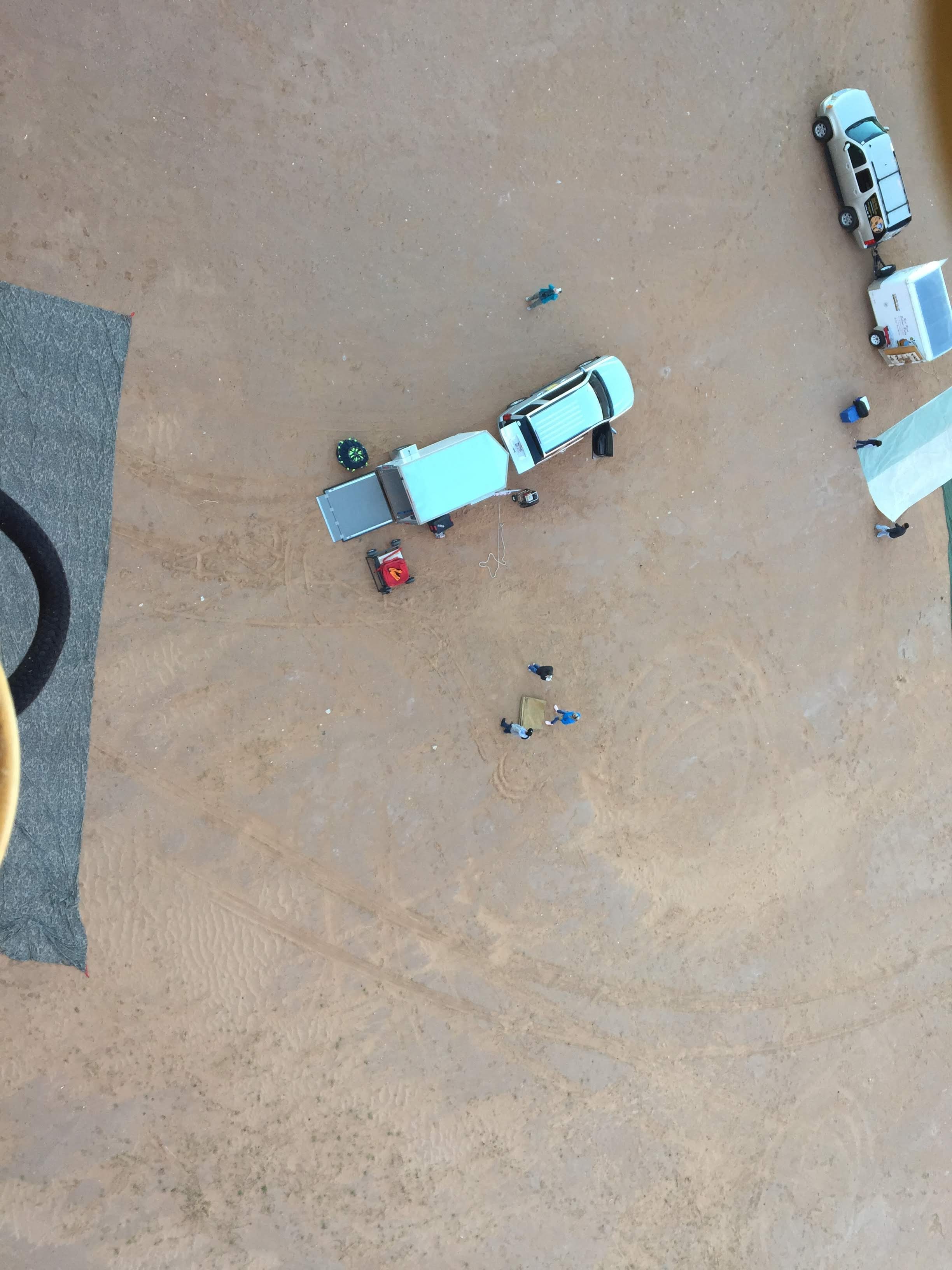
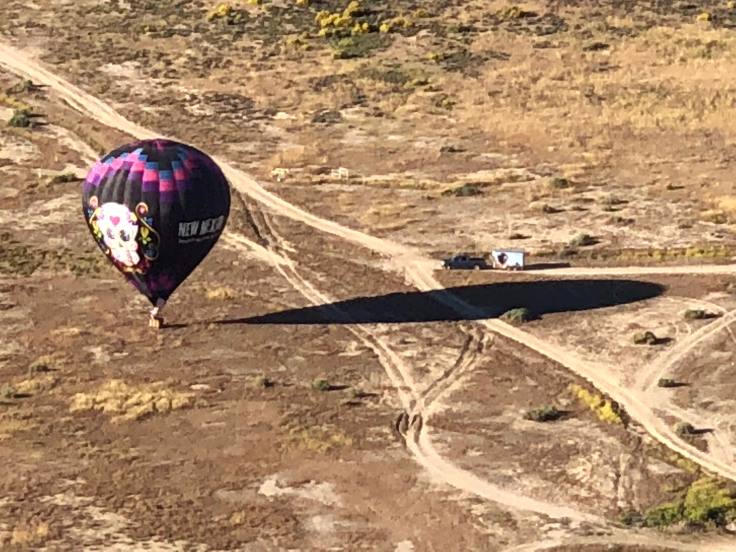
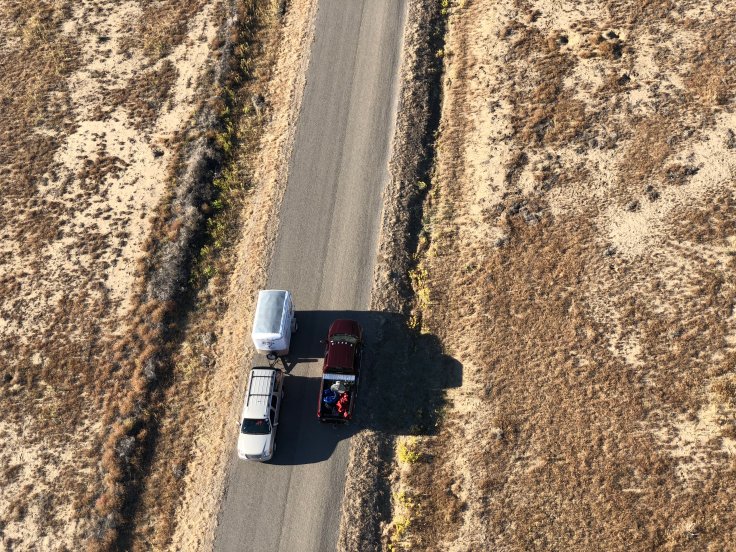
As we ascended we could look down on the ground crew and the chase vehicles.  These people will follow us along our route and pick us up when we land – wherever that might be…

img_5966

Riding in a hot air balloon is an ethereal experience.  Everything is VERY slow.  It is silent, except when the pilot hits the valve to fire the burner to add more heat.  There is no steering wheel and there are no brakes – the balloon simply follows the wind… There are some vents in the balloon to let the pilot release air, and this allows him to rotate and adjust the balloon’s trajectory.

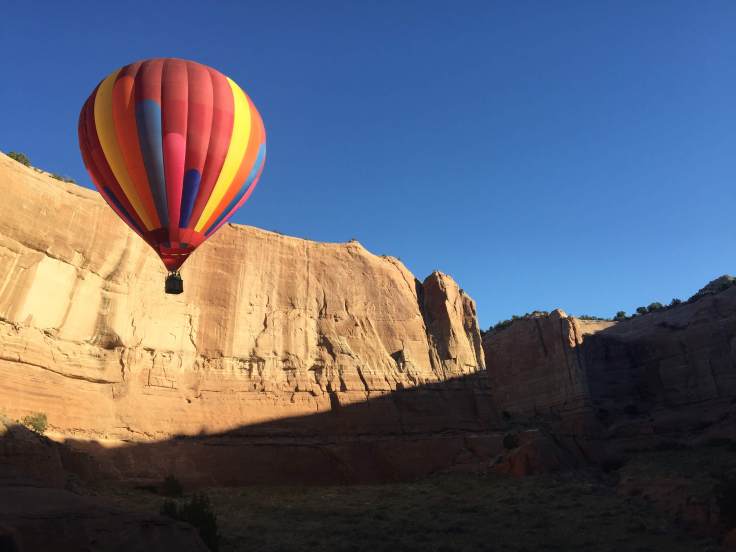
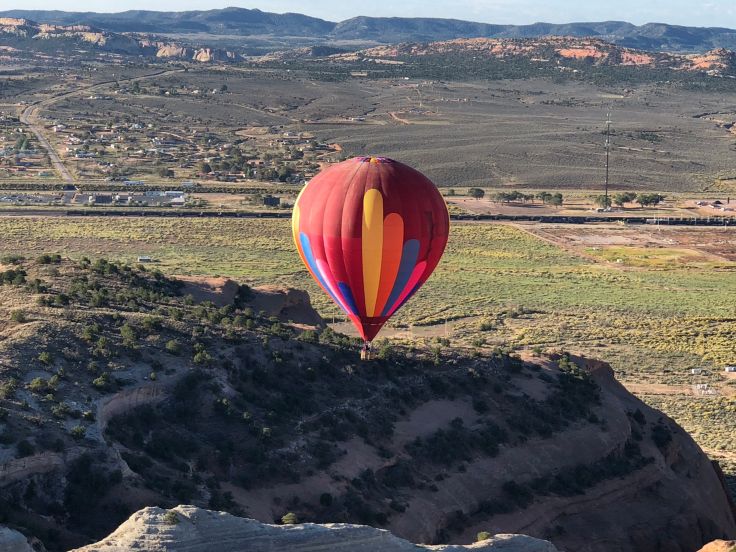
So we flew over five canyons, soaring over the plateaus and dropping deep into the canyon, then back up again…

img_9152

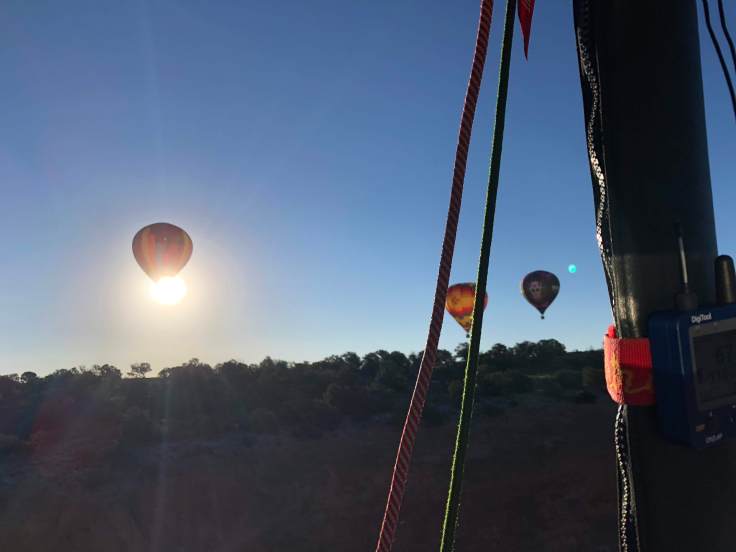
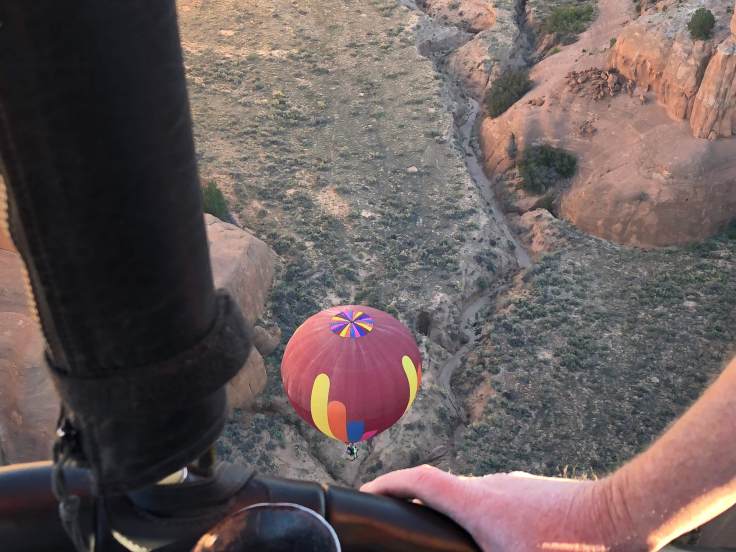
Part of the fun is flying along with other balloons…

img_9165img_9166img_9192img_9194

This is the official balloon of the State of New Mexico…

img_9200

Looking up into the hot air…

img_6008img_6006img_9216img_9235img_9258

After about five miles and one hour or so the first balloon lands…

img_9263img_9279

Our chase crew has arrived…

img_9281

As the others are starting to deflate and pack up we are still searching for a place to land…

img_9286img_9291

And we are on the ground!  This is our pilot, Jeff.  He has over 30 years experience flying balloons, and he set us down flawlessly!

img_1392

As the balloon deflates we all pitch in to pack it up…

img_9301

The basket is disassembled…

img_1411

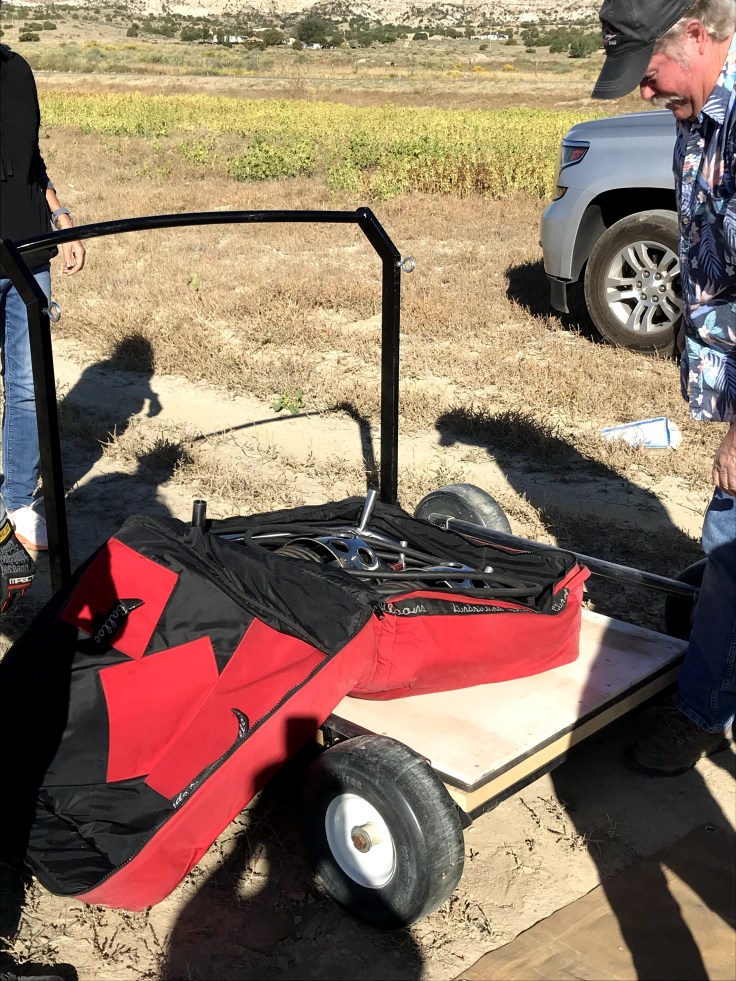
The burners are stowed…

img_1413

And we returned to the original meeting spot.  We had a traditional ceremony and we shared a little champagne to celebrate our flight…

img_9314

And, with that, our ballooning was over.  On to other adventures…

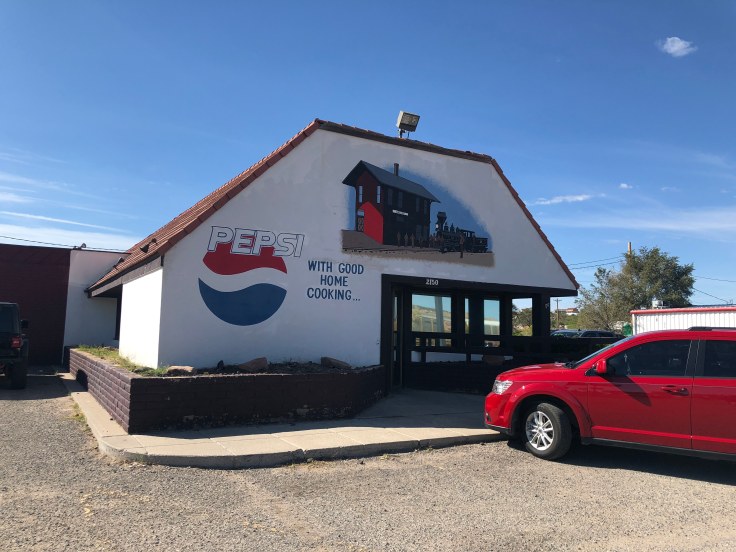
After such an exhilarating morning, we celebrated by having breakfast at the Railroad Cafe – in a remodeled mid-70s era Der Weinerschnitel.

img_9316img_9315

And then we headed south about 45 miles to the Pueblo of Zuni

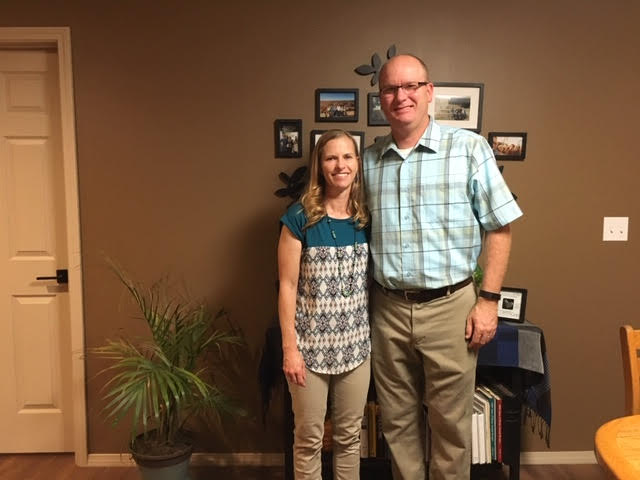
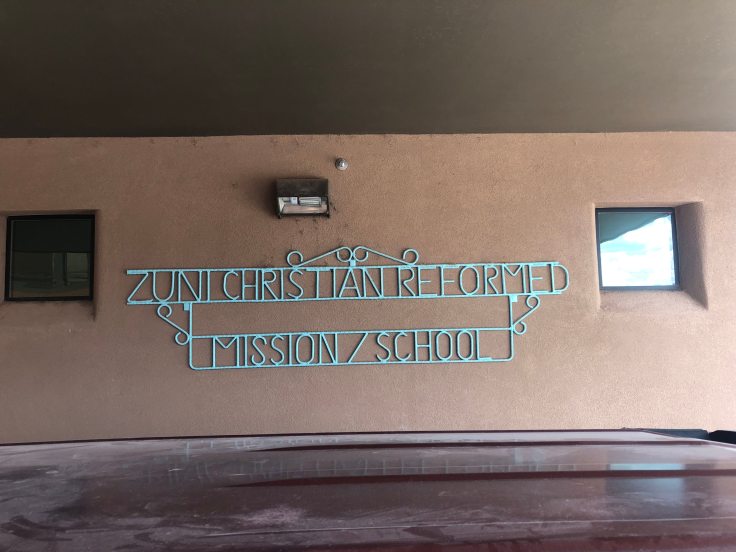
When Lynda retired from Valley Christian High School in June, 2017, another colleague, Tim Becksvoort also left.  But Tim didn’t retire – he moved, with his wife and three children to Zuni, NM, to become Principal of the Zuni Christian Mission School.  We set out today to visit the Becksvoorts and the Pueblo of Zuni…

img_6050

In 1897, Andrew and Effa Vander Wagen established a permanent mission in Zuni on behalf of the Christian Reformed Church.  Their passion and love for their Indian brothers and sisters made a lasting impression on all they touched.  They became fluent in the Zuni language and persevered in spite of physical threats to their lives.

The breakthrough for the fledgling Mission came when the Vander Wagens (with their infant children) refused to leave Zuni during a serious smallpox epidemic.  Instead of fleeing, as did the officials at Bureau of Indian Affairs, who were responsible for medical care in Zuni, the young couple went door to door caring for and administering medicine to their Zuni neighbors.  In that and later acts of mercy, the Vander Wagens pioneered the then-revolutionary mission concept that in order to minister to people’s spiritual needs one must also be willing to demonstrate Christ’s compassion and care for their physical needs.  With that groundwork laid, the first ordained missionaries were assigned to the Zuni Christian Reformed Mission in 1906.

In 1908, so that the missionary children might have Christian schooling, Miss Nellie DeJong came to Zuni as their teacher.  Along with the missionary children, four Zuni children were also enrolled.  From that humble beginning, the school expanded rapidly and soon claimed an important role in building relationships in the community, in educating the children and in sharing the Gospel of Jesus Christ with the children and their families.

Although the church and school have been housed in the same location within the Pueblo since its inception, there have been many changes in the facilities.  A major setback occurred in 1971 when a devastating fire raged through the Mission, completely destroying the church and school.  Portable classrooms were brought in and “temporary” facilities were constructed.  Forty years later, an amazing venture to rebuild the entire mission campus was begun.  Today there is a beautiful new school, a worship center for the church, residences for up to six families of staff members, a playground, and a gymnasium.

Zuni

The school is located across the river from central Zuni, the oldest part of the pueblo, “Middle Earth”, as they call it.  However, the village has, over the past 100 years, grown and now surrounds the school and church.

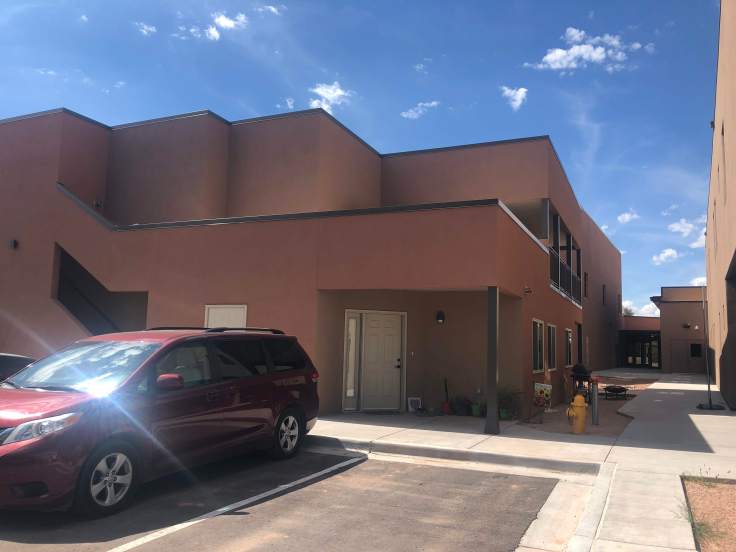
The Becksvoorts live in this very nice two-story apartment…

img_9317img_9321img_9320

We had lunch with the Becksvoort family, chatted with their three children, and walked around the “Middle Earth”…

The A:shiwi have lived here “forever”.   When the Spanish conquistadors arrived in about 1620 they gave the natives the name of Zuni… The Spanish built a church:  Our Lady of Guadalupe.  It was destroyed in the Pueblo Revolt of 1680, and the Spanish left and fled to Santa Fe when the American frontiersmen started coming through in about 1800 as part of America’s western migration.   The church was rebuilt in 1960, but, due to benign neglect, it has significantly deteriorated, making it uninhabitable today…

img_9346img_9345

The church even has vigas, which are, of course, rotting…

img_9327

We walked about the newer (1960s) buildings (with vigas…), and saw one of the Zunis’ ceremonial courtyards, and their traditional adobe ovens, used mostly to bake bread…

img_9330img_6045

(We will come back to Zuni in a few days with the caravan; we will have a native meal with the Zuni people and an official tour… Stay tuned…)

We returned to the RV park in the late afternoon, and enjoyed happy hours with our fellow Airstreamers…

And an enjoyable time was had by all…
2018-09-29 – WBCCI 2018 Southwest Adventure Caravan – Day 42 – Gallup, New Mexico…

Another quiet day on the caravan.  We began by visiting an Indian Trading post and learning about Pawn.  Among the Indians, Pawn is nothing like the typical pawn shop where folks down on their luck borrow a few dollars on something semi-valuable that they own.  For the Indians, Pawn is a combination bank and safe deposit box.  Since there is little private ownership of land, and semi-communal living is common, there is no place secure for the Indians to store their valuables.  So they bring them to the Pawn and Trading Post; the trading post will store the valuables and give a token “loan” to the owner.  The owner then comes in every 2-3-4 months and pays a fee to keep the items in pawn.  When they need their possession back, they pay back the “loan” and claim their goods.

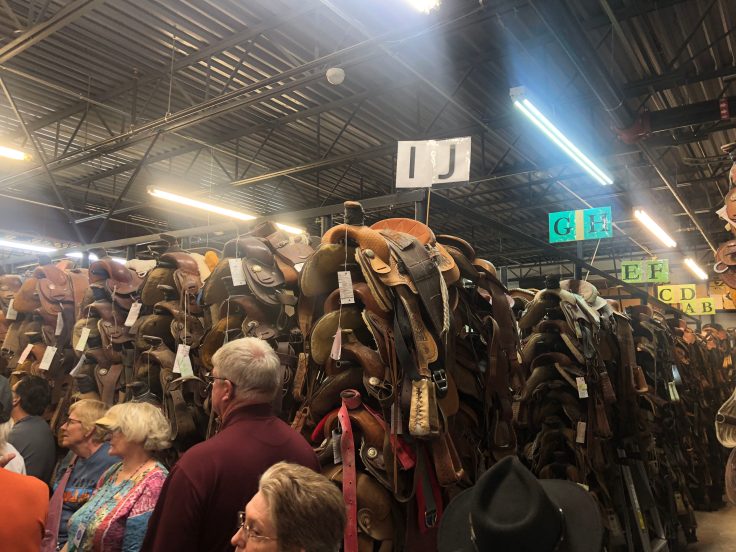
This trading post has over 1,800 saddles in Pawn.  I doubt there are even 1,800 horses in this part of the reservation… There are also guns, ceremonial head dresses and boots, lots of jewelry, and many other things the Indians deem valuable…

The saddles…

img_90701

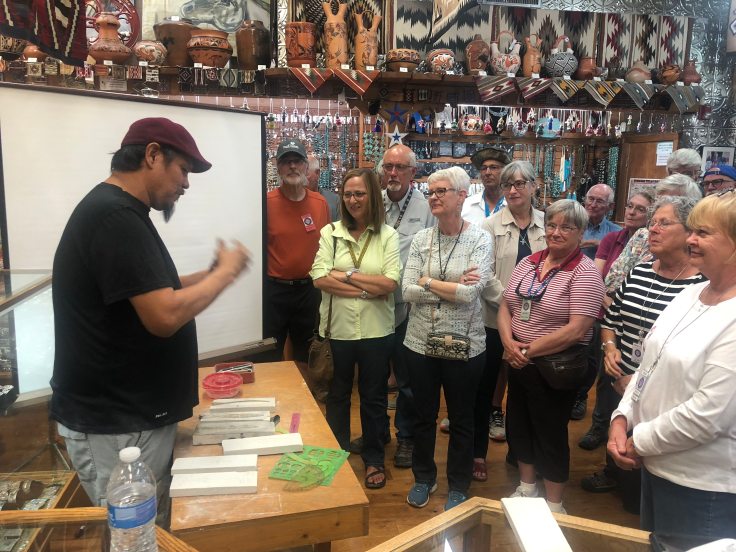
After listening to the Pawn explanation we saw an artist demonstrate his craft.  He showed us how he sketches and etches his design (in this case a silver bracelet) into a piece of soft stone.  This makes a mold, into which he pours the molten silver.  Out comes the rough bracelet, which he then polishes and finishes into a fine piece of jewelry…

img_90721

Most caravaners then proceeded to spend lots of money…

We returned to the Villa.  We enjoyed a Saturday afternoon watching college football.  While the internet service is terrible here in New Mexico, the satellite TV is great!

We had many Happy Hours with our Airstream neighbors, then watched football again well into the night…

And again we have a short day, so here I present Erin and George expressing their feelings about spending all day Saturday watching T-Ball…

img_9071And an enjoyable time was had by all…

2018-09-28 – WBCCI 2018 Southwest Adventure Caravan – Day 41 – Driving to Gallup, New Mexico…

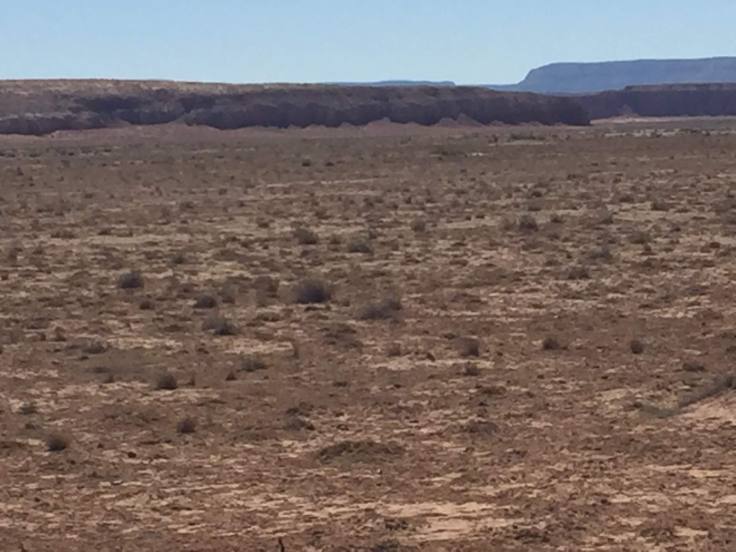
We left Lake Powell and the Glen Canyon Dam and headed roughly Southeast across some of the most remote and desolate terrain I’ve ever seen.  This is mostly the land of the Navajo Nation…img_5963img_59611img_90631

We drove for miles and miles… and saw nothing but miles and miles…

At Kayenta, AZ, we stopped at a Burger King, home of a great exhibit telling the stories of members of the Navajo Nation who served in WWII, and, particularly, the story of the Code Talkers.

By the time we had finished looking at the exhibits other Airstreamers had also arrived…

img_90602img_9059

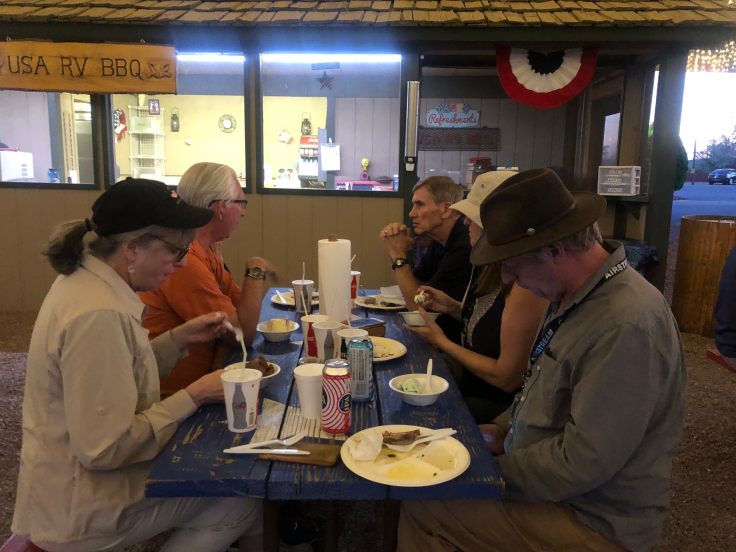
And then we left and drove to Gallup, NM.  Nothing too exciting.  In the evening we enjoyed a BBQ dinner provided by the RV park in their dining pavilion…

img_90651img_90661img_90671img_90681img_90691

We were visited by the representative of the ballooning folks to brief us on the coming days’ activities – we are going to be riding in hot air balloons!  We are scheduled for Sunday…

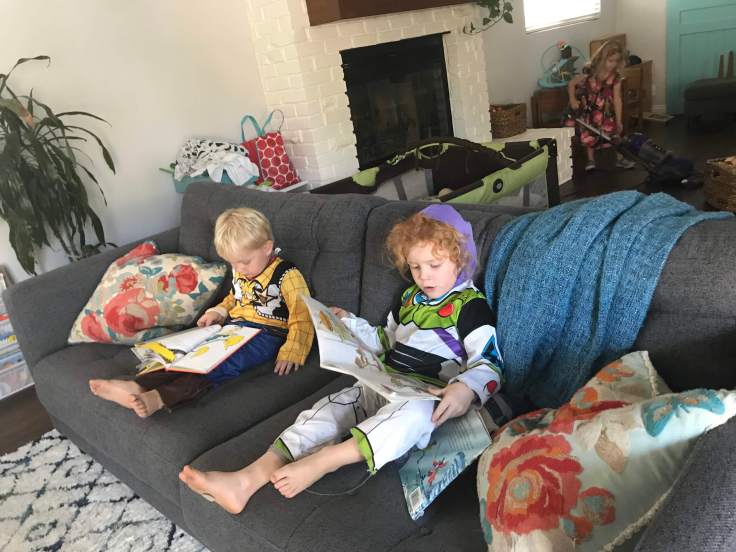
So, as is our tradition, on slow news days, we present some of our great grandchildren…  Maybe you’ve seen these before…

Roisin, age 5:

img_58691

Ian, age 4, and George, almost 3:

img_60551

Ian, Roisin, and Evelyn, age 6 months:

img_58681

Ian:

img_84591

Evelyn

img_89111

And, finally, Evelyn:

img_57751

And an enjoyable time was had by all…
Blog at WordPress.com.

Up ↑