Another travel day is upon us. We had a nice catered breakfast, and a drivers’ meeting.
We left Eureka Springs, and headed more or less west to Bella Vista. This is a big motorcycle rally weekend. We bypassed most of the traffic, but we did see great groups of motorcycles traveling along the roads…
The geography and topography changed again. Flatter fields, straighter roads, and fewer other cars on the roads.
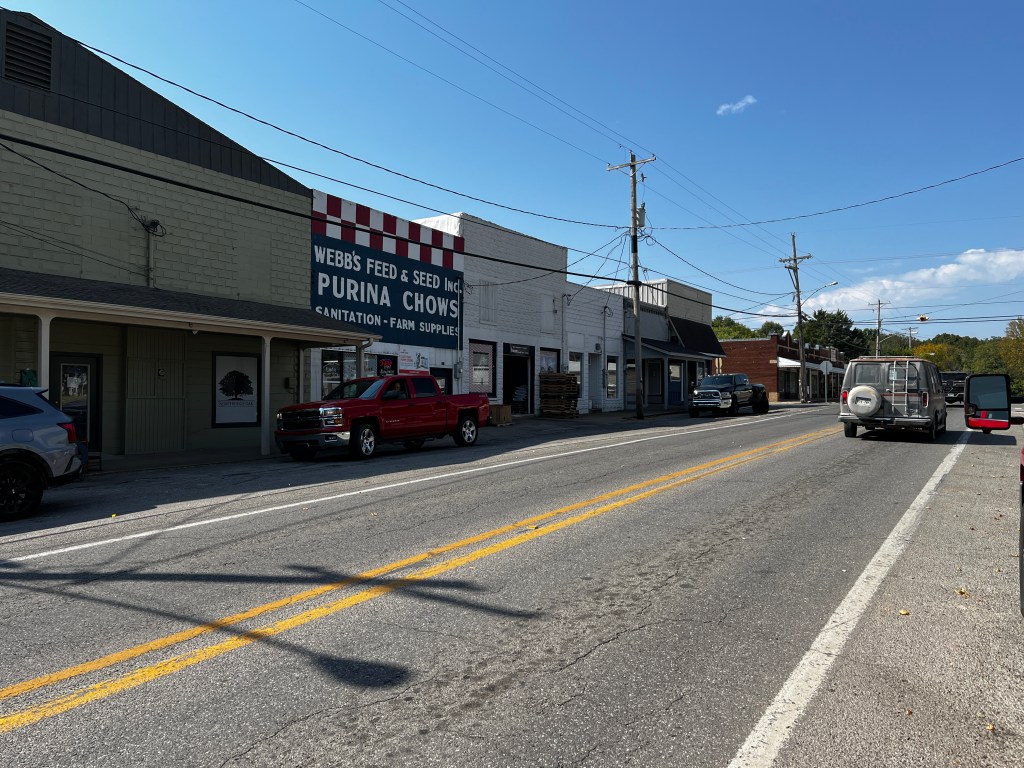
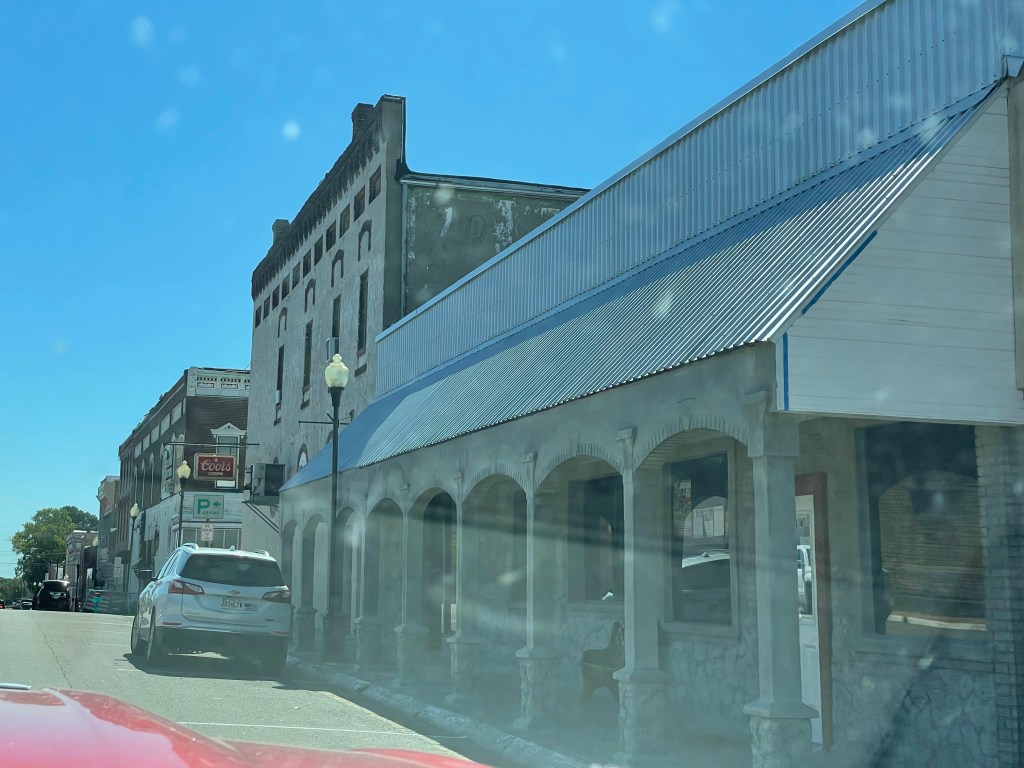
WE stopped to stretch our legs is Pea Ridge, a nice little town…
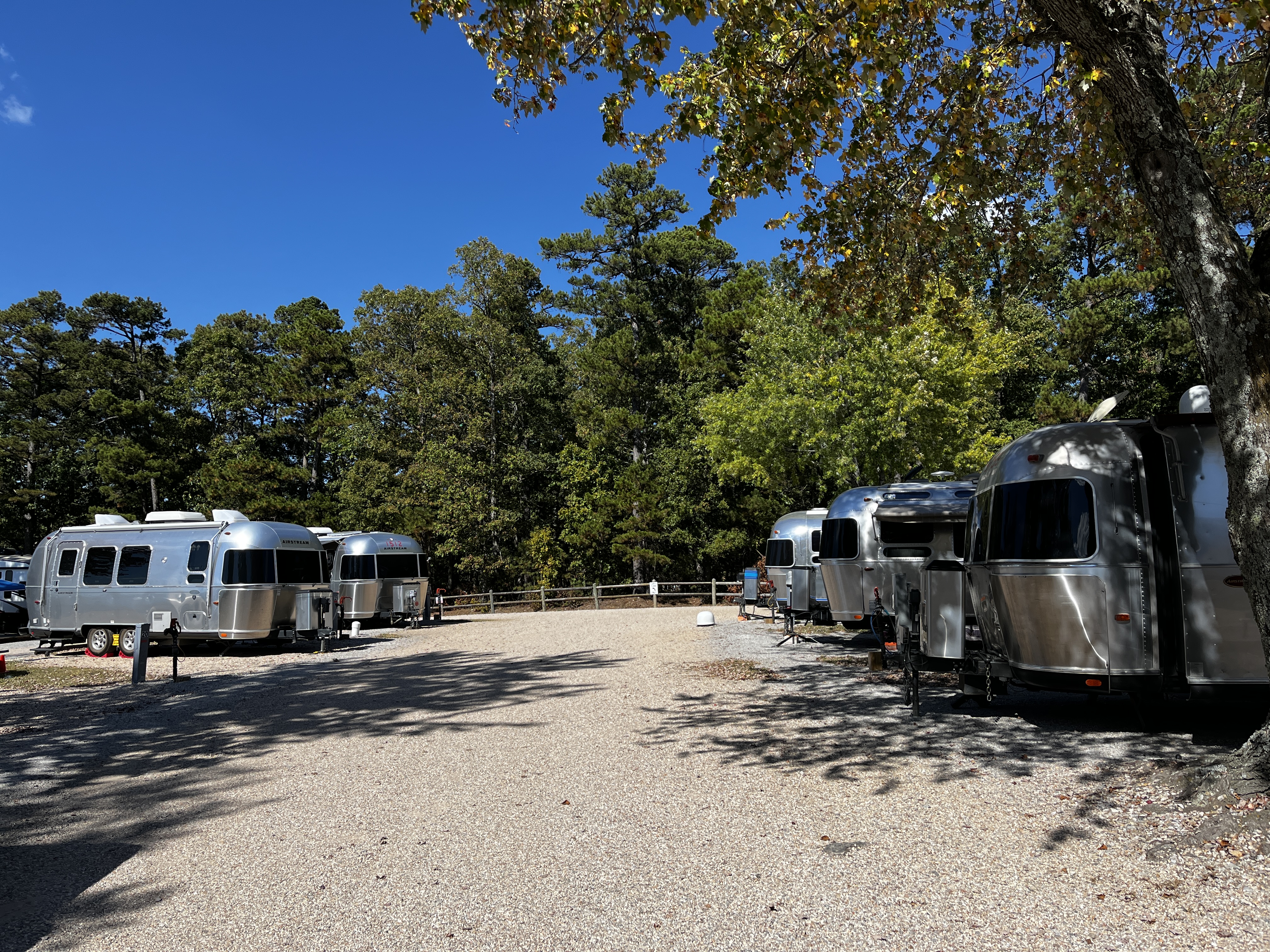
We arrived at the RV park and were soon set up…
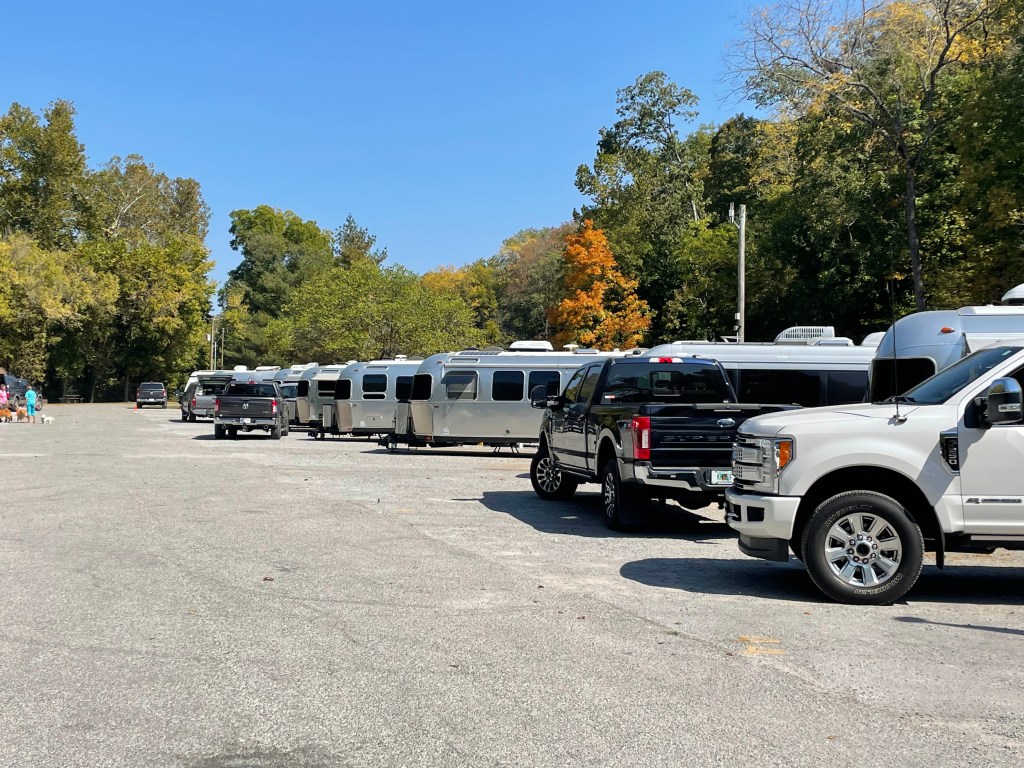
The RV park is located in a city park. We had many places to walk about…
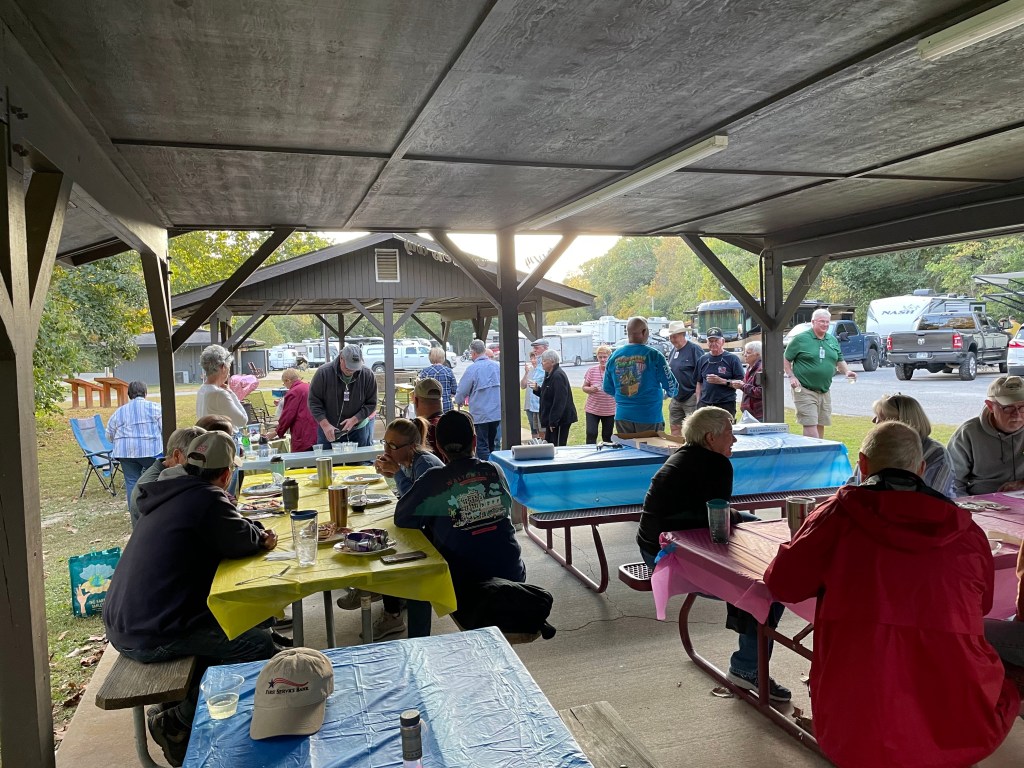
This evening we had a pizza dinner, and celebrated another anniversary…
After a leisurely breakfast we headed out to the Turpentine Creek Wildlife Refuge.
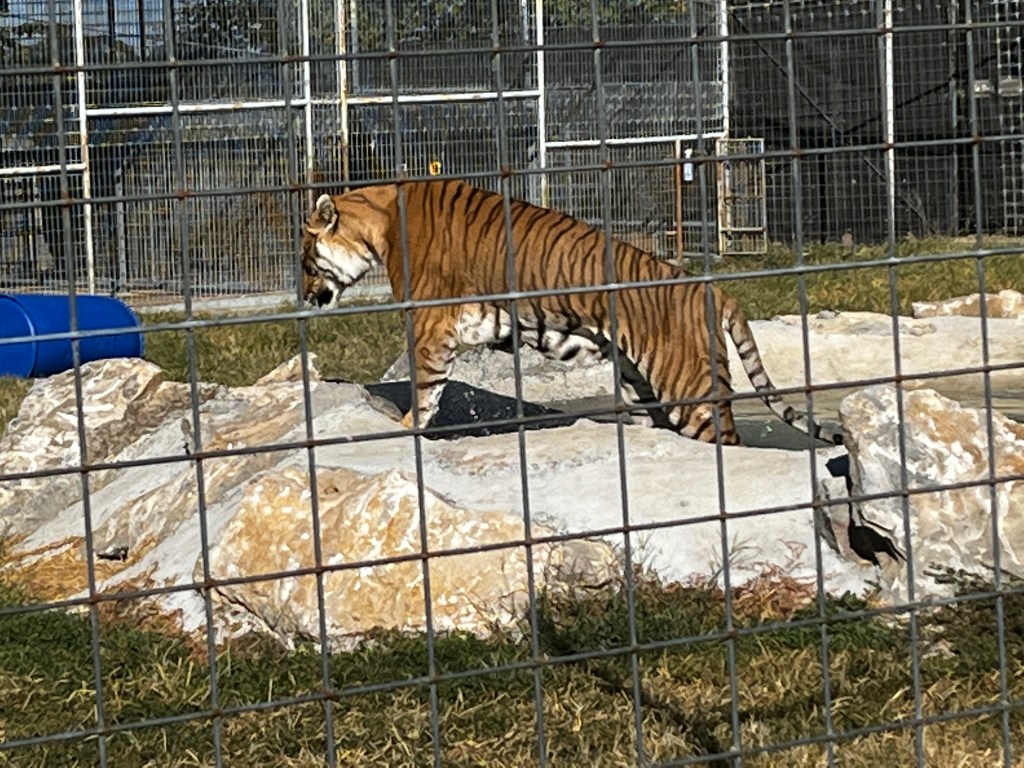
No, this is not a Tiger. It is a Li-tigon. More on this later…
Turpentine Creek Wildlife Refuge (TCWR) is a 459-acre wildlife refuge for abused, abandoned, and neglected big cats.
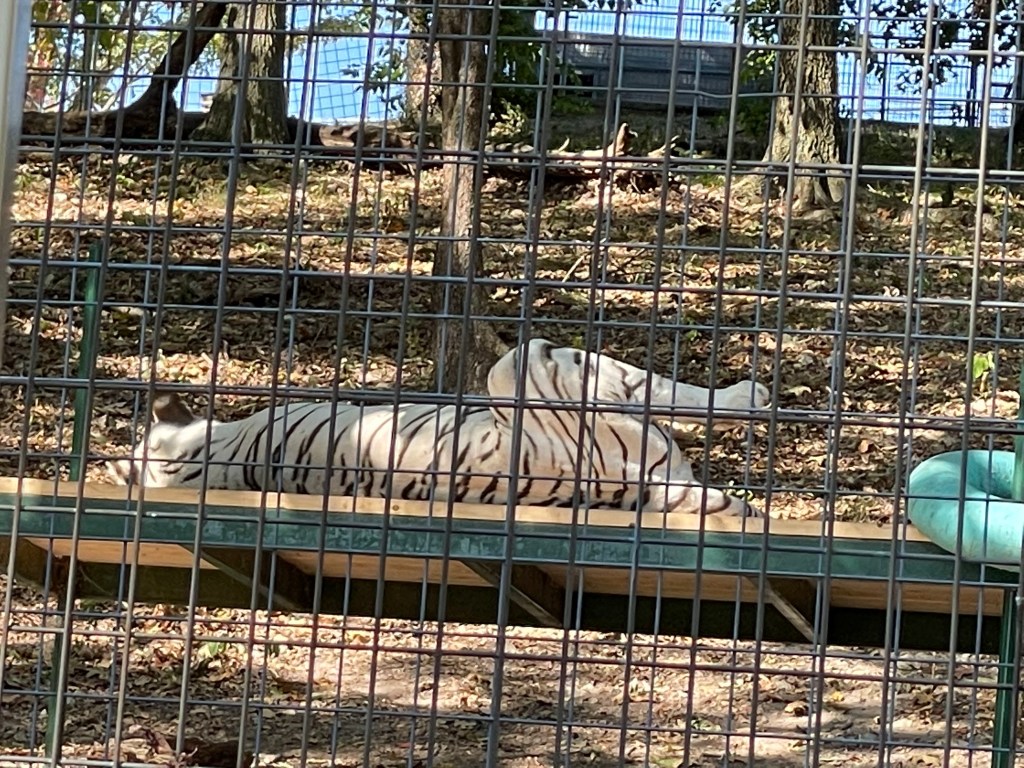
The Eureka Springs, Arkansas, refuge houses 100 or more animals. It mainly specializes in tigers, but there are also lions, leopards, cougars, bobcats, black bears, ligers*, servals, a monkey, a coatimundi and a grizzly bear.
In 2015 Turpentine Creek reached Verified Status from the Global Federation of Animal Sanctuaries.
In 2012 Turpentine Creek rescued 34 big cats from a breeding facility. To accommodate this number of cats a secondary area was built, which is now referred to as “Rescue Ridge”. Many of the cats rescued from the facility were not used to human contact. To reduce stress on the animals this area is not open to the public.
Turpentine Creek spent the past few years working to expand the refuge. The original area, now referred to as the “Compound” that contained smaller cages with cement flooring has been emptied. Turpentine has built spacious, grassy habitats ranging in size from 1/4 acre to 1/2 acre for the animals to live in over the past 14 years.
By September 16, 2015, all of the small concrete cages that used to make up the majority of Turpentine Creek were emptied. On September 17, 2015, demolition of the old “compound” area began.
Turpentine Creek has an on-site Veterinary Hospital for the animals who reside at Turpentine Creek. The vet hospital is on Turpentine Creek’s property and makes giving the animals medical attention easier. Having a vet hospital on-site is less stress to the animals and reduces the risk of the animals, or any human around them, from getting injured.
A very interesting fact, heretofore unknown to me, is that almost all these animals have been bred in captivity and many are hybrids:
Liger: Lion father and mother tiger
Tigon: Tiger Father and Lion Mother
Ti-Liger: Liger Mother, Tiger Father
Li-Liger: Liger Mother, Lion Father
And so on… Of course lions and tigers never see one another in the wild: they live on different continents…!
These animals were rescued from homes and apartments, where the cats were “pets”, fake zoos, breeding farms, and the like. Most were abused before they arrived here…
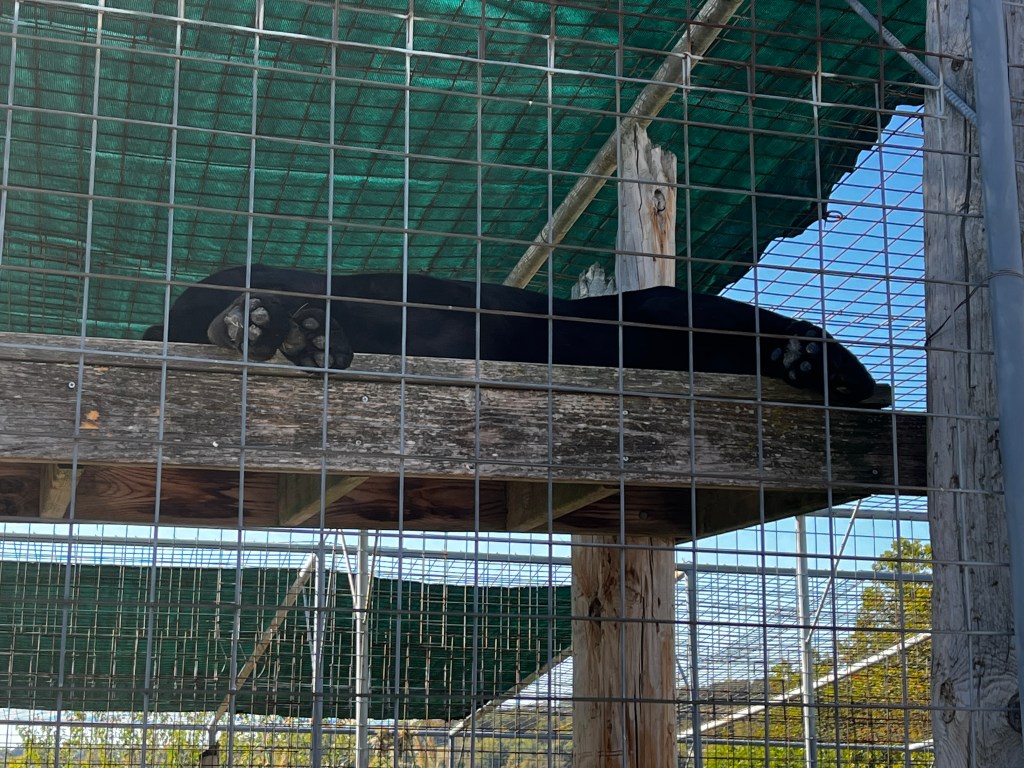
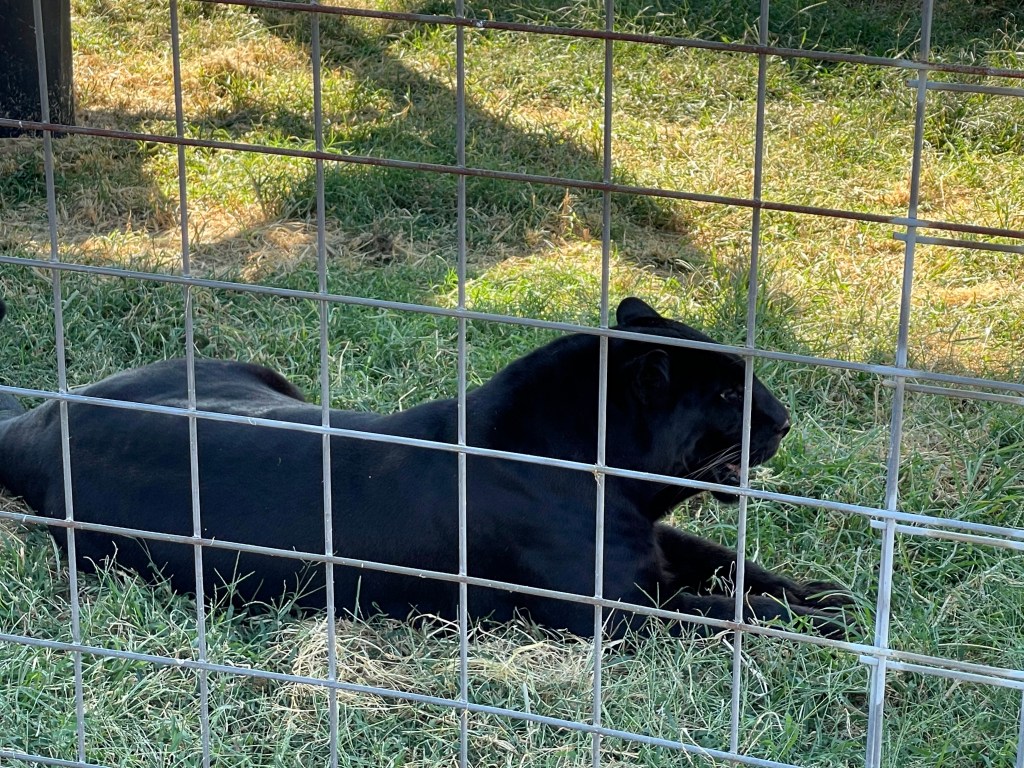
The black panther was asleep, but later awoke…
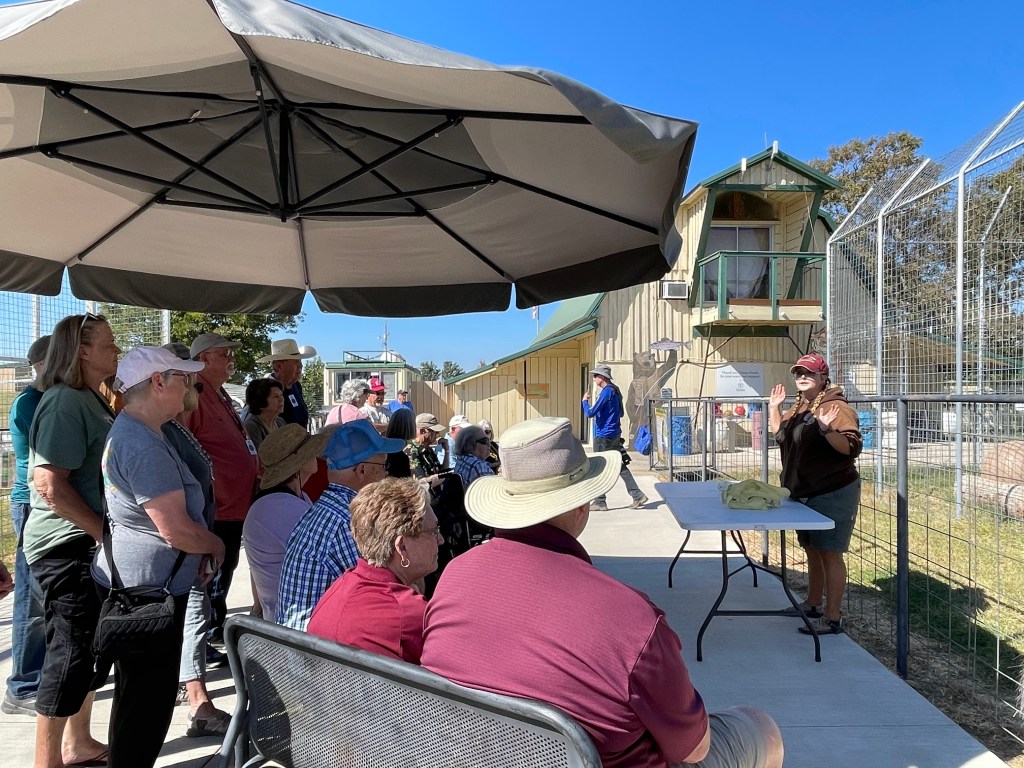
After the tour we had more animal talk…
These are some of the toys that the big cats regularly destroy…
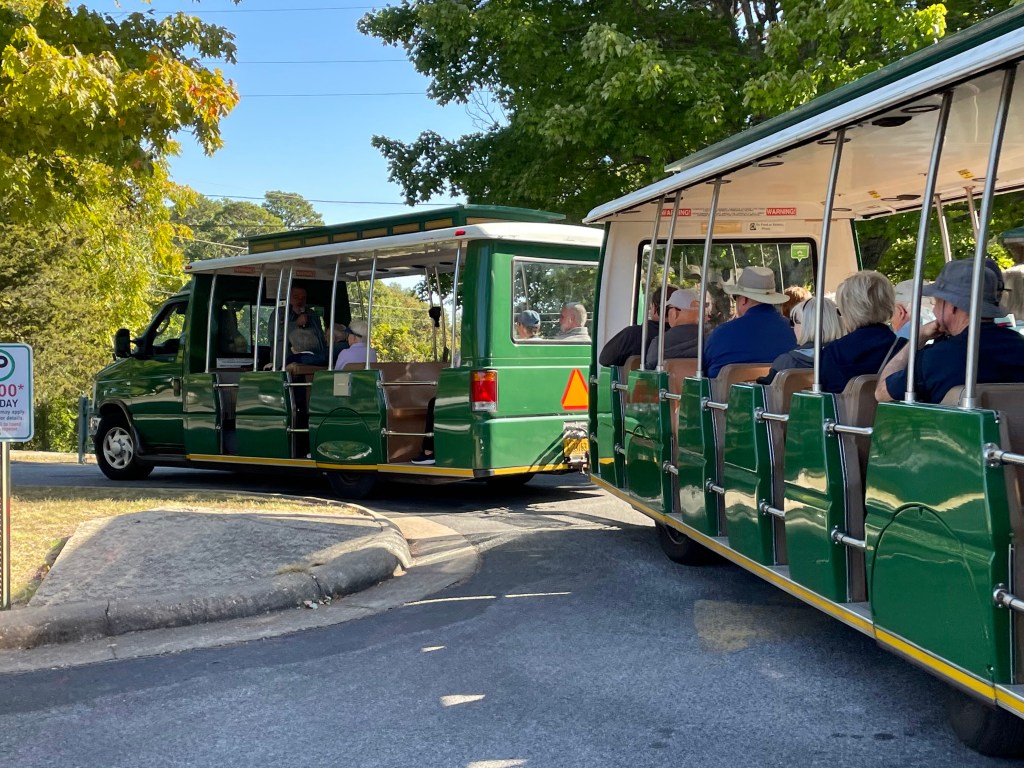
We had a leisurely breakfast in the Villa this morning; then we headed into Eureka Springs for a Trolley Tour of the historic town…
Eureka Springs is a city in Carroll County, Arkansas. It is located in the Ozark “Mountains” (elevation 1,260′) in northwest Arkansas. As of the 2020 census, the city population was 2,166.
The entire city is listed on the National Register of Historic Places as the Eureka Springs Historic District. Eureka Springs has been selected as one of America’s Distinctive Destinations by the National Trust for Historic Preservation. Eureka Springs was originally called “The Magic City”, “Little Switzerland of the Ozarks”, and later the “Stairstep Town” because of its mountainous terrain and the winding, up-and-down paths of its streets and walkways.
It is a tourist destination for its unique character as a Victorian resort, which first attracted visitors to use its then believed healing springs. The city has steep winding streets filled with Victorian-style cottages and manors. The historic commercial downtown of the city has an extensive streetscape of well-preserved Victorian buildings. The buildings are primarily constructed of local stone, built along limestone streets that curve around the hills, and rise and fall with the topography in a five-mile long loop. Some buildings have street-level entrances on more than one floor and other such oddities: the Basin Park Hotel has its front entrances on the floor below first, and a ground-level emergency exit in the back of the building on the fifth floor. The streets wind around the town, with few intersecting at right angles. There are no traffic lights.
The tour was fun, and there is lots to see. Our tour guide has lived in Eureka Springs all his life. We’ll take his word for it. Some of the other things he told us were definitely not true…!
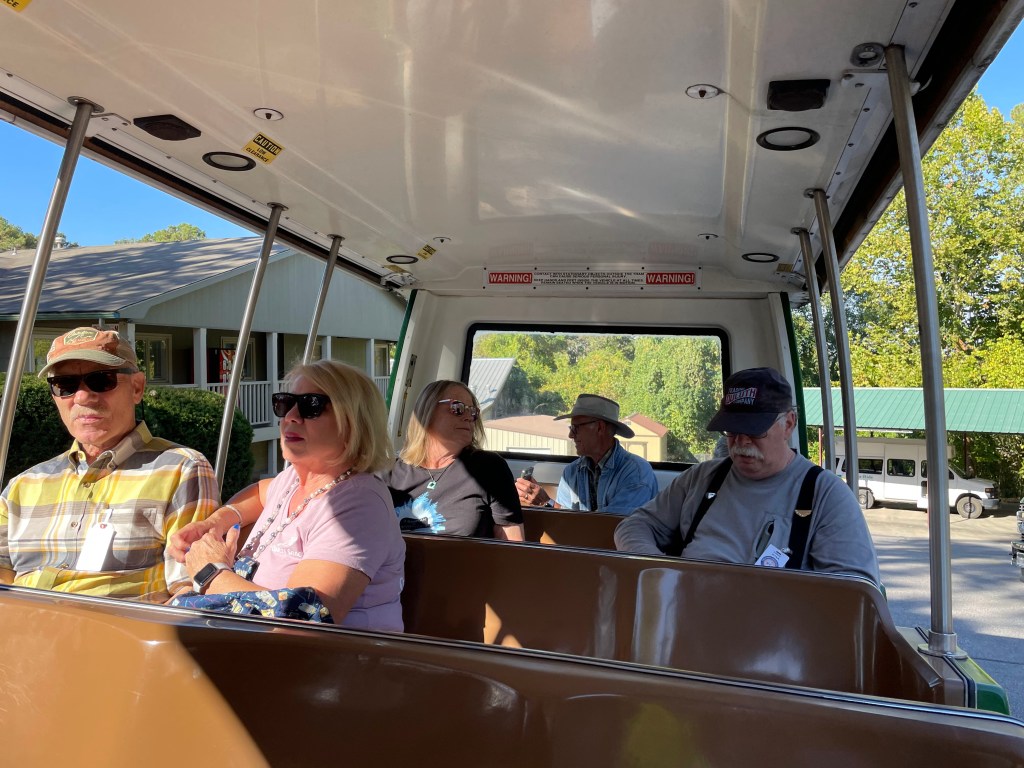
This picture of us on the tram is compliments of Lynda Polk…!
The Crescent Hotel is one of the larger hotels in town, and it is certainly a fine place…
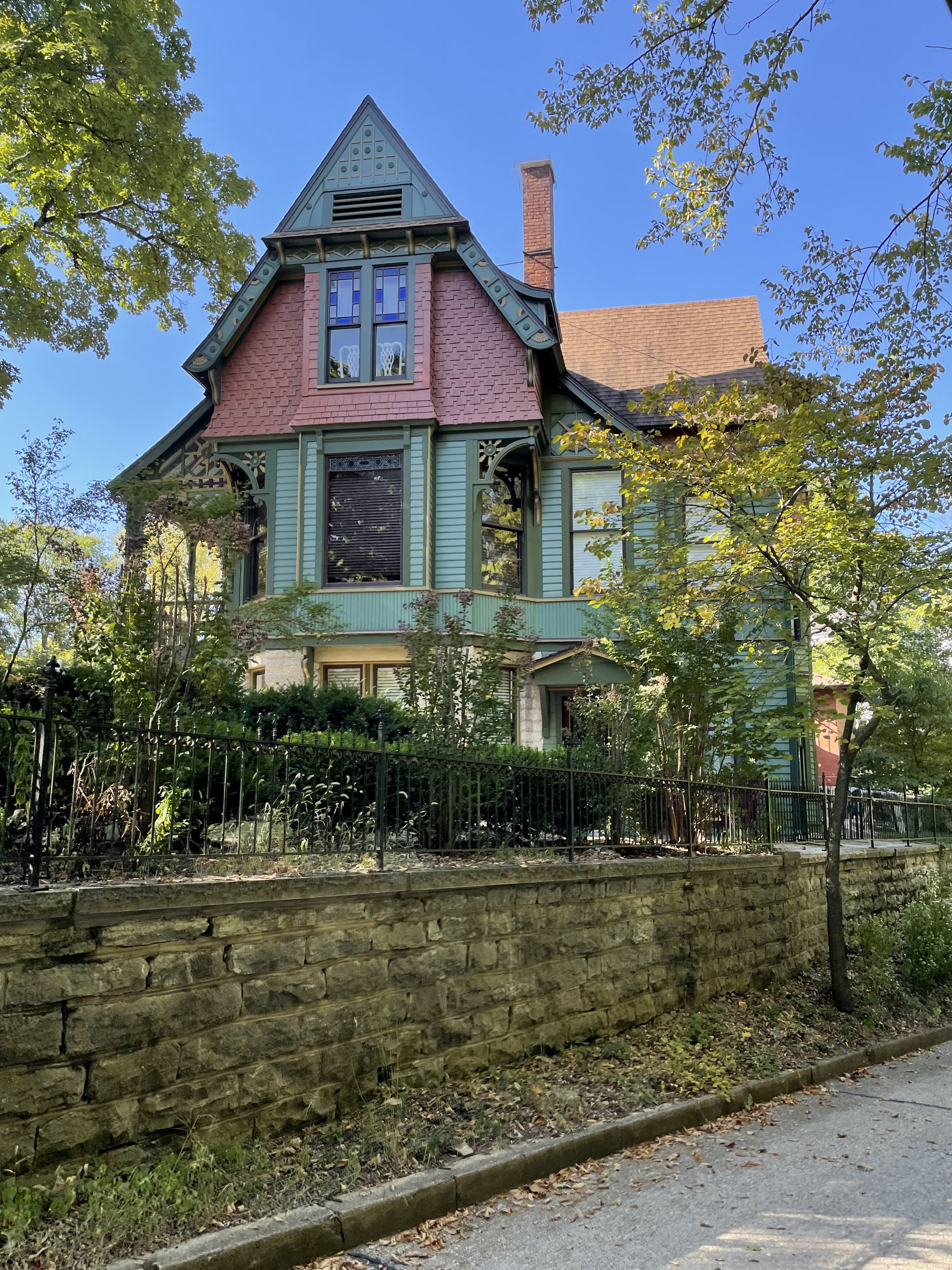
A lot of the houses are built with native stone…
Tour Guide lie #1: “This house was designed by Frank Lloyd Wright, and is pictured in many of the “coffee table” picture books of his work.”
Truth: No, it’s not. It is like virtually all houses built in the US in the 20th century: It was “influenced” by the work of Wright…
The hills are full of these beautiful rock formations…
Tour Guide lie # 2: “This house is the smallest Victorian house in the US”,
Truth: No, it’s not. There are over 600 Victorian houses in Redlands, CA, and many of them are much smaller than this…
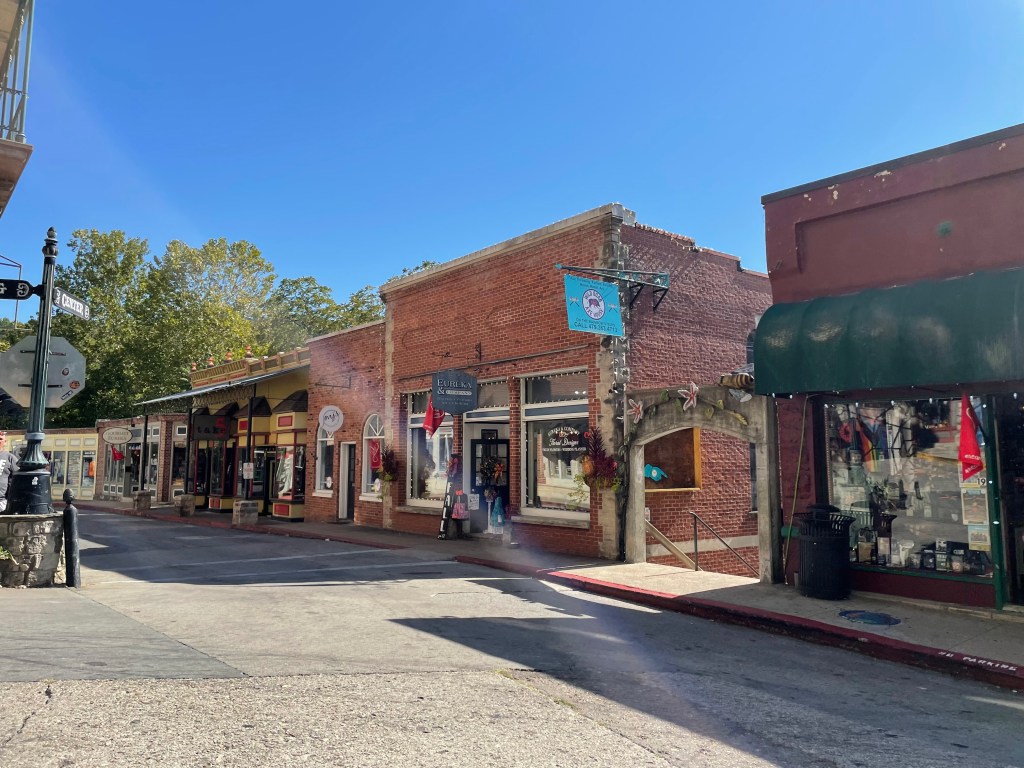
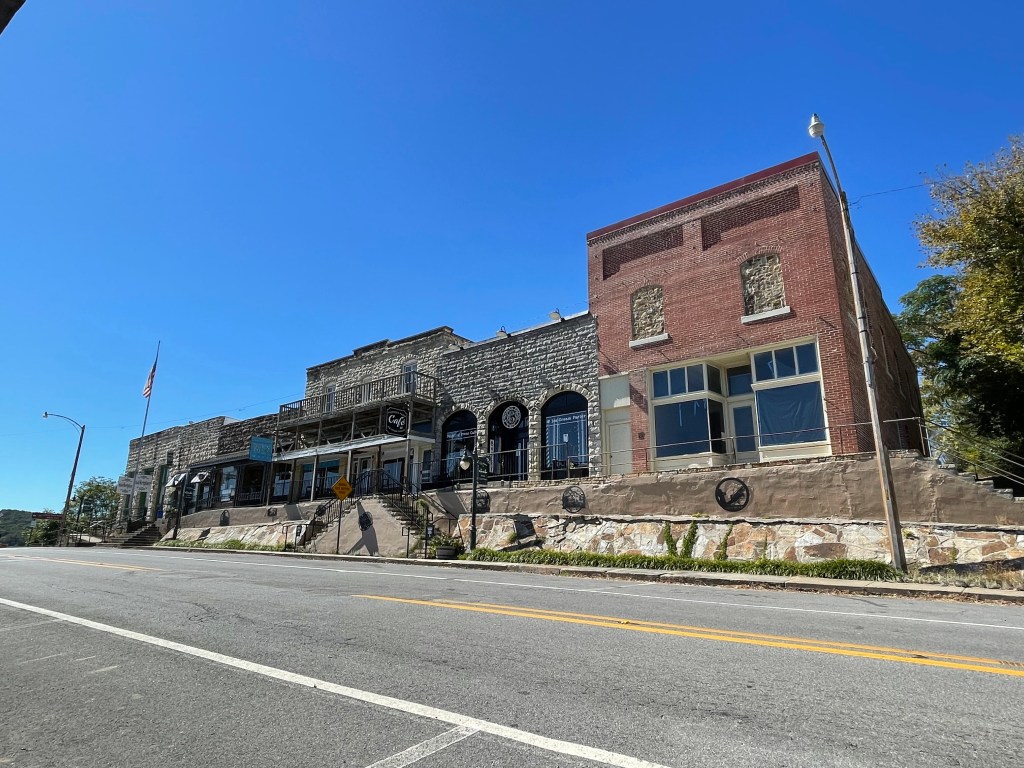
The downtown streets are quaint, crowded, and quite touristy…
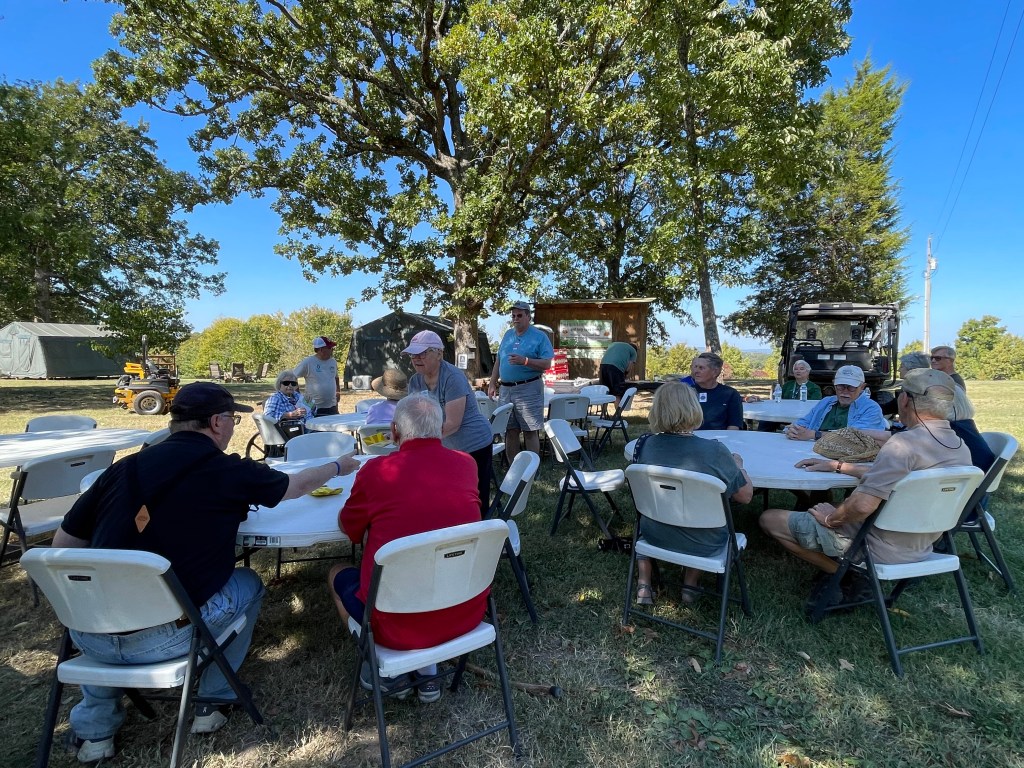
After the trolley tour we joined other caravaners and had lunch at “Local Flavor”…
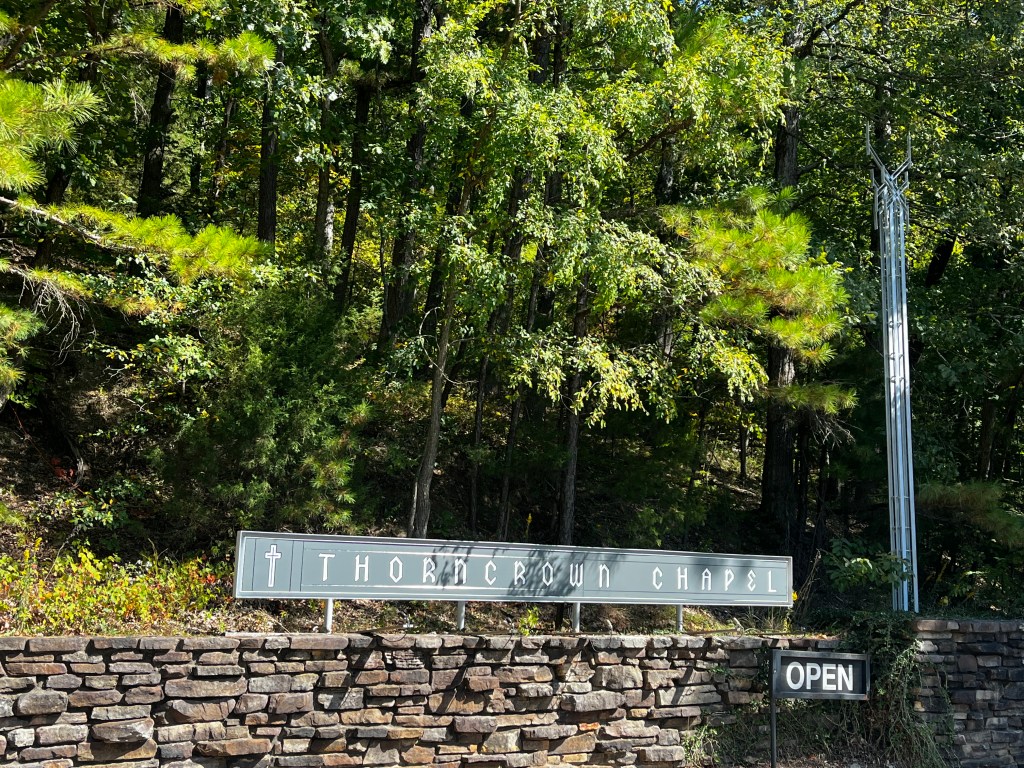
After lunch we drove the five minutes up the highway to view the Thorncrown Chapel
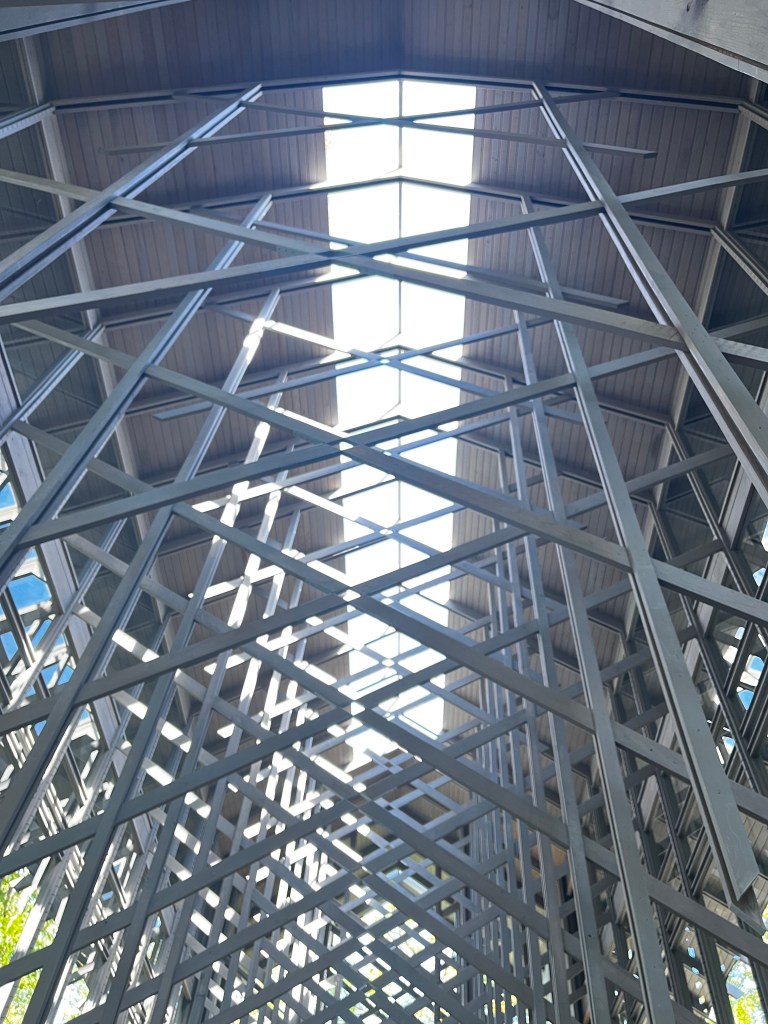
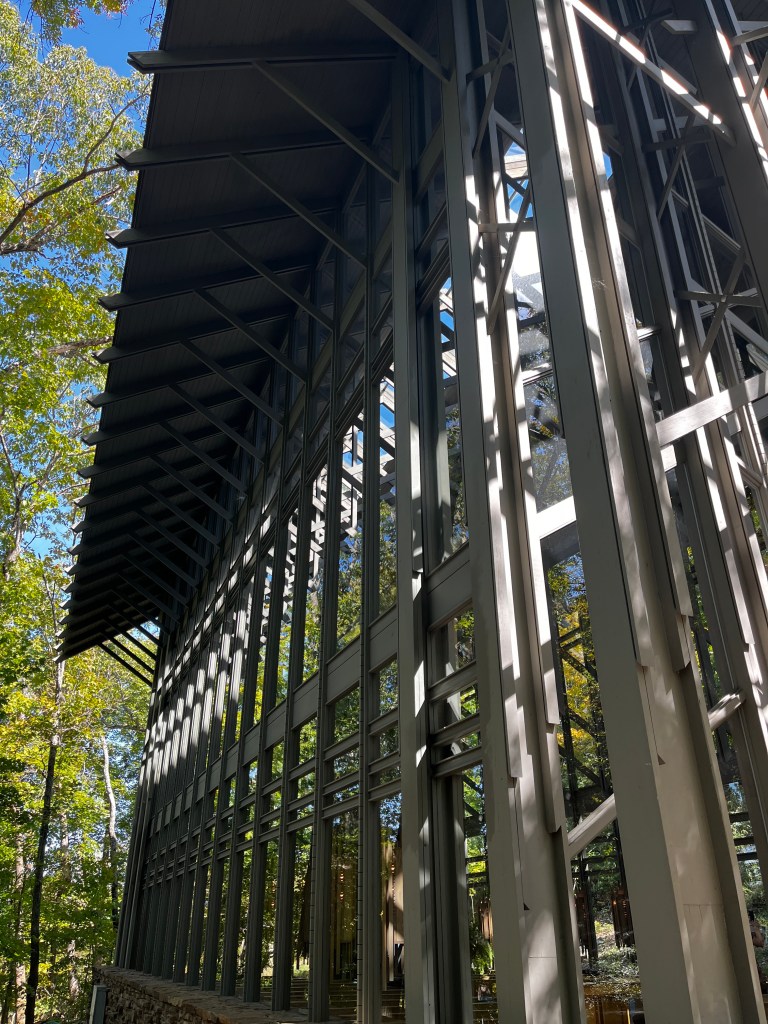
Thorncrown Chapel is a chapel located in Eureka Springs, designed by E. Fay Jones and constructed in 1980. The design recalls the Prairie School of architecture popularized by Frank Lloyd Wright, with whom Jones had apprenticed. (Jones was the only apprentice of Wright whom Wright thought was any good…) The chapel was commissioned by Jim Reed, a retired schoolteacher, who envisioned a non-denominational pilgrimage chapel set apart for meditation. The design of Thorncrown Chapel was inspired by Sainte-Chapelle, a Gothic church in Paris, France, pierced by numerous stained glass windows. It held some of King Louis’s medieval Christian relics, including the Crown of Thorns believed worn by Christ. This relic inspired the name of the American chapel.
The chapel’s unusual artistry has been recognized worldwide. It was selected for the 2006 Twenty-five Year Award by the American Institute of Architects. It was listed on the National Register of Historic Places in 2000, a status not granted to buildings fewer than fifty years old unless exceptionally significant.
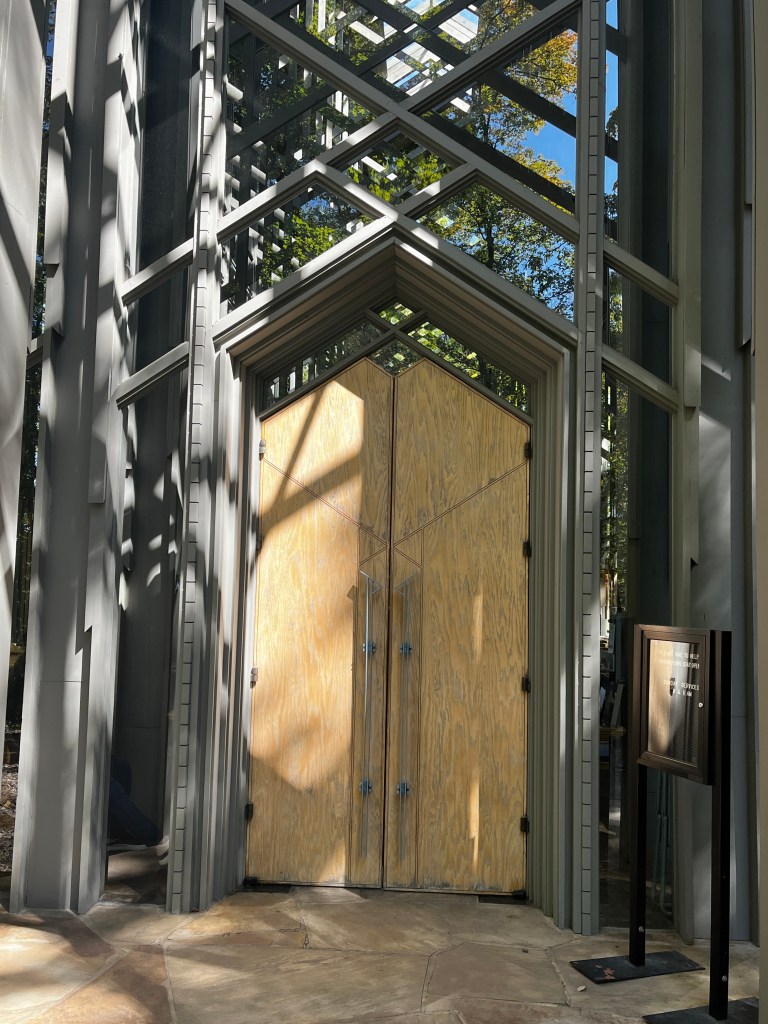
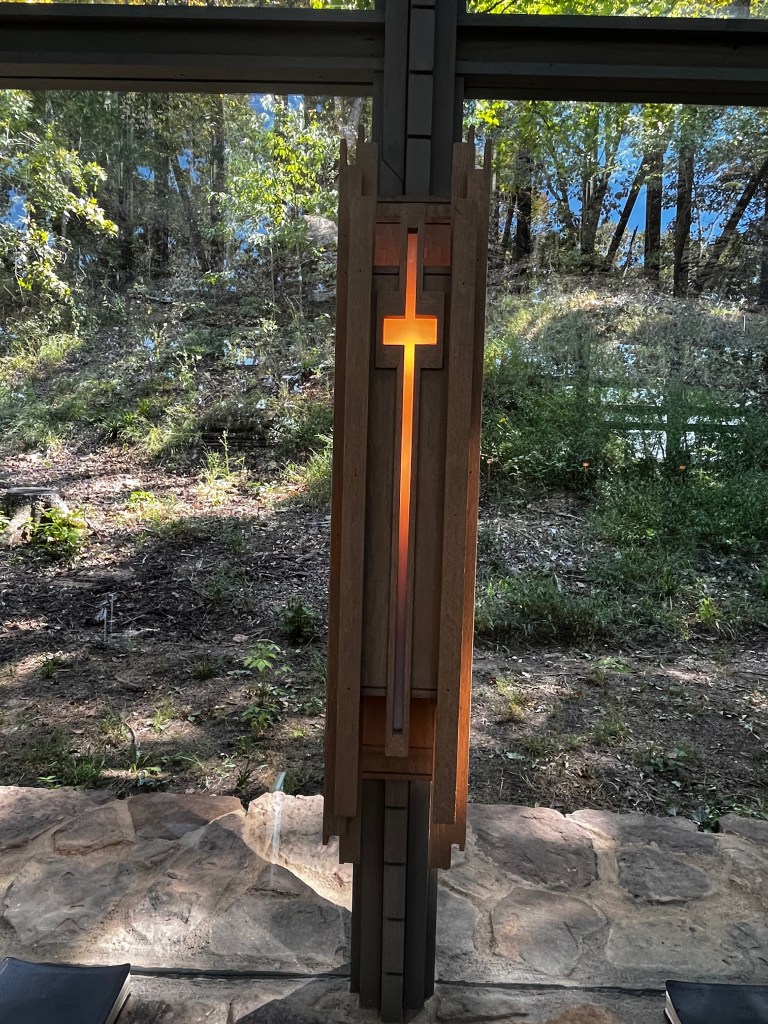
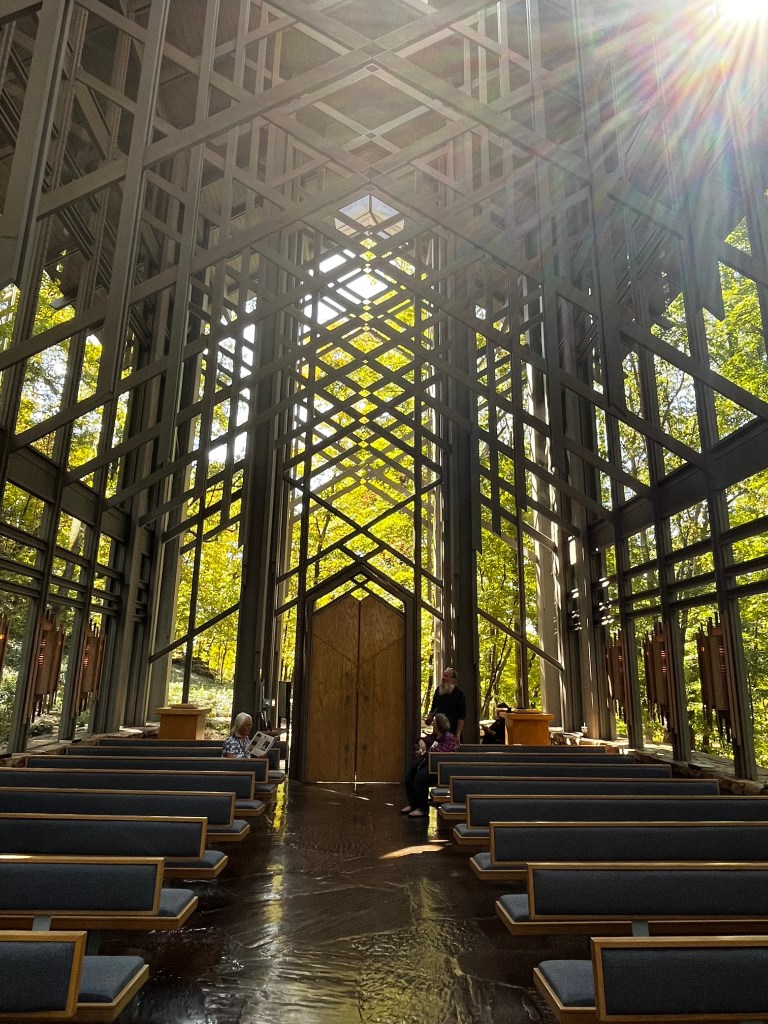
The chapel stands 48 feet high, 24 feet wide, and 60 feet long. It has 425 windows, which add up to 6,000 square feet of glass. During the design process, Jones decided that in order to preserve the site’s natural setting, no structural element could be larger than what two men could carry through the woods. The structure was constructed using organic materials indigenous to northwestern Arkansas, including pressure-treated Southern pine and flagstone for the floor and surrounding wall. The small ornamental roof skylight was later enlarged to provide additional natural lighting throughout the chapel.
The chapel looks like an open-air structure, but is, in fact, an enclosed and air-conditioned space that seats up to 100 people. It is open daily from March to December with free admission. It is closed January and February except for weddings and other special events. Non-denominational church services are held on Sundays from April to December.
Note the attention to detail: All the screws are oriented in the same direction…
Some of the flagstone on site…
It was with much regret that we had to leave this beautiful and awe-inspiring place…
Tonight we have a hamburger cookout…
We returned to the Villa; an enjoyable time was had by all…
Another travel day. First breakfast, Drivers meeting, and the last GAM. It’s 45 degrees outside. Not a fun situation for outdoor breakfast and meetings…
But the drive was lovely… We crossed the White River many times…
Slight change in topography along the way. Less forest, more farming…
We arrived at the campground in Eureka Springs, set up the Villa, and added DEF to the truck.
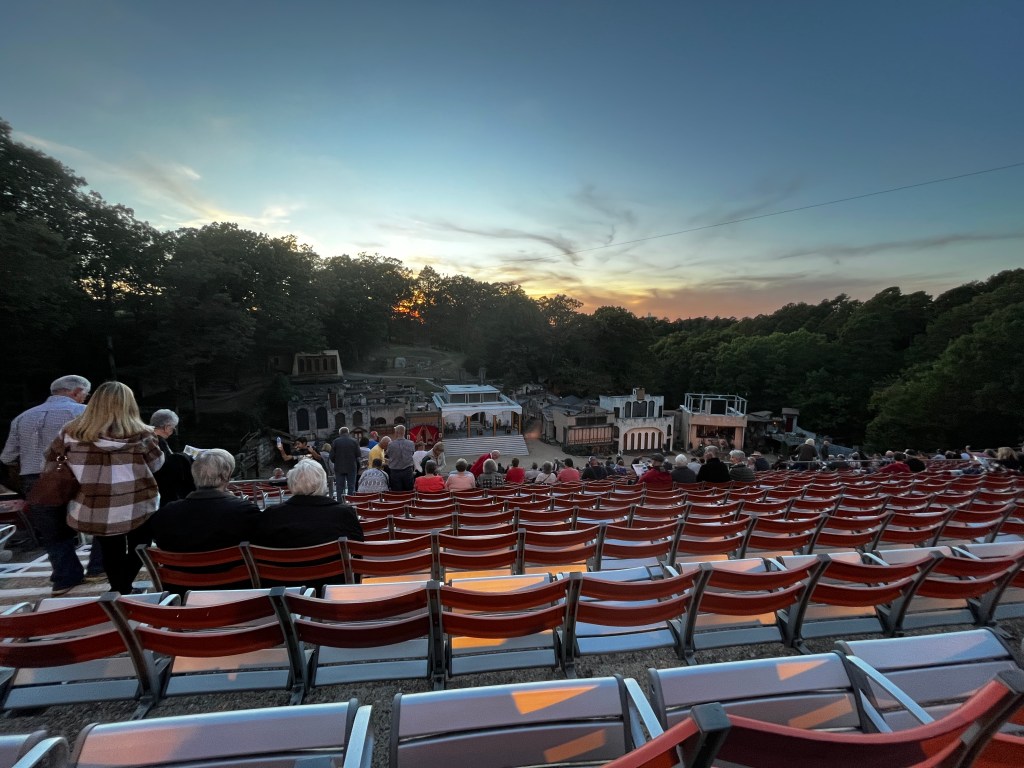
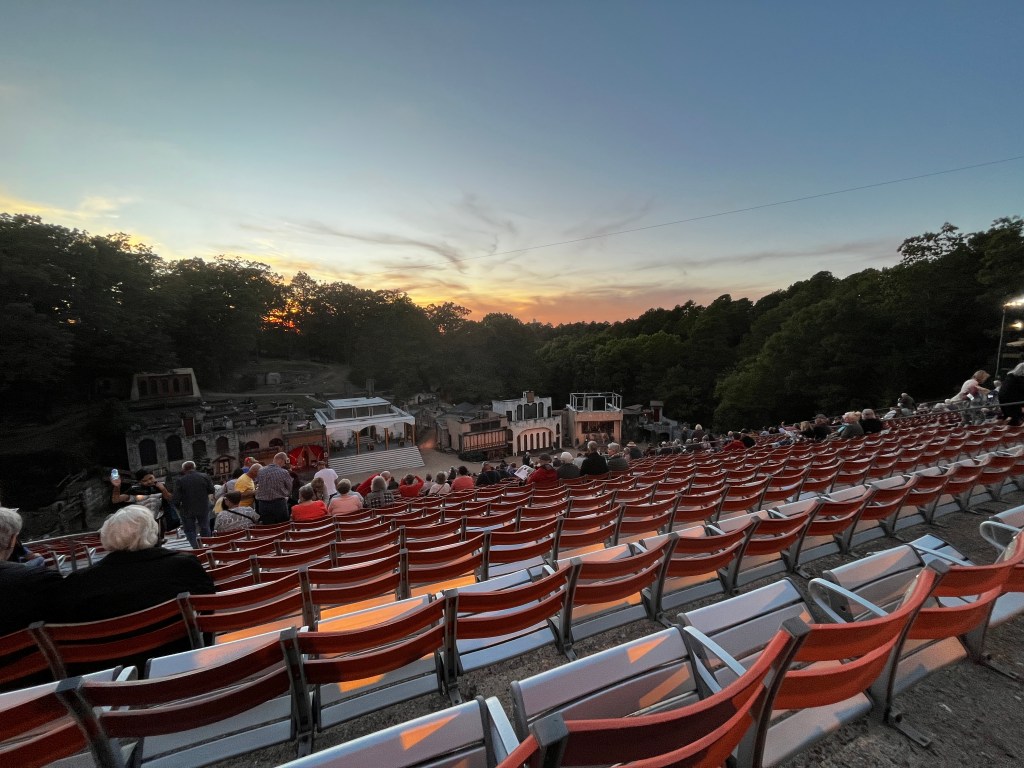
Later, we dressed warmly to head out to see The Great Passion Play…
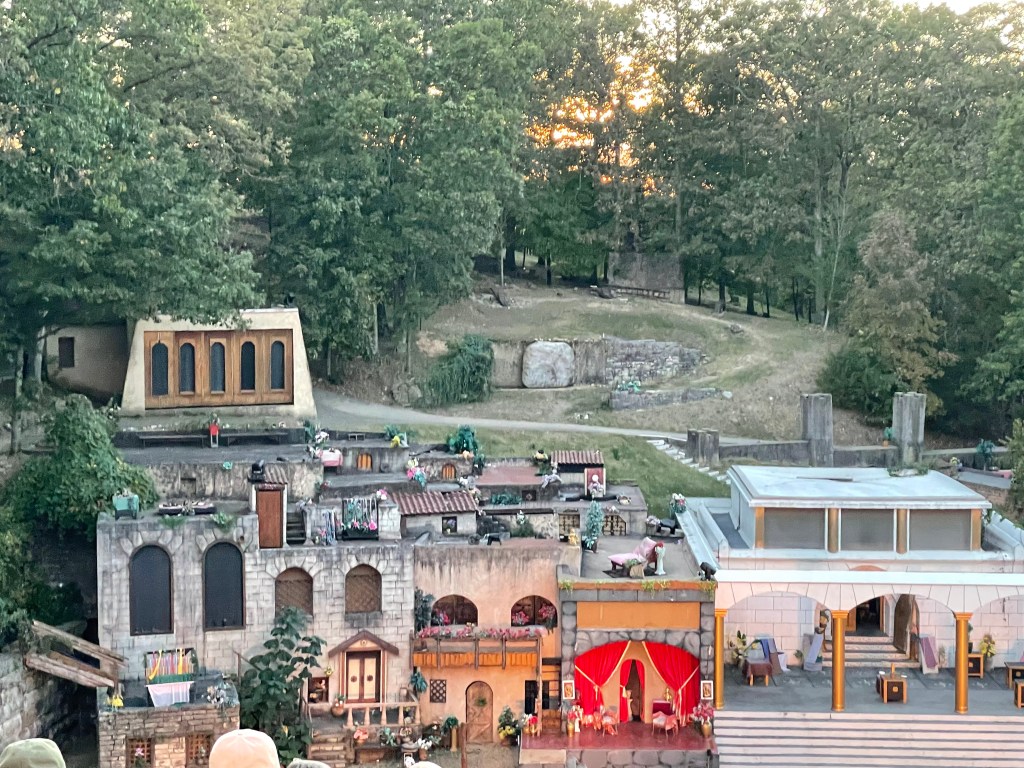
The outdoor amphitheater seats about 5,000 people, and the stage set is HUGE!
The play was well presented, although the few times a southern accent slipped through it was a bit of a jolt…!
We returned to the Villa. An enjoyable time was had by all…
Travel Day today. This caravan is different from our previous caravans. We began the day with breakfast together, then we held our traditional Drivers Meeting, where the route was discussed, then we had another GAM. The reason we have so much time before we leave is that all our drives are short. Only 57 miles today.
When we travel like this between campgrounds we have to leave by a certain time, but we can not arrive at the new campground until after a certain time. This leaves us time to stop along the way and kill an hour or two…
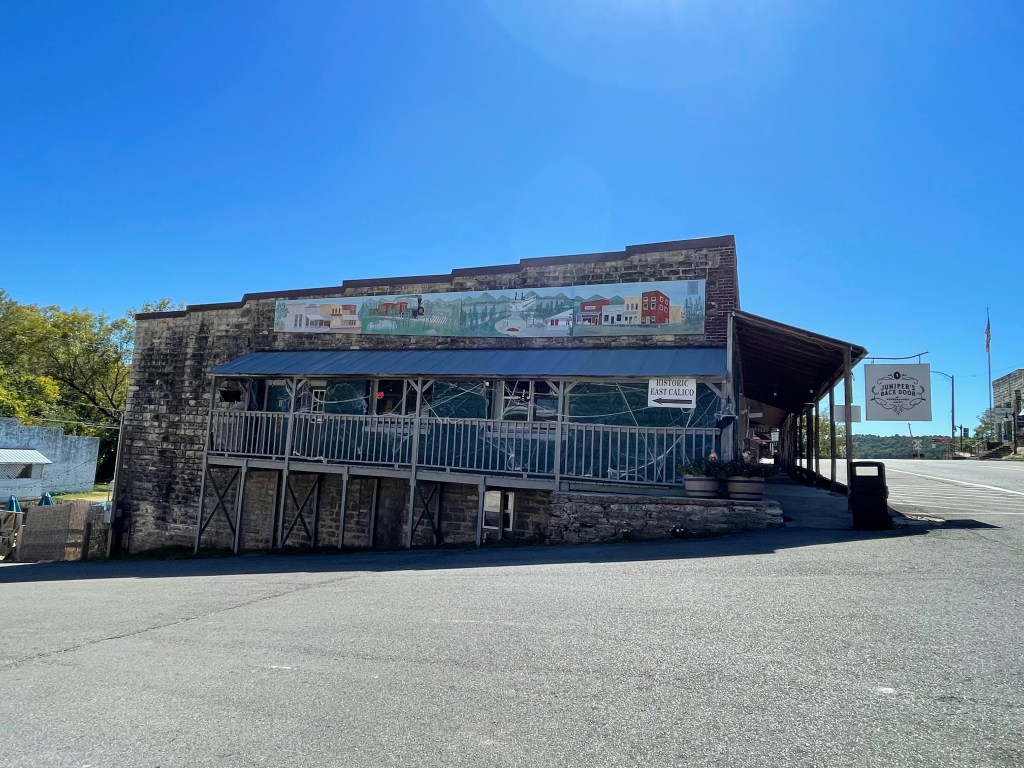
We crossed the White River, then stopped in the town of Calico Rock…
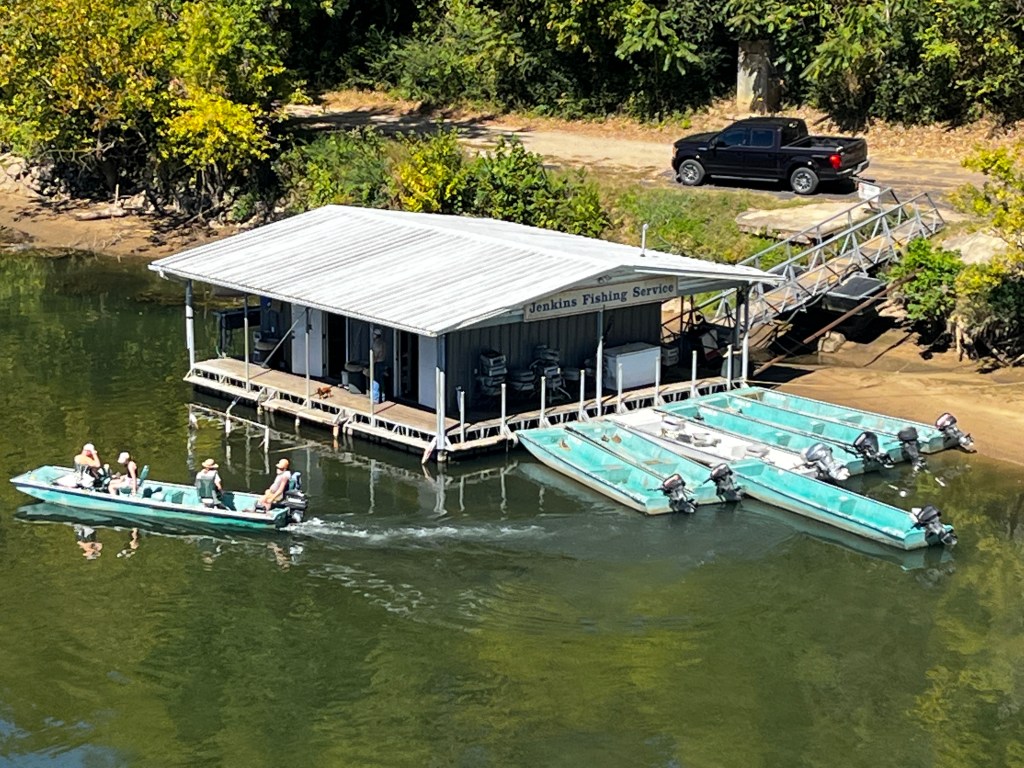
This being Sunday, everything was closed… The White River is famous for trout fishing, so there are several fishing concessions on the river…
This appears to be the Calico Rock…
To quote a song from the musical “Oklahoma”, on the occasion of one of the cowboys going to the big city, “And then I put my ear to a Bell telephone, and a strange women started in to talk…”
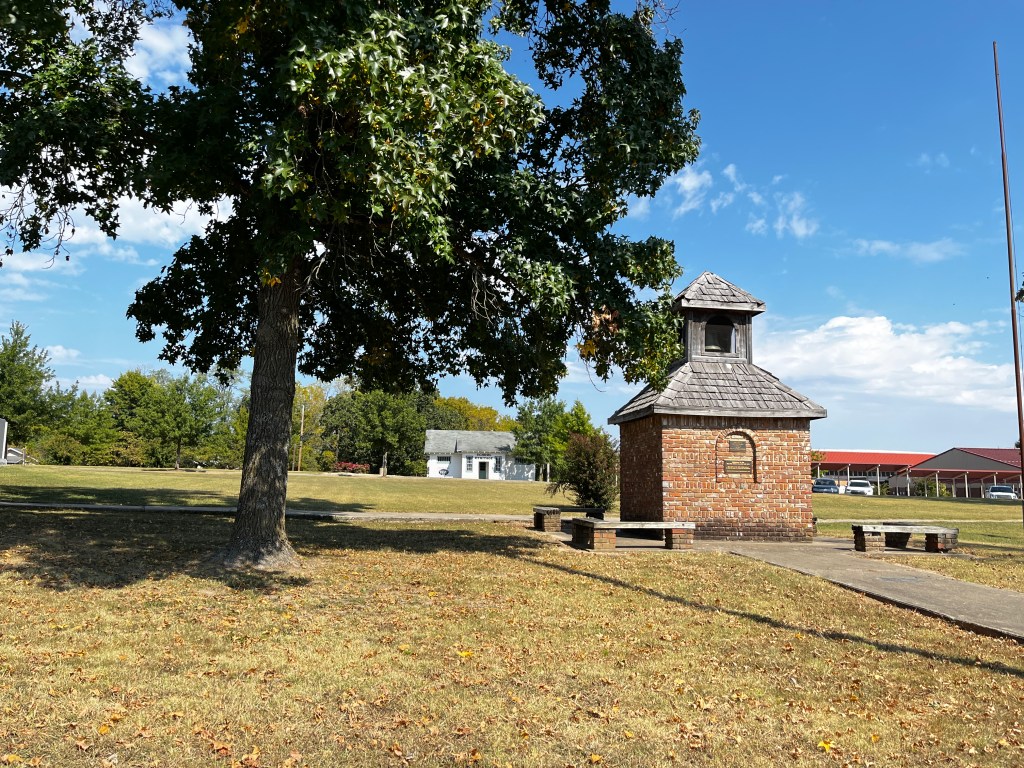
There is a nice park in the center of town with a picnic area…
We enjoyed a little lunch before we moved on…
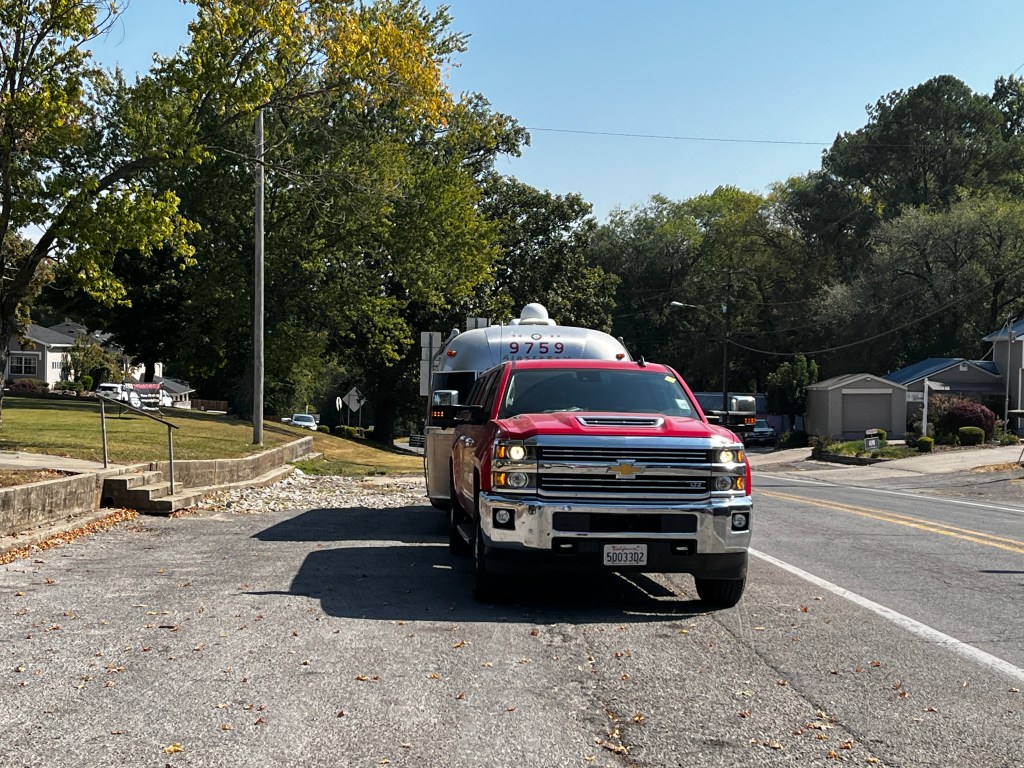
We stopped once more, just to stretch our legs…
We arrived at the Denton Ferry RV park in Cotter, AR, population 886. There is literally nothing in this town. Its main attraction appears to be access to the White River and its trout fishing…
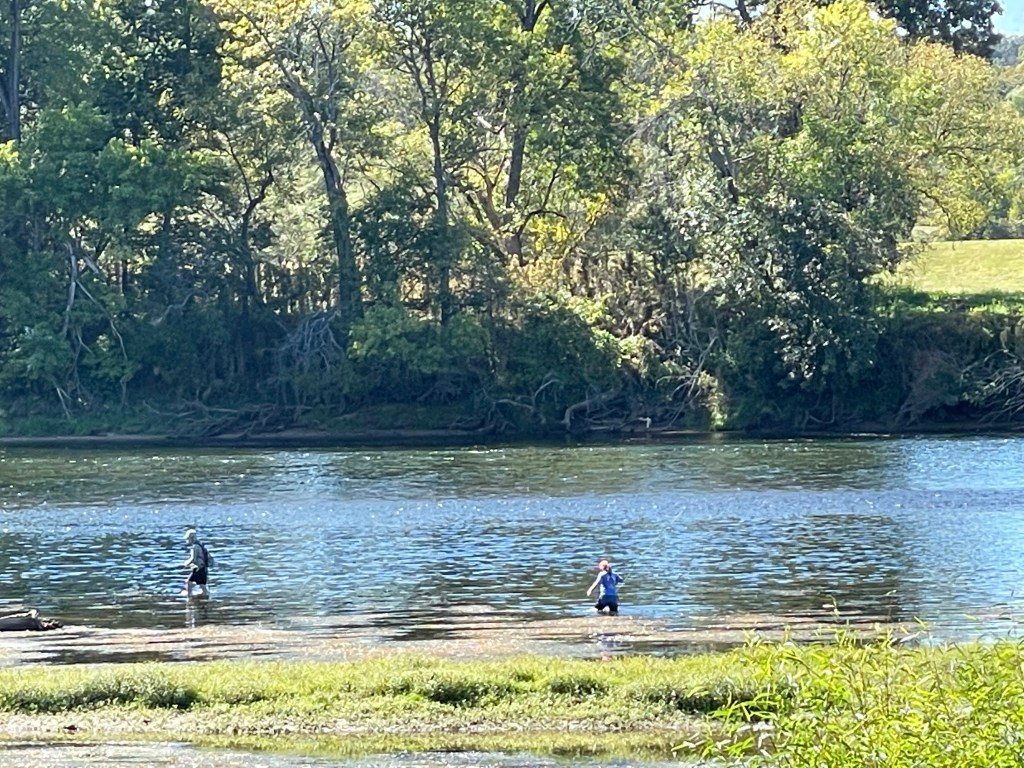
The campground is directly along the river…
Tonight’s dinner is at Colton’s, a chain steak house in nearby Mountain Home, AR. It is had to miss…
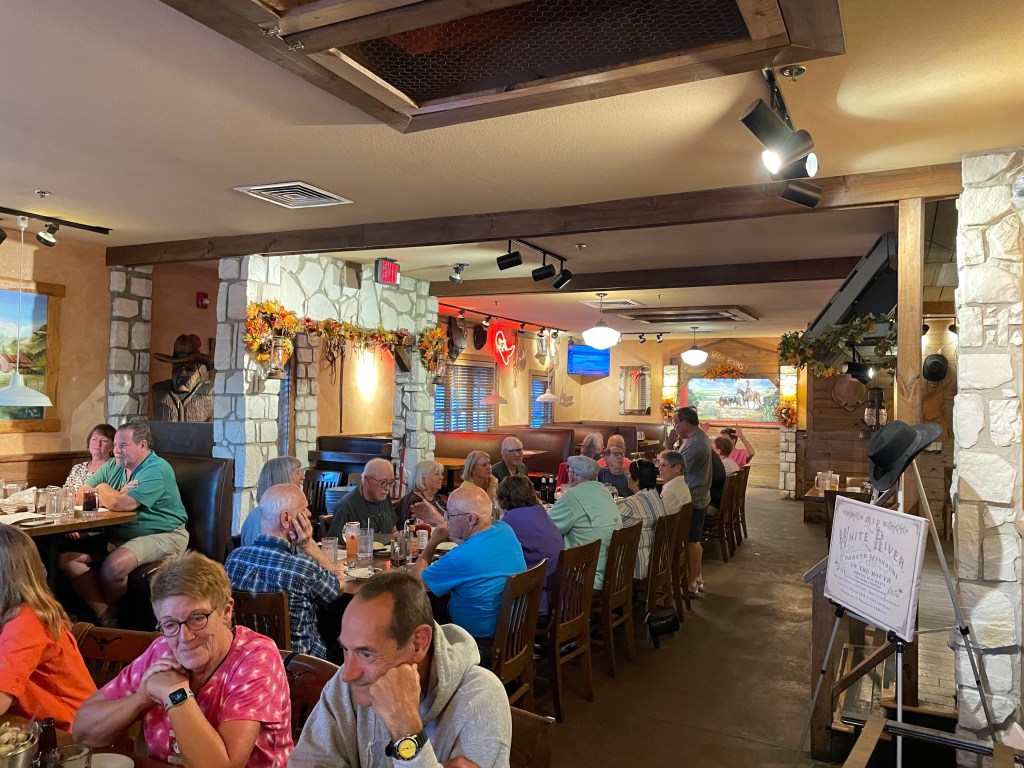
We had a nice banquet room to ourselves… Steaks, chops, chicken, ribs, and Salmon were on the menu… Service was a little slow (which is to be expected). It was nice to not eat deep fried Southern food…
We returned to the Villa. An enjoyable time was had by all…
Today is a free day to explore the area on our own. We chose to drive to the Blanchard Springs Caverns, about a 20 minute drive from the RV park…
Blanchard Springs Caverns is a cave system located in the Ozark–St. Francis National Forest in Stone County in northern Arkansas. It is the only tourist cave owned by the United States Forest Service and the only one owned by the Federal government outside the National Park System. Blanchard Springs Caverns is a three-level cave system, all of which can be viewed on guided tours. The Dripstone Trail runs through the uppermost level of caverns for about a half-mile and opened in 1973. The Discovery Trail opened in 1977 and loops through a 1.2-mile section of the cavern, descending to the lower level of the cave, 366 feet underground, as well as to the Natural Entrance, about 100 feet below ground at that point, following the stream bed of the springs that created the cavern. This trail includes the Rimstone Dams, which create pools along the stream bed, and the Ghost Room, a small but very well decorated room in the uppermost level, with its huge white flowstone. Also offered is a “Wild Cave” tour which allows access to undeveloped parts of the cave to more adventurous visitors. It follows the upstream section of the cave, allowing visitors to see all three levels as the original explorers did, continuing beyond where the Discovery Trail ends.
Residents knew about the cave by the 1930s and called it Half-Mile Cave. Systematic explorations began in the 1950s and continued sporadically through the 1960s. Explorers discovered a skeleton in the cave in 1955 which was incomplete; a cause of death could not be ascertained. The caverns were opened to the public in 1973 after 10 years of development on the Dripstone Trail.
With 8.1 miles of surveyed passage, Blanchard is the second longest cave in Arkansas and the largest in volume. The limestone rock from which the caves and their formations developed was laid down in an ancient sea more than 350 million years ago. The cave is in middle Ordovician to lower Mississippian rocks and extends through six stratigraphic formations. The cave has shown over 5 levels of passage development but the upper two levels have eroded away as deepening valleys on the surface cut into them. The cave’s formation was largely phreatic in nature (formed below the water table) and passages have elliptical cross-sections typical of these formations. During the cave’s development, active streams have been pirated from one level down to another without much vadose erosion occurring. The present stream currently rises from the cave at Blanchard Springs itself, at the same temperature as the cave, a constant, year-round 58 °F. Most of the lower-level Discovery Route is in the approximately 100-foot thick Plattin limestone whereas the Dripstone tour route in the uppermost level of the cave spans 3 units, the Boone Chert, Cason Shale, and the Fernvale Limestone. Blanchard remains a “living” cave in part because of the care given by visitors and the United States Forest Service. Thus the formations inside continue to grow as calcite is actively deposited by seeping and dripping water. One of the outstanding examples of formation growth is the Giant Flowstone, one of the largest in the U.S., at 164 feet long, 33 feet wide, and 30 feet thick.
We drove through typical Arkansas countryside…
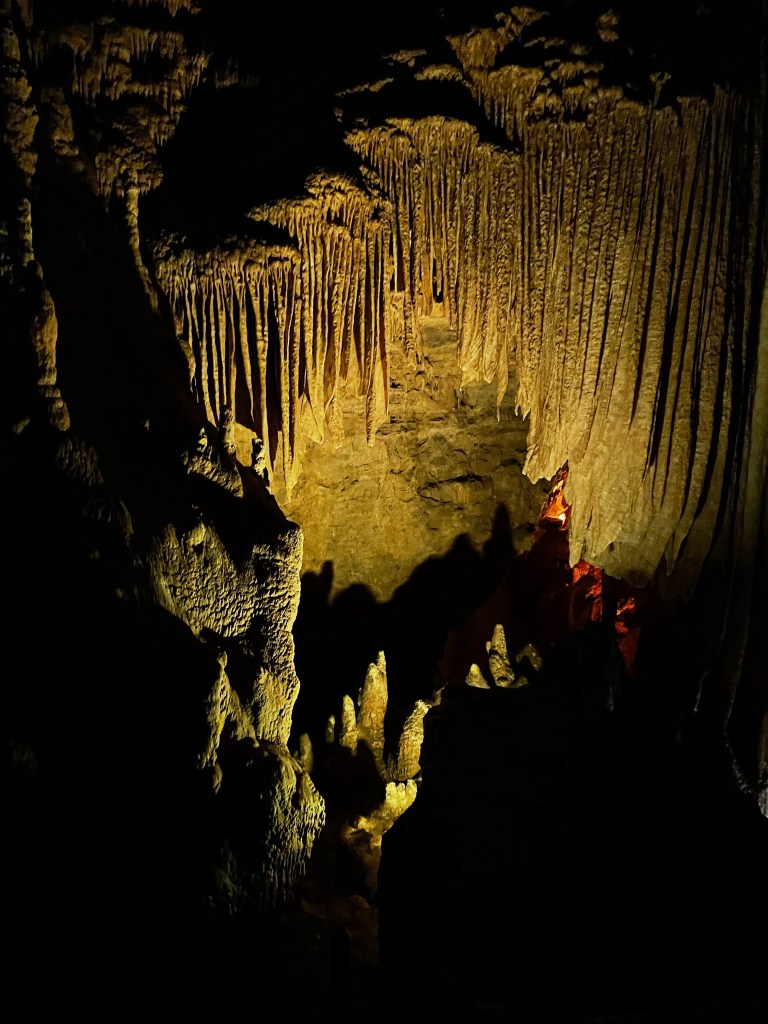
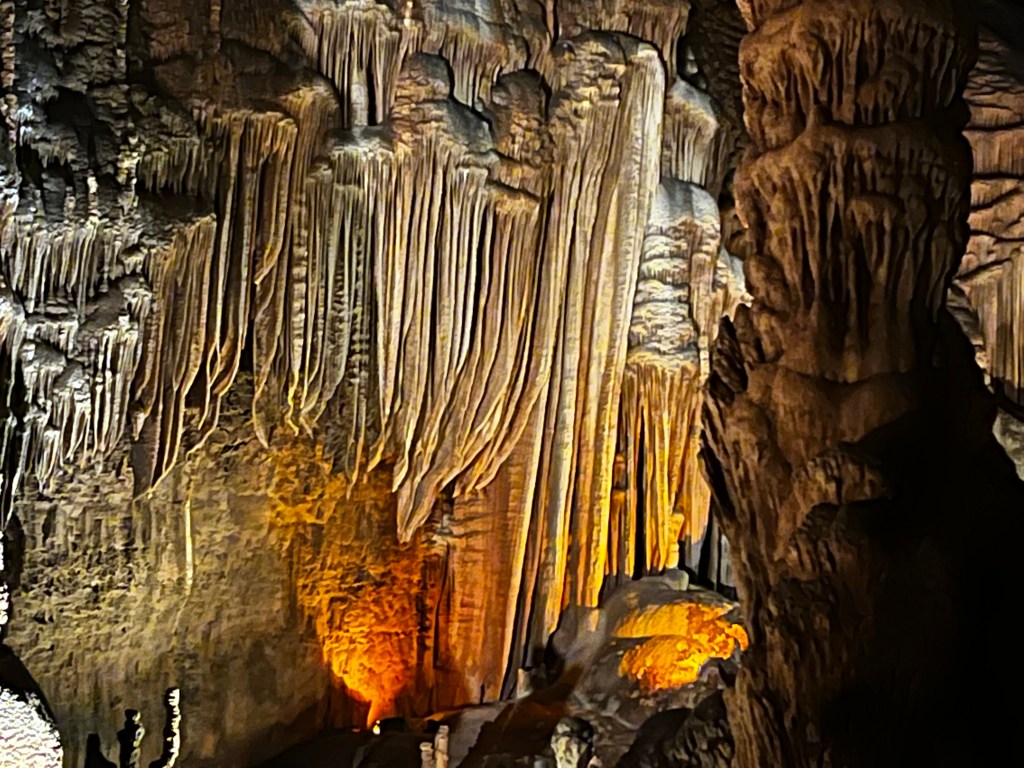
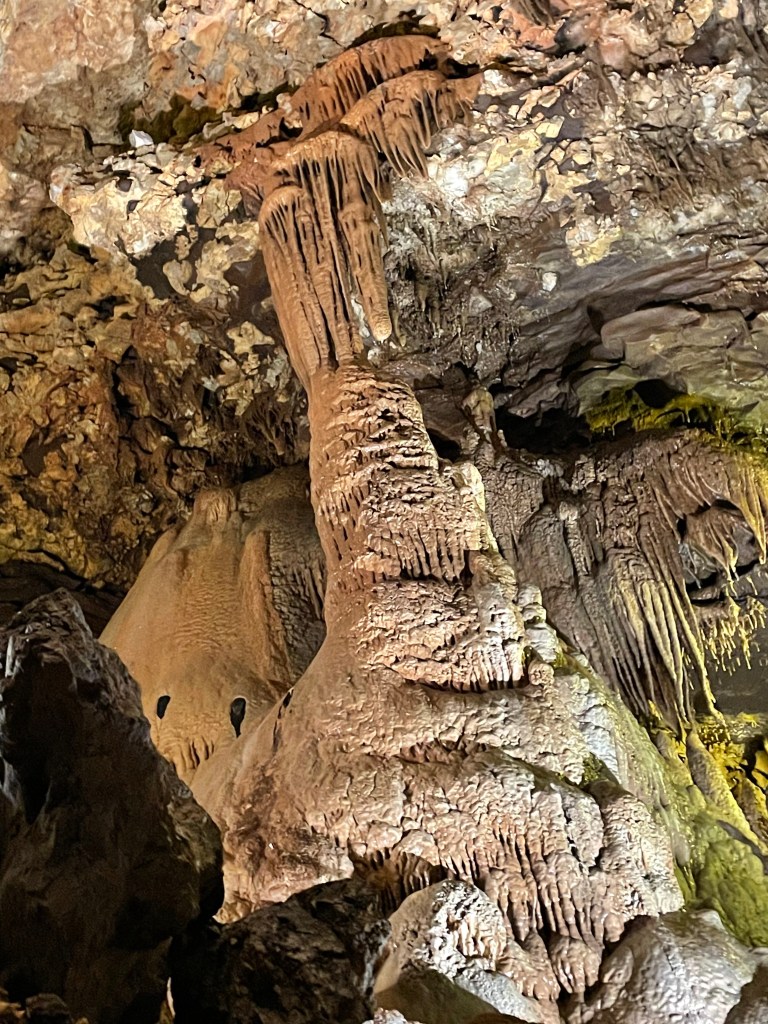
It was a nice, easy tour; as with most caves, photos do not do it justice… But we tried…
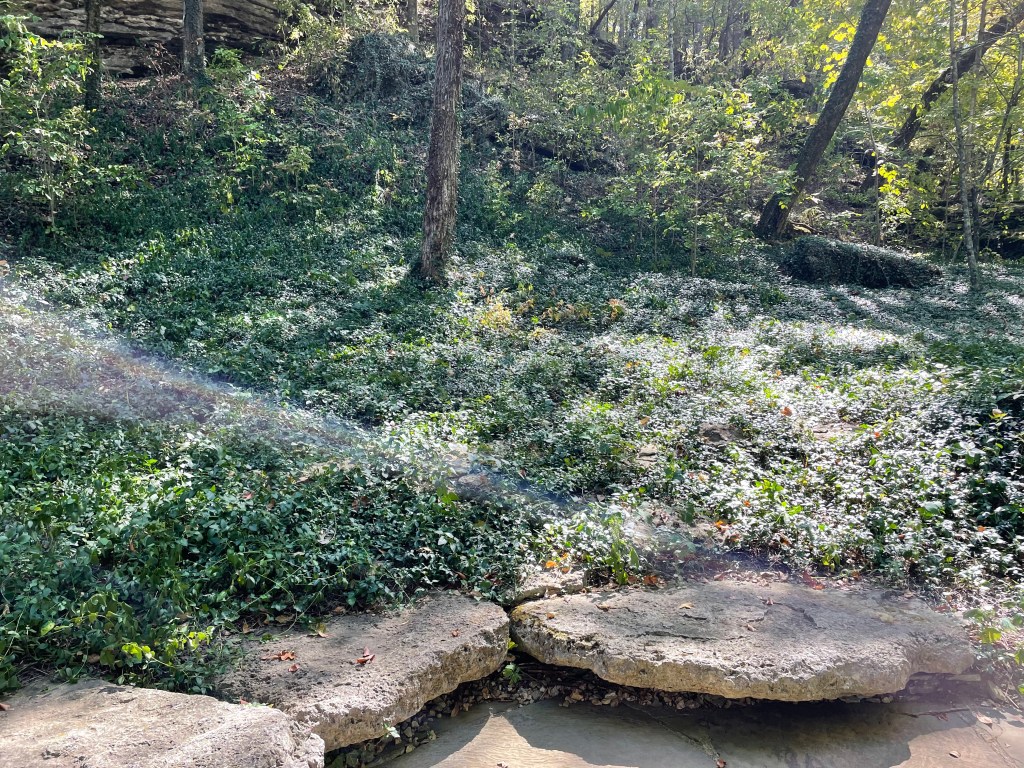
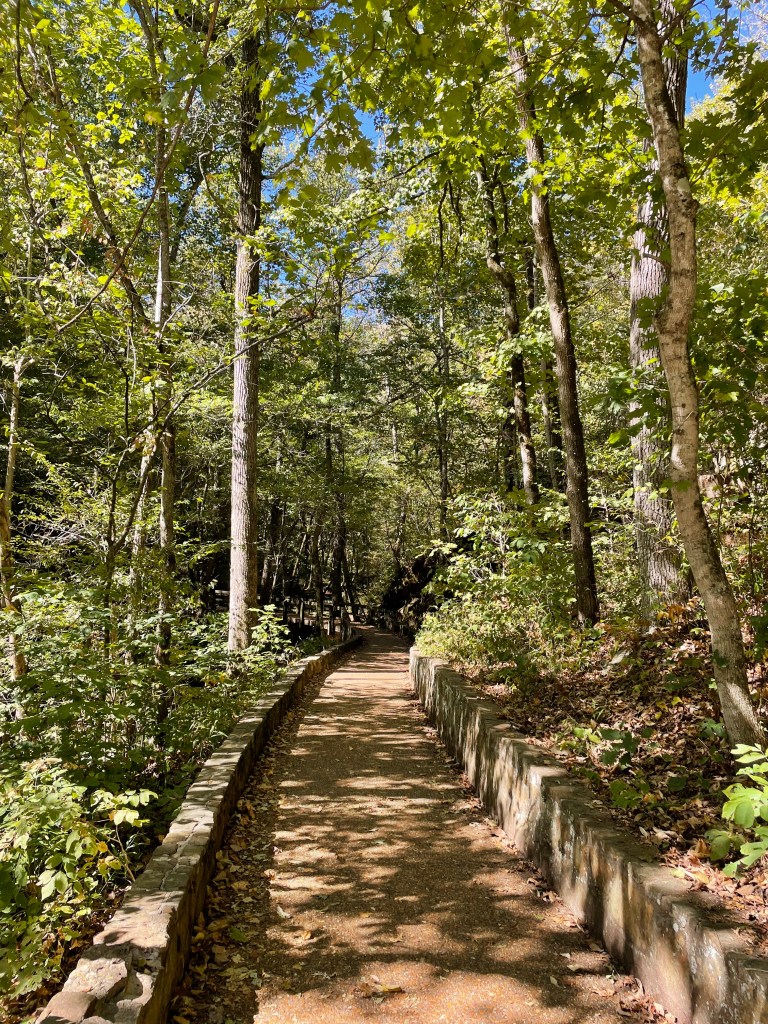
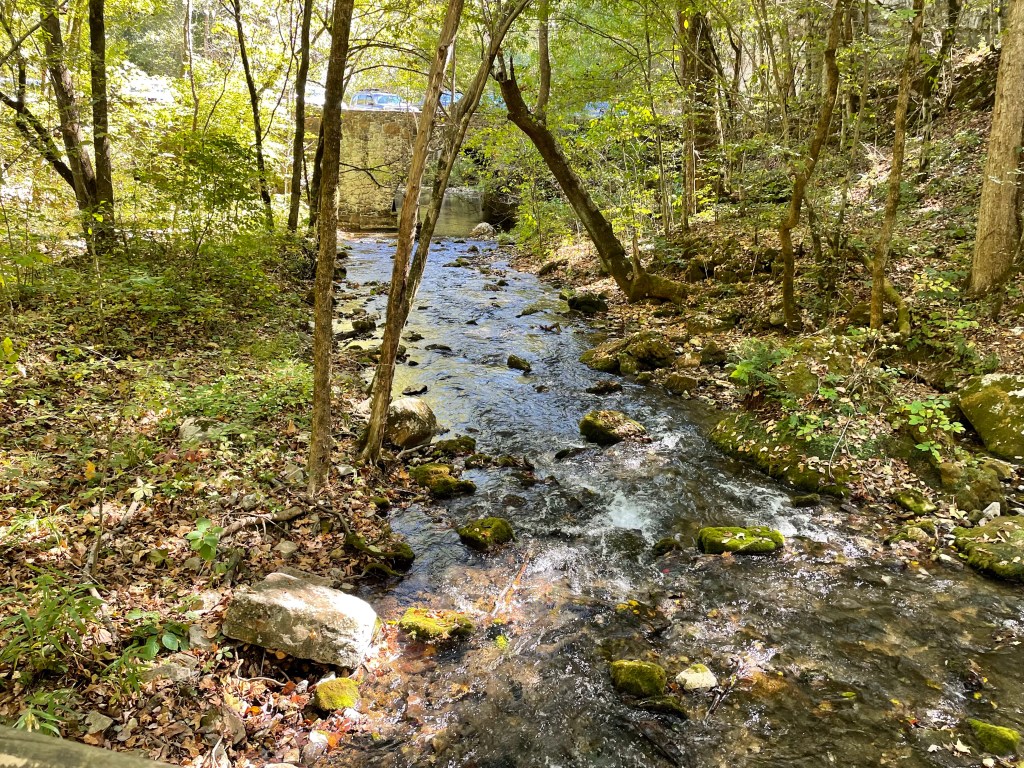
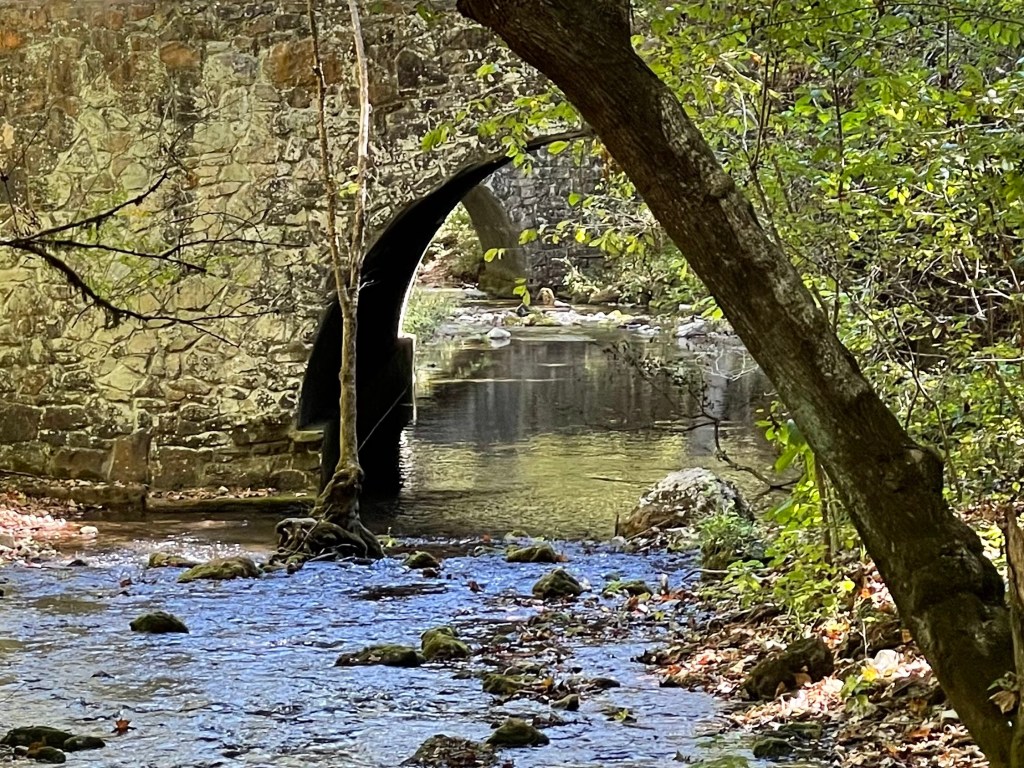
After the cave tour we drove a mile to see the springs. This is where the water from the caves flows out and forms a creek…
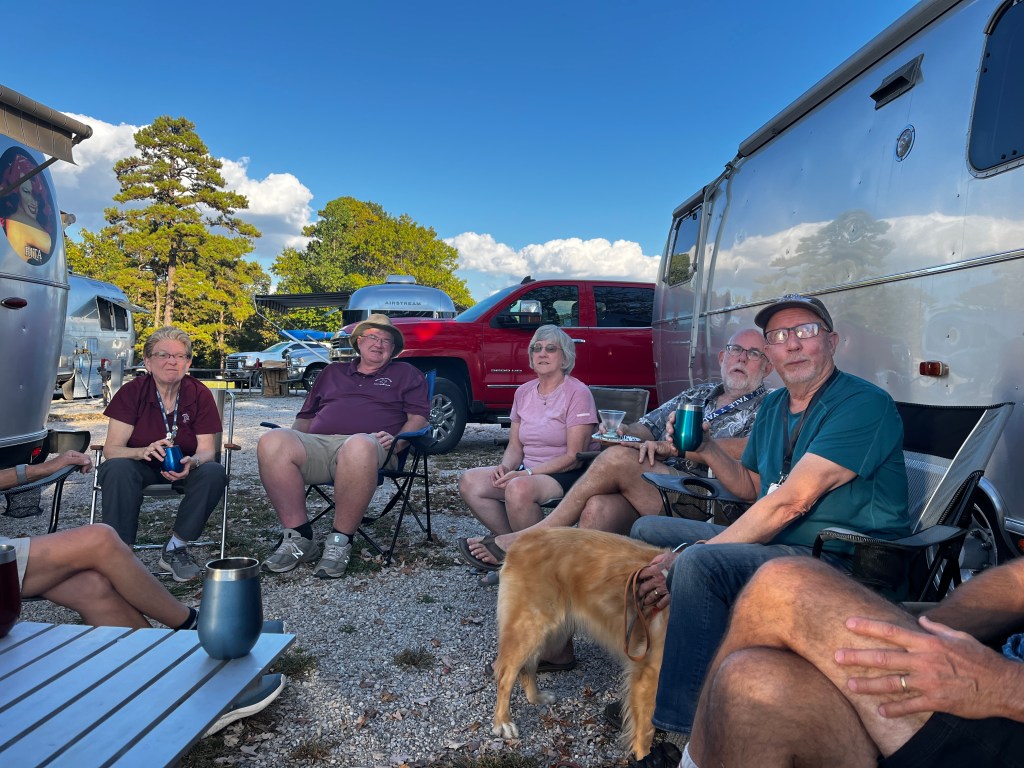
We returned to the Villa and had a relaxing evening. We did have an opportunity to invite a few other caravaners over to share happy hours. And an enjoyable time was had by all…
There will be 24 rigs in the caravan. In case you are wondering, no, we don’t travel down the road all together… Maybe two-three rigs together, maximum. Typically Lynda and I travel by ourselves.
We will be exploring northern Arkansas and southern Missouri. Our itinerary is as follows:
Mountainview, AR; Cotter, AR; Eureka Springs, AR; Bella Vista and Bentonville, AR; Branson, MO; Mountain Grove, MO; Mountain View, MO.
Never heard of some of these places? Neither have we… (In 2019, we did visit Eureka Springs, Bella Vista, and Bentonville…)
We received our “Drivers Manuals” – a three ring binder containing everything we need to know about the entire caravan.
At dinner time we trekked about 1/4 mile to “The Skillet” restaurant, part of the Ozarks Folk Center, adjacent to our RV park…
Dinner was a huge buffet of Southern food… Soup, salad, turnip greens, chicken and dumplings, fried okra, fried chicken, meat loaf, and blackberry cobbler. The soup and cobbler were good…
The Mayor of Mountainview greeted us…
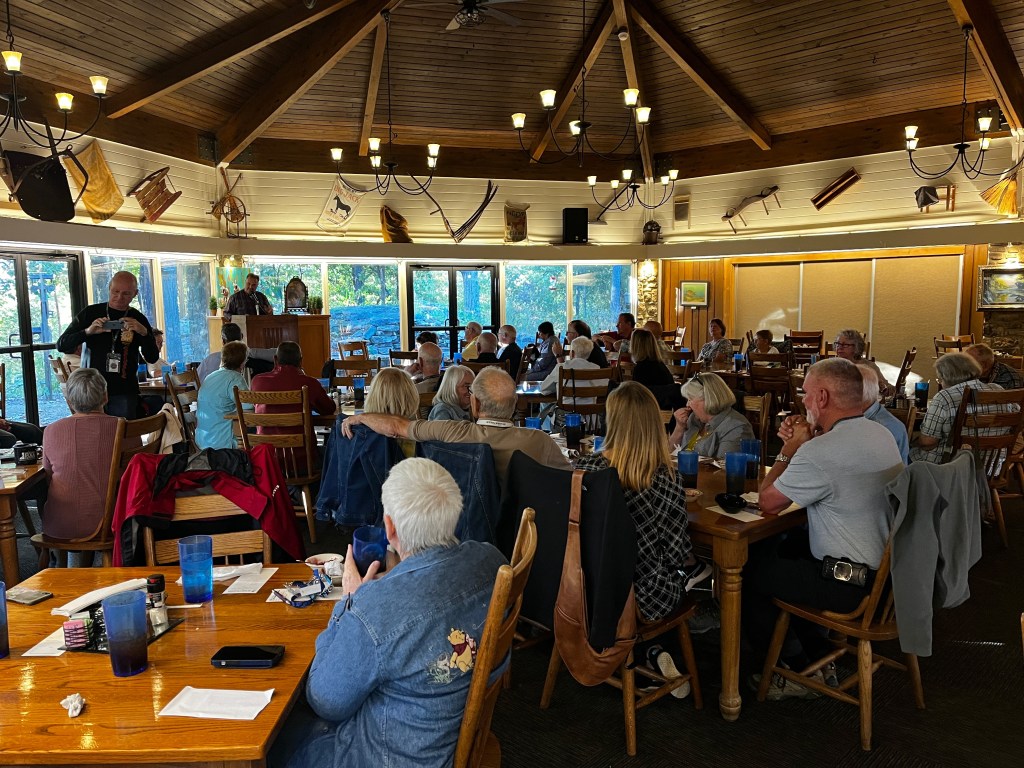
After dinner we walked back to the RV park, then we met again to review the drivers manual, job assignments, and other logistical things…
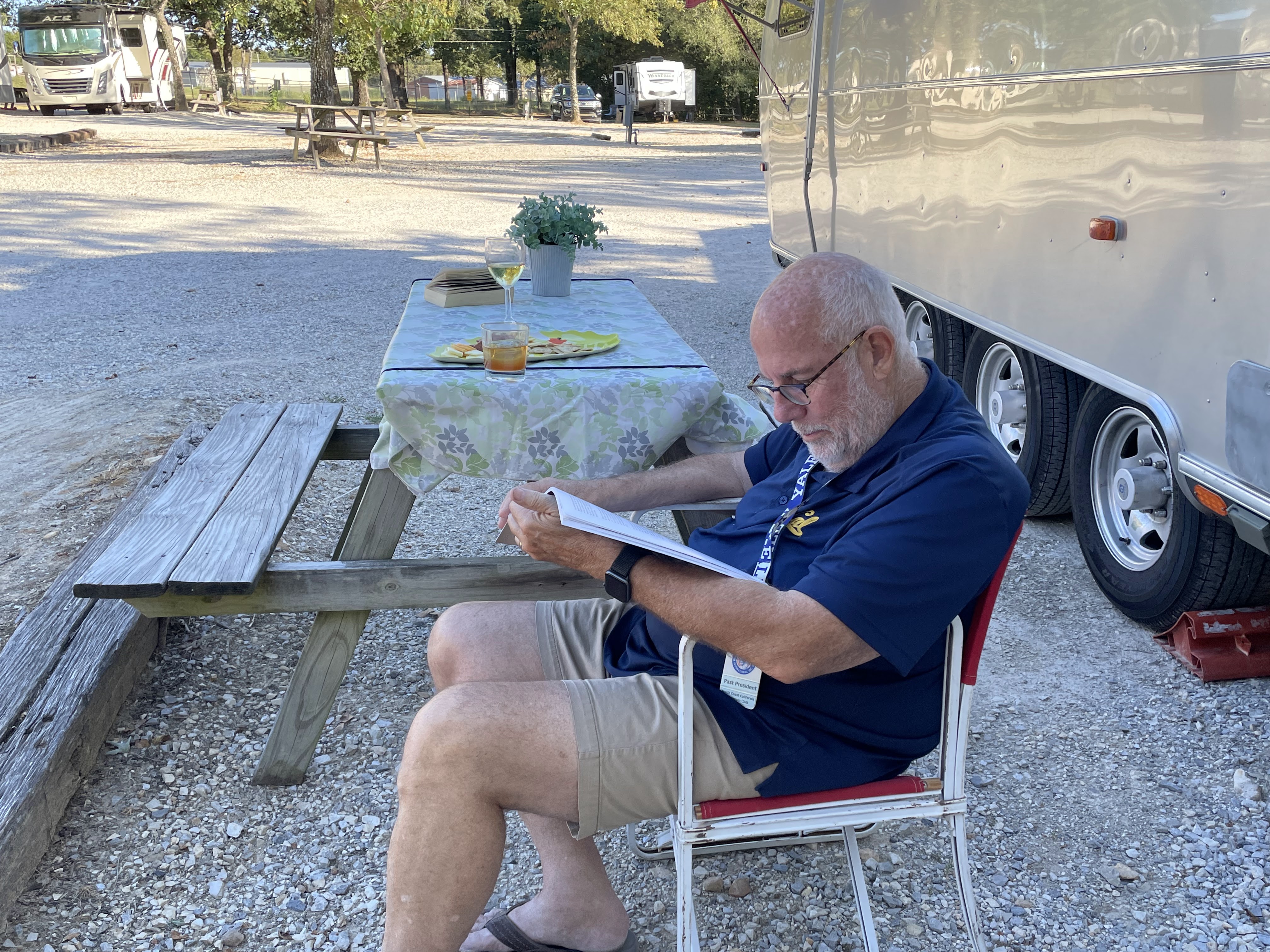
We returned to the Villa, drank the wine we had forgotten to bring to dinner, and turned in early…
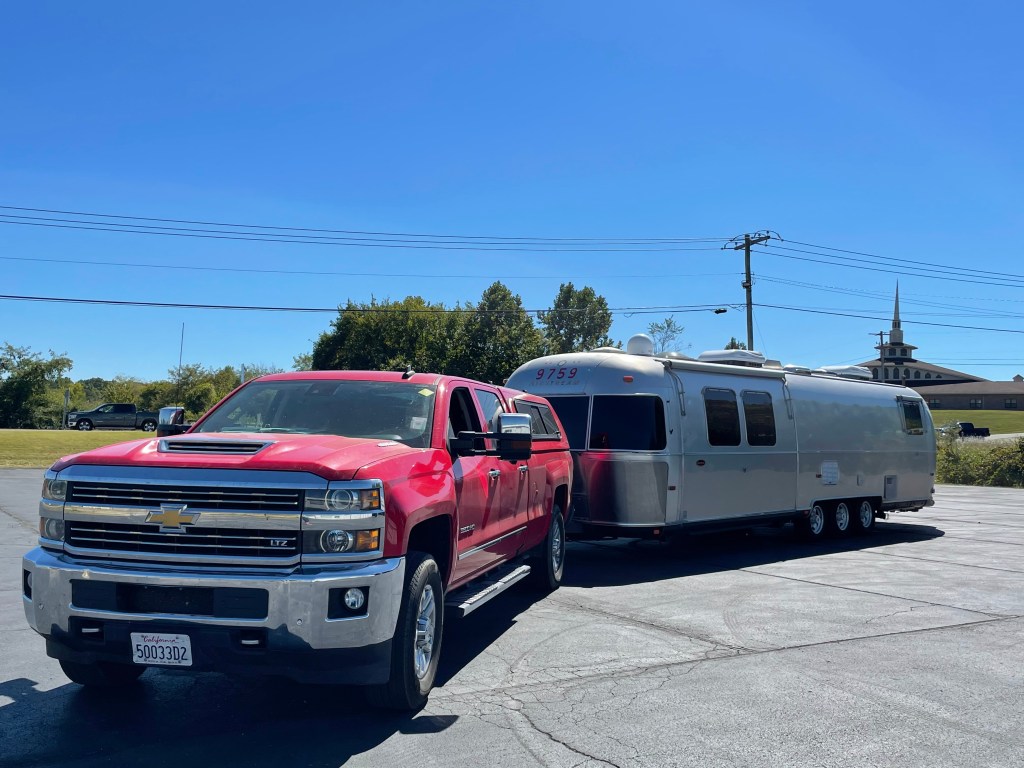
We hitched up and left Eureka, MO today. We are heading out to Mountainview, AR to the rendezvous spot for the caravan.
We drove about 50 miles along the interstate, then we topped off fuel in Rolla, MO. We left the interstate and said goodbye to civilization…
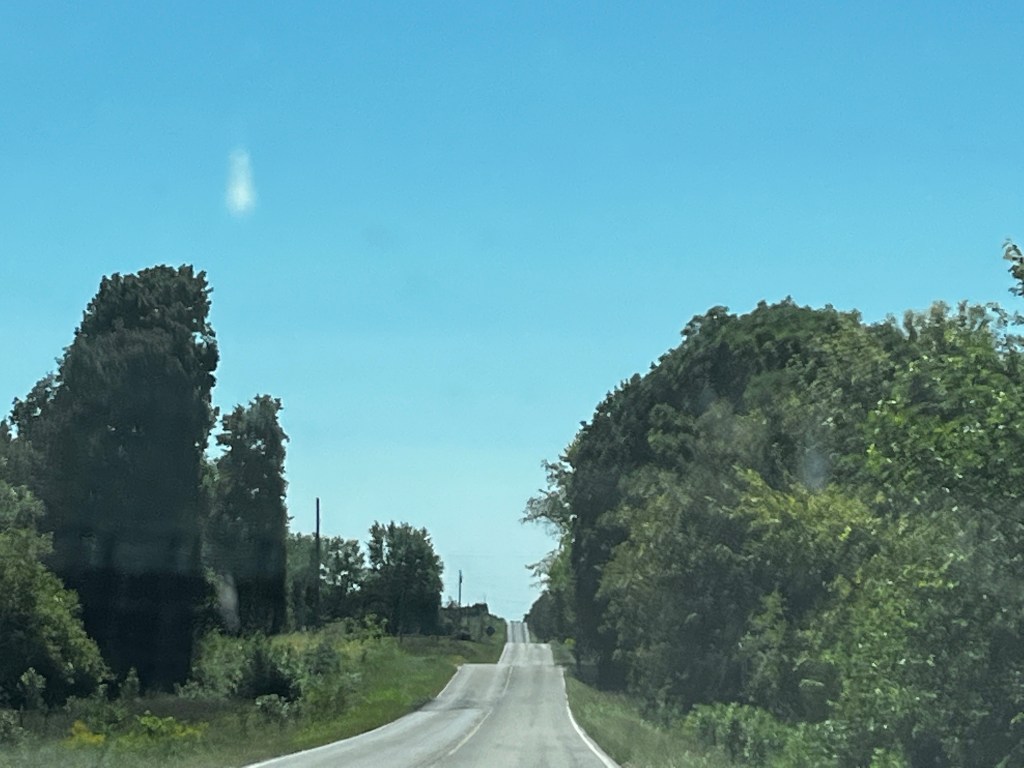
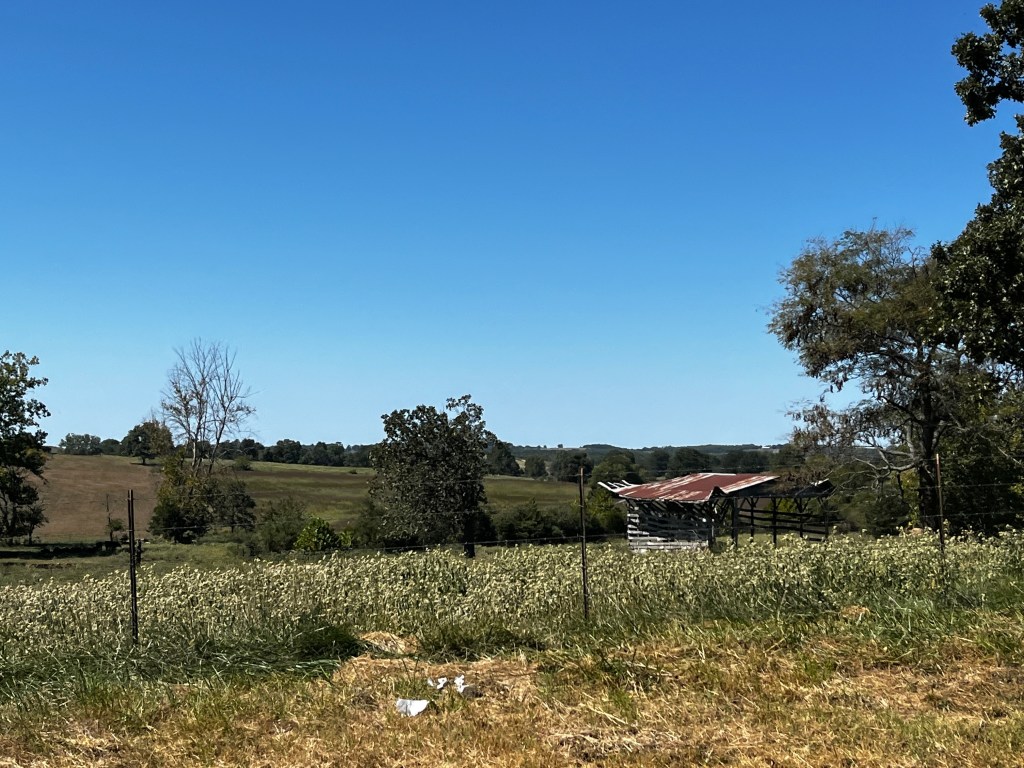
This is Missouri…
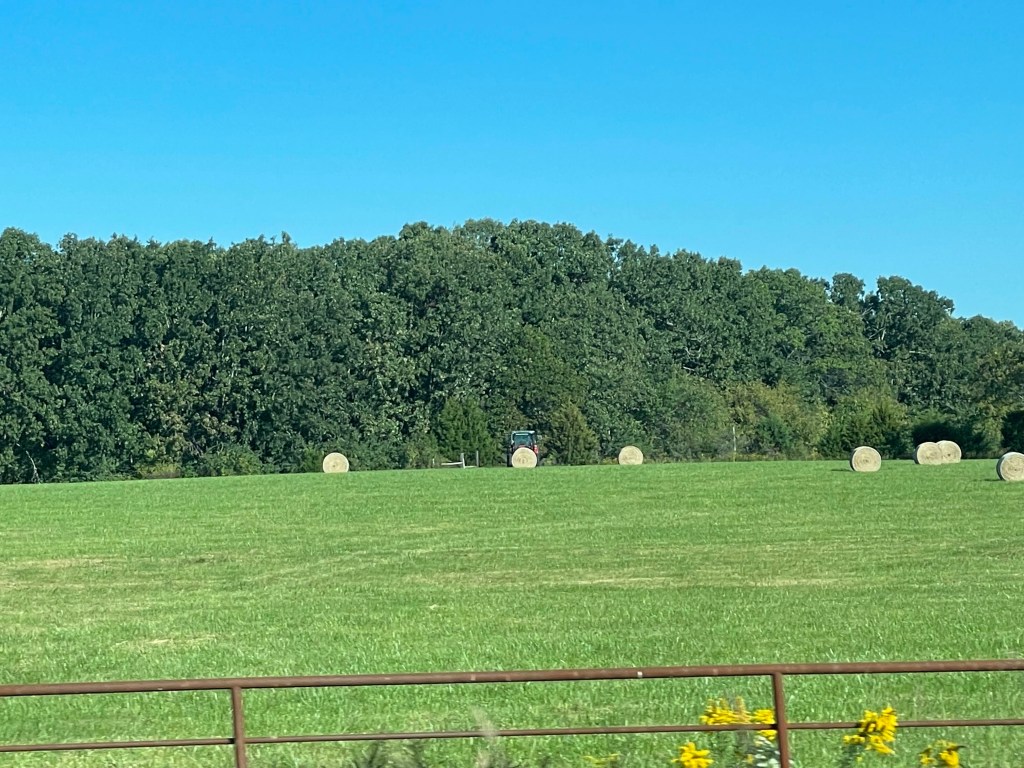
We no longer saw vast field of corn; here was more general farming and lots of rolling hills…
This is Willow Springs, MO, about halfway to the border…
We moved on…
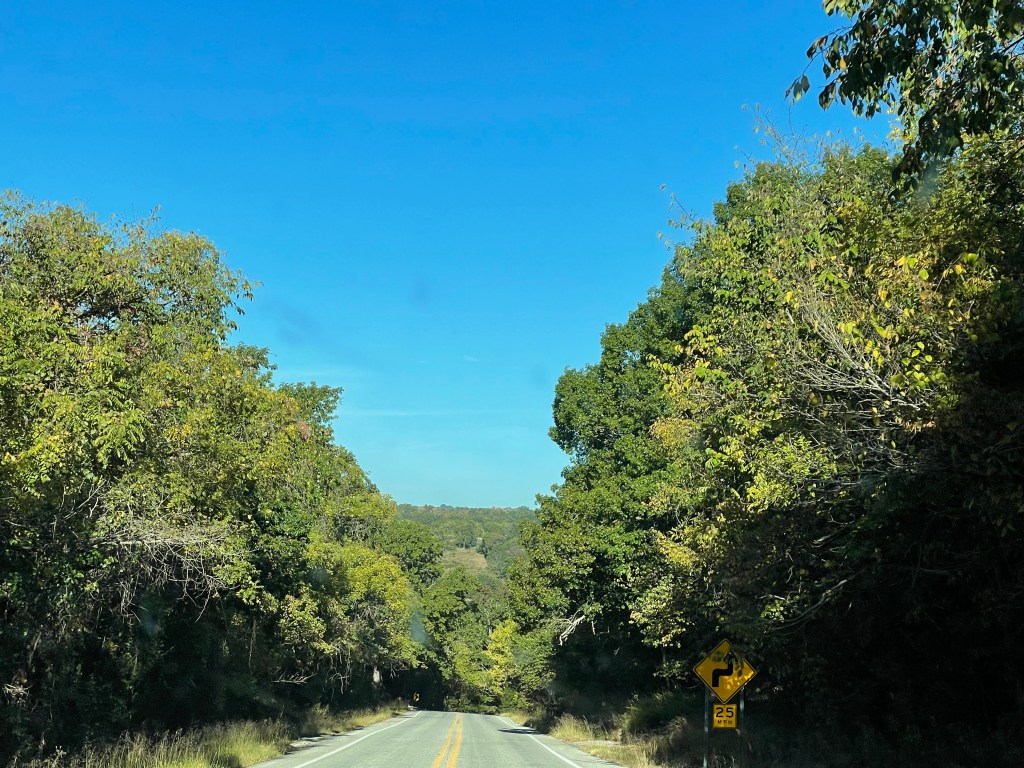
These roads are all marked 55 mph, but the entire way is all curves, uphill, and downhill. The entire way is signed as SLOW – 25 mph, 35 mph, 45 mph for the curves, so there is no way you can go 55 mph…
The Ozarks, also known as the Ozark Mountains or Ozark Plateau, is a physiographic region in the states of Missouri, Arkansas, Oklahoma and the extreme southeastern corner of Kansas. The Ozarks cover a significant portion of northern Arkansas and most of the southern half of Missouri, extending from Interstate 40 in central Arkansas to Interstate 70 in central Missouri.
There are two mountain ranges in the Ozarks: the Boston Mountains of Arkansas and the St. Francois Mountains of Missouri. Buffalo Lookout, the highest point in the Ozarks, is located in the Boston Mountains. Geologically, the area is a broad dome with the exposed core in the ancient St. Francois Mountains. The Ozarks cover nearly 47,000 square miles (120,000 km2), making it the most extensive highland region between the Appalachians and Rockies. Together with the Ouachita Mountains, the area is known as the U.S. Interior Highlands.
The Salem Plateau, named after Salem, Missouri, makes up the largest geologic area of the Ozarks. The second largest is the Springfield Plateau, named after Springfield, Missouri, nicknamed the “Queen City of the Ozarks”. On the northern Ozark border are the cities of St. Louis and Columbia, Missouri. Significant Ozark cities in Arkansas include Fayetteville, Bentonville, Springdale, Eureka Springs, and Fort Smith. Branson, just north of the Arkansas–Missouri border, is a tourist destination and popularizer of Ozark culture.
As we drove south we finally crossed over into Arkansas…
This is Arkansas – the countryside is not much different than southern Missouri…
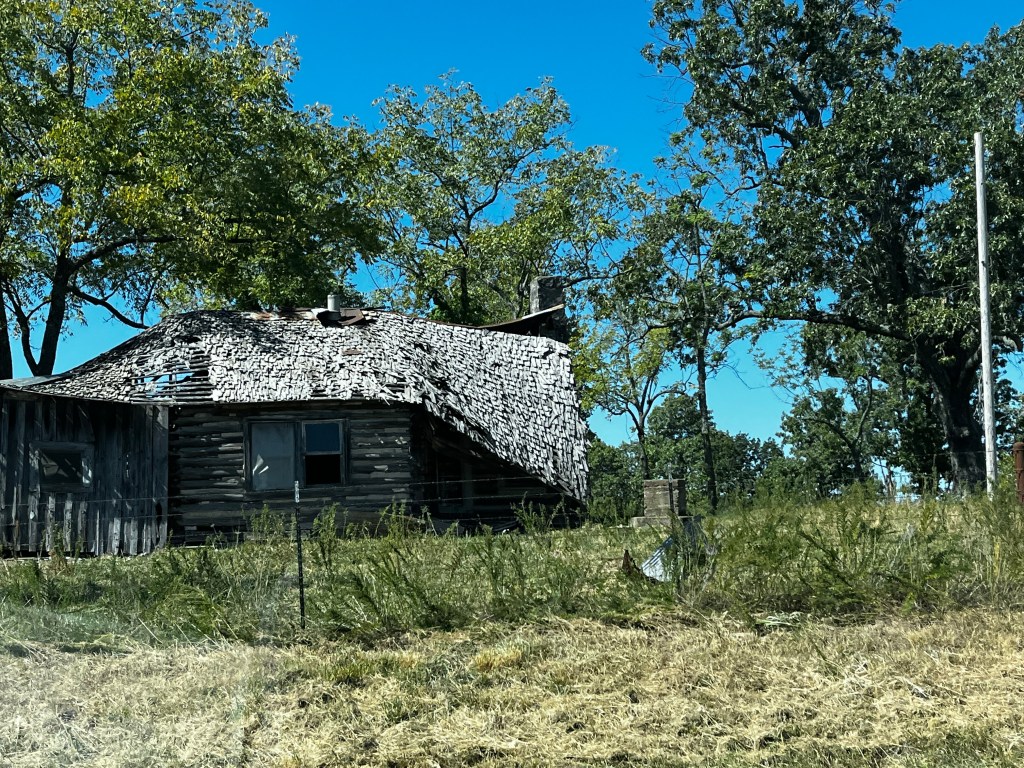
Some fixer-upper real estate is sometimes available…
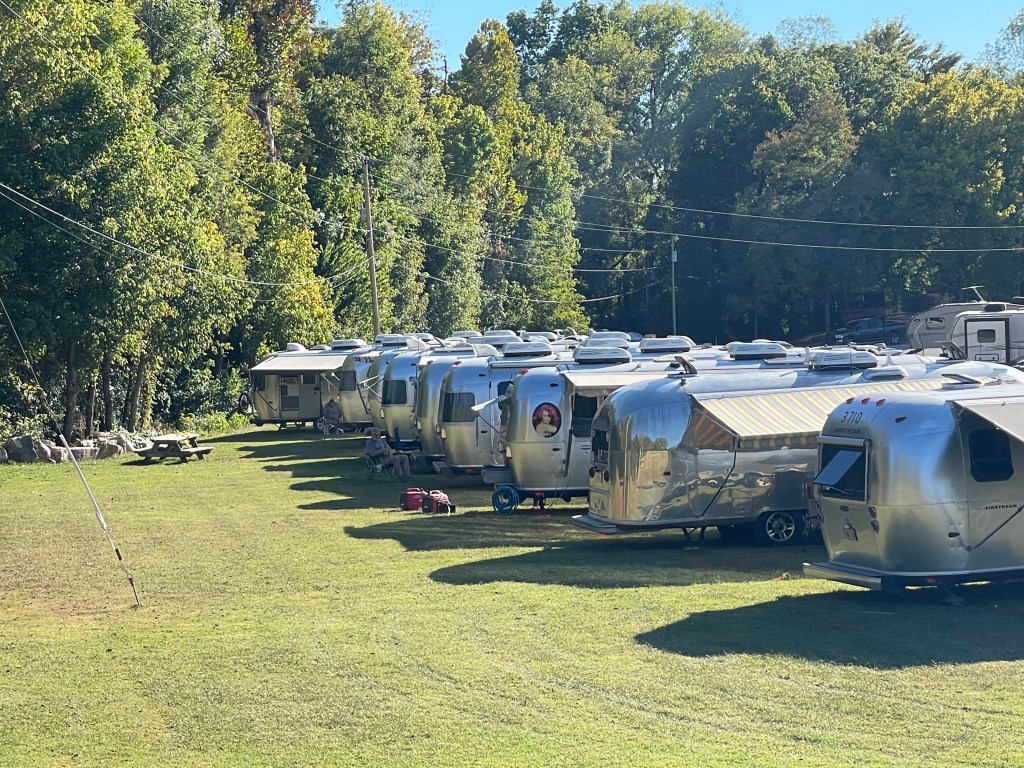
We arrived at the Ozarks RV Park in Mountainview… Three other Airstreamers were already here – these are our leaders, co-leaders, and a friend who came in early to help out…
We set up the Villa, and met our new friends; soon we all headed out together to go to dinner. At 4:30! We went to The Wing Shack and Cheeseburger Grill, one of the finer attractions in town…




















































 Adventures in the Villa
