Search

Adventures in the Villa

Category

Architecture

2019-04-16 – Airstream Caravan Travels – Tallahassee, FL to Chattahoochee Hills, GA…

We left Tallahassee in the morning and headed north.  it wasn’t long before we were in Georgia; we pulled in to the Visitor Center for a brief stop…

img_2011

img_2043

We continued on.  For about 4 hours Georgia looked like this…

img_7848

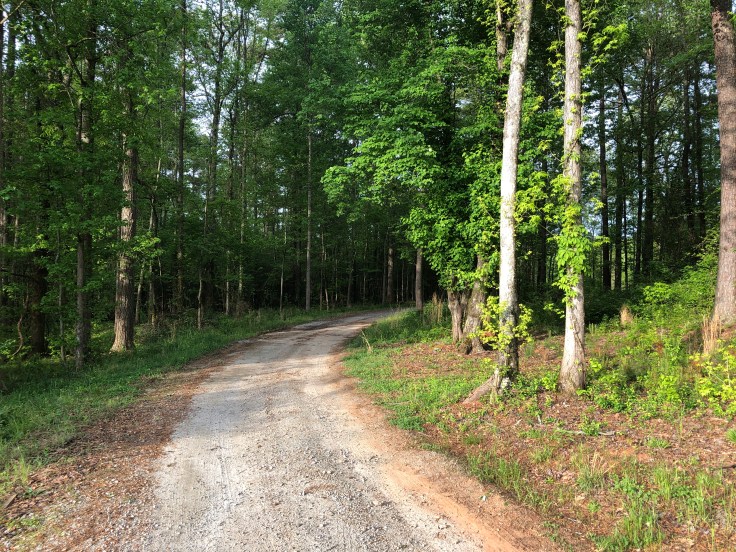
We arrived at Chattahoochee Hills by mid afternoon.  We drove down this dirt road…

img_2034

We ignored the Private Driveway signs and proceeded in, hoping we were in the right place and that we wouldn’t find a dead end…

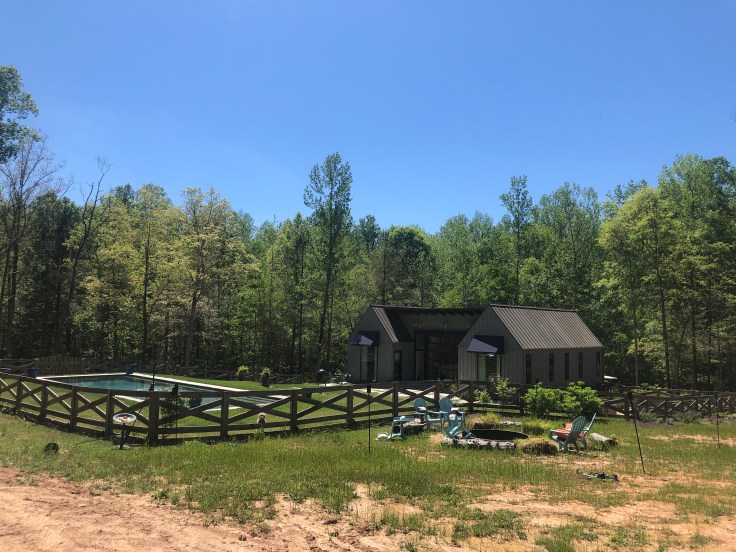
But it was OK – we arrived at this large clearing with a lovely house and pool…

img_2015

img_2014

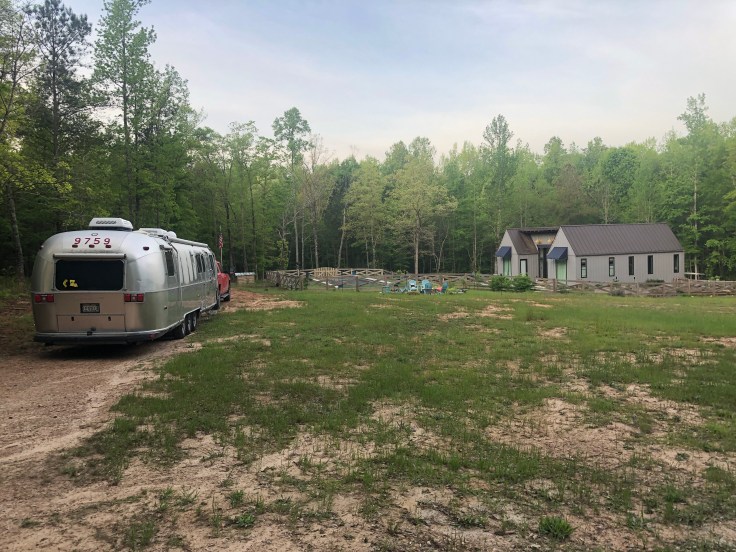
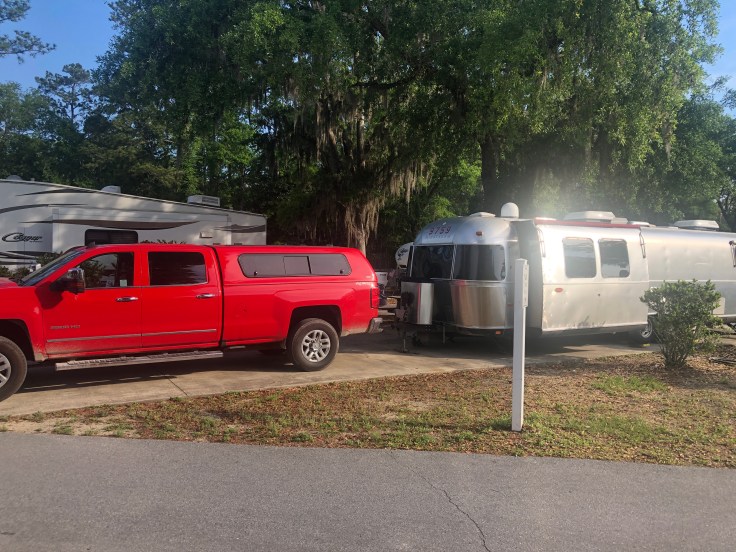
We parked the Villa off to the side and called our friends, who live nearby…

img_2028

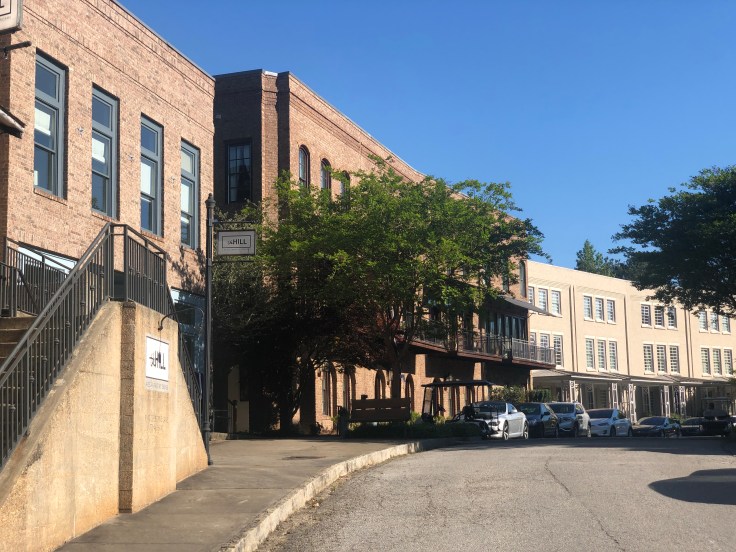
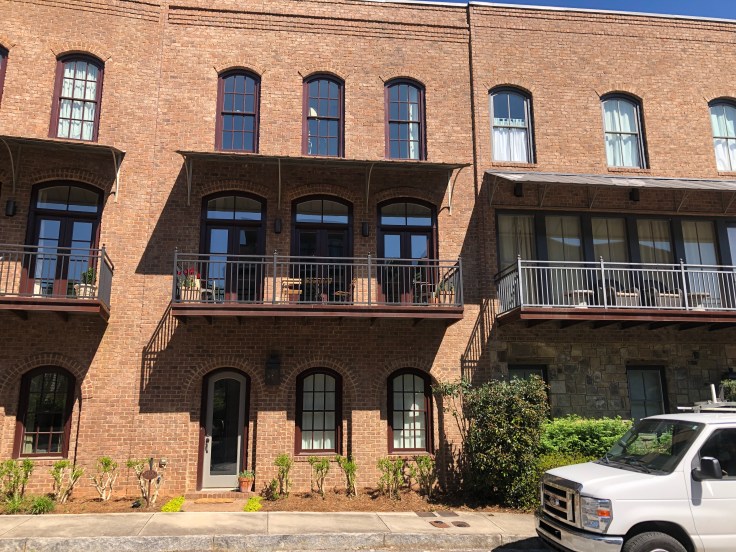
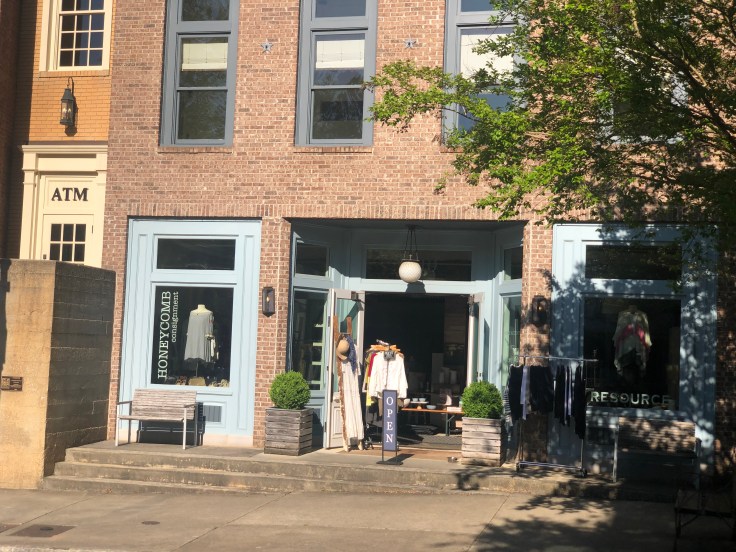
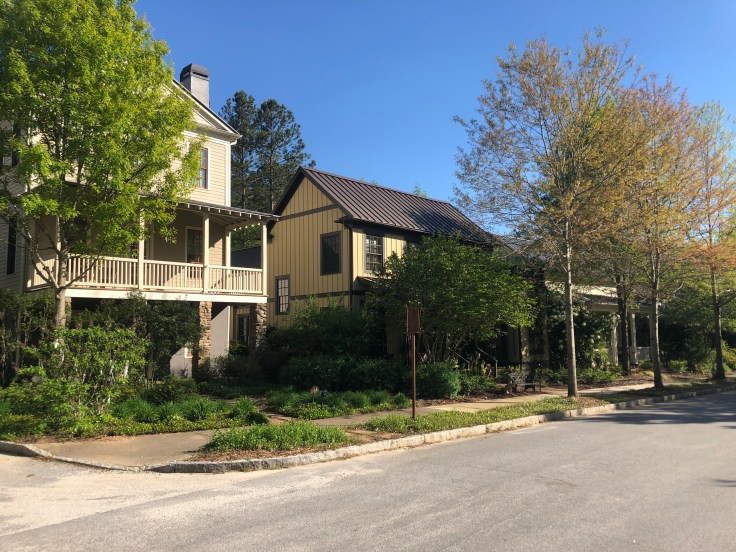
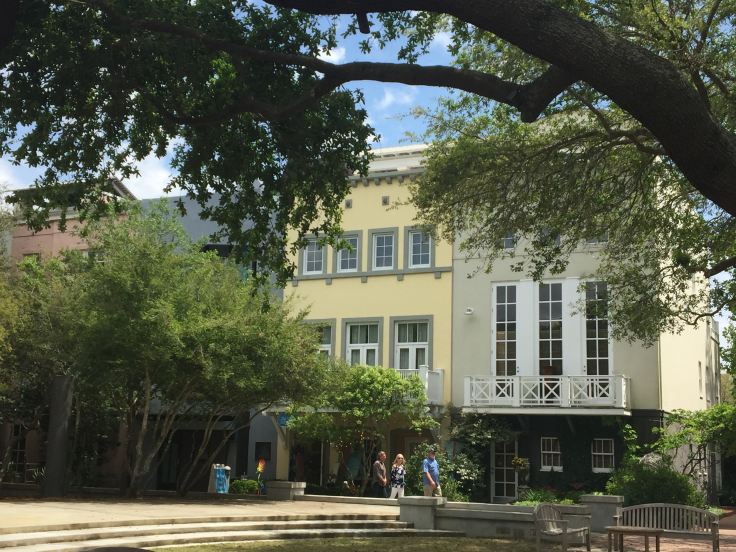
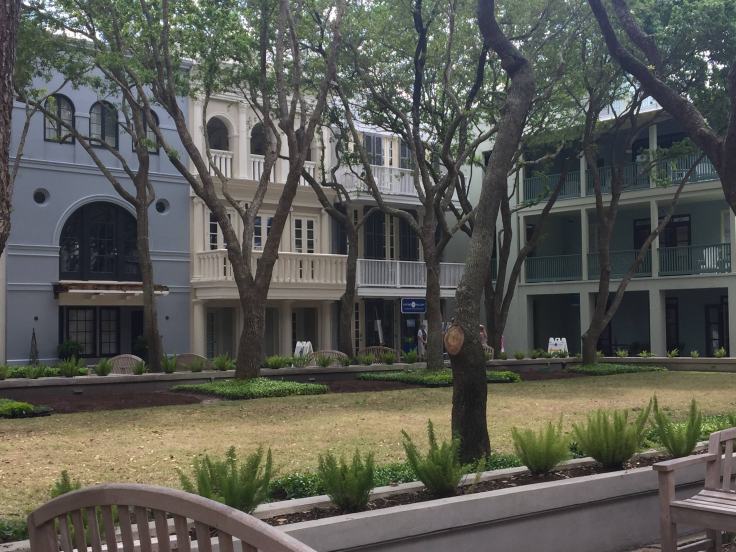
Our friends arrived and we walked about 1/2 mile to the village of Serenbe, more specifically, the hamlet of Selborne…

img_2023img_2016img_2024img_2026img_2025img_2027

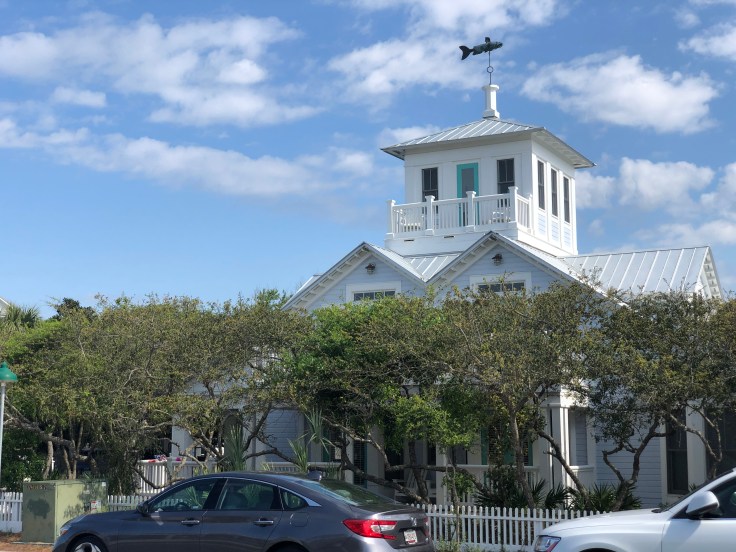
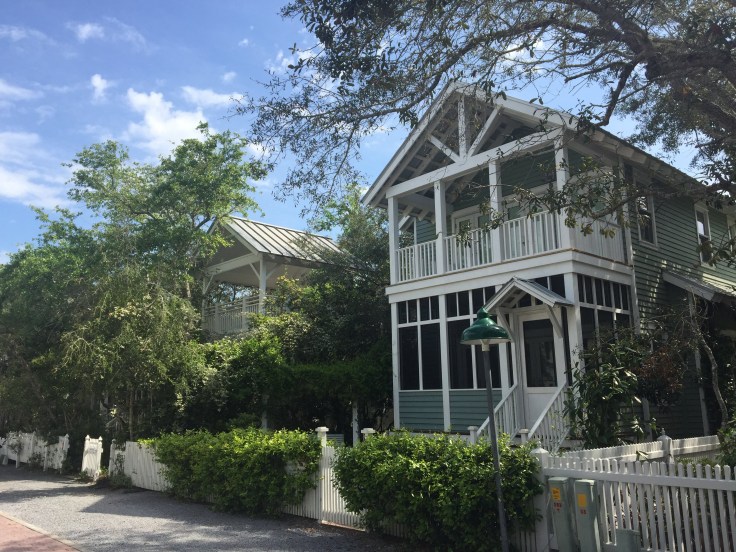
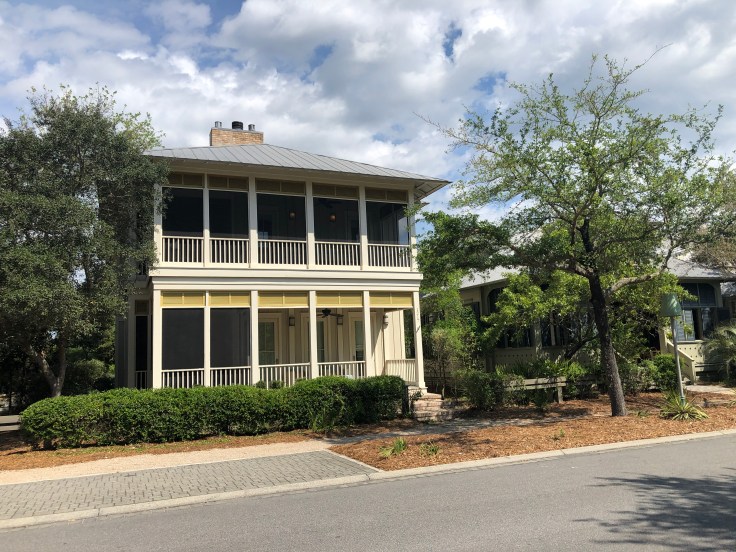
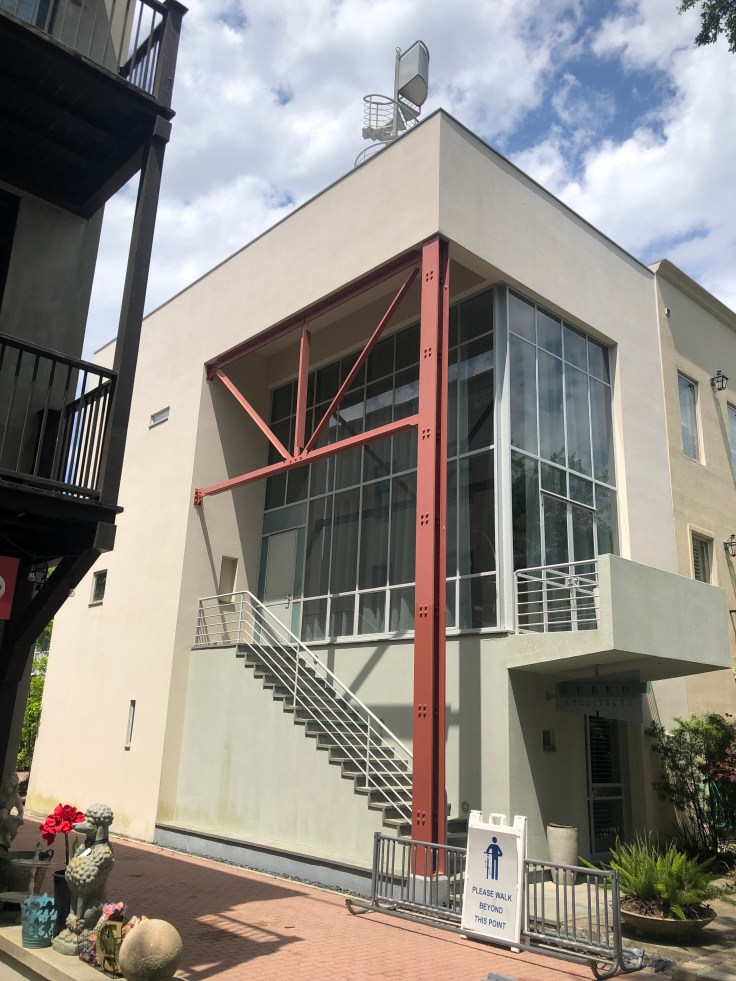
Serenbe was designed and developed along the lines of Neo-Traditional Town Planning similar to Seaside.  Unlike Seaside, which is a holiday town, by the sea, Serenbe is a place meant for full-time living, on the outskirts of Atlanta.  While Seaside is relatively dense and compact, all on 80 acres, Serenbe is hundreds of acres, with four hamlets separated by rolling open space.

It was delightful.

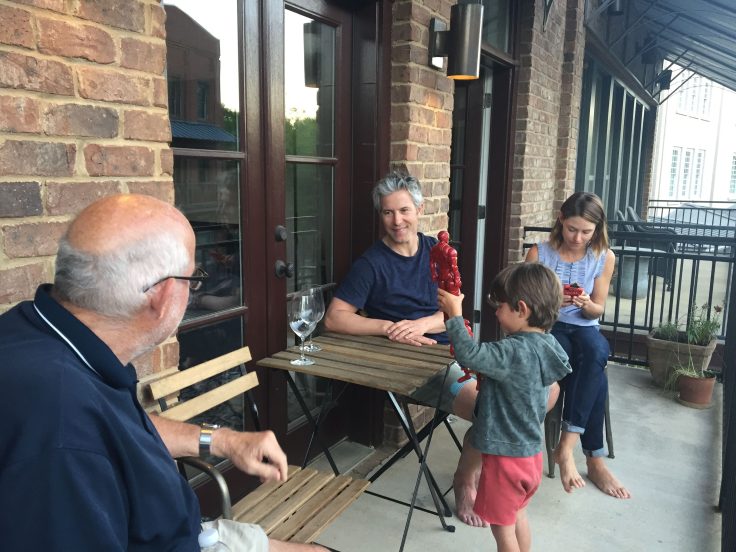
We met up with our friends and hung out at the pool for awhile.  Dinner and wine was consumed, and we ended the day on the balcony, overlooking the streets below…

img_2018img_7854

We were transported back to the Villa on their golf cart…

And an enjoyable time was had by all…

2019-04-13 – Airstream Caravan Travels – Seaside, FL, and a shocking discovery…!

We spent the day in Seaside, FL.    WARNING:  Architectural rantings and discussions approaching!!!

img_1924

Seaside is an unincorporated master-planned community on the western Florida panhandle.  One of the first communities in America designed on the principles of New Urbanism, ot Neo-Traditional Town Planning, the town has become the topic of slide lectures in architectural schools and in housing-industry magazines world-wide, and is visited by design professionals (like me…) from all over.  

The idea behind Seaside came in 1946, when the grandfather of future founder Robert S. Davis bought 80 acres of land along the shore of Northwest Florida as a summer retreat for his family.  In 1978 Davis inherited the parcel from his grandfather, and aimed to transform it into an old-fashioned beach town, with traditional wood-framed cottages typical of the Florida Panhandle.  Davis, his wife Daryl, and architectural partners Andrés Duany and Elizabeth Plater-Zyberk of Duany Plater-Zyberk & Company did painstakingly detailed research; they toured the south, studying small towns, armed with cameras, sketch pads, and tape measures; this became the basic for the planning of Seaside.  While a few houses were built in 1982 to “test the waters”, the final master plan was complete around 1985.

The developers used the master plan to write their own zoning codes.  Seaside’s commercial hub is located at the town center.  The streets are designed in a radiating street pattern with pedestrian alleys and open spaces located throughout the town.  There is a mix of uses and residential types throughout the community.

Individual housing units in Seaside are required to be different from other buildings, with designs ranging from styles such as Victorian, Neoclassical, Modern, Postmodern, and Deconstructivism.  Seaside includes buildings by many different architects, including such notables as Robert A. M. Stern, Daniel Solomon, and Samuel Mockbee.  Architect Scott Merrill designed the Seaside Chapel, an interfaith chapel and local landmark.  Seaside has no private front lawns, and only native plants are used in front yards.  The picket fences, required to be in front of all houses are all different from each other…

The result of all this work and planning is a remarkable little community.  Streets are designed first for pedestrians, and secondarily for automobiles.   We walked for hours, and every time we turned the corner a new delight was seen.

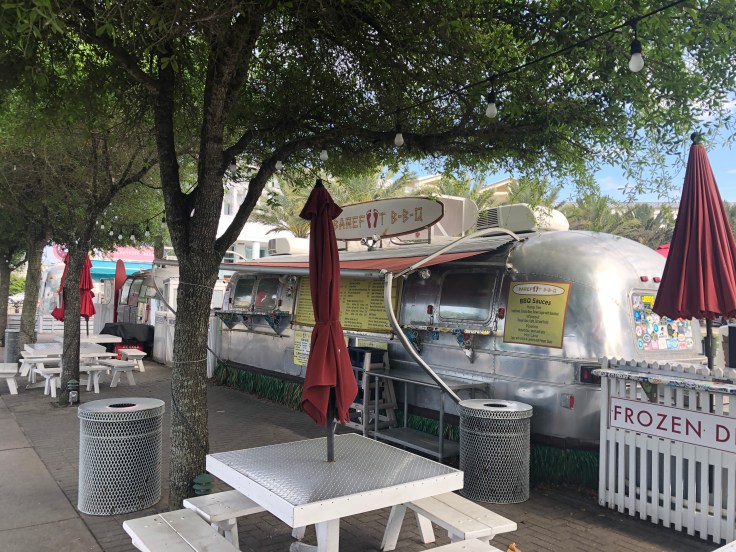
We arrived at about 9:00 on a Saturday morning.  The farmers’ market was in full swing; we stopped by one of the many Airstream “Food Trucks” for a breakfast crepe and coffee…

img_1901img_1902img_1913

We then headed out for a stroll along the beach.  There are seven access points to the beach, each one with a tower-type structure to mark its presence, each tower designed by a different architect.  This tower and stair is the ONLY public access to this stretch of beach…

img_1916-1img_1917

Yes, that’s right.  The beach is private, and all the other access points have locked gates.  Not only that, but there is a solid wall of buildings lining the Gulf Coast Highway (30A), so that as you walk or drive along the highway you wouldn’t even know the beach and the gulf are there!  I think Florida could learn a thing or two from other States which treat the beaches and oceans as a public resource to be enjoyed by all…

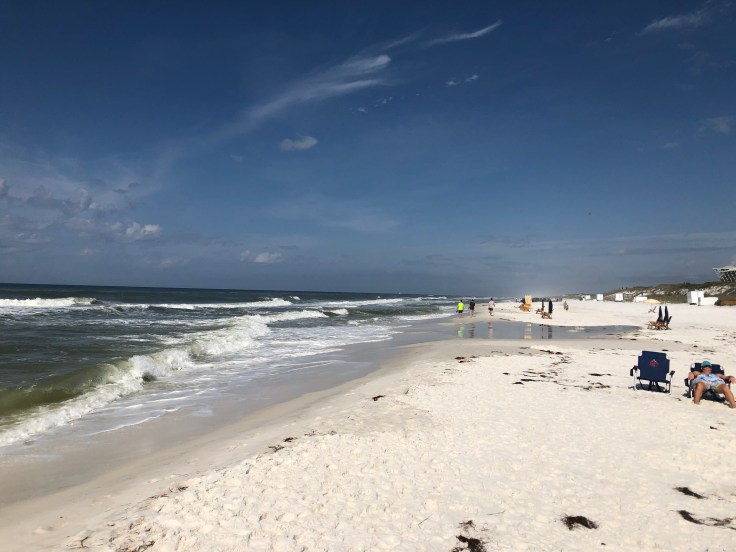
But, in any case, the beach is beautiful, with the same powder sugar sand like we saw in Mississippi…

img_1914img_1915img_1927

img_1928

Lynda tested the waters.  Cooler than what we expected, but warmer than any beach in California… (You did not know that California beaches and the Pacific Ocean there are cold???)

img_1938

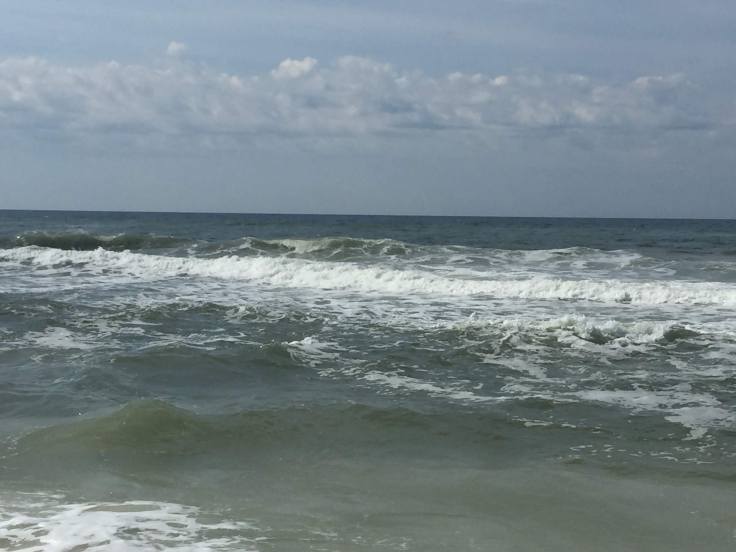
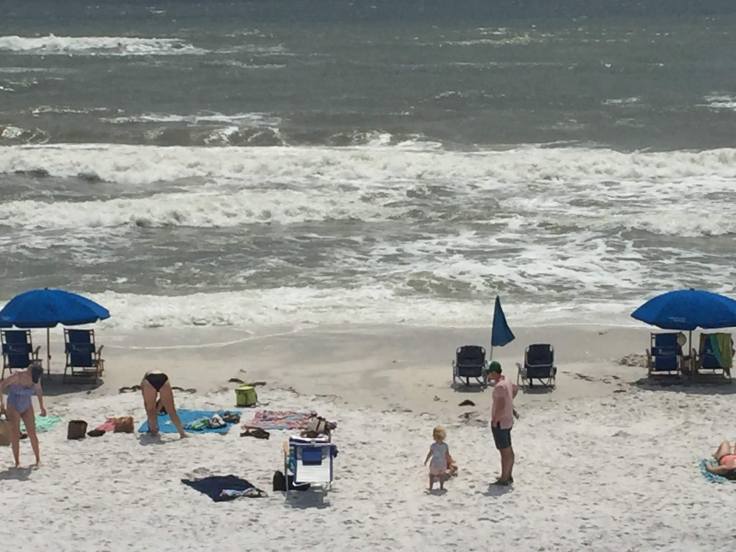
We were also surprised to see the waves, which were non-existent in Mississippi…

img_7801

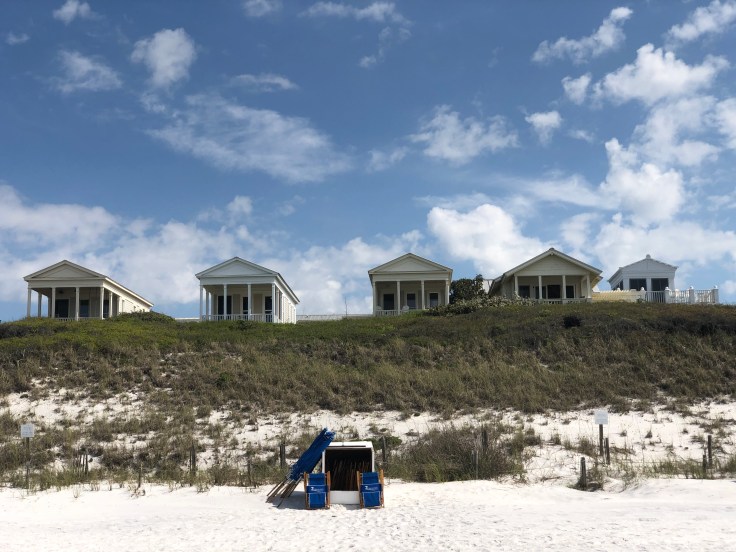
These are some of the houses that block off the beach from the highway…

img_1940img_1941img_1943img_1944img_1945

We had a lovely walk on the beach, but we came here to see the town…

All buildings appear to have the form of this type of vernacular, although there are many different styles of homes…

img_1923img_7804

The streets are delightful…

img_1948img_1949

This tiny house is set back far from its neighbors…

img_1950img_1953

Not all the houses are traditional…


img_1961

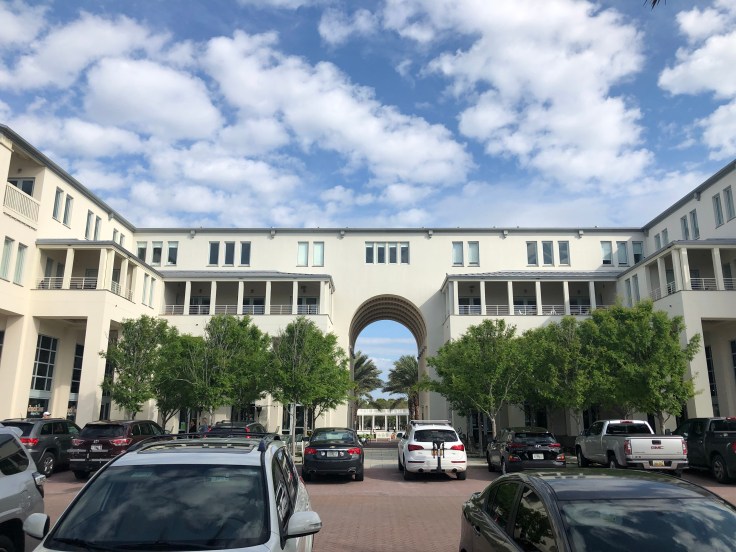
These townhouses surround a courtyard just a short block from the business district, and many have businesses on the ground floor…

img_7807img_7806img_1960

This is the interfaith non-denominational chapel.  We wished our schedule would have allowed us to attend services on Sunday…

img_1963img_1965img_1964

More streets – each one more delightful than the next…

img_1958img_1955

Finally, by mid afternoon, we were ready for a break.  The beach was much busier now, and the patrons of the restaurants were hopping…

img_7814img_7815img_7818img_1967

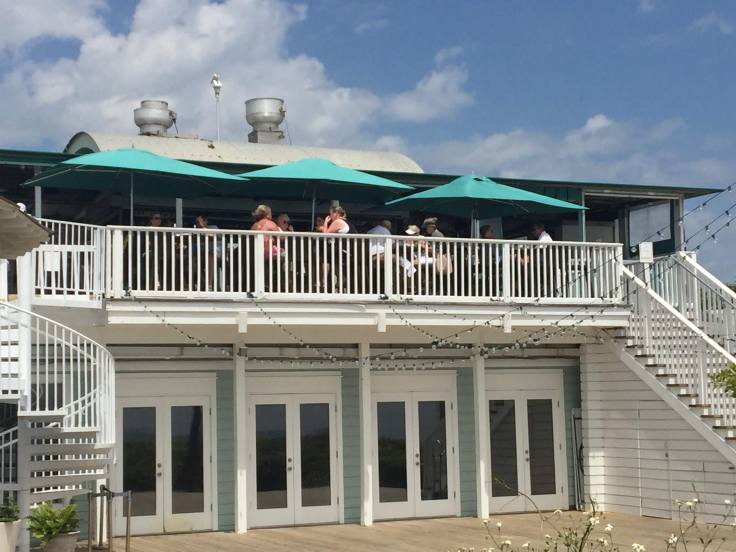
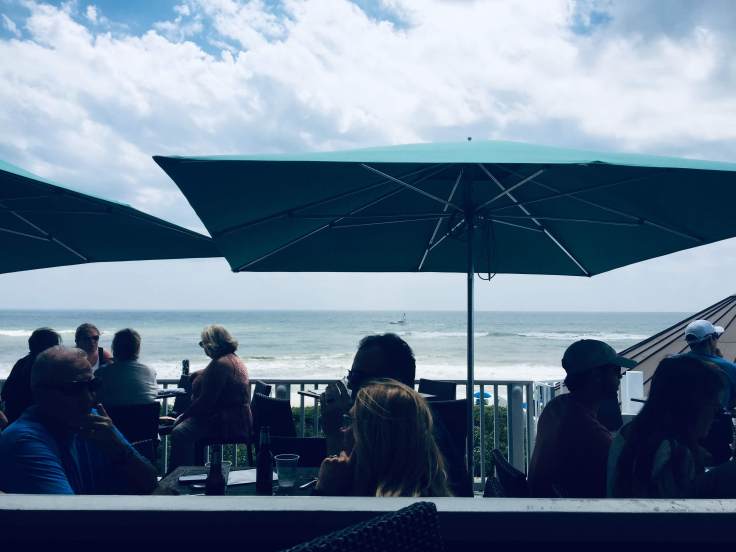
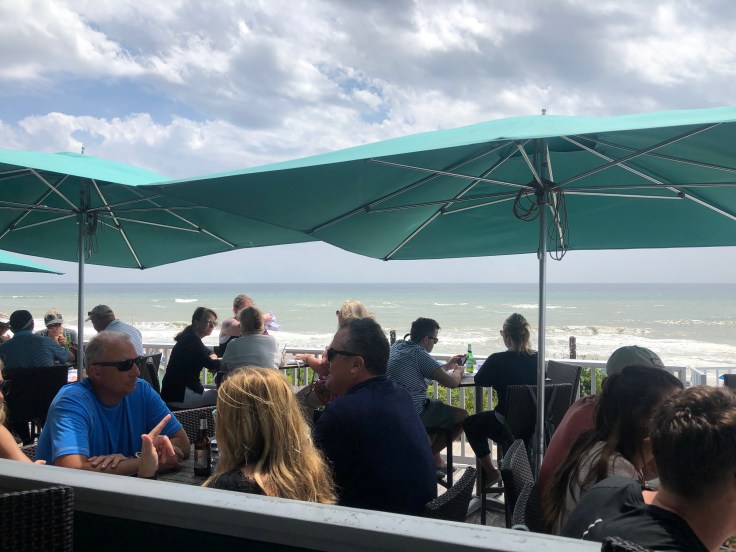
We had a lovely lunch on the terrace overlooking the beach…

We walked around the business district and did some shopping…

img_1905-1

The troubadours were playing adjacent to the farmers’ market…

img_1912

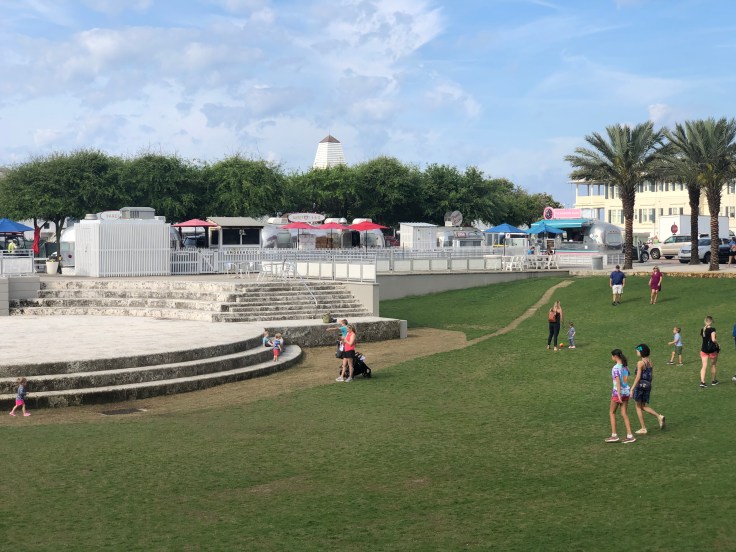
There is this large central park shaped like a amphitheater.  On Friday evenings they show movies on the lawn…

img_1911img_1909img_1908

The farmers’ market…

img_1907img_1910img_1903img_1904

We returned to the Villa.  Happy Hours ensued.

And an enjoyable time was had by all…

2019-04-12 – Airstream Caravan Travels – Four States!

We woke up early in the Villa, in a parking lot in the French Quarter of New Orleans.

We took a walk in the early morning light…

img_1882img_7734

After about one mile we arrived at the famous Cafe Du Monde…

img_1883

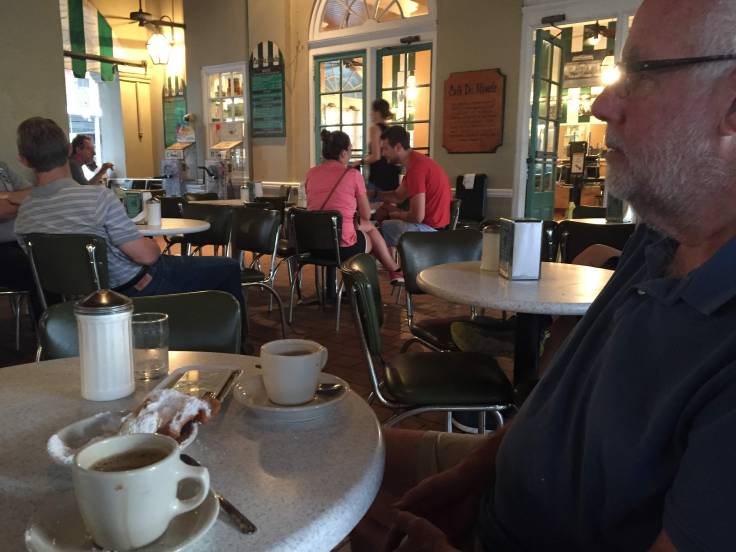
We took a table inside, and ordered Beignets and cafe au laits…  (They are famous for Chicory coffee, but I don’t understand why; chicory is a cheap substitute for coffee that doesn’t taste like coffee nor does it have much caffeine in it.  It is used where people can’t afford coffee, of when coffee supplies are rationed, such as during WWII…  No real coffee drinker would touch the stuff.  Leave it to the South to romanticize and popularize bad food, like chicken fried steak, or grits, or biscuits and near-rancid gravy…)

img_7735

But we had a great time, watching the early birds come in for their coffee and beignets… After scraping about two cups of powdered sugar off the beignets they were quite tasty…

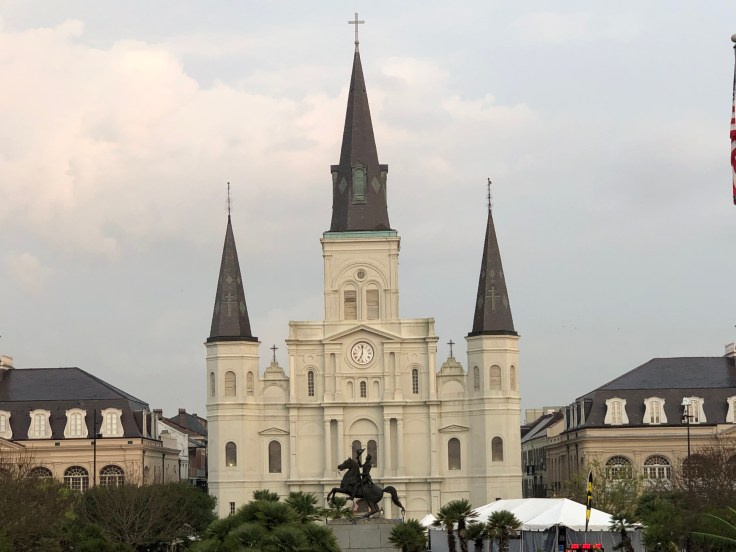
We walked over to get a better picture of the Basillica.  It sort of reminds me of Cinderella’s castle…

img_1884img_1885img_1887

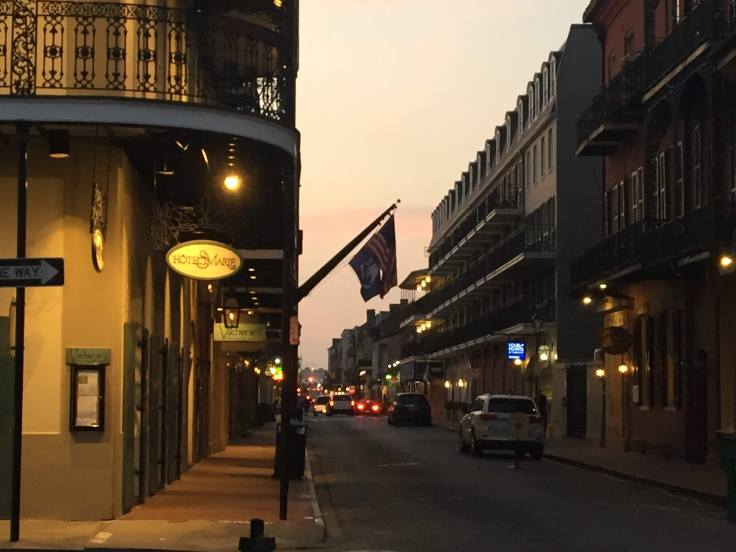
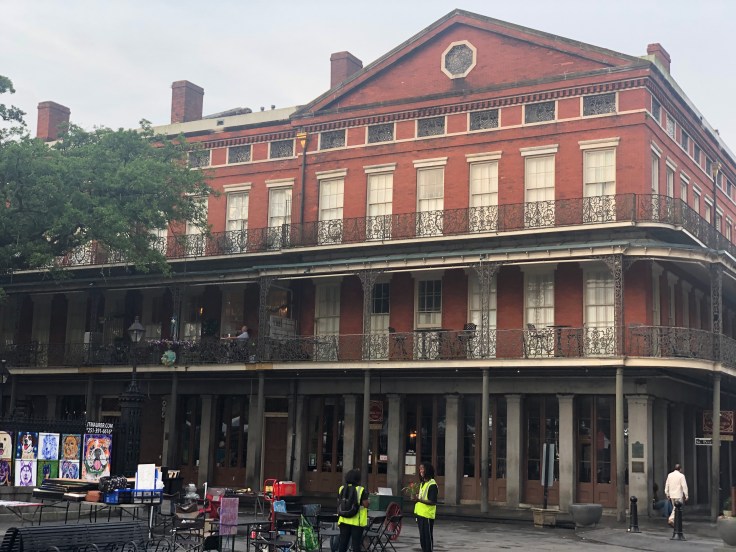
We caught a few more early morning street scenes on our way back to the Villa.  We love early mornings in big cities…!

img_1886img_1889img_1890

We returned to the Villa and prepared for travel.  We headed out, found the 10 freeway, and pointed ourselves east.  It wasn’t long before we arrived at a new State:


img_1891

We pulled into the Visitors Center.  It looked like the inside of your grandmother’s house, with some grandmotherly women offering us coffee and assistance.

img_7741

We asked how to get to the scenic Gulf Coast Highway, and maps were supplied.  We returned to the truck and soon we were on the coast of the Gulf of Mexico…


img_7749

The sand is like powdered sugar – just like what we scraped off our beignets earlier this morning…

img_7750

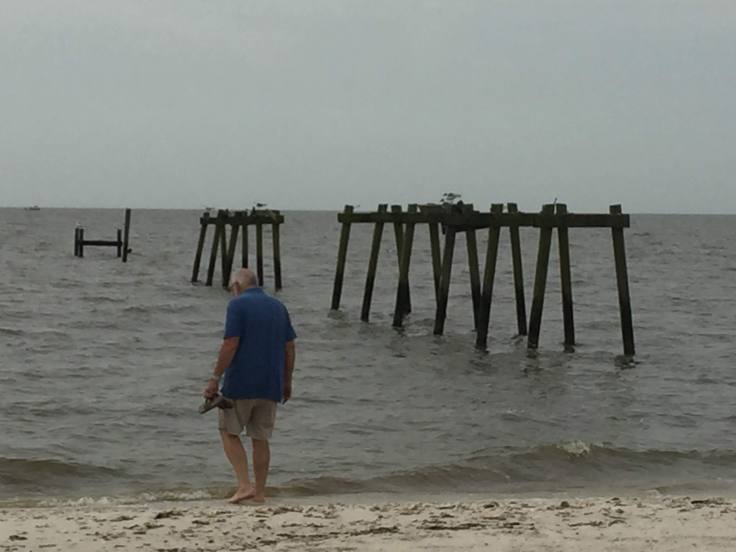
I put my feet into the gulf waters, the first time since I did it in Galveston in 1984.  This time, when I pulled my feet out of the water they were not covered in tar and oil…

img_7751img_7753

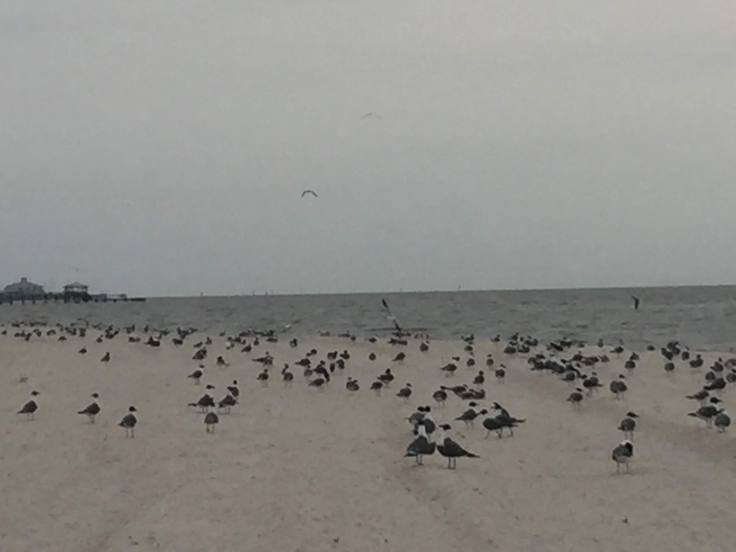
There were thousands of seagulls on the sand.  Probably because there were millions of sea shells on the sand…

img_7754img_7755

img_1892

Other than the seagulls, the beach was deserted.  We don’t see deserted beaches in California at any time, day or night…

Across the street from the sand are these houses, fronting on the highway.  They are built up on stilts to protect from flooding and storm surges…

img_1895

A house under construction – note the brick columns…

img_1899img_7762

We eventually left the coast and drove through several swamps and other wetlands…

img_7769img_7769-1

Soon we arrived at…

img_7773

We stopped in for a minute, and continued on…

Alabama is a lot like Mississippi… until it doesn’t.  Mobile is a big city!


img_7776

Mobile has a tunnel under the bay!

img_7778

And then Alabama looks just like Mississippi again…

img_7780img_7782

We stopped for lunch at a Cracker Barrel.  Our first visit to a Cracker Barrel.  It seems to me that almost everything Cracker Barrel represents or espouses are things that I dislike.  But they are RV friendly, they are located at every major interstate interchange (usually right next door to a Waffle House), and we are meeting fellow Airstreamers at a Cracker Barrel in Tennessee in a few weeks…

img_7783

We able to find a few items on the menu that we could eat, and the portions were only double what we can handle, not the 4x they usually serve… The food we had was pretty good, and I think if we eat here once or twice per year the food won’t kill us… Don’t get me started on why we, as restaurant diners, should have to stand in line behind trinket-buying tourists in order to pay our check…!

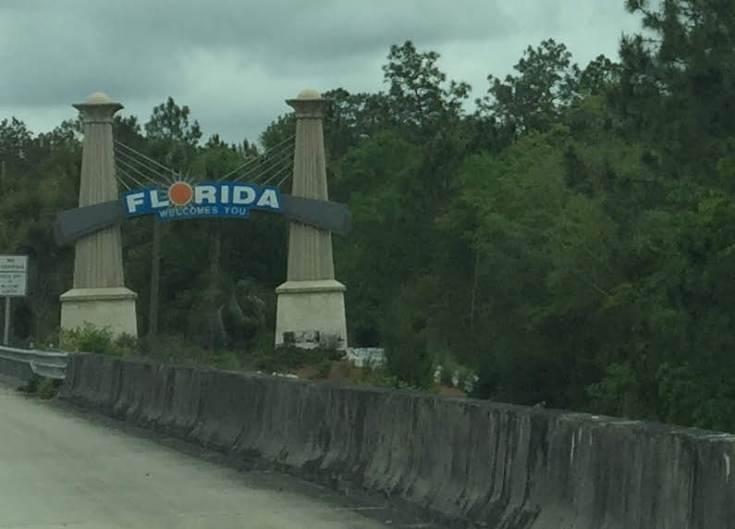
But soon we were in Florida!

img_7784

We will stay four nights in Florida… Tonight we are outside Freeport, on the western portion of the panhandle.  It amazes me that we still are not yet in the eastern time zone…!

The RV Park is quite nice.  There is even a boat launch; this river gives access to the salt water bays and the freshwater lakes…

img_7787img_7788img_7790

The Villa is set up and Happy Hours occur…

img_1900

And an enjoyable time was had by all…

2019-04-11 – Airstream Caravan Travels – New Orleans, LA

We left Carencro at first light.  Not too many Airstreamers were up and about…

We drove east on the 10.  After about 20 minutes we stopped.  And stayed stopped, despite the sign…

img_1798

We were there for 1 1/2 hours…  Apparently there was an accident about three miles ahead on the causeway, so they simply closed the freeway…  So everyone in their cars was able to catch up on their Facebook posts…

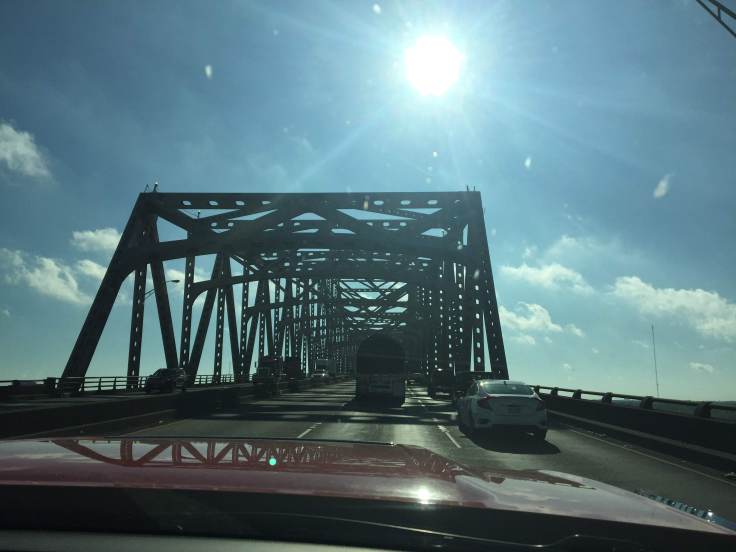
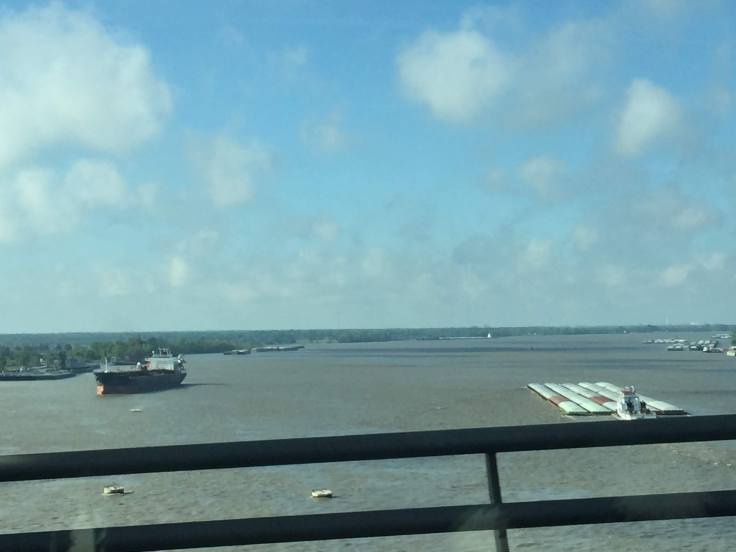
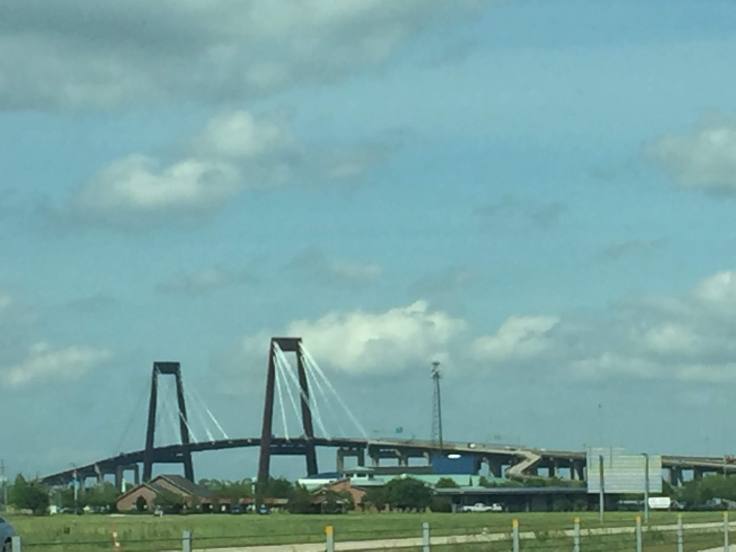
Eventually we were on our way.  We crossed the Mississippi river for the first time today…

img_7675img_7681

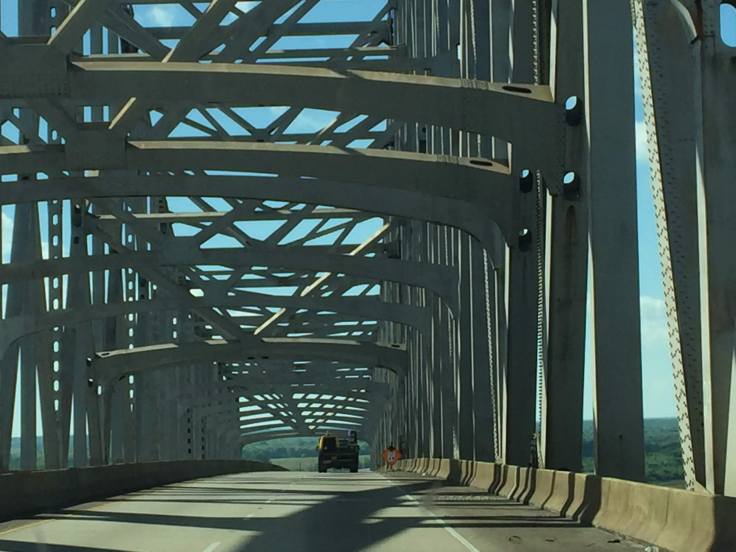
An hour later we crossed over the Mississippi for the second time today…

img_7683img_7690img_7691


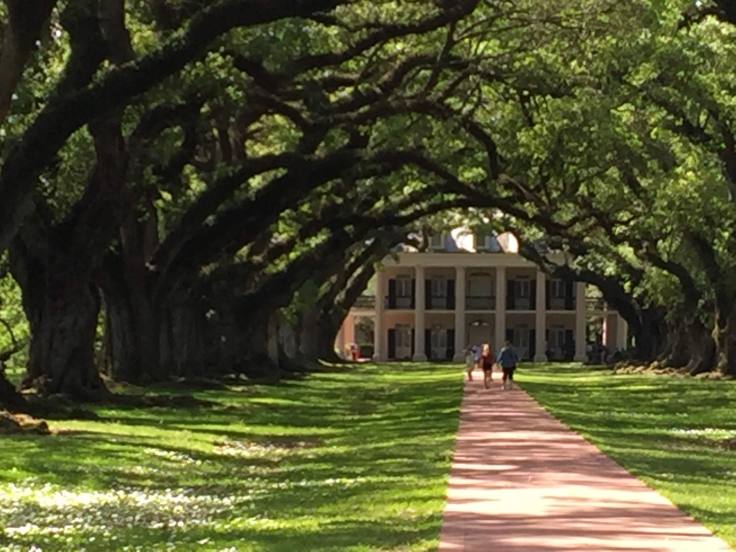
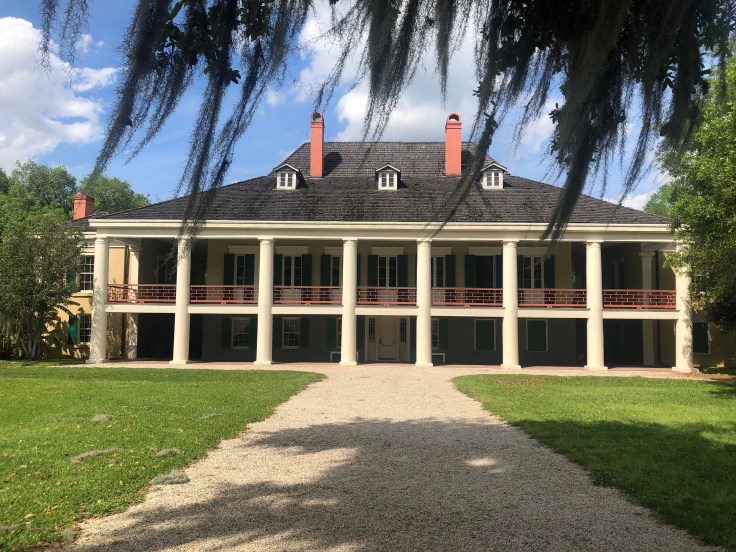
By about 10:15 we arrived at our first destination:  Oak Alley Plantation…

img_7706

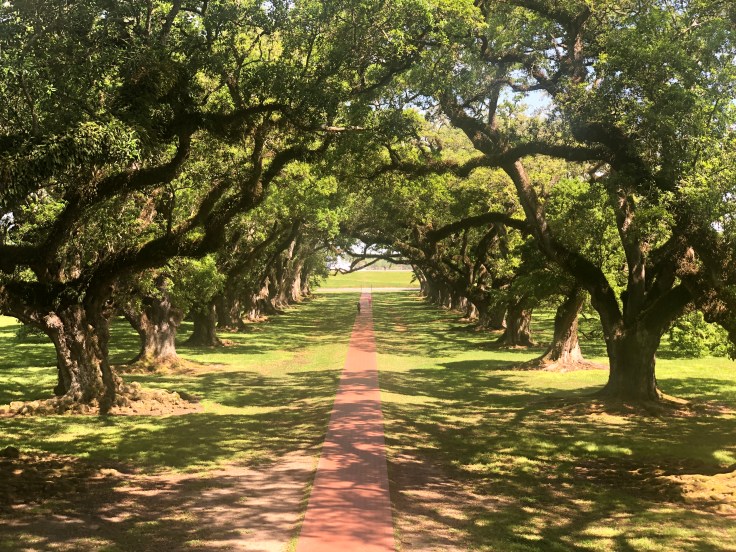
Oak Alley is one of the more famous “Big Houses” due to this lane of 200+ year old Live Oak trees… The interior tour did not disappoint.  (Unfortunately, no photos were allowed…)

The interiors of the Big House are quite grand – much more than I had anticipated.  If you recall, the governor’s mansion in Baton Rouge is modeled after Oak Alley, but we were told that the governor’s mansion was much grander.  I’m not so sure… Certainly the governor’s mansion is bigger – 25.000 s.f vs Oak Alley’s 7,000 s.f., but the ceilings are tall (12 1/2 feet) and the rooms are large – there are only eight rooms and a large central hallway.  We were impressed.

The house was built in the 1830s, similar to Shadows -on-the-Teche, but this is far more sophisticated and grand.  The original owner died young, in the 1840s; the difference is that the owner of Shadows built a modest house, where as the owner of Oak Alley built a very grand house, way beyond his means, with several hundred thousand dollars of debt.  Where as Shadows was maintained after the Civil war, and newly freed slaves were hired for cash wages, the war ruined Oak Alley and its owners.  After the war it was abandoned by the family and sold for taxes.  It was unsuccessfully operated as a farm and as a cattle and hog ranch.  It fell into disrepair until the 1920s, when it was bought by the Stewarts, a family from Texas; they restored the house and added indoor bathrooms and a kitchen.  The Stewarts lived in the house for many years, as a vacation home and later as a retirement home.  Upon Mrs. Stewart’s death in 1972 the house was deeded to the Oak Alley Foundation, which restored the house (removing bathrooms and kitchen); it was then opened them to the public.

After the interior tour walked the grounds…

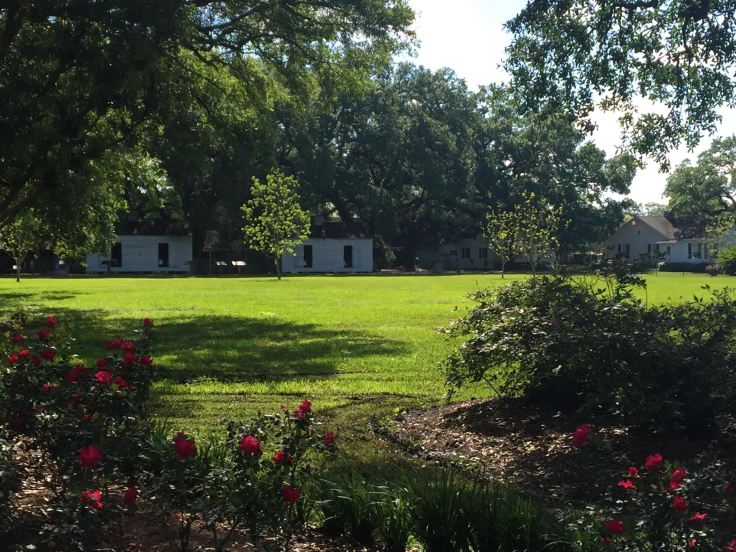
Slave quarters in the distance…

img_7692

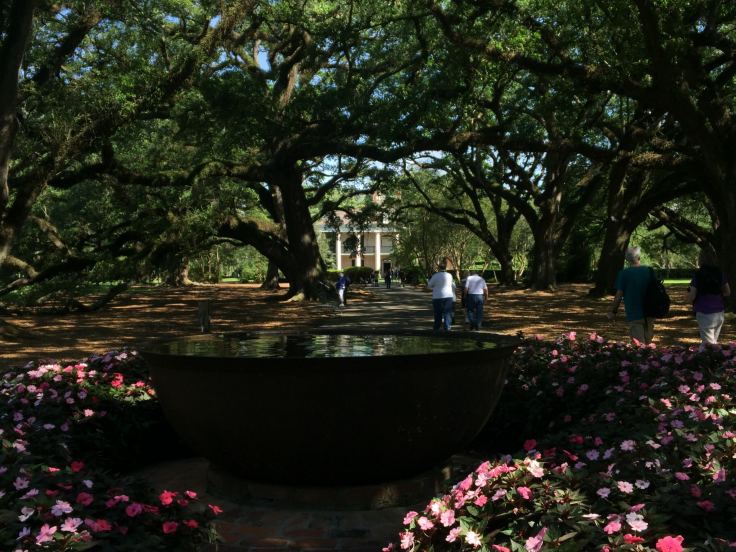
Gardens…

img_7693img_7694

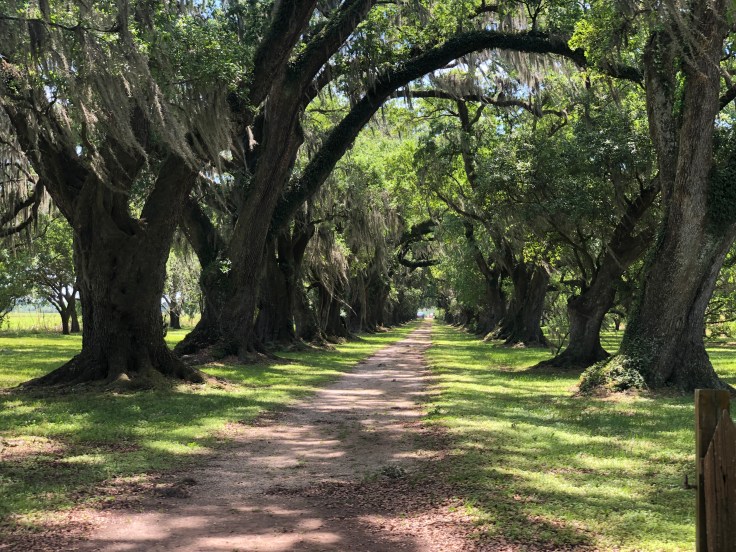
The Oak Alley…

img_1799img_7695img_7696

The rear of the house…

img_1800

The oak alley, looking away from the house… The Mississippi River is just beyond the levee.  In the olden days the levee was much lower and the river could be seen from the uppers verandas of the house…

img_1807

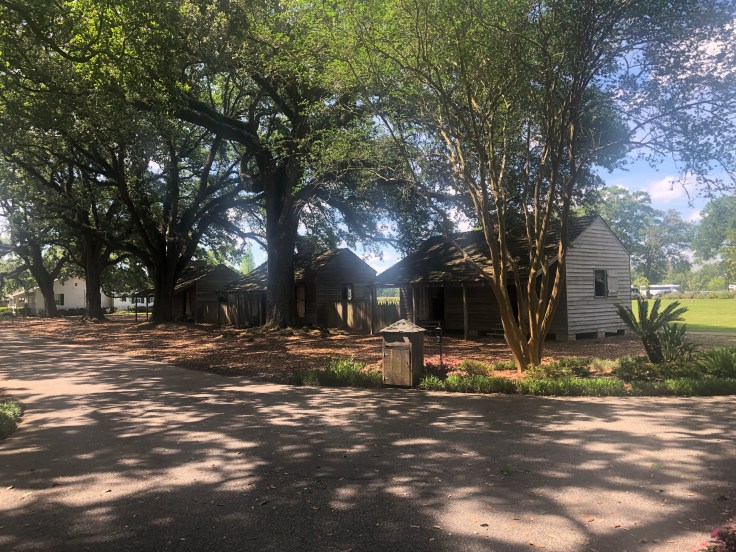
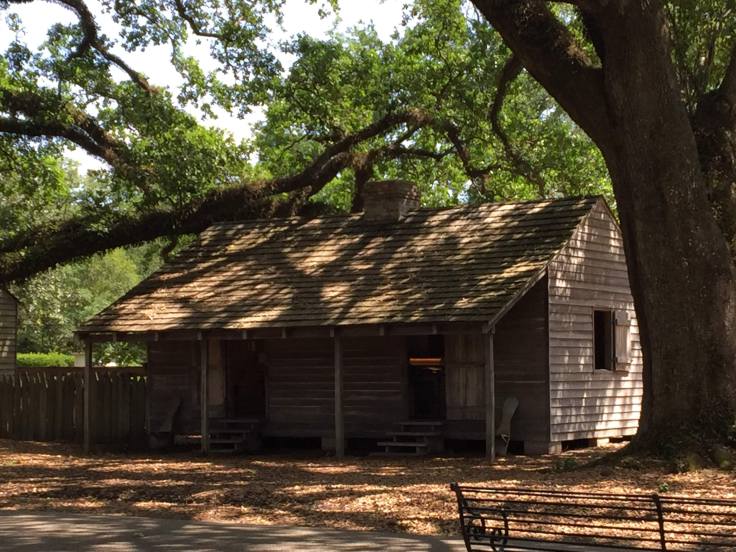
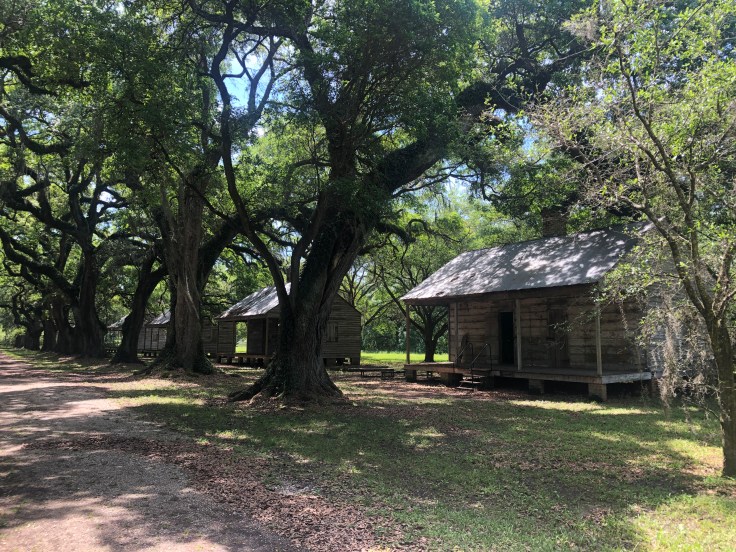
The oak alley extended from the front and the rear of the house… At the rear are the slave quarters…

img_1818img_1819img_7708

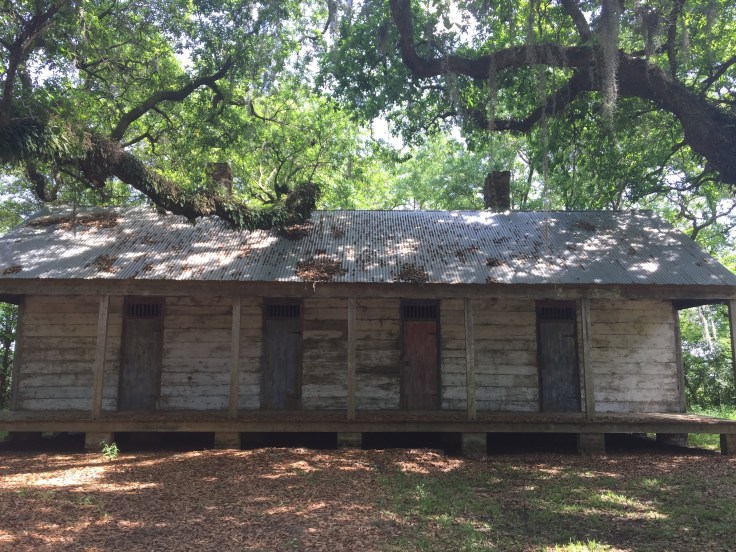
These are all double cabins, exactly as we saw at the Rural Life Museum.  They are reproductions.  The exhibits tell of the lives of the slaves, with very little sugar coating or white washing.  One cabin was filled with various shackles and other restraint devices…

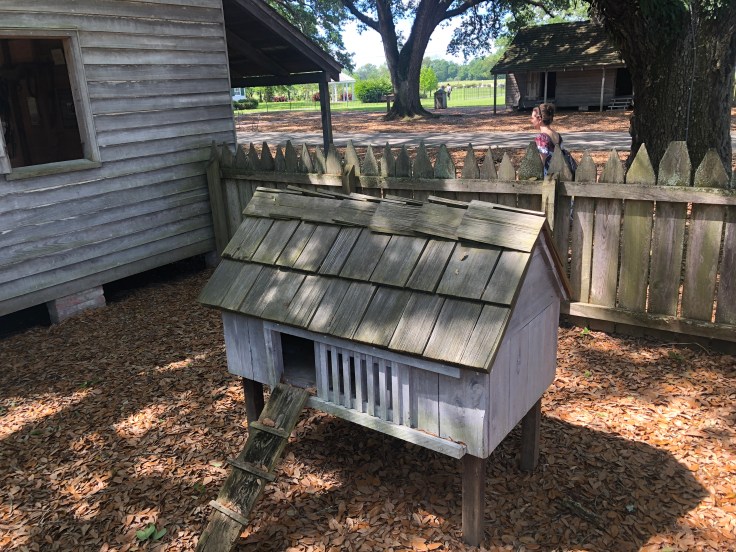
The was even a slave chicken coup…

img_1820

A few interesting details…

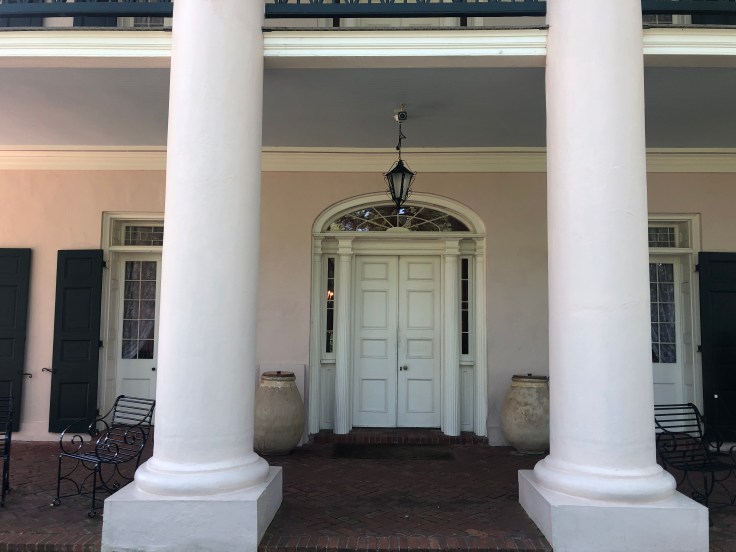
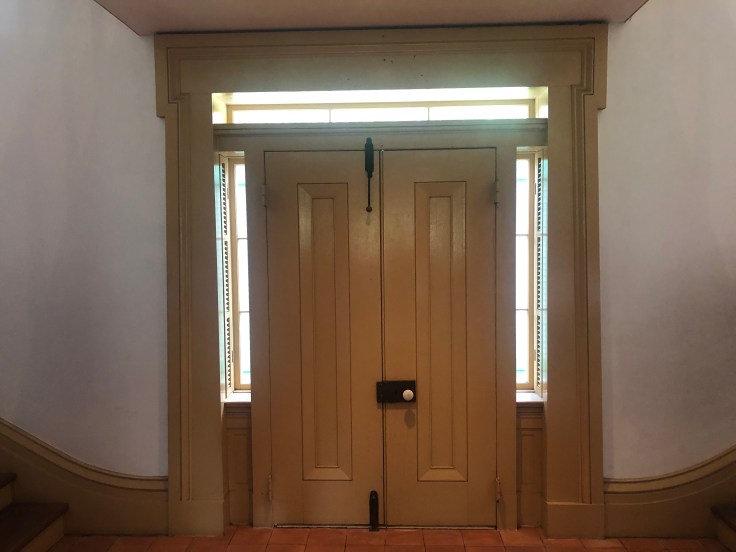
The front door:

img_1804

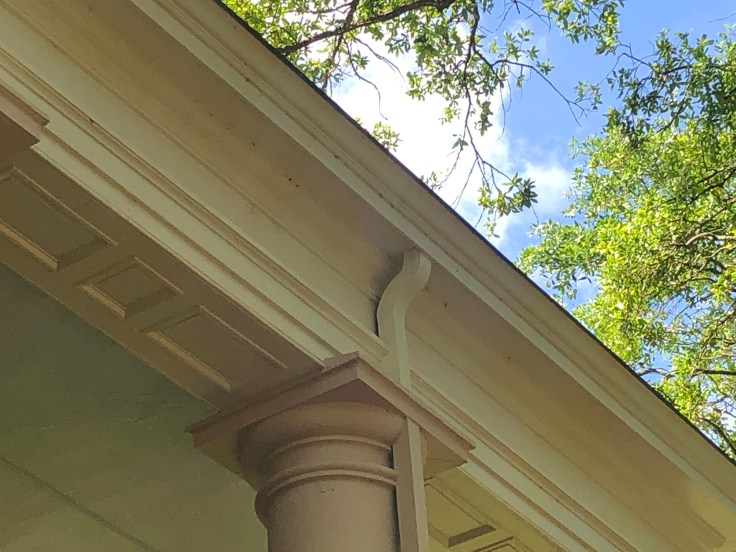
The columns (as is the house) are solid brick, covered with plaster.  Sometimes historical accuracy gives way to modern technology…

img_1805

This is an appropriate time to mention that these houses were made to look like Greek temples, which were built of stone.  Of course, the Greek temples were copies of Egyptian temples, which were built of wood…  So here we see plaster mimicking stone mimicking wood…

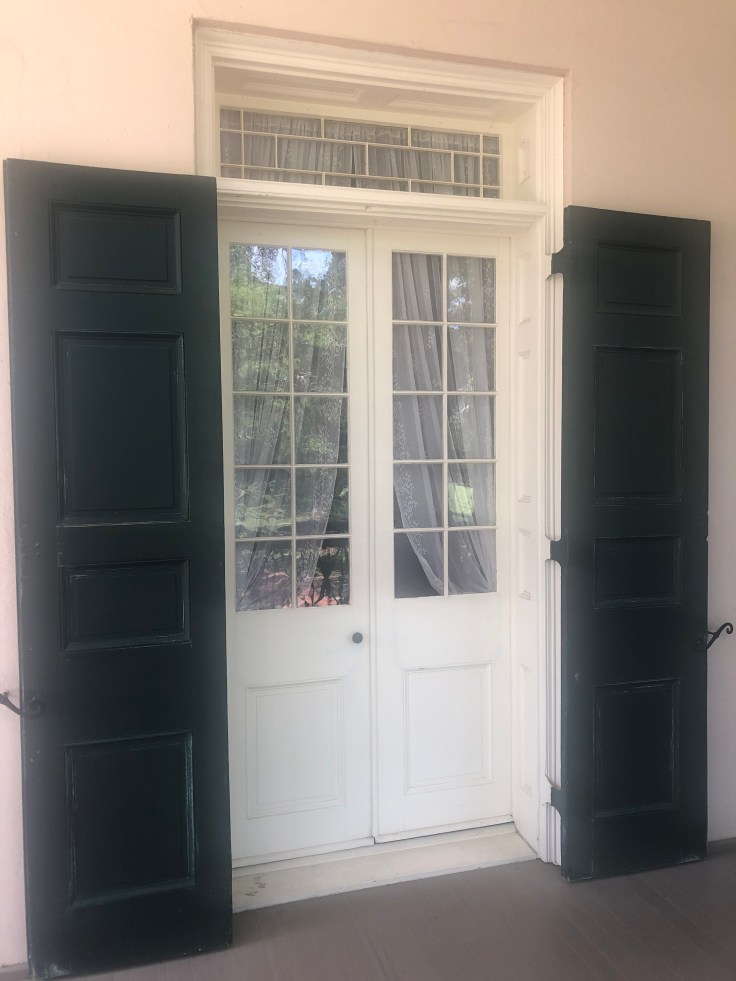
Most rooms have French doors:

img_1809

Some rooms have windows to match the French doors…

img_1810

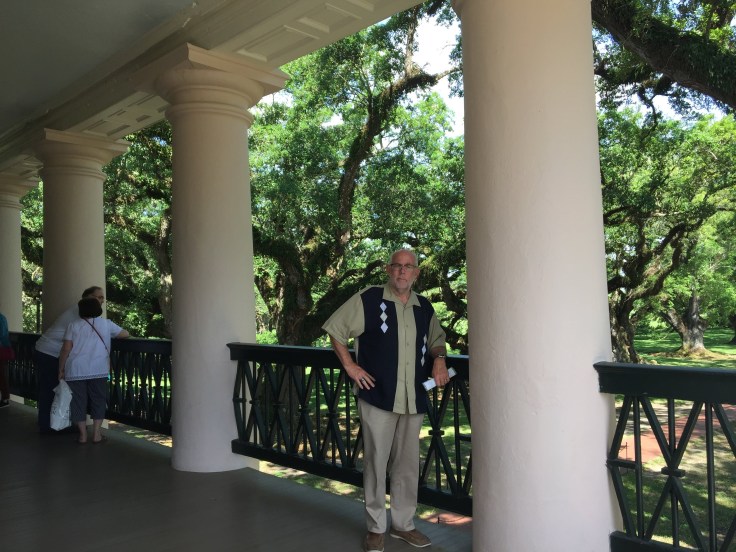
Typical tourist on the veranda…

img_7700

And so we moved on…

img_1821

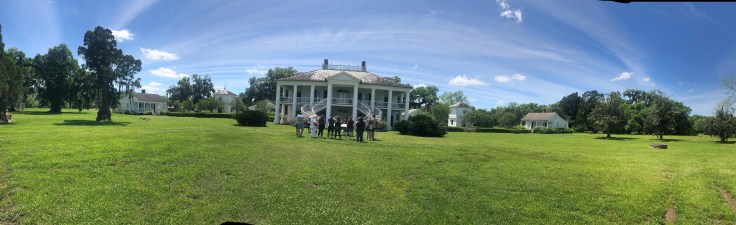
Next stop is Evergreen…

img_1831

Evergreen was originally a simple one story three room house in the Creole style, raised up about six feet off the ground to ward against flooding.  It was built in the 1790s.

img_1827

In the 1830s the house was raised up so that three ground floor rooms could be added, and these stairs were added to give access to the main living quarters on the second floor.  In this way this house is very similar to Shadows.  Eventually the rear verandas were enclosed and additional rooms were added on the sides.

The entry door:

img_1834

Again, plaster and brick mimicking wood…

img_1835

The rear verandas were enclosed and exterior stairs became interior stairs.

img_1838

Gardens to the rear…

img_7717

The rear of the house…

img_1841

The kitchen in one of the dependencies…

img_7721

There are two VERY long oak alley’s here – one planted in the 1780s and one planted in the 1940s.  They are much longer than the alley at Oak Alley, but they are not centered on the Big House.

The interesting thing here is that these trees conceal the slave quarters…

img_1844img_1848img_1849

These are the original slave quarters; after the war they were occupied by former slaves and hired workers until the 1940s…

img_1851img_7724

Again, after the war the house was sold for taxes, and subsequently it was unsuccessfully operated as a farm.  Eventually the bank foreclosed and the Big House was boarded up.  However, the bank never noticed that more than 100 people were living on the property, both in the former slave quarters and in the various sharecropper houses further to the rear.  The people on the property let the house stay boarded up, but some of the former owners moved back in.  They let the grass grow un-attended and the place appeared to be abandoned.  But the people continued to farm the land and live in the many buildings.  In the mid 1930s the bank sold the property to a woman who had no idea that all these people were living here, but eventually they made a go of the farm.  This family still owns the property and it is still a working farm (although no one lives in the slave quarters, or the big house…).

This tour was less about the house and dependencies and the grounds than it was about pushing the agenda of the owners.  What we heard was that slavery was wonderful, slave owners were wonderful, slaves were happy and well taken care of, no slave-owner would ever mistreat a slave because it would hurt his investment and profits, and the slaves knew they would have to work somewhere, somehow, so they might as well be happy working as slaves.

Poppycock…

We moved on.  We crossed the Mississippi again:

img_7725img_7726img_7729

Our third Big House today is called Destrehan.

img_1856

Destrehan was also one of the oldest Big Houses, built in the late 1780s.  Originally it was a one story house build up above the ground similar to Evergreen, but after the river levees were raised they enclosed the ground level and enclosed the rear verandas.  During the Civil war the owner, who was a French citizen, abandoned the house and sailed for France to try to become the French ambassador to the Confederacy.  Obviously, that didn’t work out.  Federal troops took over the house in about 1863.  After the war they turned the house and grounds into a settlement house for freed slaves who had nowhere else to go.  The owner, upon returning from France, convinced the Feds that he had always been loyal to the North, so they gave him his plantation back.  The family continued to live in the house until 1916 or so, when the plantation was sold to an oil company.  An oil refinery was built and the house was used for offices and as a residence for the manager.  In the early 1960s the oil company torn down the refinery and abandoned the property.  The house was looted and ransacked by vagrants and squatters, and fell greatly into disrepair.  Finally a restoration society was formed and the house was restored.

This is the “warming Room, where the food was brought from the kitchen, plated, then delivered to the butler’s pantry before being delivered to the dining room.  I had never seen this arrangement before…

img_1860

When the rear verandas were enclosed they used this Egyptian motif for the door trim.  Note the tapered jamb casings…

img_1861

The house originally had simple wood columns with corbels at the top.  Later, brick columns were built around the wood columns and a fascia was built to give the house its Greek revival facade.  But on the veranda you can still see the wood columns and their corbels… The wood columns still support the house today…

img_1863img_1862

The slave quarters are all reproductions, and they were originally not in this location directly behind the house…

img_1857img_1858img_1859

I’ll save you from the more repetitive photos… after a while, all interior photos look alike…

The day was getting late.  We returned to the truck and the Villa and drove into New Orleans – the French Quarter…

img_7732

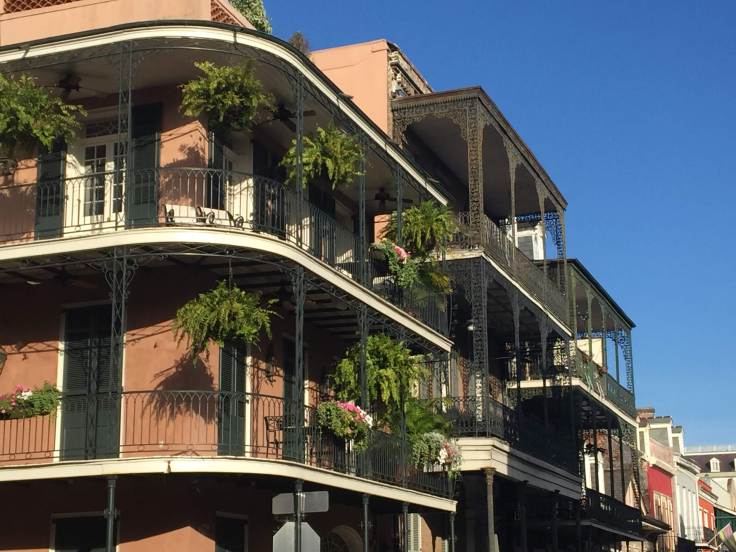
We parked the Villa in a parking lot at the Visitors Center and walked around a bit.  I think if the French ever saw New Orleans they would roll over in their graves… But some of the street scenes were interesting.

img_1866img_1868img_1869

img_1873

This streetcar was NOT named Desire…  These RR tracks run right along the waterfront.  Most enlightened cities today have removed RR tracks from their tourist oriented waterfronts…

img_1870

The Mississippi was still mighty…

img_7733

The massive basilica facing Jackson Park:  We’ll get a better picture tomorrow…

img_1872

We returned to the Villa, changed into our dress-up clothes, and walked to dinner at Meauxbar Bistro.

img_1968

I wish we had a place like this in Redlands.  Or any where in the IE, for that matter… Cozy neighborhood place, small bar, very French, but very contemporary menu and recipes…

img_1877img_1879

We each had two courses, which is more than either of us can comfortably eat, especially with a fine wine (Gigondas…)

Lynda ordered Pom Frites and Aioli, and their house special French Onion Grilled Cheese Sandwich, of which she could only eat one of the four pieces…

img_1880

I opted for two simple dishes – Escargot and Beef Tartare.  Both were fabulous and, since they were small appetizer courses, I could actually finish them…

We walked back to the parking lot, snuck into the Villa, and had a wonderful night’s sleep…

And an enjoyable time was had by all…

2019-04-09 – Airstream Cajun Country Caravan – Carencro and Lafayette, LA

We began our day again with a nice walk around the perimeter of the campground… Yesterday I posted this field of colored weeds.  Today the horses were out standing in their field…

img_1698

The swamp is looking as swampy as ever…

img_1699

Today we have our last official caravan outing.  We carpooled out to central Lafayette to the Vermilionville Historic Center.

img_7645img_7646

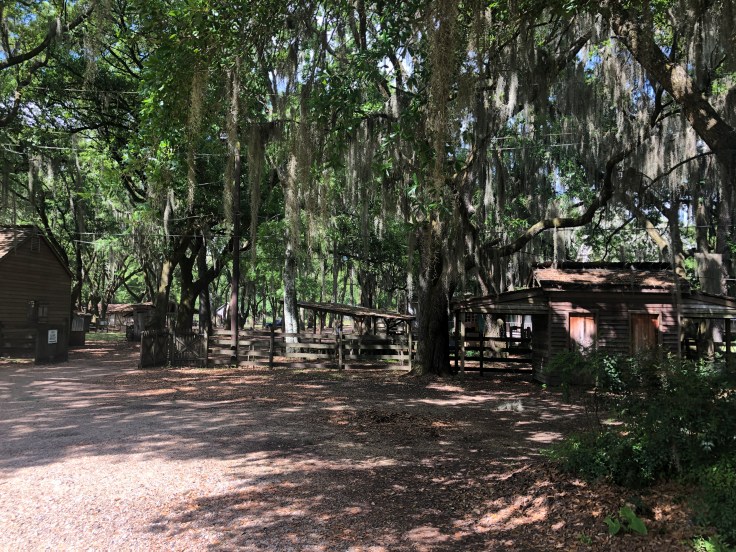
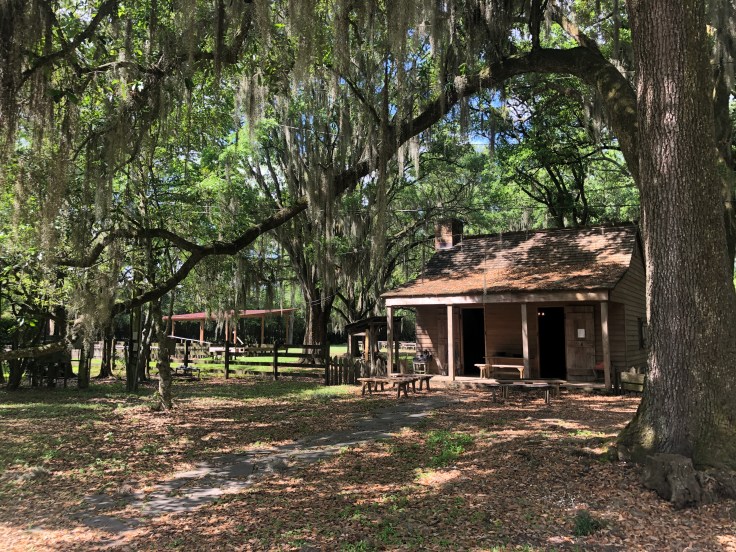
This is the Vermilion River or Bayou.  The river has a reddish hue.  The town was originally named Vermilionville after the river; in the early 19th century the Catholic Church created a new parish in this area called Lafayette, so they renamed the town… This location is not the original city center – the Cathedral we saw  yesterday was at the original city center.  This land was originally one of the many plantations surrounding the city, and the buildings we saw were either moved here or they are re-creations of typical buildings of the era.  This place is very much like the Rural Life Museum that we saw in the first days of the caravan, so I will try not to repeat information here…

We spent about two hours walking the various buildings.  Again, the guide was really not interesting to me, mostly talking about the families, weaving, crocheting, and nonsense like that.  I wanted to know more about the architecture and construction techniques I was seeing, but she was clueless…

But the buildings are interesting in their own unique way…

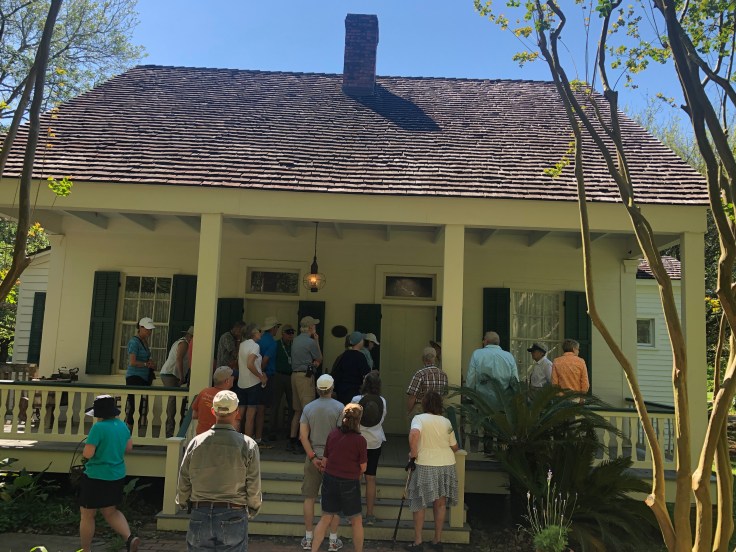
This is a large Acadian plantation or ranch home from the early 1800s .  It was very substantial, obviously owned by a prosperous land owner.

img_1705

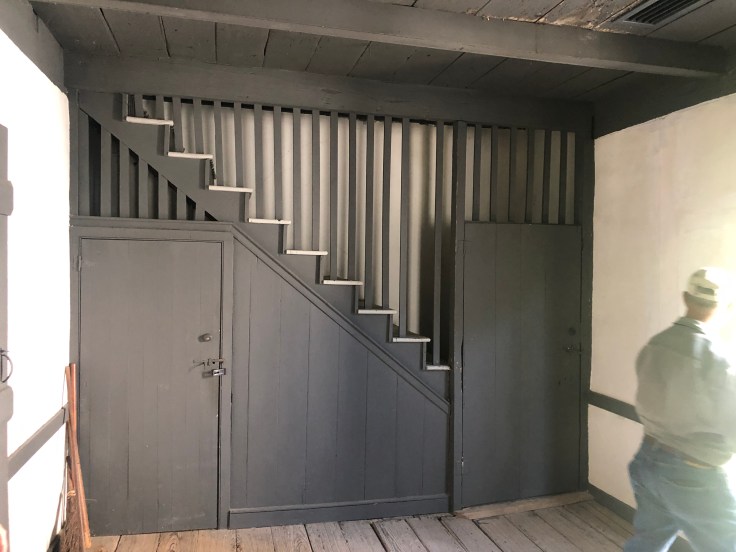
It did have an interior staircase…

img_1708

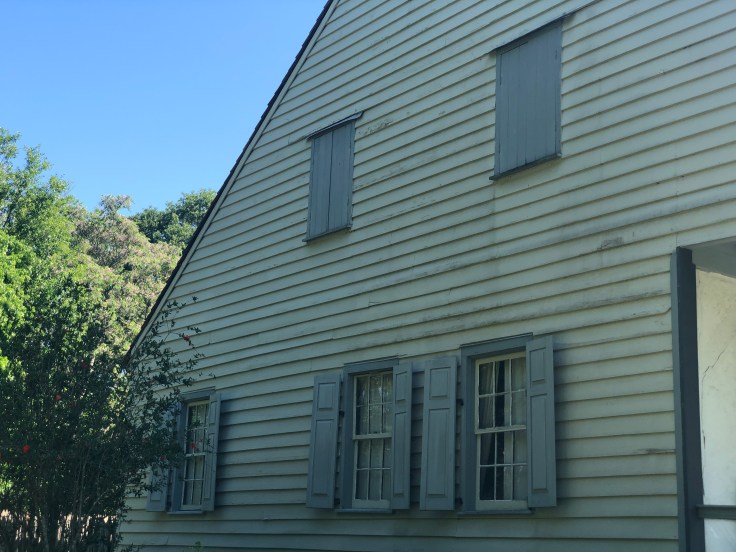
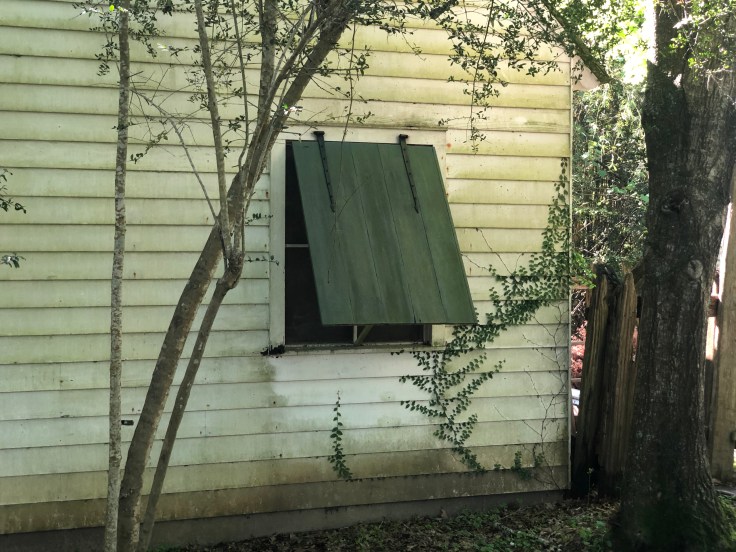
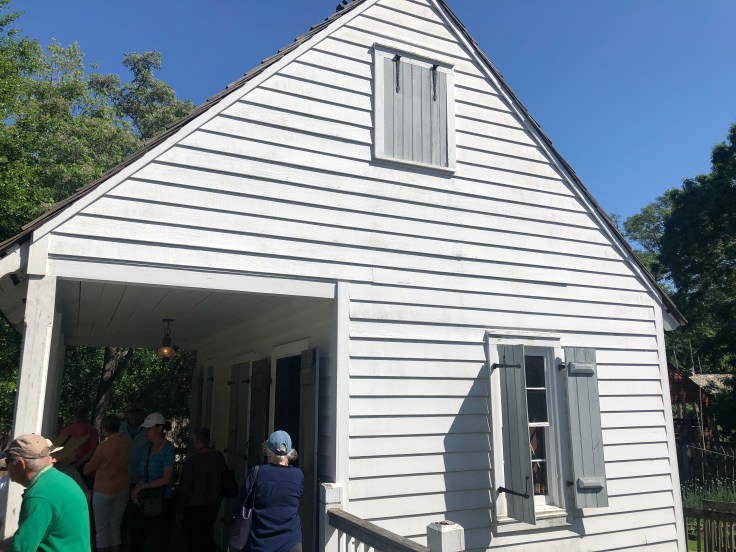
I immediately noticed the shutters.  Some are hinged like doors, and some are hinged at the top.  I asked if this was just a personal preference or was there a functional reason to use one or the other?  The guide was clueless – I don’t think she understood the question, maybe she never noticed that they were different, or maybe she didn’t know what shutters were… All the houses had different configurations:

img_1702img_1701img_1711img_1715

img_1770

As we walked amongst the houses several opinions and ideas were expressed, but as soon as we thought we had a good theory going the next house proved us wrong… I guess that just did whatever they wanted…

This next house is an urban house, built in central Lafayette in the 1880s, post-Civil War.  What was neat about this was that the original house is in tact, but they were also showing the additions, made in the 1920s, of a indoor kitchen and bathroom…

img_1720

Another interior stair…

img_1725

1920s bathroom:

(I have the same bathtub in my 1905 house…)

img_1728

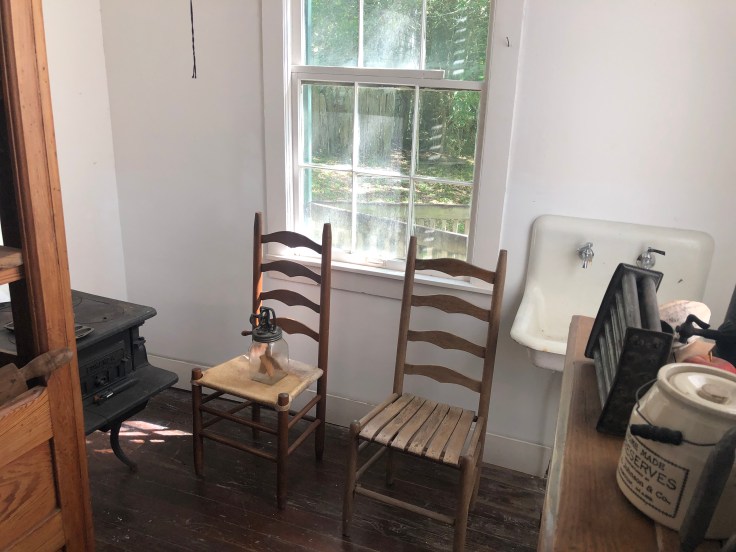
The kitchen:

img_1727

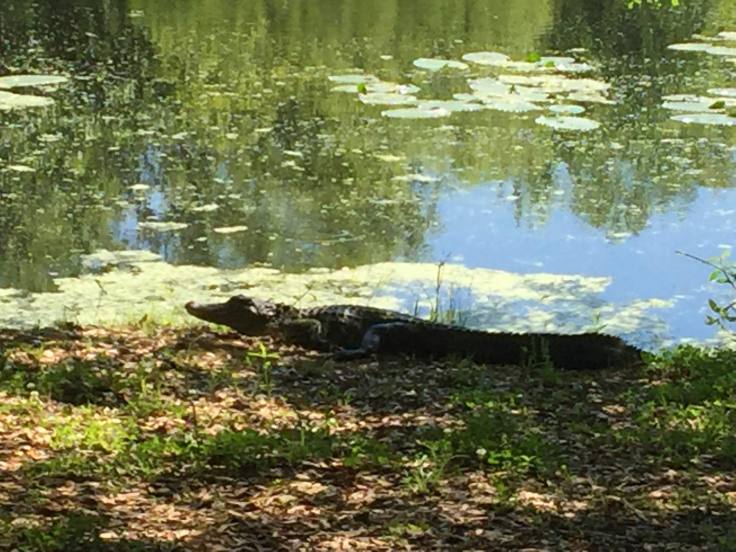
We strolled near the swamp.  Wait!  Is that a… an alligator!

img_7663img_7659img_7657

He seemed harmless enough.  Alligators are not naturally aggressive – he slinked away into the lake as we walked nearer.  (Crocodiles ARE very aggressive…!)

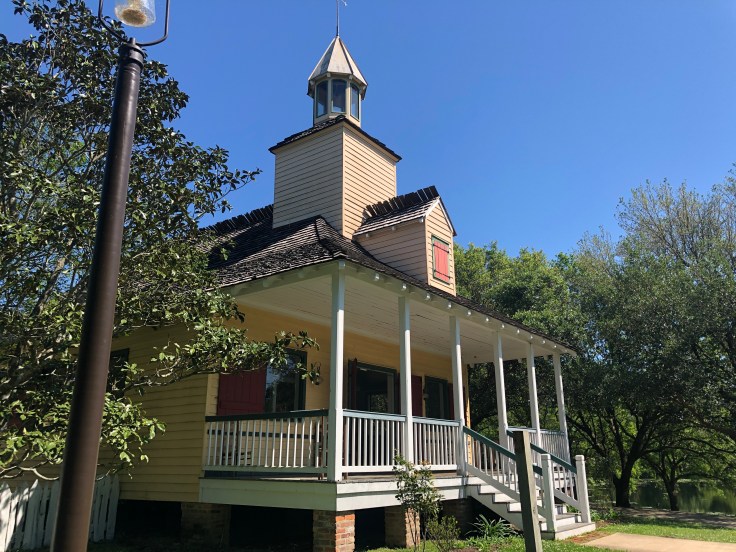
This is the church and the pastor’s house…

img_1730img_1733img_7654

This next house has an interesting floor plan, and it helps to explain some other features of these various houses we have seen on the caravan…

Note the layout here in this exhibit:

img_1739

The center front room is the “great Room” for living, dining, and entertaining.  To the right is a bedroom for the younger children; to the left is the room for the parents and infants.  Behind the parents’ bedroom is a bedroom with no door except into the parents’ room; this was for the older daughters.  Behind the children’s room is a bedroom with no door except a door directly onto the rear porch.  This was for the older boys.  All older boys had jobs, either on the plantation or ranch, or as an apprentice at a local tradesman’s place.  The boys slept here, but they often had their own schedules that might have been different than the family’s; also, they may have taken meals away from home.  Thus they needed their own entrance so that their comings and goings did not disturb the family…

Door to the older girls’ bedroom directly from the parents’ bedroom…

img_1742

Door to the older boys’ bedroom directly on the rear porch…

img_1744

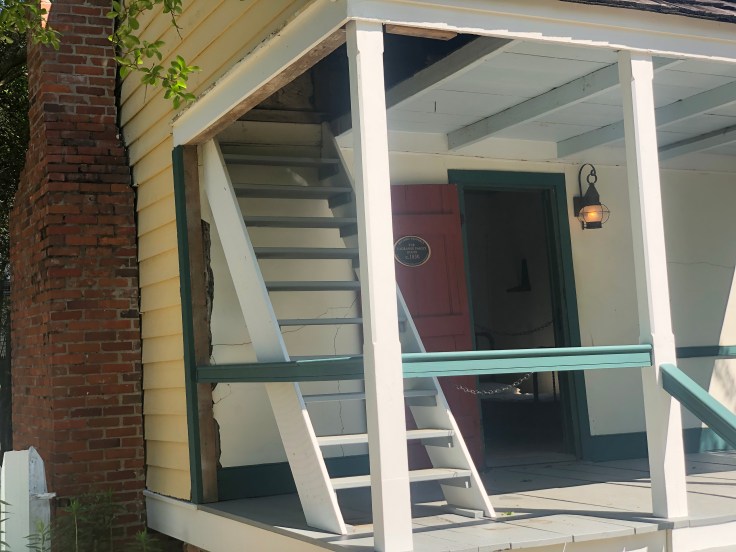
This concept also explains why these exterior stairs that we have been seeing also made sense – the older boys slept upstairs, but they had their own entrance…

img_1737

img_1778img_1768

One mystery solved, another mystery still unsolved…

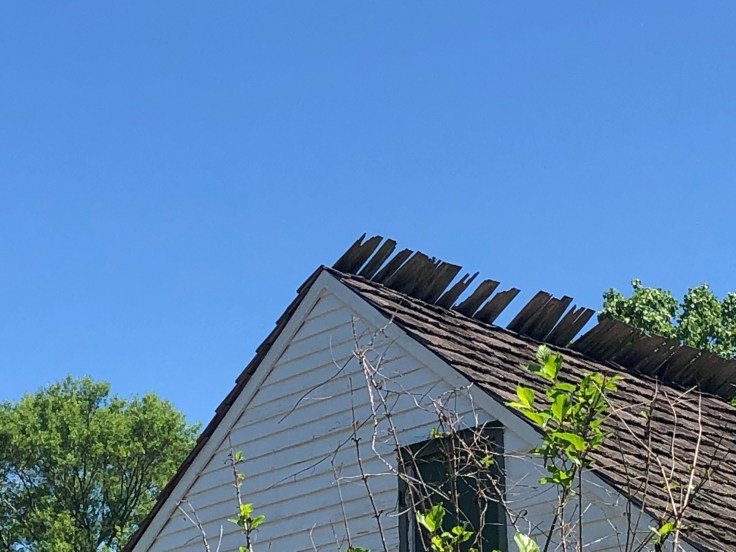
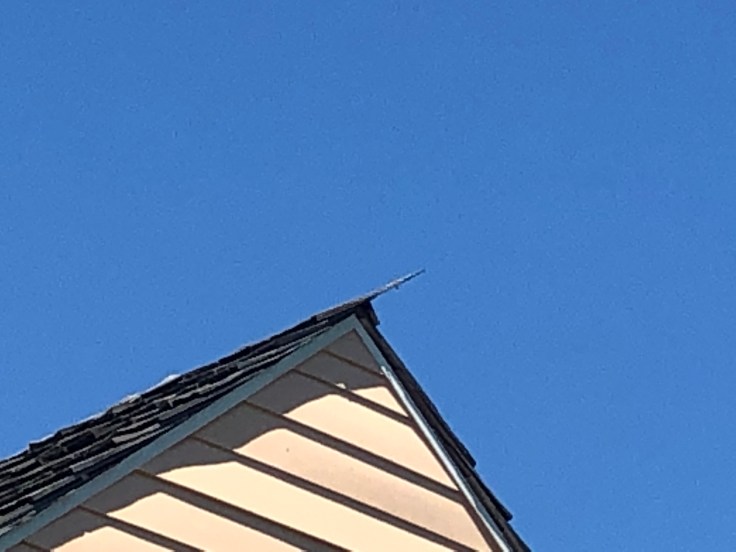
At the Rural Life Museum I had asked about these weird ridge shingles.  I asked here again, to no avail… Some houses have them, some don’t; they face all directions, so prevailing winds wouldn’t determine anything.  There was no consistency between Cajun, Creole, French, or Spanish influences…  I guess we’ll never know…

img_1756img_1757img_1758img_1759

This is the school house from the 1920s.  Note the Spanish Moss in the trees:

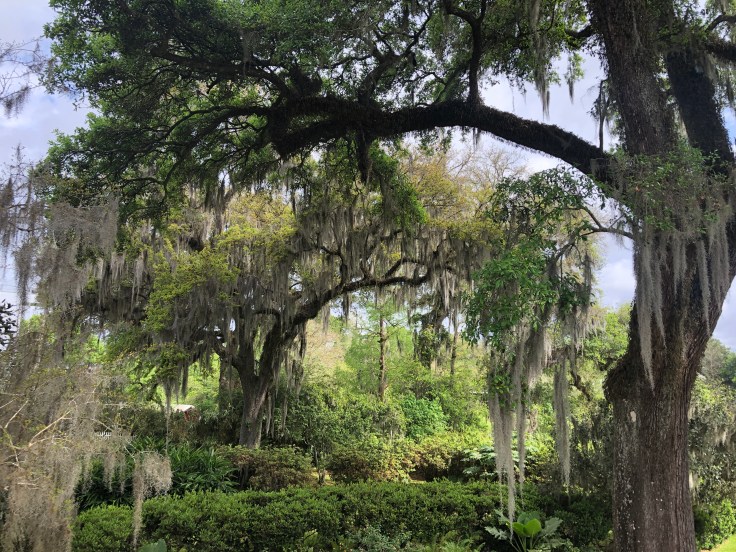
Also note:  It is not Spanish, nor is it Moss.  It is an air plant an (epiphyte), which takes its nutrition from the air.  It is not a parasite, and it does not harm the tree… Its proper name is tillandsia usneoides.  It is a bromeliad—a perennial herb in the pineapple family, and most bromeliads, including Spanish moss, are epiphytes.  So there you have it…

img_1763

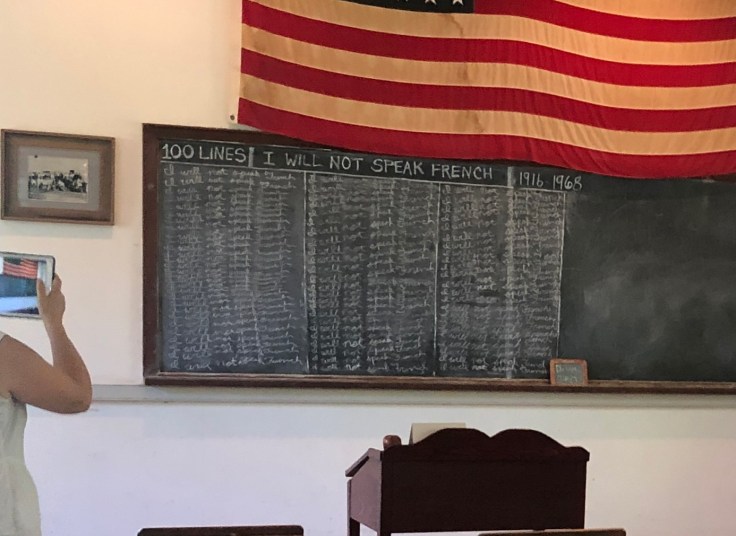
In 1916 Louisiana banned the speaking of French in the public schools.  Here we see on the blackboard that some student had to “write lines”.  They read, “I will not speak French”.

img_7664

img_1764

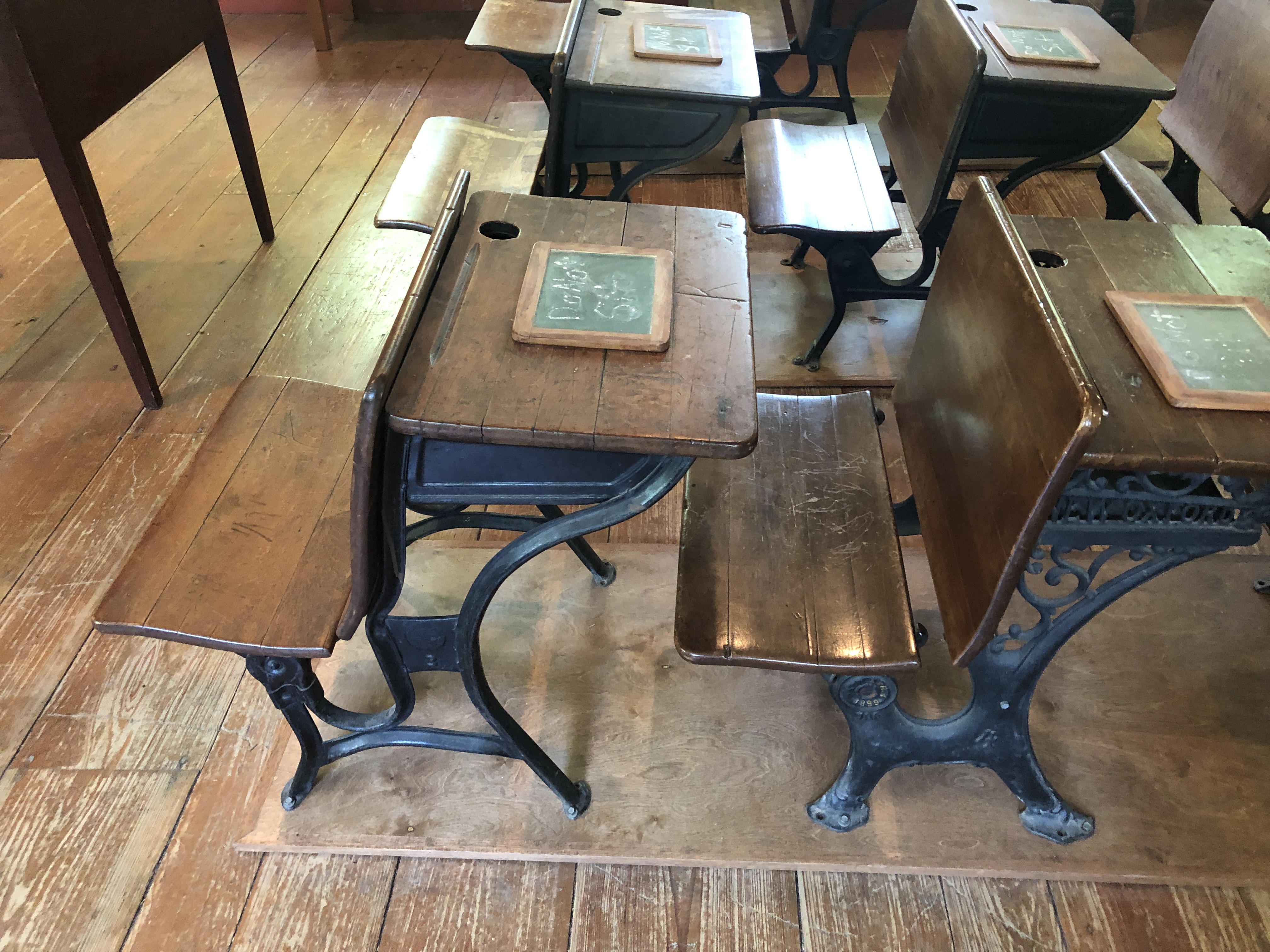
Not that I’m dating myself, but the two-room schoolhouse I attended in my early years had desks exactly like this…

img_1765

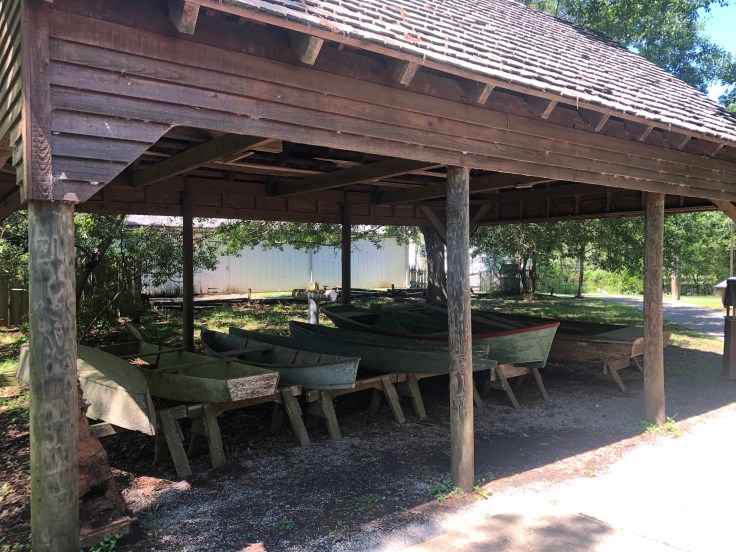
Some other utilitarian buildings:  The boat house:

img_1772

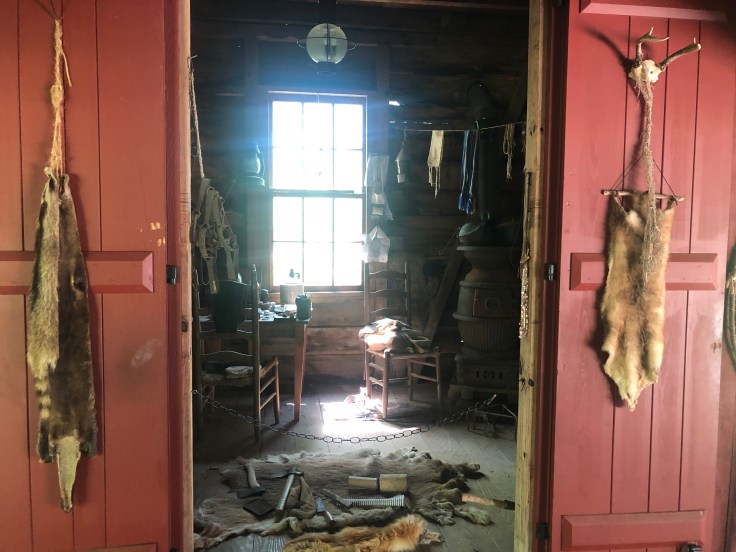
The trapper’s cabin:

img_1773img_1774img_1775

After over two hours of wandering amongst these great old buildings we enjoyed lunch in the museum’s cafe – Red Beans and Rice, Chicken Gumbo, and Shrimp Po-Boys.  Very good!

We returned to the truck, and Lynda found several Egrets nearby…

img_7672img_7673

We turned to the Villa.

That evening Lynda joined into the fun of Left-Right-Center…

img_1780img_1782

And an enjoyable time was had by all…

2019-03-30 – Airstream Cajun Country Caravan – New Iberia, LA

img_1346

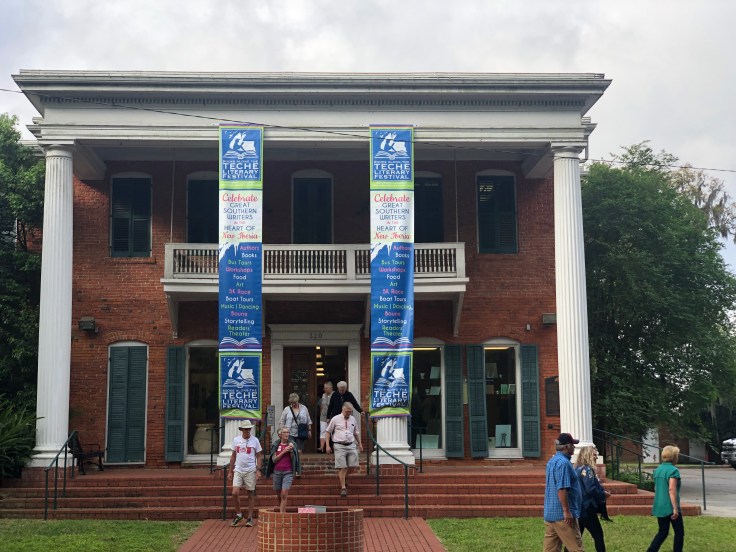
Today we get to see a Big House!  No, this isn’t it – this is the Visitors Center, across the street.  The house is called “Shadows on the Teche”.  Shadows is the house, named for the shadows from the giant Live Oak trees that envelope the house and grounds.  Teche is the name of the bayou the house faces.  (A bayou is a shallow, slow moving, muddy  river…)

img_1347

Here is the Big House, in all its glory…

img_1351

The house was built between 1831-1834.  It was occupied by four generations of the same family until 1958.  Ownership was transferred to the National Trust for Historic Preservation one day before the fourth generation occupant died…

The house today sits on 2 1/2 acres near the center of the town of New Iberia.  When it was built it was the center of a 158 acre farm.  The farm was only as wide as the current property, about 325′, but it stretched over two miles in either direction.  The family’s wealth came from their sugar cane plantation about 15 miles away.  (Due to swamps, bayous, and water being generally everywhere, it took 5-6 hours to travel from this house to the plantation…)  This farm was used for growing food to feed the family, their employees, and their 200 slaves.  Fortunately, right before the Civil War the owner subdivided the farm with the intention of selling town lots and small farms.  The war interrupted all that.  However, after the war, they were able to sell the lots as needed to raise cash, and they were able to hire and pay their former slaves to keep the plantation going.  In contrast, many (most?) plantation owners lost their land to pay taxes and other debts…

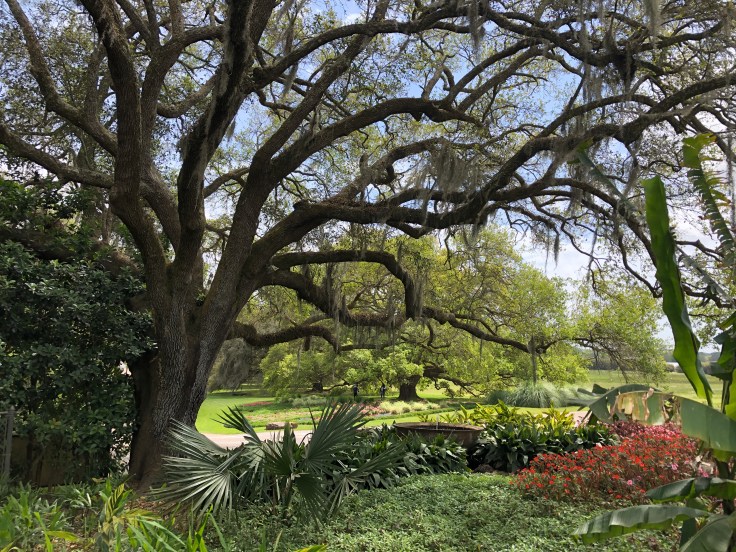
The grounds are beautiful, shaded by these 250 year old Live Oak trees…

img_1349img_1348img_1350img_1352img_1367img_1368img_1372

Behind the house is the Bayou Teche…

img_1357

We began the tour of the house on the front porch.  In contrast to plantations in Virginia (Mt. Vernon) the front door faces the street, not the bayou.  The stairs are here on the exterior, because interior stairs would block the breezes.  Everything about the design of the house is intended to maximize bringing the cooling breezes through the house.  Another unique thing is that the main living quarters are on the second floor, as protection from potential flooding.  This house has never flooded, but it has come close.  It is on the highest land in the area – about 18′ above sea level…

img_1355

The first room we saw upstairs was the master bedroom and its adjacent sitting room..

img_1359


img_1360

The Living Room is in the center of the house, facing porches in the front and in the rear.

img_1363

Two secondary bedrooms complete the rooms on the upper floor…

img_1364

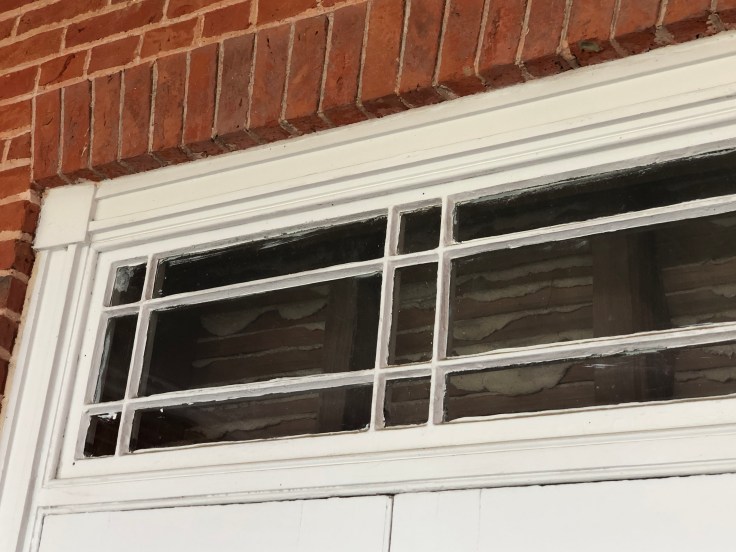
We noted that these clerestory windows are for decoration only – inside is a plastered wall…

img_1371

On the ground floor is a work room and storage room…  The Kitchen was in a separate building behind the house.

img_1373img_1375

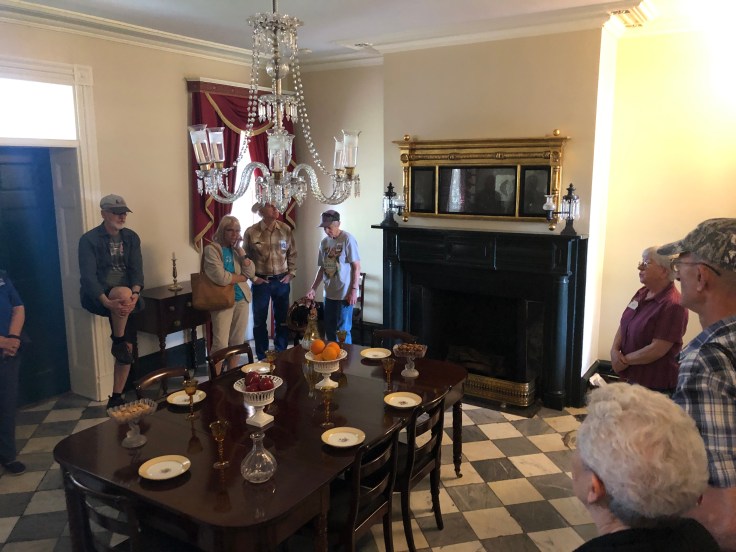
The formal Dining Room, used only for parties and distinguished visitors, is in the center of the ground floor.

img_1377img_1378

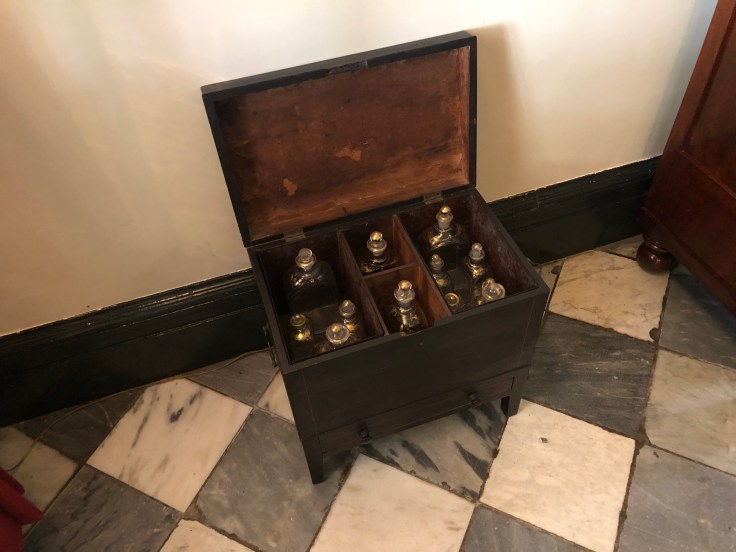
In a corner of the Dining Room is a “cellarette”, where wine and other beverages were kept.  Ice was inserted into the drawer below the bottles…

img_1379

There was also an Office and a “Bathing Room” on the ground floor.  The Bathing Room contained a bathtub.  Other bodily functions were handled via a chamber pot or a commode chair… and slaves to empty them…

During the Civil War Union Troops occupied the ground floor rooms.  Mrs. Weeks refused to leave, and she continued to live upstairs.

After the war Mr. Weeks was able to retain the former slaves as contract workers on the plantation and to pay them in cash, probably thanks to having the ability to sell lots carved out of the original farm.

The final owner and resident of the house was Weeks Hall, great grandson of David Weeks, who had built the house but died (in New Haven, CT) before the house was finished.  Weeks Hall moved in around 1922.  He never married and had no children.  He added a bathroom and a Kitchen and lived in the house until his death in 1958.  He had started to restore the house, and the National Trust for Historic Preservation finished the job, taking out the kitchen and bathroom and adding climate control to protect the contents.

After our very fun tour we traveled a few miles away to Rip Van Winkle Gardens and The Joseph Jefferson House… Joseph Jefferson was a wealthy actor who played Rip Van Winkle in live theater productions all over the country.  He bought and built this place to have a country vacation home.

img_1392

The house was an ugly conglomeration of Victorian kitsch…Fortunately for you, dear reader, interior photos were not permitted, so you didn’t have to look at it; however, we did…

The grounds (Rip Van Winkle Gardens) are beautiful…

img_1390

We started the tour with lunch in the delightful cafe.  We had seafood bisque and muffuletta, a sandwich made with round Italian bread and filled usually with cold cuts, cheese, and olive salad.  The muffuletta is one of the great sandwiches of New Orleans and southern Louisiana.  Food was great!

img_1389img_1388

The fun history story here is that in the 1920s the house was bought by the neighbor, Mr. Bayless, a horticulturist.  He designed and planted the gardens.  In 1980 his son inherited the property.  Having the same opinion of the house as I do, he had a new house built not far from the current cafe.  Unfortunately, the entire property sits atop a salt dome, which was being mined, and oil drilling was taking place around the salt dome, which is quite common in this area.  Oops!  A drilling rig punched a hole into the salt dome and within a few minutes the lake dropped 150′ as it flooded the mines.  The receding lake also took about 60 acres of land with it, including the brand new house of Mr. Bayless.  Within a few hours the lake filled up again from the Gulf of Mexico via the local bayou.  Today the lake is brackish, it contains some salt water fish, and all that remains of the brand new house is the chimney…

img_1387

We returned to the Villa, and we had another GAM, where we met another five of the caravan couples…

And an enjoyable time was had by all…

2018-11-03 – South Coast Airstream Club – Emerald Desert RV Resort – Day 3

Another lovely day!  We had breakfast (in the crowded, noisy club room)…

At 10:00 we walked 2 1/4 miles to look at a lovely condominium open house.  We were joined by our friend, Steve.

img_0181

They were very well designed and well decorated.  It’s nice to see well-executed condo projects like this – there are too many terrible ones out there…

And then there was Football!  Real football!  College Football!  From noon until 11:15 pm I watched 9 or 10 games – it was great!  Some gratifying wins, some gratifying losses, some heartbreaking losses, too.  I even skipped the too-noisy dinner to stay in the Villa to watch.  It is exactly the way I like to spend football Saturdays.

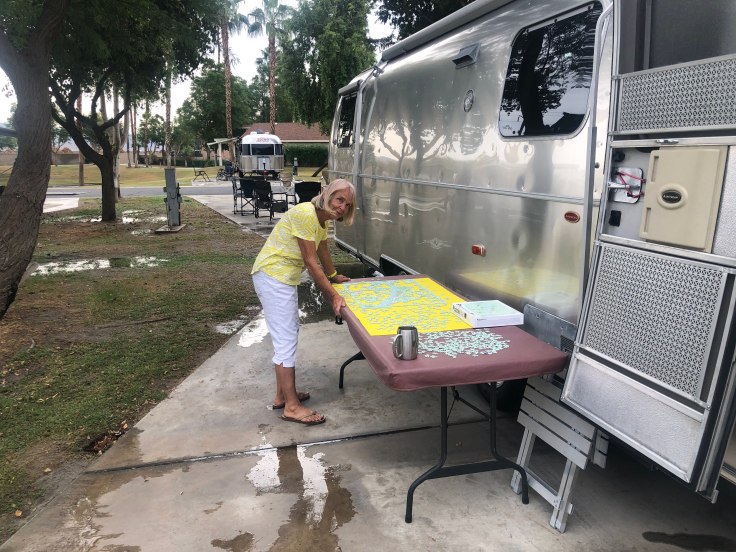
Meanwhile, Lynda spent her day doing a near-impossible jigsaw puzzle, sometimes alone, sometimes along with one, two, or more, other ladies…

img_0183

img_01841

Watching so many football games for so long is exhausting… I collapsed into bed at 11:30 pm…

And an enjoyable time was had by all…

2018-10-13 – Arizona – Day 56 – Taliesin West and the Biltmore… And Rain!

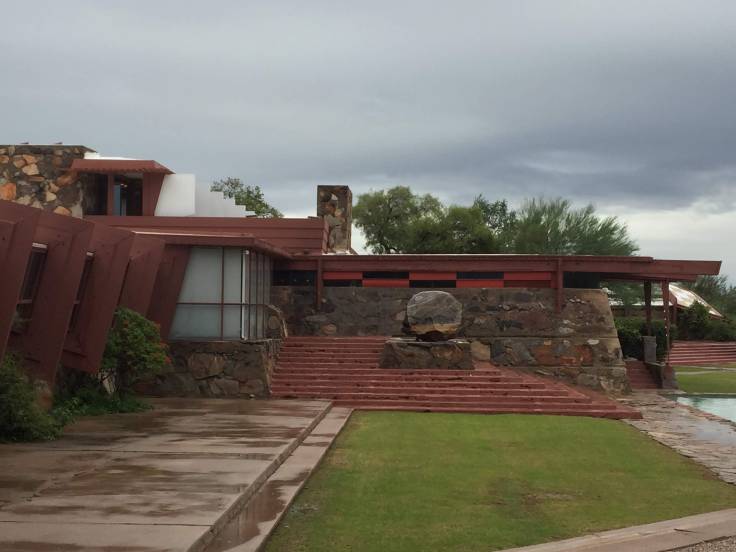
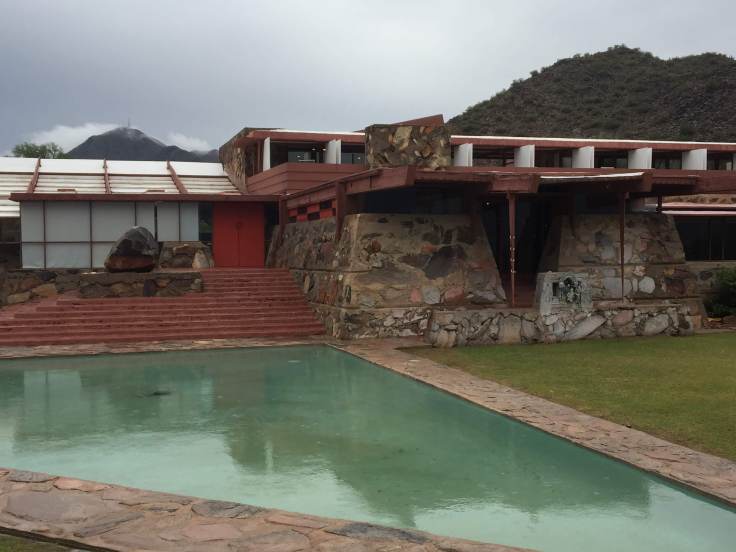
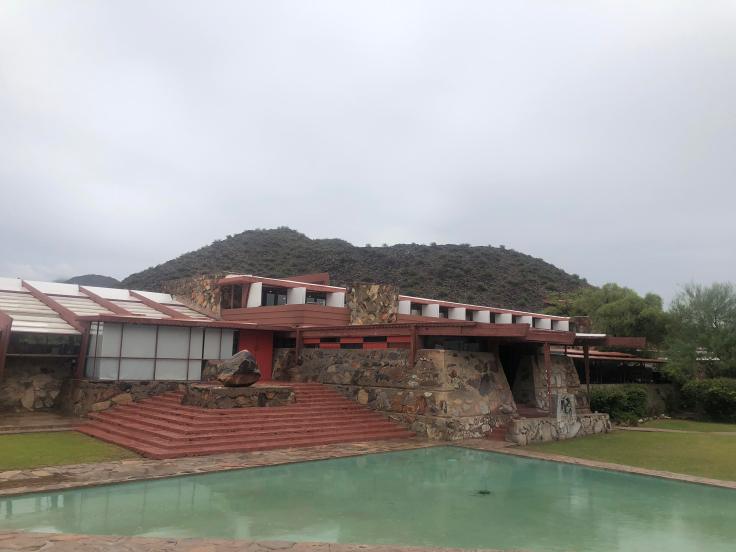
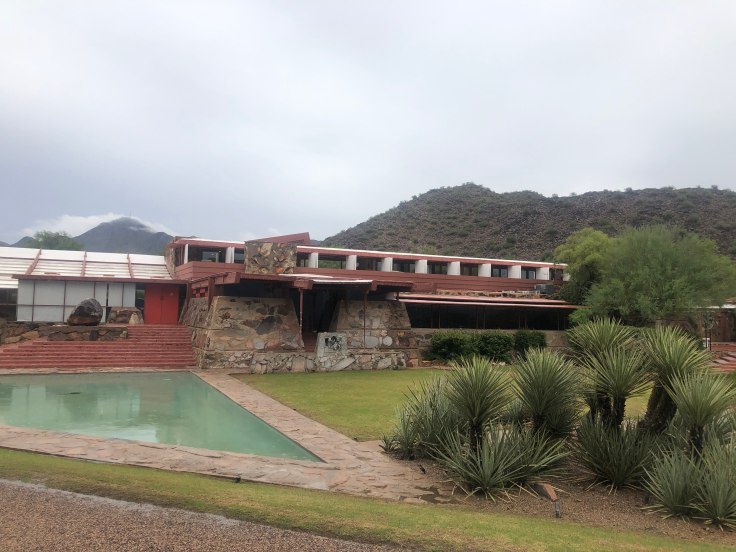
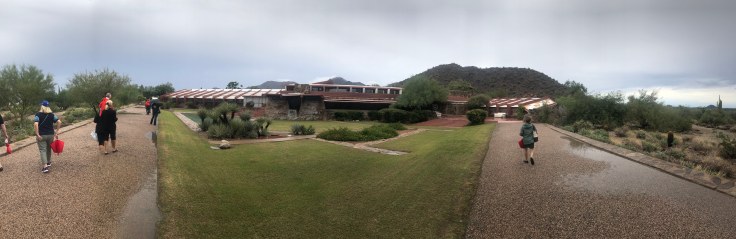
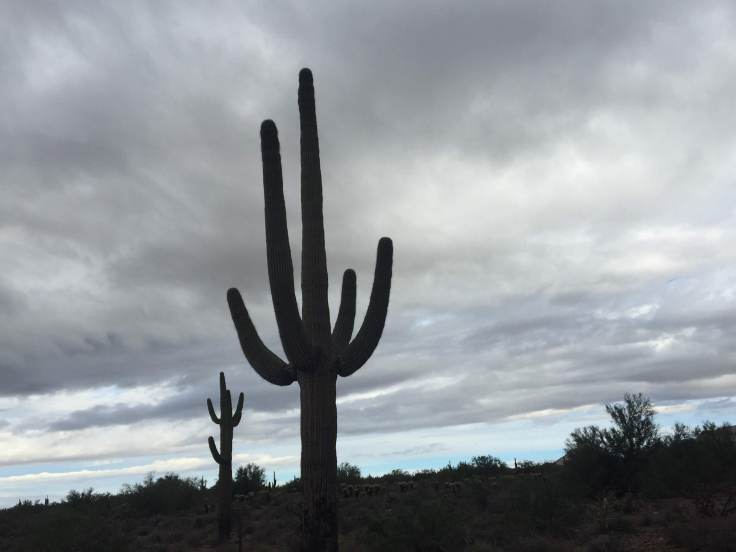
It was slightly raining this morning when we left Sun City to drive to Taliesin West.  We arrived in plenty of time for our tour.  We were able to take a few pictures, but soon it was raining quite hard.
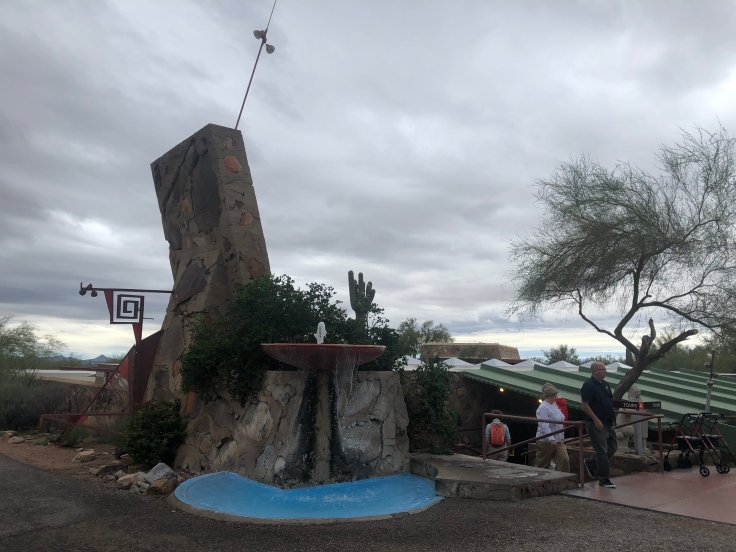
img_6465img_9954img_9955img_9956

Taliesin is today a fully accredited School of Architecture, and it is not affiliated with any university.  It has between 20 and 30 students at any one time, and they can earn a Masters Degree.  The students live and work and study at each of the two campuses for 6 months each year, Summer in Wisconsin, Winter in Arizona…

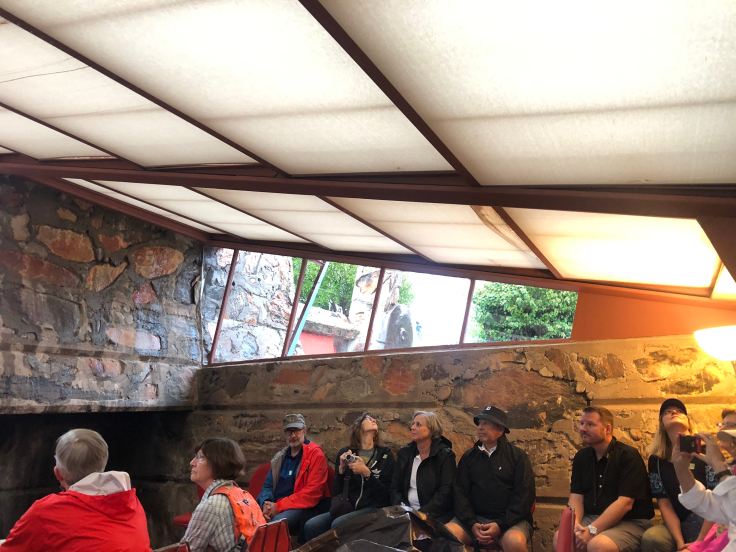
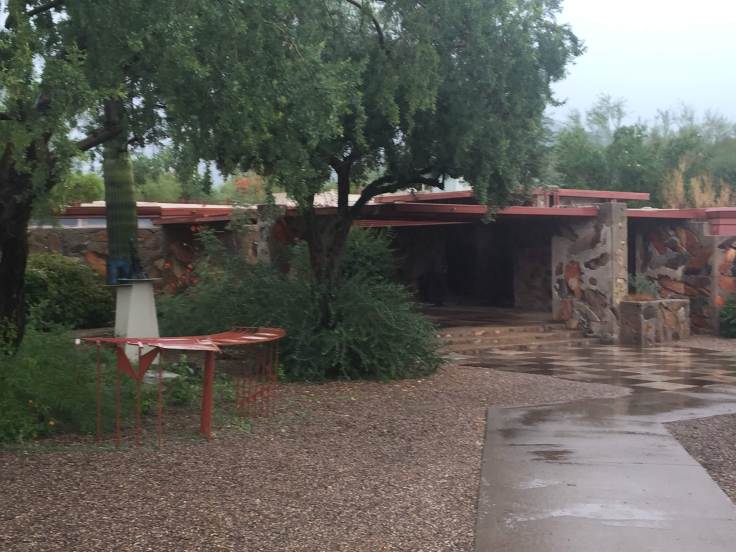
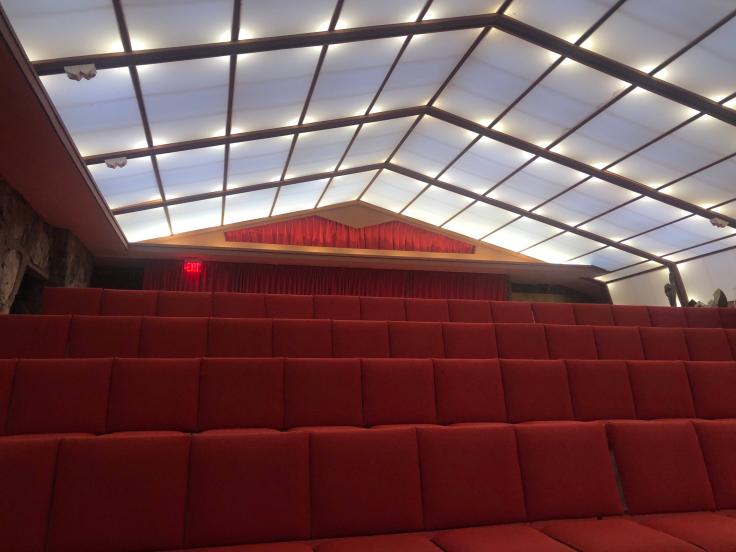
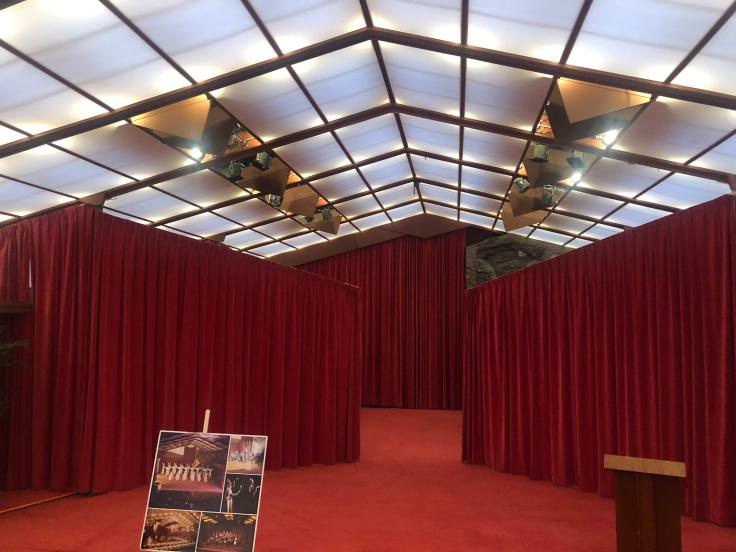
We started the tour, but quickly retreated to the “Dance Pavilion”.  This was a performance space, and it is about the last building built at Taliesin West by Frank Lloyd Wright.
img_9957img_9958

What you need to know is that for FLlW, Taliesin West was his “desert camp”, and he enjoyed “camping” here in maximum communion with nature.  The first few years they put together temporary structures with scrap lumber and canvas.  They left it all when they returned to Wisconsin in the Spring, but when they returned in the fall they found that it had all been stolen and carted away by the locals…

So they began to build more permanent buildings, but they were still built to be open to nature.  The roofs were sheets of canvas, walls and doors were open, maybe partially covered with canvas flaps.  They had no electricity (except from generators) until the early 1950s.

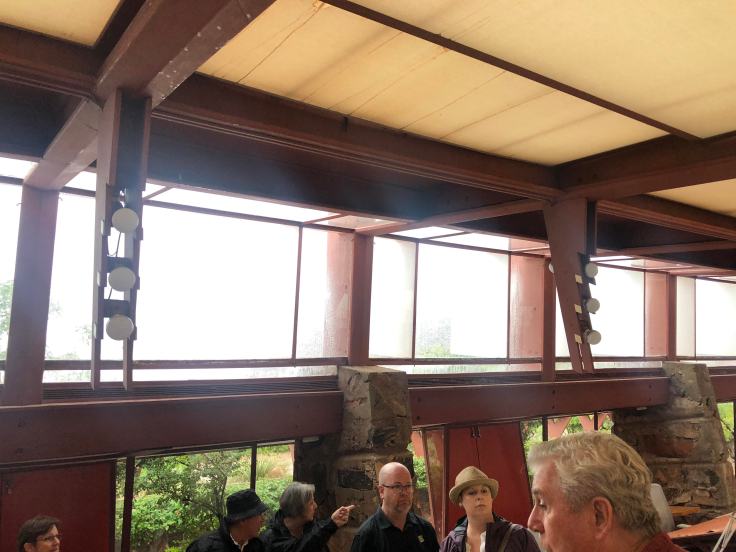
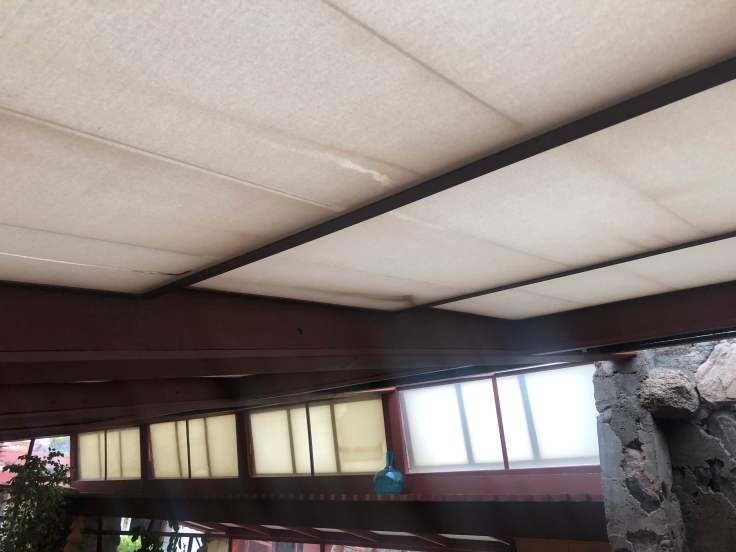
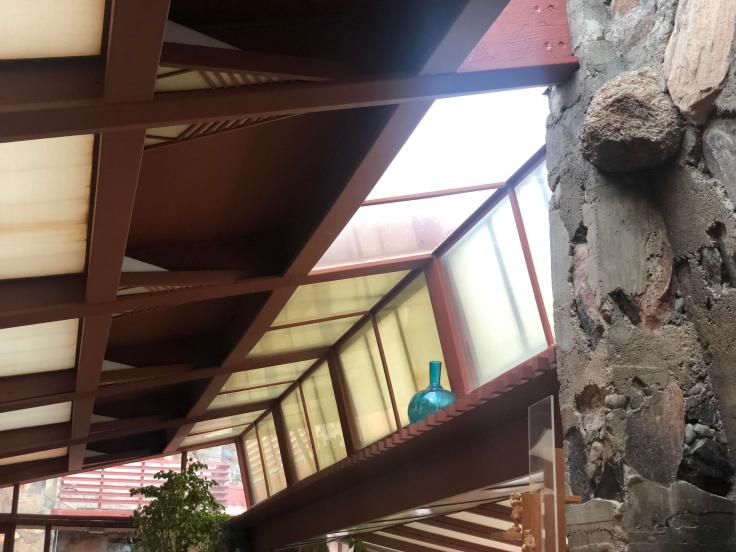
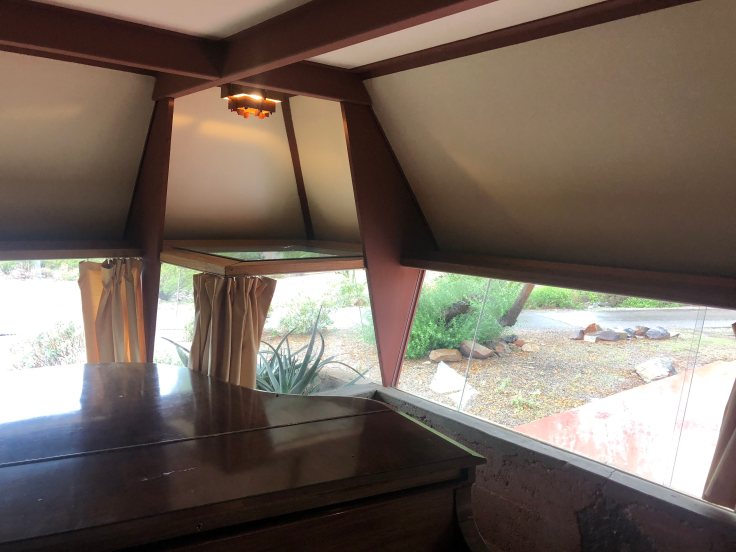
So the dance pavilion was originally an open air pavilion.  Only in later years was it enclosed by glass.  The canvas roofs still remain today, and everyone enjoys the softly filtered light that they provide…

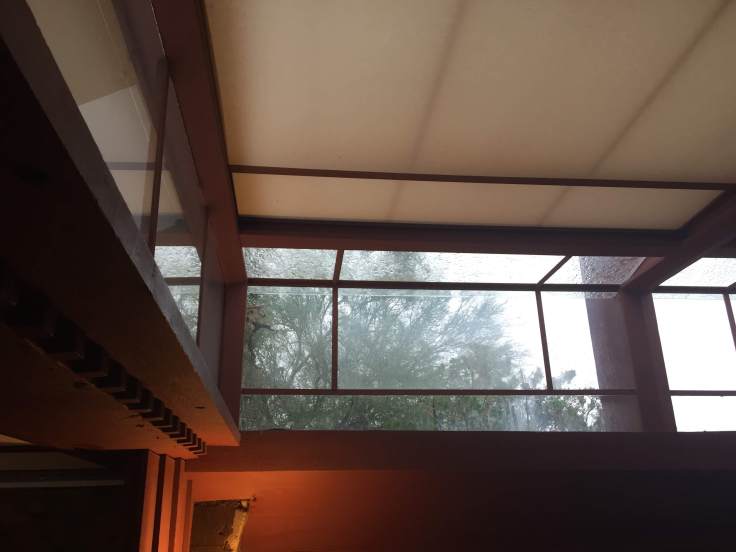
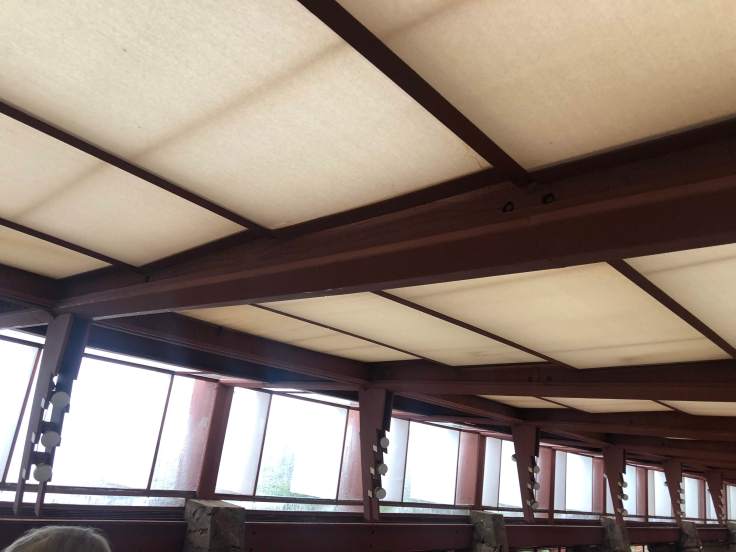
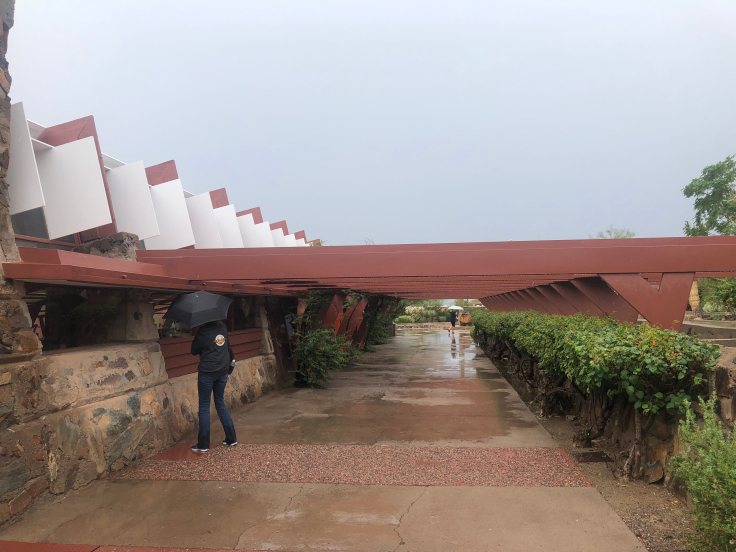
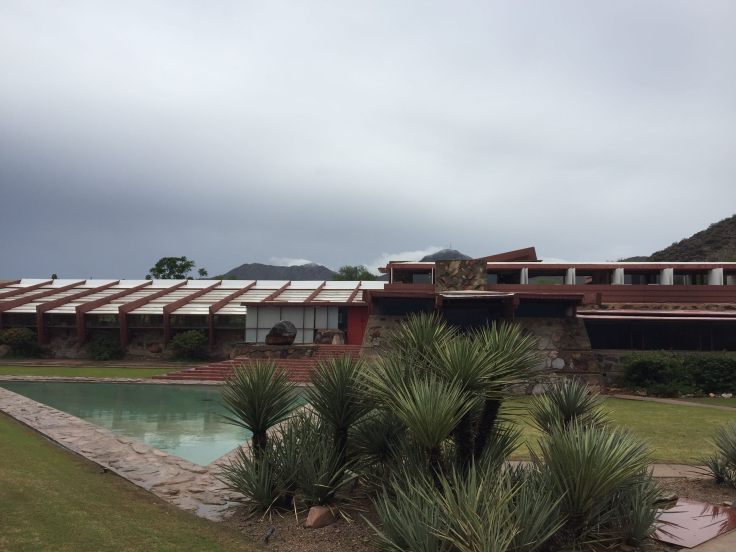
We walked in the rain to the FLlW’s “Office”.  This was not a work room, but was a conference room and presentation room… On the way we could see the canvas roofs.  Originally they were just sheets of canvas.  But they deteriorated quickly under the desert sun, so a panelized system was created to make for easy replacements of individual sections.  Today the canvas is covered by translucent acrylic, and the canvas still needs to be replaced about every five years…
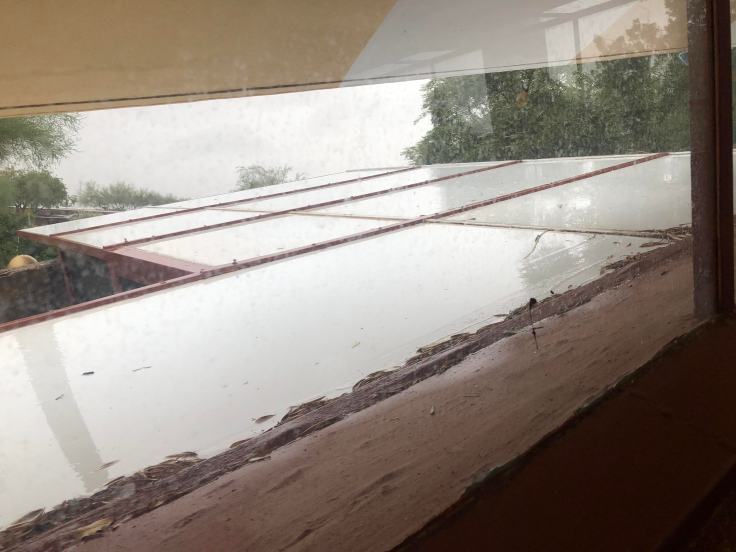
img_9960

Inside, the canvas is supported by steel beams and internal gutters to channel away (most of) the water that seeps through…
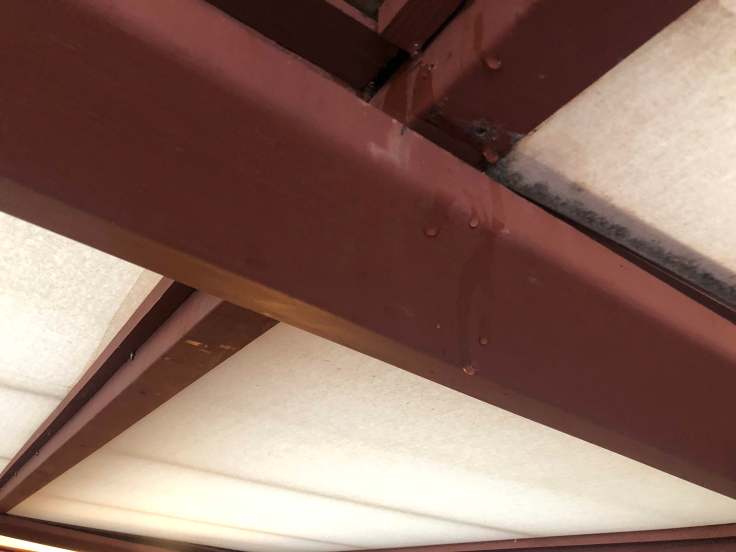
img_9959

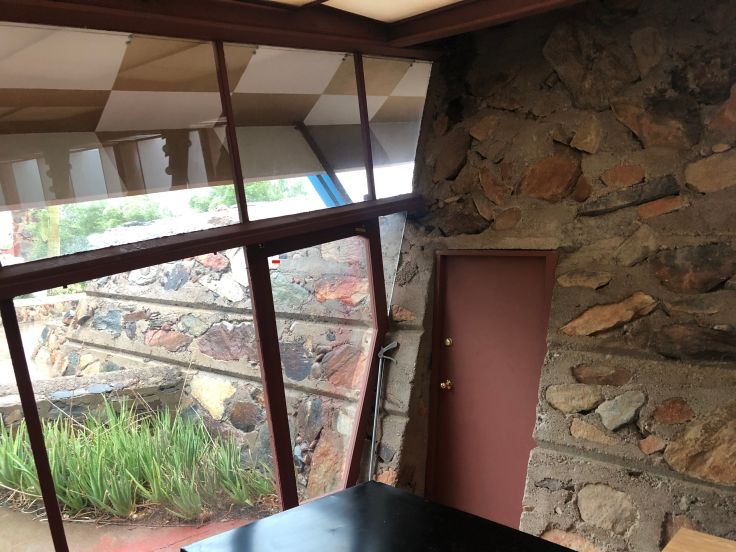
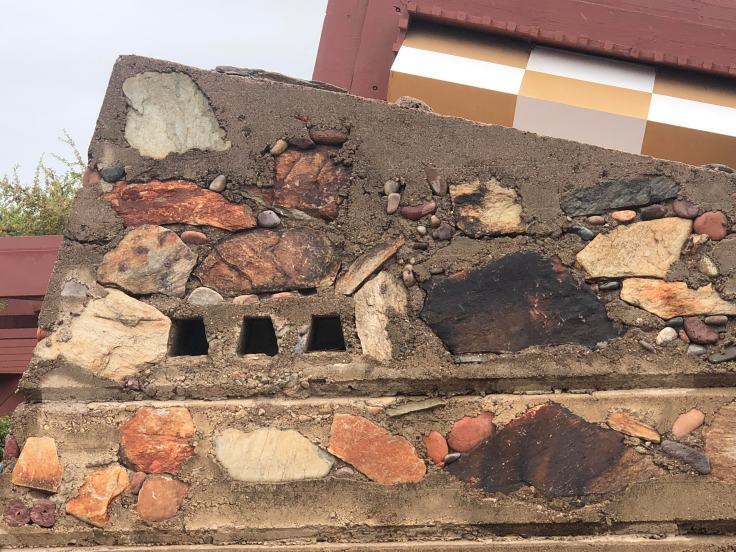
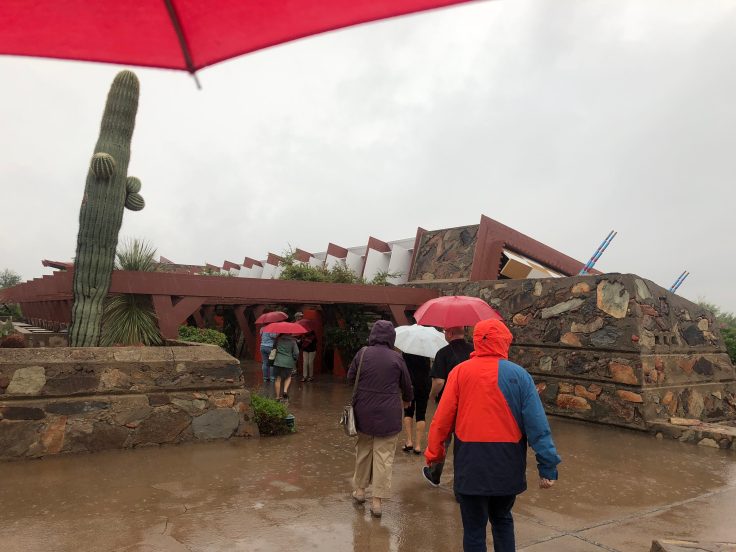
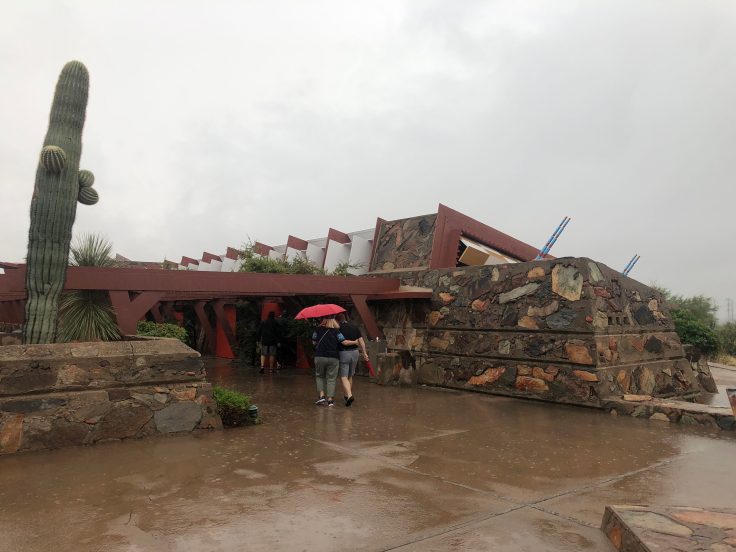
All of the solid walls at Taliesin West are concrete, formed with rocks gleaned from the desert by the Taliesin students.  This has proven to be an economical system that has stood the test of time.  This being Arizona, there is no rebar in these concrete walls…

img_9966

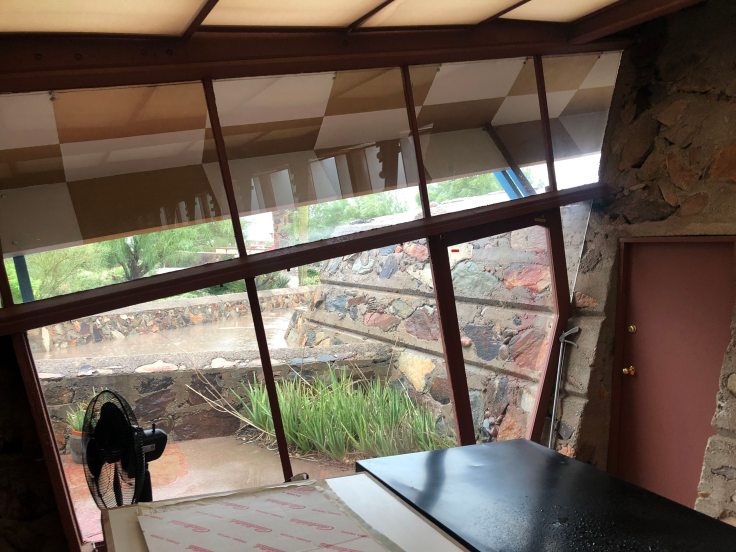
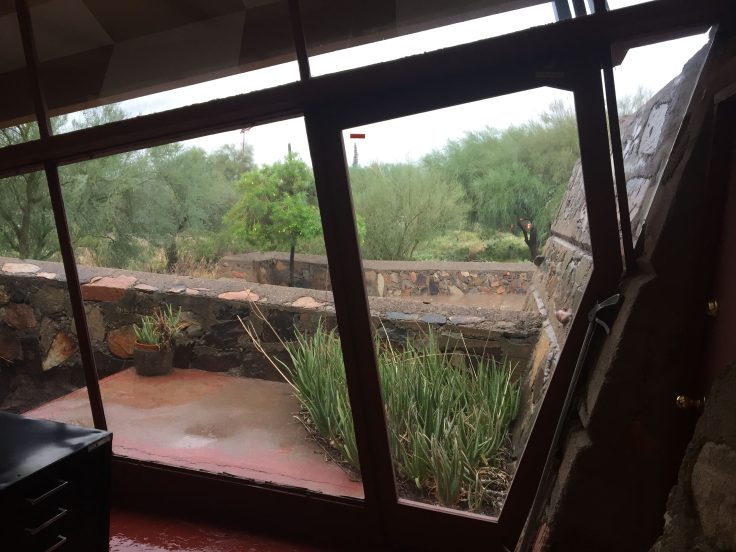
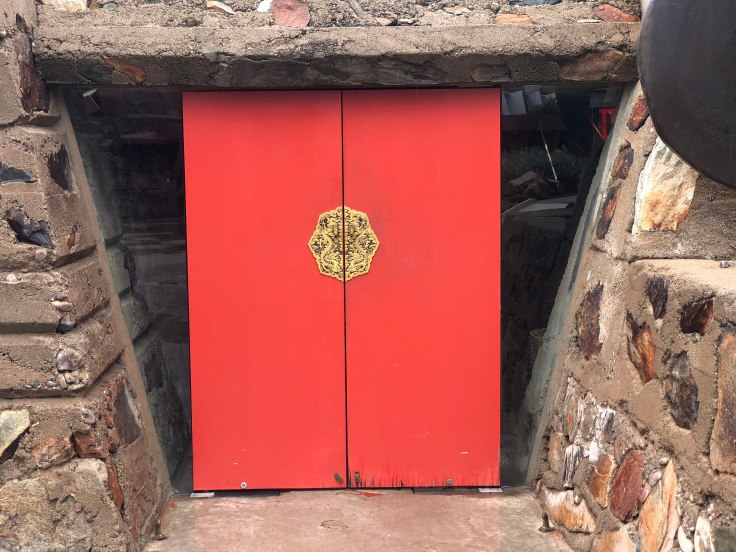
The entrance to the Office is through this odd-shaped door.  The door is barely six feet tall, and the ceiling is not much higher.  FLlW’s secretary sat in this entry space, in a “cave” constructed of this large rock concrete.  This entry exhibits FLlW’s famous “compress and release” concept as you move through the low-ceilinged space into the larger space beyond…
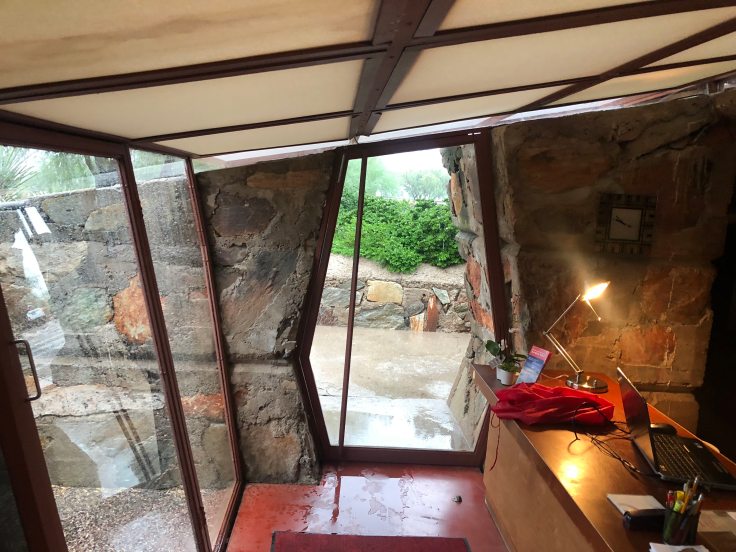
img_9961img_6467

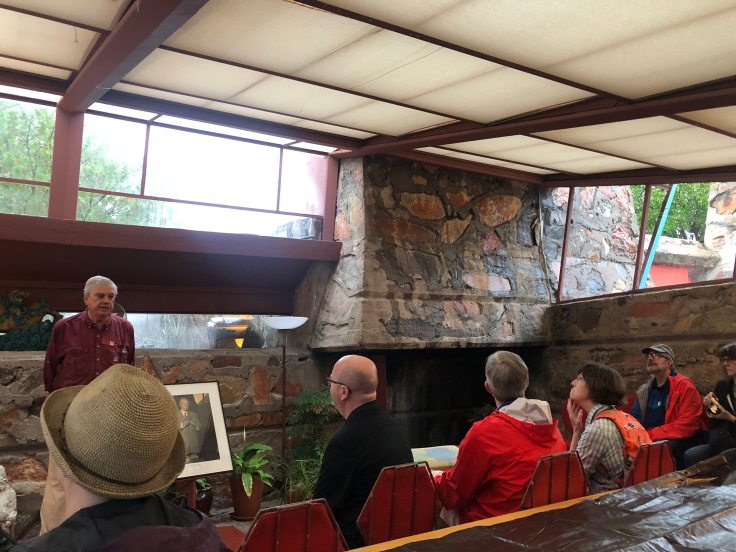
It is a very nice space… Of course, because it was raining, I had to position my chair so that I would not be dripped on…
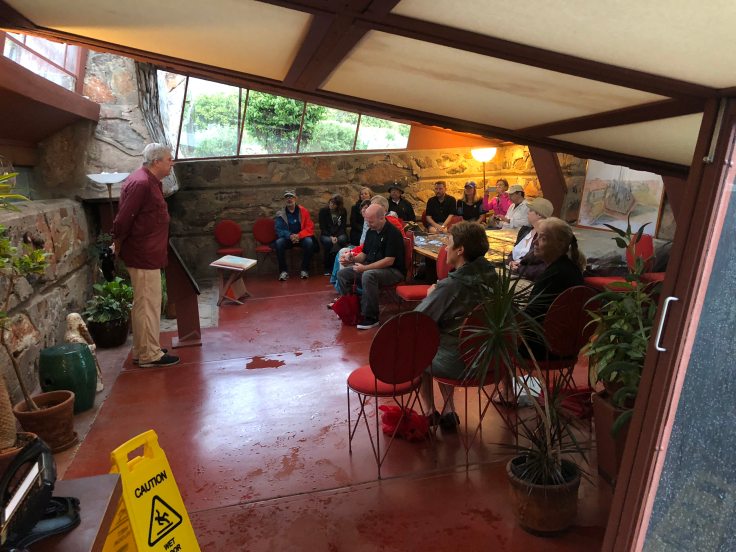
img_9962


img_9963img_9964img_6469

The table you see covered with a tarp to protect it from the rain is VERY low, as are the chairs.  FLlW designed it this way so that when clients looked at the drawings placed on the table they could see them very well as an overview, but if they wanted to examine them more closely they would have to stoop, and it would be very uncomfortable.  He didn’t want his clients looking too closely at the drawings…

img_9965

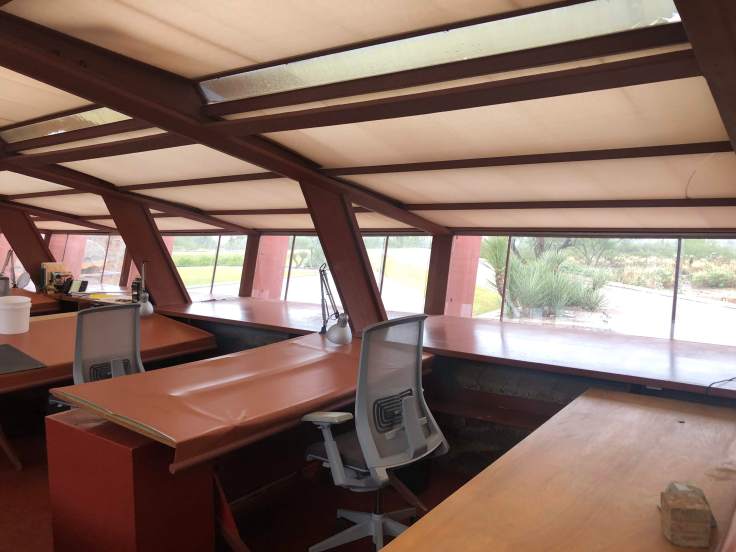
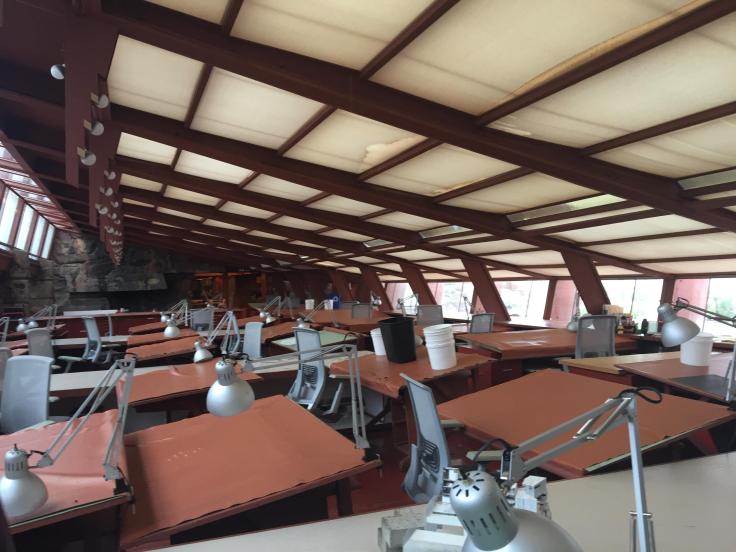
Our next stop was the drafting room.  This room is generally off limits when the students are present, but the students are still in Wisconsin, and they won’t arrive for a few weeks yet… We walked in the rain and passed the concrete walls of the drawing vault.  Paper drawings must always be protected from fire and other elements.  (Today we use computers to draw and make presentations, so they are much safer, if backed-up properly…)
img_99661img_9968

The drafting room has the same style of canvas roof.  The glass ares were originally open, with canvas flaps…

img_9969img_9971img_9972img_6472img_6473img_9973img_9974img_6480img_9975img_6487img_6490img_9976

It is a marvelous space!

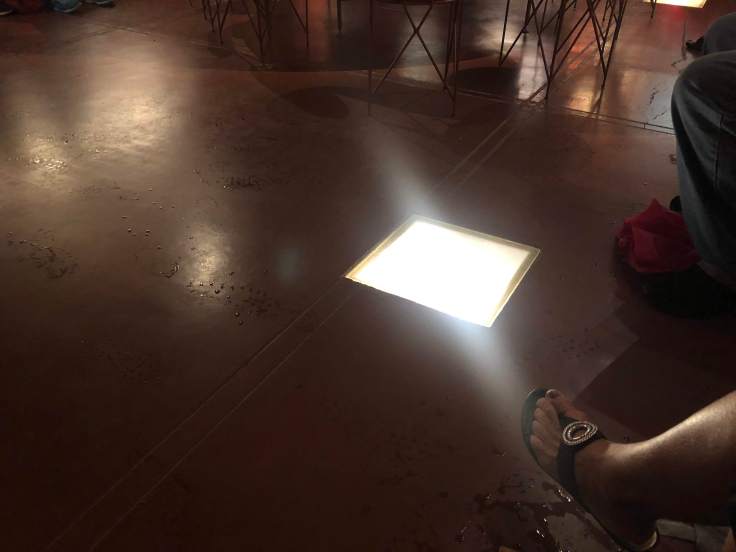
We then moved to the “Kiva”.  This is the original “man cave”, where FLlW would show movies for his students and guests.  Originally this was a windowless storage room.  When they would leave in the spring they would put anything of value that they were not taking with them in here for security… Later they added the projection room and they experimented with lighting…

img_9980

Floor lights…

img_9981

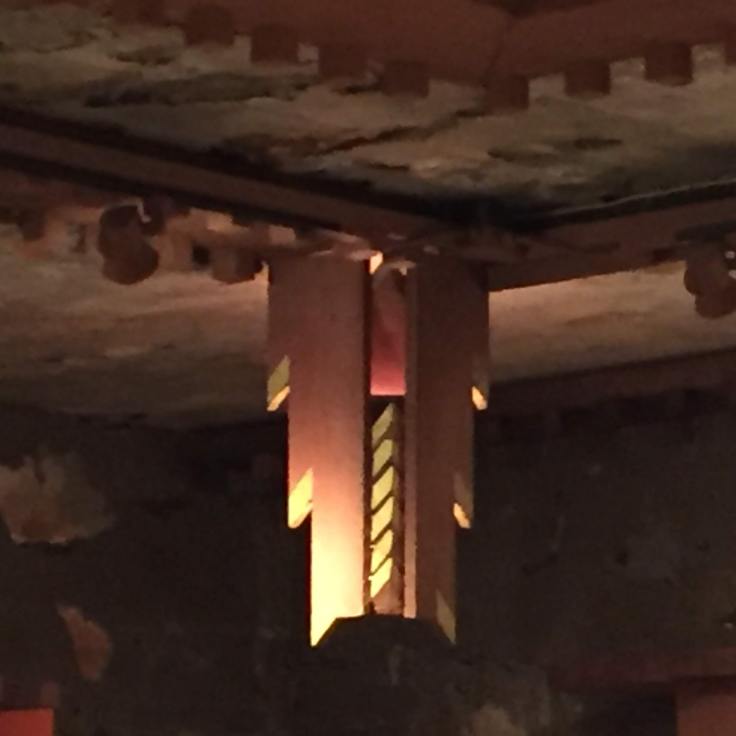
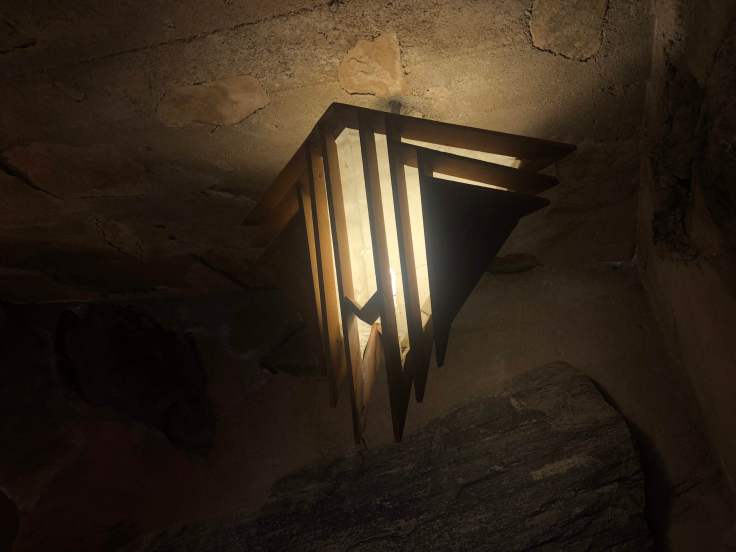
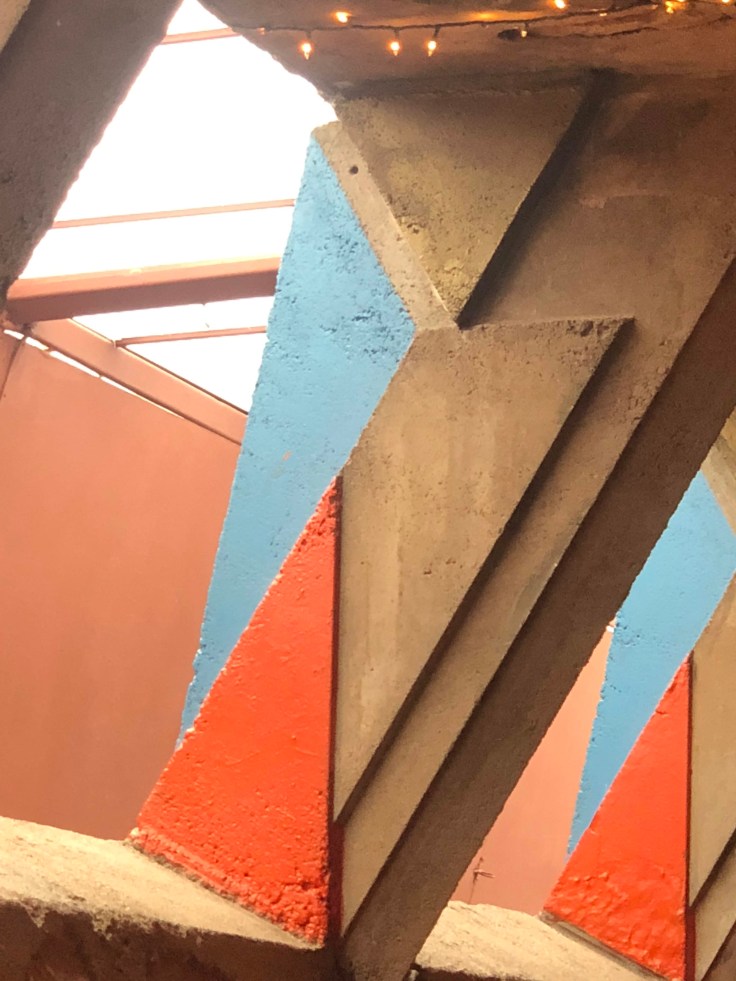
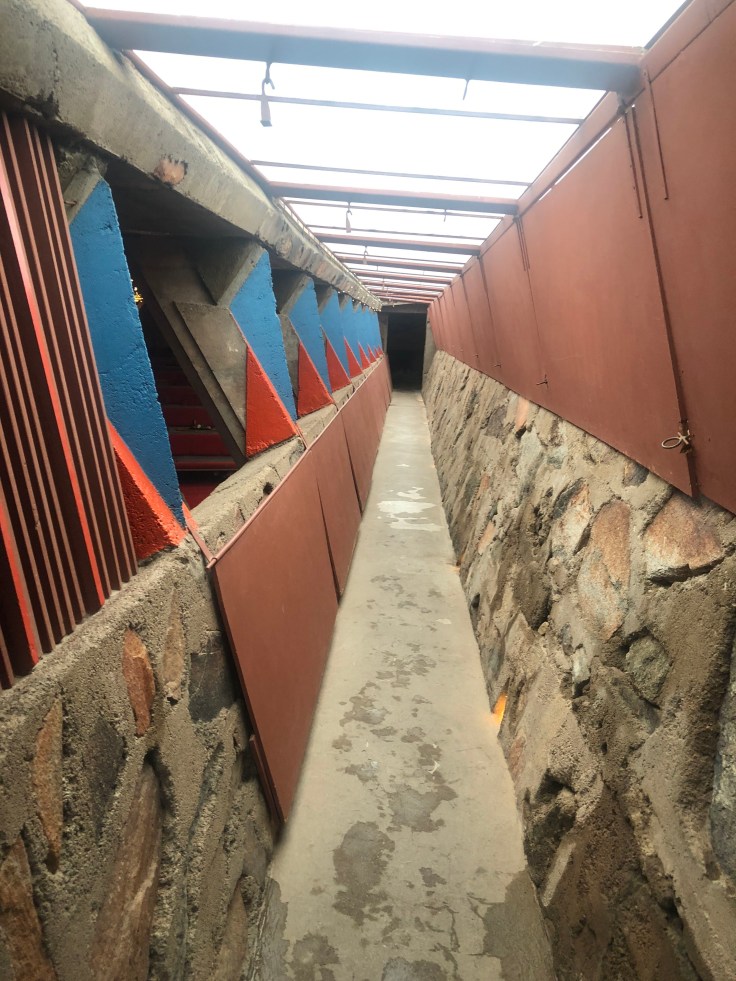
Cove lighting, with “cut-out” shapes to form shadows.  Are these triangles representative of teepees?  Or mountain peaks?

img_9982

Corner lighting…

img_6500

We moved on to the Dining Room…

img_99841img_9985

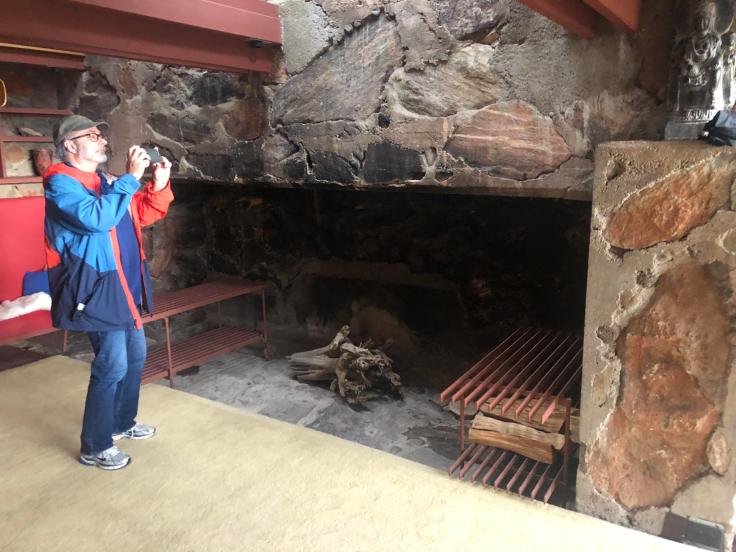
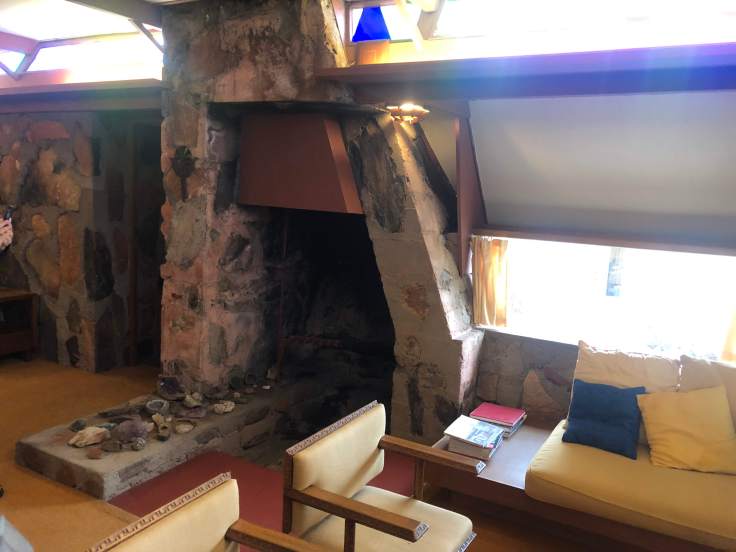
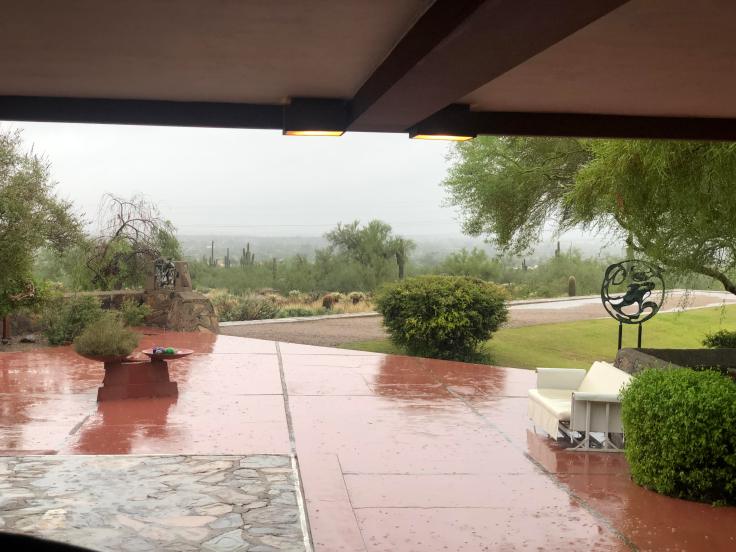
The Dining Room is entered from this Breezeway.  The Breezeway has always been here, but the ceiling was raised after FLlW’s death in 1959.  Apparently his son-in-law, Wesley Peters, who was an MIT-trained engineer, and who was FLlW’s right-hand-man for all things engineering, was 6′-5″ tall, and he hated that he always had to stoop when he was around FLlW.  He wanted a space to sit and enjoy the desert in front of a fireplace and remember FLlW.  So he had the ceiling raised to make this space…
img_9987

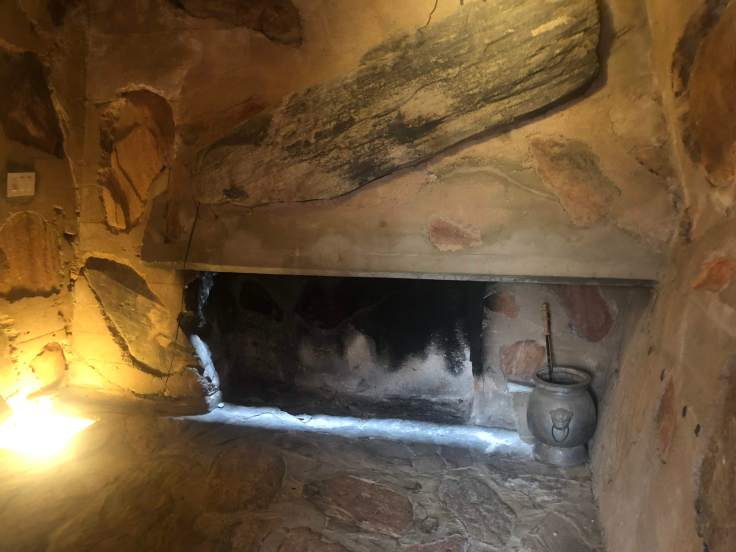
The fireplace…

img_9993

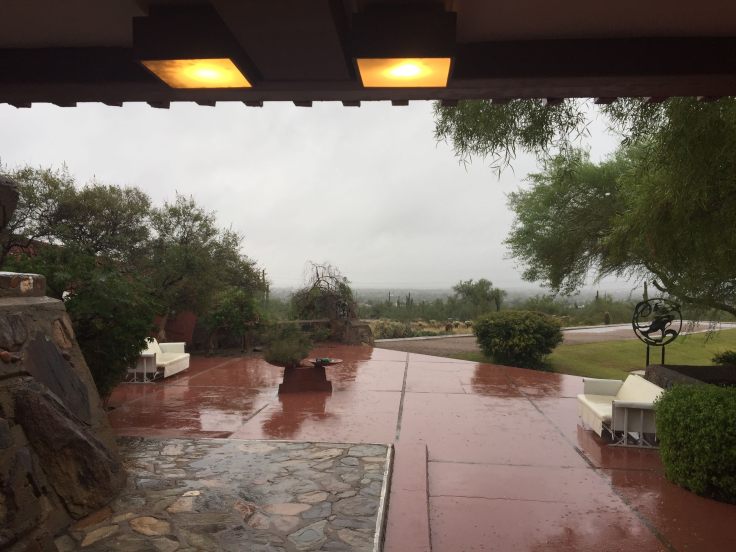
The views…

img_6505img_9990

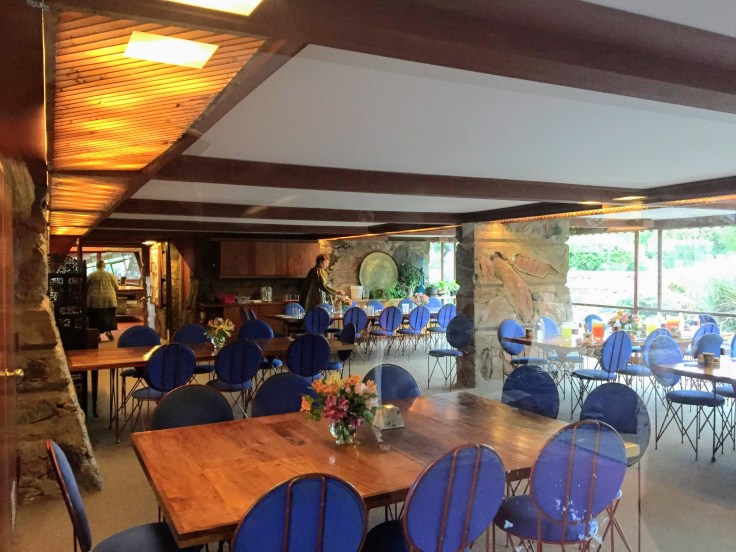
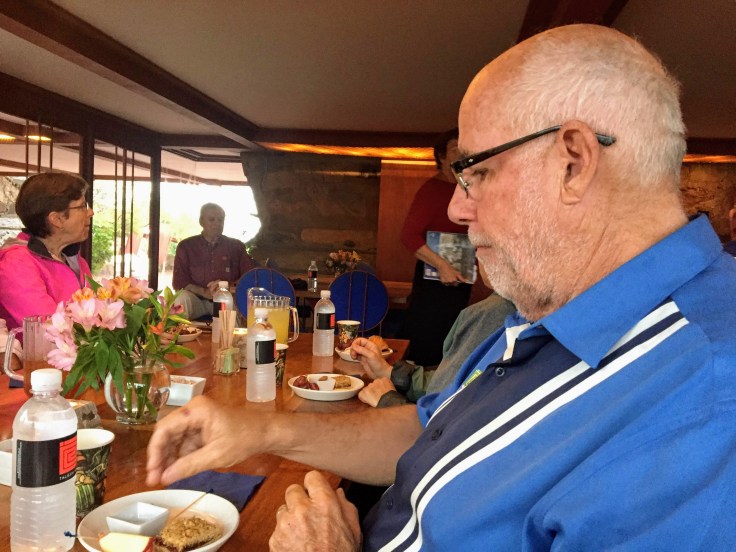
We entered the Dining Room to enjoy a break and a little refreshment…

img_6506img_6507img_6508img_9991

The Dining Room wasn’t always here… It was originally on the opposite side of the house, overlooking the southern views across the desert.  But, in 1948, the local power company strung power poles across the edge of the property to facilitate the rapid post-war expansion of Scottsdale.  FLlW was so incensed at this, after exhausting all avenues of protest, including a letter to President Truman, that he redesigned the buildings and landscaping to reverse the orientation and avoid the views of power poles.  (Truman’s response to his letter:  “Do you really think I have nothing better to do than to worry about your view?”)  Today the power poles have been replaced by giant steel high-tension wire structures… They are quite ugly…)

So we enjoyed our refreshment… We had a VERY interesting talk by a woman who was born at Taliesin.  She lives here today, where she works in the archives department.  Her mother and father were some of the first students here in 1937.  They stayed on after their school days were over, having two children here.  They moved away briefly during WWII; they subsequently divorced, and her mother moved back and lived and worked here the rest of her life.  She passed away just last year, well into her nineties.  There are three other original students who came and never left who still live here…

We saw many photos of life at Taliesin in the old days, and many interesting stories.  Originally, the students pitched tents out in the desert (there were no dormitories…) or they built “Desert Shelters” in which to live.  No electricity, running water, or kitchens.  Students still live out in the desert today… If you come to see Taliesin West in the winter you can tour the student “homes”…

We thoroughly enjoyed her talk…

But it was time to move on… We left the Dining Room via the Breezeway and went to the entrance to Mr. and Mrs. Wright’s home…

img_9992

As usual, the front door is hard to find, and is very small…
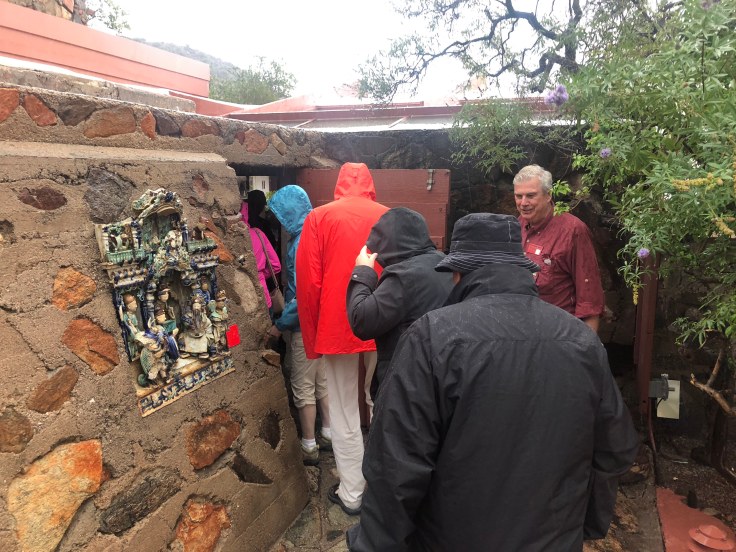
img_9994

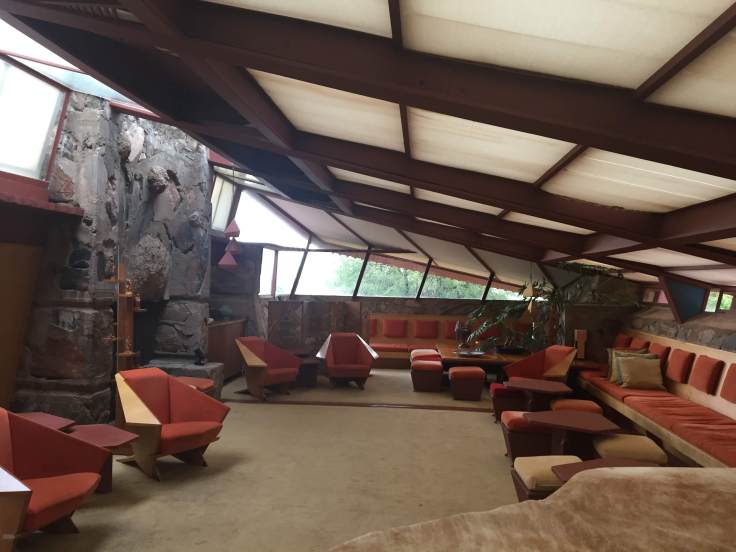
This is the Garden Room, or the entertaining space.  Parties, called, “Taliesin Nights”,  were held here most Saturday evenings.  Celebrities, friends, and students mixed, all in formal attire.  In the early days FLlW would send a large flat bed truck the four miles to Scottsdale to pick up the guests, so that they would not have to navigate the narrow, steep, dirt road…

The room has a canvas roof; glass was added in the late 1940s, and central heat and AC was added by Mrs Wright in the 1970s… It is a lovely room…
img_6509

Water is added whenever it rains…

img_0010

img_9995img_9996

img_9998img_0001img_0002img_0003img_0004img_0012img_0013


img_6513img_6514

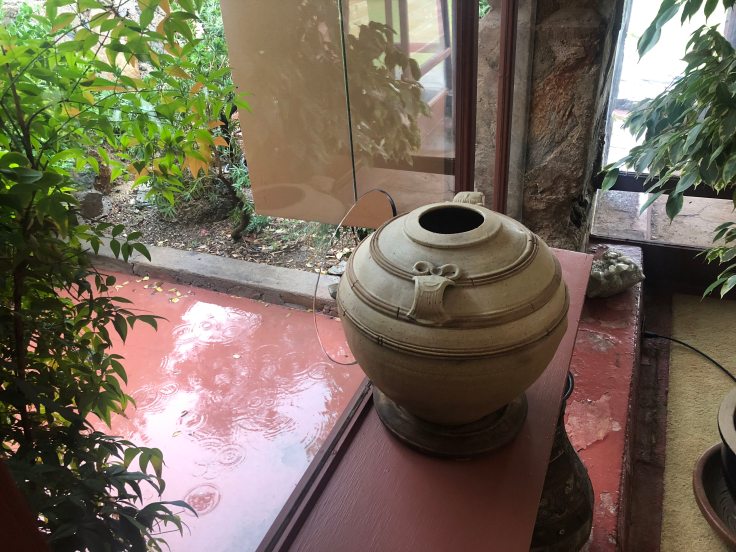
Adjacent to the Garden Room is the Wrights’ private sitting room.  Originally it was an open-air space, open to take in the nature of the desert…

img_0017img_9997img_0014

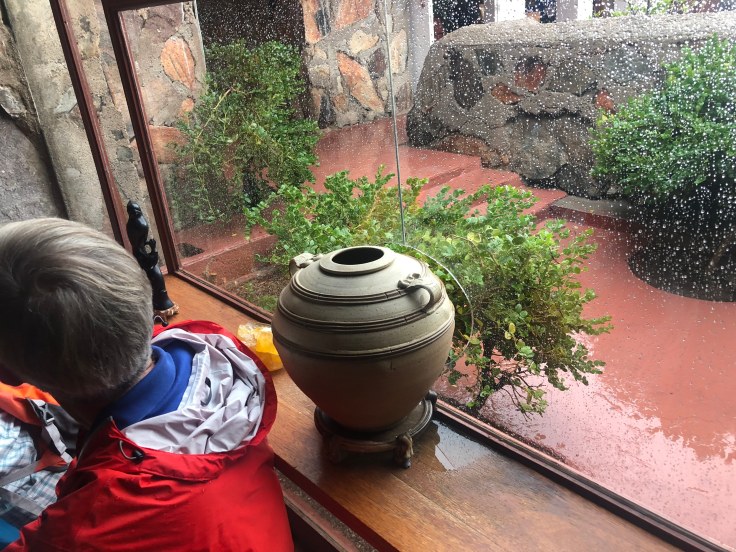
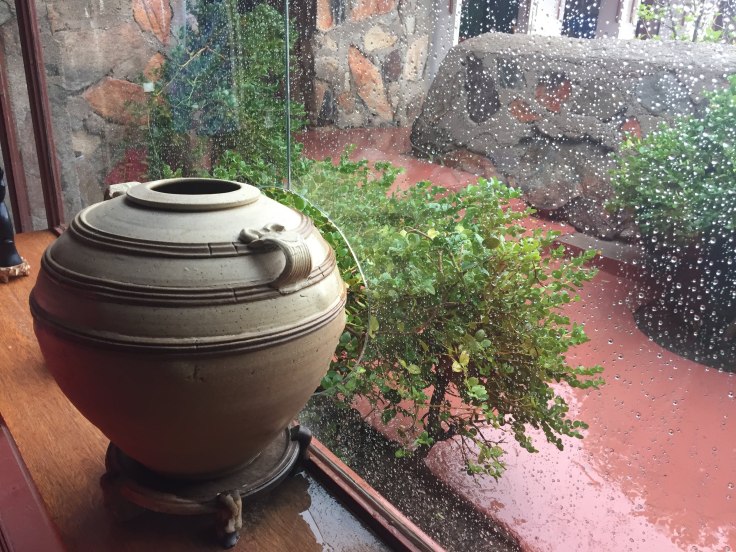
But Mrs. Wright eventually tired of the exposure to the desert and asked that glass be installed.  FLlW objected for many years… Finally, FLlW consented, and ordered the apprentices to install the glass.  When they asked what they should do with the pots on the shelves, FLlW angrily answered, “Leave them exactly where they are”!  Thus:
img_0015img_0016img_6515

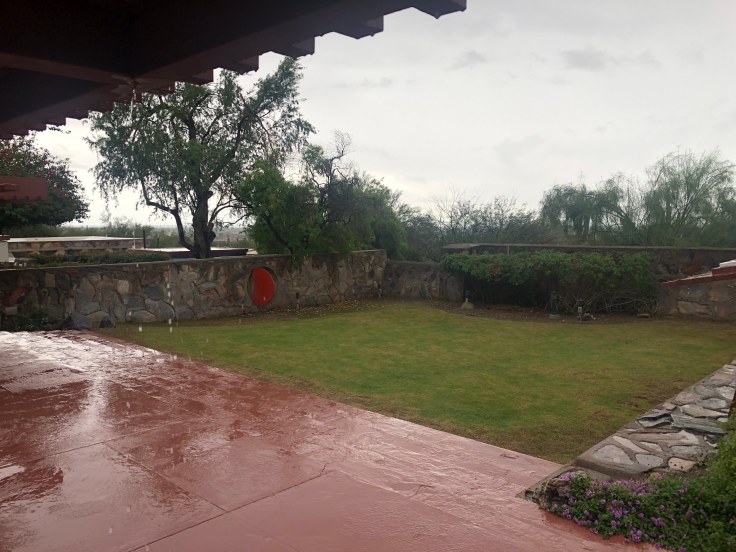
The Wrights’ bedroom and Mrs. Wrights sitting room, face onto the desert, but the views have been constructed, using fencing and trees, to obscure the power poles… The “Moon Gate” allowed the Wrights’ children to access the adjacent courtyard and their rooms.  Mrs. Wright eventually built another bedroom suite for herself after FLlW’s death…
img_0018img_0019

The Sprites seen here are two of the five remaining original Sprites (out of over 500) that were designed and built for the Midway Gardens project in Chicago in 1915.  The others were all bulldosed into Lake Michigan, along with the rest of  Midway Gardens, after prohibition doomed the project and the City wanted something else on the site…

img_0020

This is the Master Bedroom…

img_0023img_0024img_0025

The bathroom is sheathed in polished aluminum… as befitting an Airstream!

img_0026

More lighting experiments in the bedroom:  recessed lighting and up-lighting…

img_0027img_0028

We then moved to one of the guest cottages.  The rain is briefly letting up…
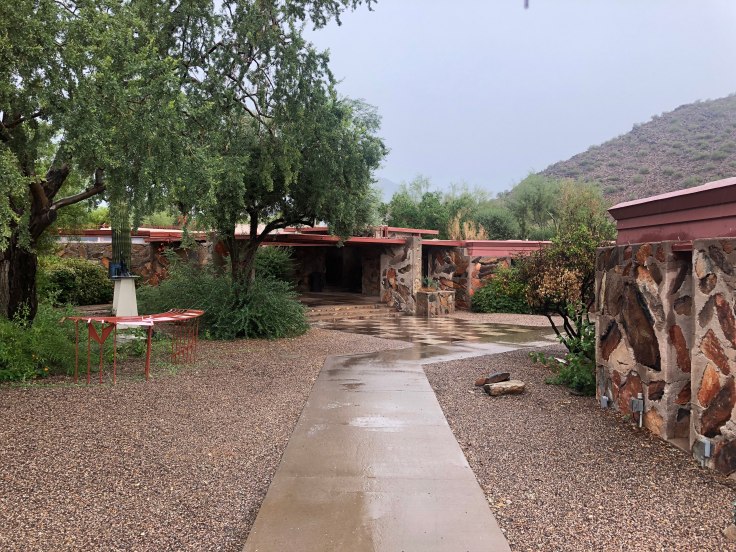
img_0029

img_0030img_6519img_0032img_0033img_0034img_0035img_0036img_0037img_6521img_0038img_6522img_0039img_0040img_0041

Walking back along the main house… This is about the only 2-story building… The upper floors contain apartments for staff and/or guests…
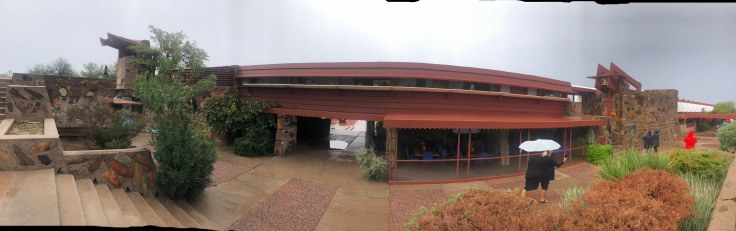
img_0045

The dinner bell…

img_6530img_0047img_0048

Our last building is the Cabaret…

img_0061

This is an underground “supper club” where the students and staff would put on various types of entertainment… The acoustics are great!
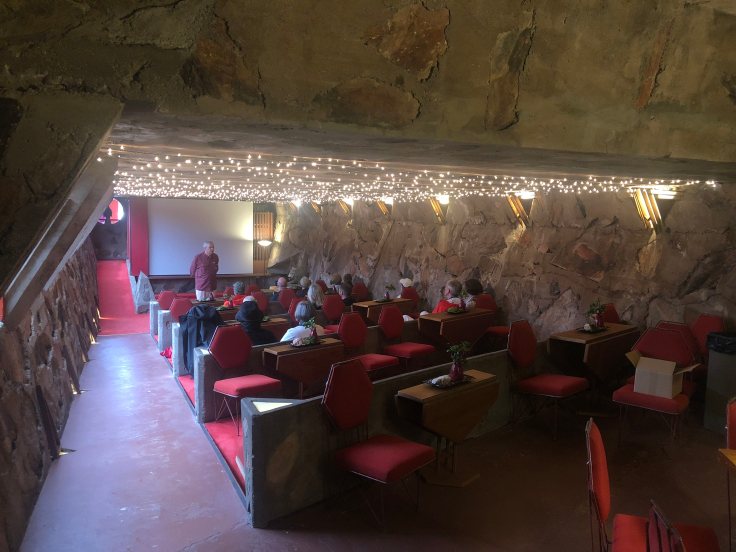
img_0050

Notice that the rows of seats are angled relative to the stage area.  Mr. Wright always sat a certain way in venues like this, so the seating was designed to accommodate his habits.  This was his way of dictating how you sit if you want a good view of the stage…
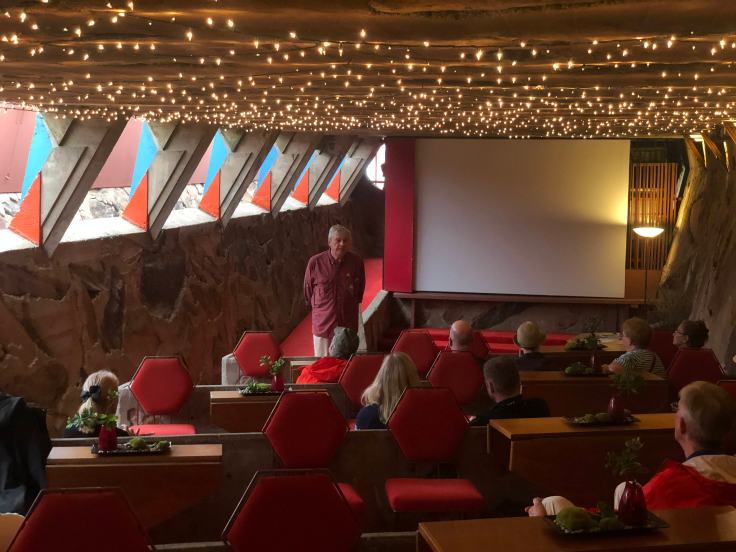
img_0051img_0052img_0053img_0054img_0055img_0056img_0057img_0058img_0059img_0060

I couldn’t help peeking into the kitchen and service corridor…

img_0049

As we left the Cabaret the rain stopped briefly, so we could take a few photos of the exteriors…
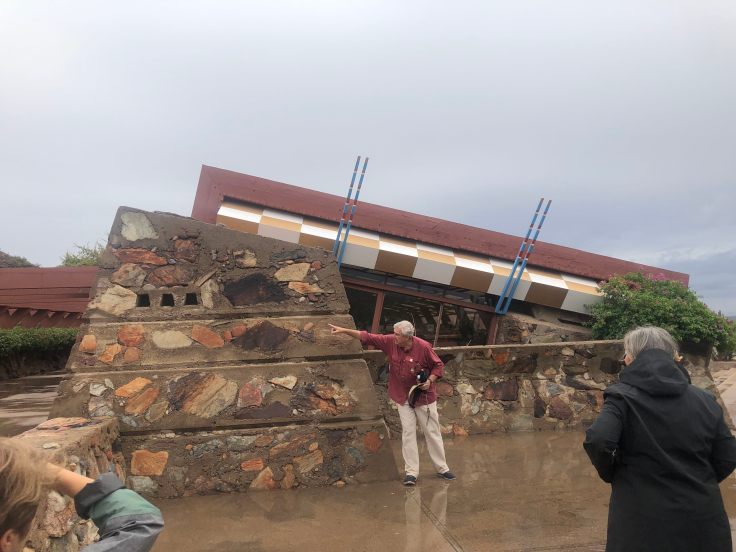
img_0062

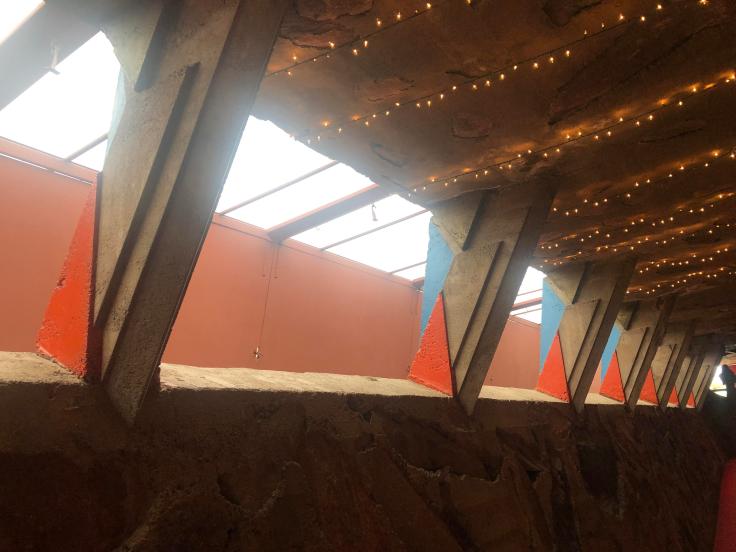
Ventilation holes in the vault…

img_0063

The Office…

img_0064

The Drafting Room…

img_6535img_0065img_0066img_0067img_6540img_0070img_0072img_6541img_6542img_0073img_6543img_6544img_0076

The view of the power towers…

img_0078

img_0079

img_6547

And then our three hour tour was over…

We left, sadly, in the rain…

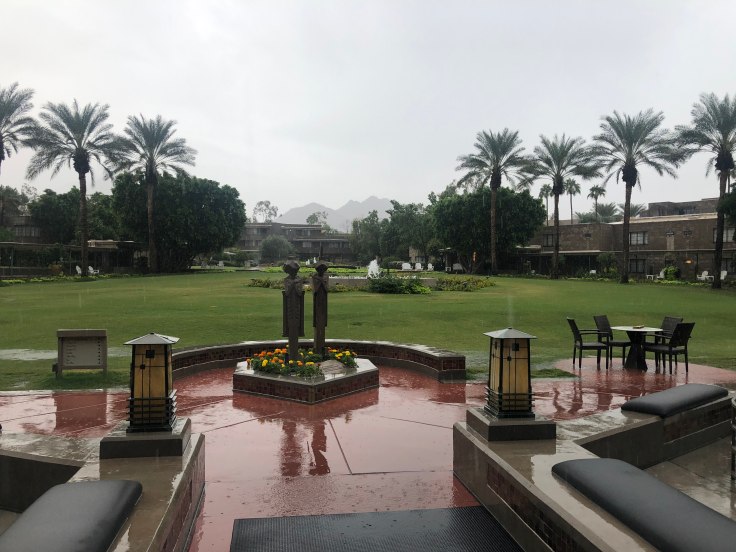
We dropped in at The Arizona Biltmore, a Waldorf Astoria Resort… We immediately noticed the Sprites… Oh.  And it was raining with a capital RAIN!
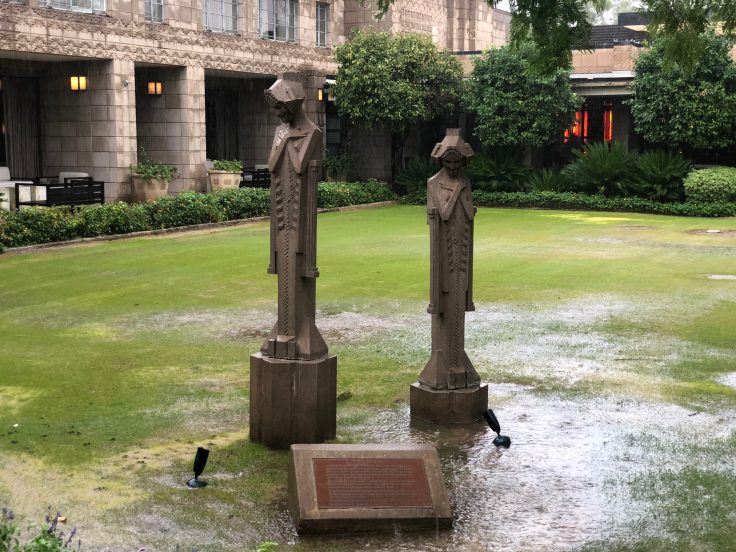
img_0080

Warren McArthur, Jr. and his brother Charles McArthur along with John McEntee Bowman, opened the Arizona Biltmore on February 23, 1929.

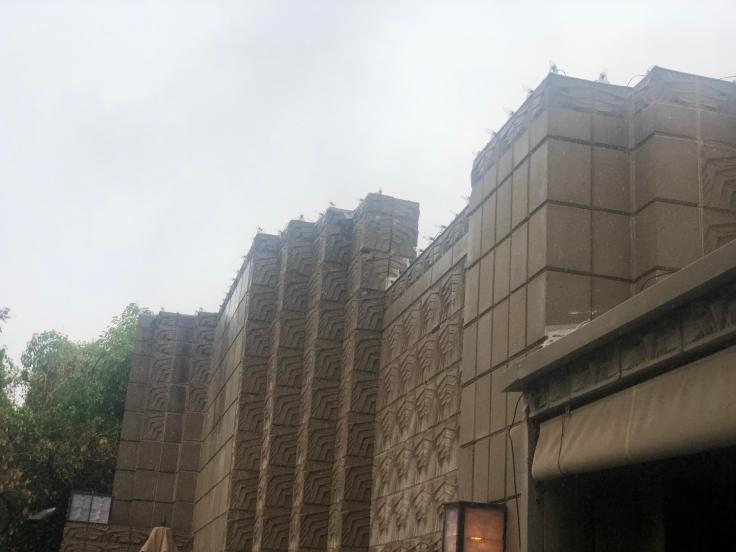
The Arizona Biltmore’s architect of record is Albert Chase McArthur (brother of the hotel owners), yet the design is often mistakenly attributed to Frank Lloyd Wright.  This is due to Wright’s on-site consulting for four months in 1928 relating to the “Textile Block” construction used in the hotel.  Albert McArthur had been a draftsman for Wright, and specifically asked Wright to assist with implementing the textile block system, which became a signature element of the hotel’s appearance.  The hotel has similarities to several Wright buildings, especially in the main lobby, owing to a strong imprint of the unit block design that Wright had utilized on four residential buildings in the Los Angeles area six years earlier.  McArthur is indisputably the architect as original linen drawings of the hotel in the Arizona State University Library archives attest, as does a 1929 feature article in Architectural Record magazine. The two architects are a study in contrast with the famous and outspoken Wright being self-taught and never licensed as an architect in Arizona. The more soft-spoken McArthur was Harvard trained in architecture, mathematics, engineering, and music. McArthur obtained an architect’s license in Arizona, number 338, in 1925, the year he arrived in Phoenix to begin his practice.

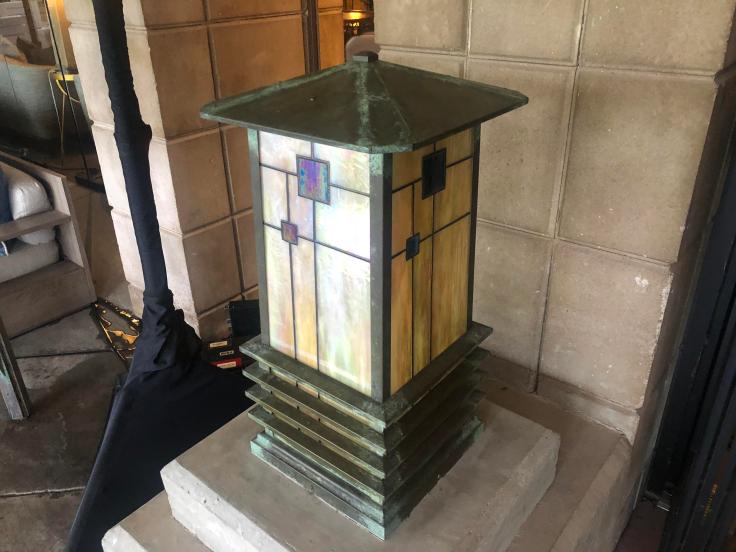
Reproductions of the geometric ‘sprite’ statues originally designed by sculptor Alfonso Iannelli for Wright’s 1915 Midway Gardens project in Chicago are placed around the property.  Also, the original hotel solarium was converted to a restaurant in 1973 and since the mid-1990s has been named ‘Wright’s’.  Three on site restaurants bear Wright’s name, Wright’s at the Biltmore, The Wright Bar, and Frank & Albert’s.

We were there to have lunch at Frank and Albert’s

We looked around and found many interesting details…

img_6549img_6550img_0083img_0088img_0089img_0091img_0092img_0093img_0095

And then we enjoyed a very nice lunch…

img_6552

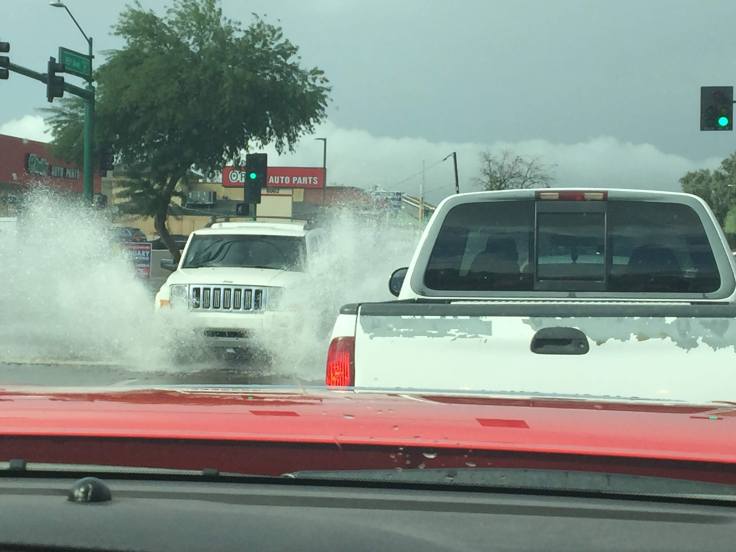
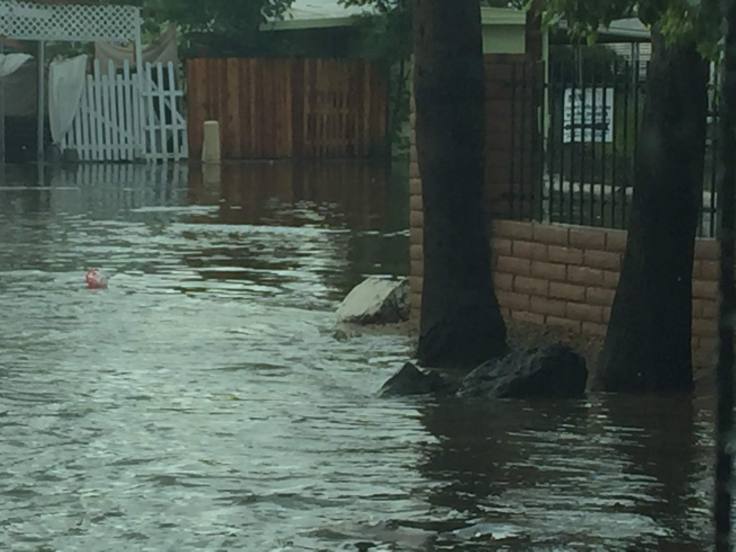
Driving back to the Villa proved to be quite an adventure…

img_6556img_6559img_6562img_6564img_6573img_6575img_6576img_6577img_6578img_6582img_6583img_6586img_6587img_6589img_6590img_6591

We did safely return to the Villa and spent the rest of the day and evening watching football…

And an enjoyable time was had by all…

2018-10-12 – Arizona – Day 55 – Arcosanti and Taliesin West

We packed up early, left Camp Verde, and headed south.  Our first stop was at Arcosanti:

img_9917

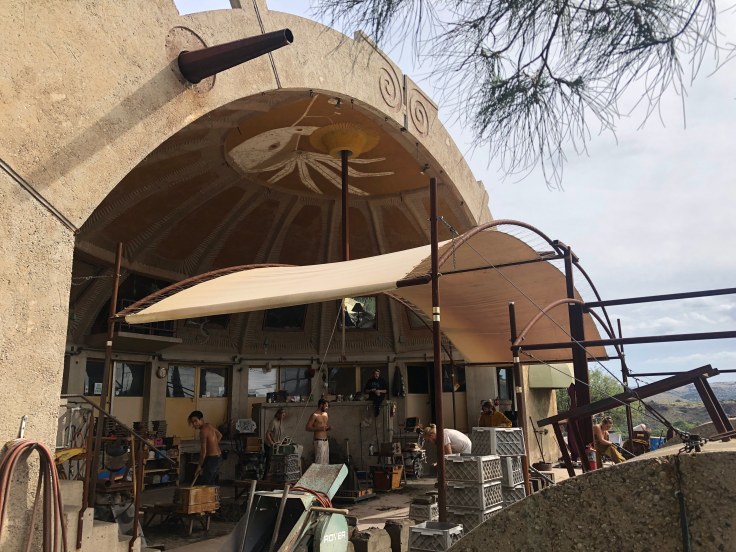
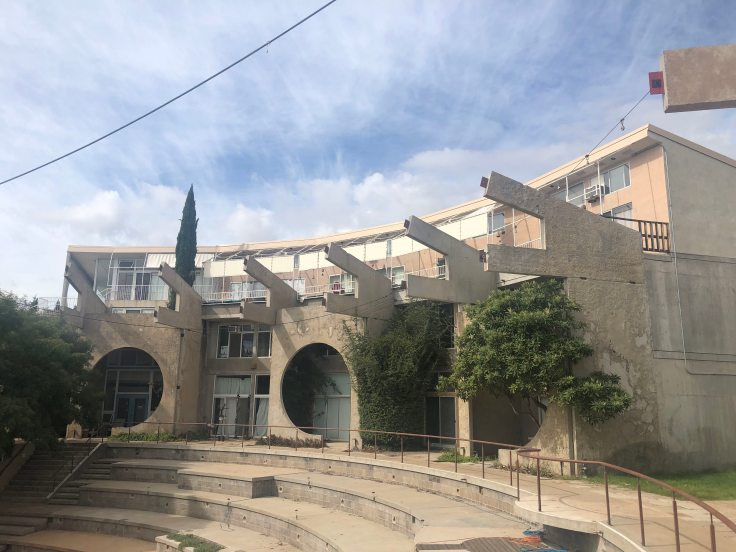
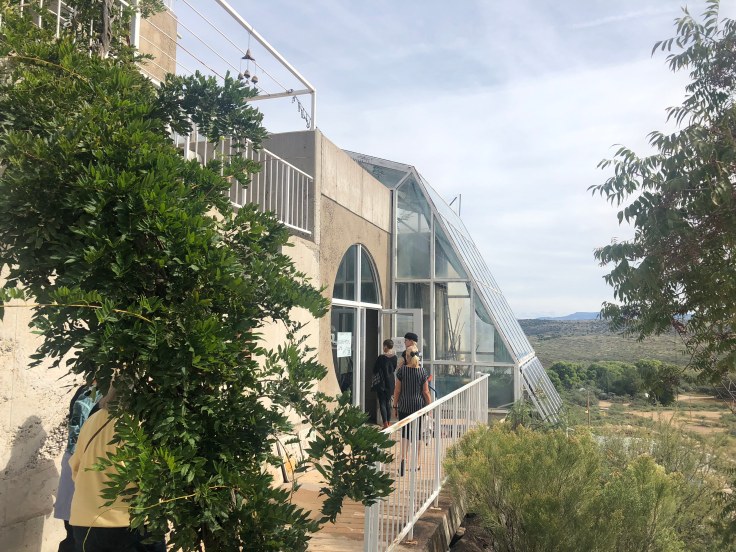
Arcosanti is a planned experimental town with a molten bronze bell casting business 70 miles north of Phoenix, at an elevation of 3,732 feet.  Its “arcology” concept was posited by the Italian-American architect, Paolo Soleri, a former student of Frank Lloyd Wright.  He began construction in 1970 to demonstrate how urban conditions could be improved while minimizing the destructive impact on the earth.  He taught and influenced generations of architects and urban designers who studied and worked with him there to build the proposed ‘town.’

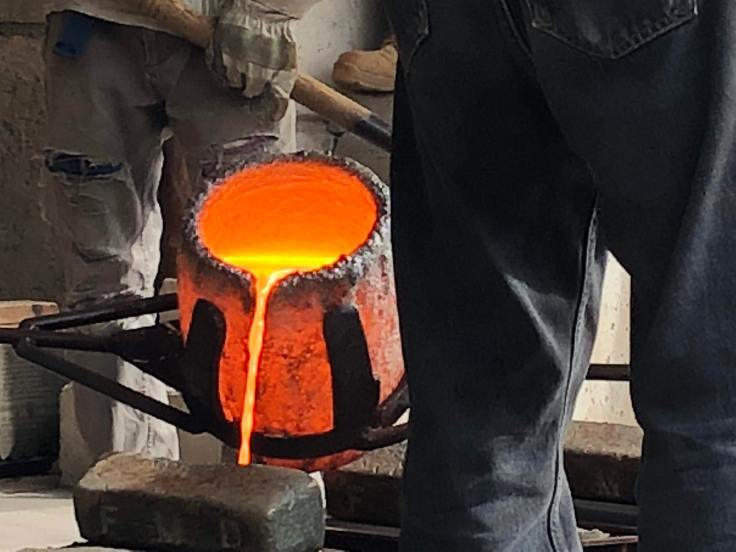
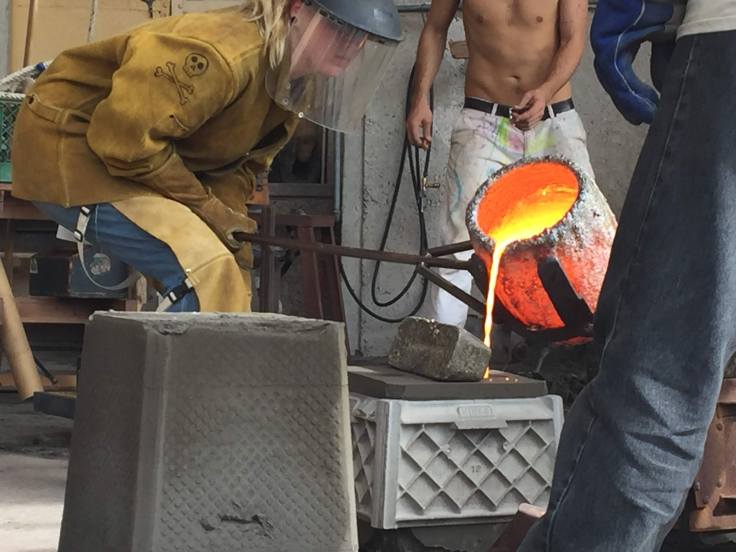
We arrived in time for the 10:00 am tour.  After a brief video presentation we toured the various buildings of this “urban experiment”.  We saw the “students” making their signature clay bells, then we moved on to the Foundry.  Today we watched as they poured molten bronze (2,100 degrees F) into dies (forms) to become bronze bells…

img_6454img_9924img_6457

We were shown performance areas, living quarters, and lounge spaces.

The place is a little strange… Sort of like a hippie commune with high academic credentials.  And we didn’t even see any of the architects living and working there…

img_9919img_9920img_9927img_9928img_9929img_9930img_9931img_9932img_9934img_9935img_9936img_9938img_9939img_9940img_9941img_9942

We continued on into Phoenix, or Sun City, to be exact.  We checked into our RV park, then I took the truck into the Chevrolet dealer; we are about 1,000 miles overdue for an oil change, and I don’t want to risk driving home across the desert with bad oil…

The big event today is an evening tour of Taliesin West, Frank Lloyd Wright’s home and studio and school in Scottsdale…

Taliesin West was Frank Lloyd Wright’s winter home and school in the desert on the outskirts of Scottsdale, AZ, from 1937 until his death in 1959 at the age of 91. Today it is the main campus of the School of Architecture at Taliesin and houses the Frank Lloyd Wright Foundation.

Wright and the Taliesin Fellowship began to “trek” to Arizona each winter in 1935. In 1937 Wright purchased the plot of desert land that would soon become Taliesin West. He paid about $7,000 for over 600 acres on the southern slope of the McDowell Range overlooking Paradise Valley outside Scottsdale.  In 1937 is was 4 miles past the last paved road in Scottsdale, a hamlet of about 200 people.  Today it is about a 45 minute drive from the RV park in Sun City… It is almost totally surrounded by the sprawl of Scottsdale…  We arrived just before dark…

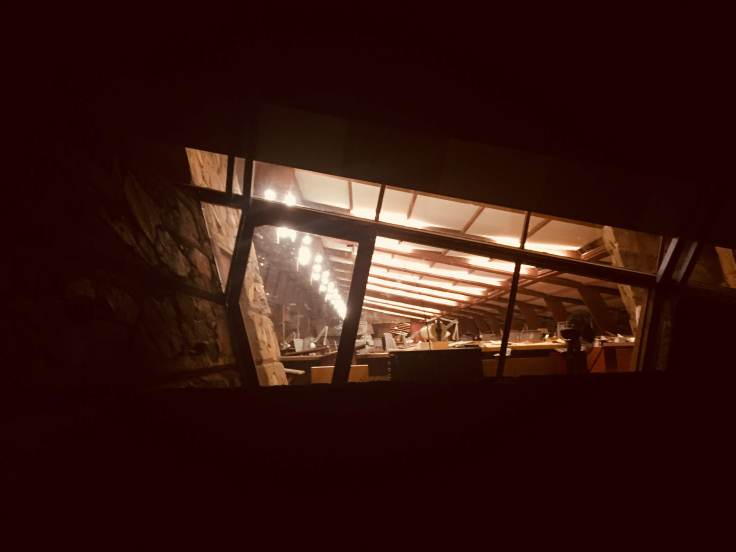
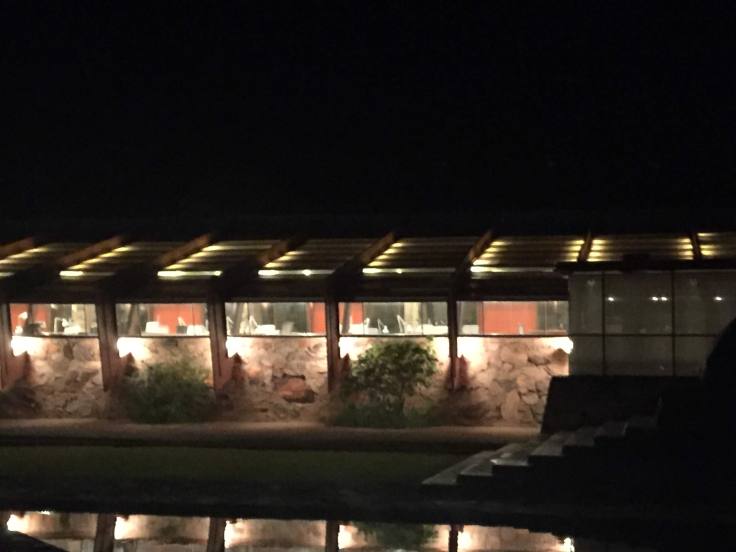
The tour was fabulous, but, since it was at night, we took few pictures.  We will come back tomorrow and do it in the rain, so pictures might be better…

This is the main drafting room…

img_6459img_6462

This is the Breezeway…

img_6463

We arrived home at about 10:00 pm – very late for us…

Tomorrow we come back to Taliesin West and have a three hour “In Depth” tour…

And an enjoyable time was had by all…

Blog at WordPress.com.

Up ↑