It was a day of mourning and rejoicing over yesterday’s sports results… Dodgers lost, Stanfurd won, Notre Dame lost, USC lost, Alabama lost, Tennessee won, TCU won, CAL lost…
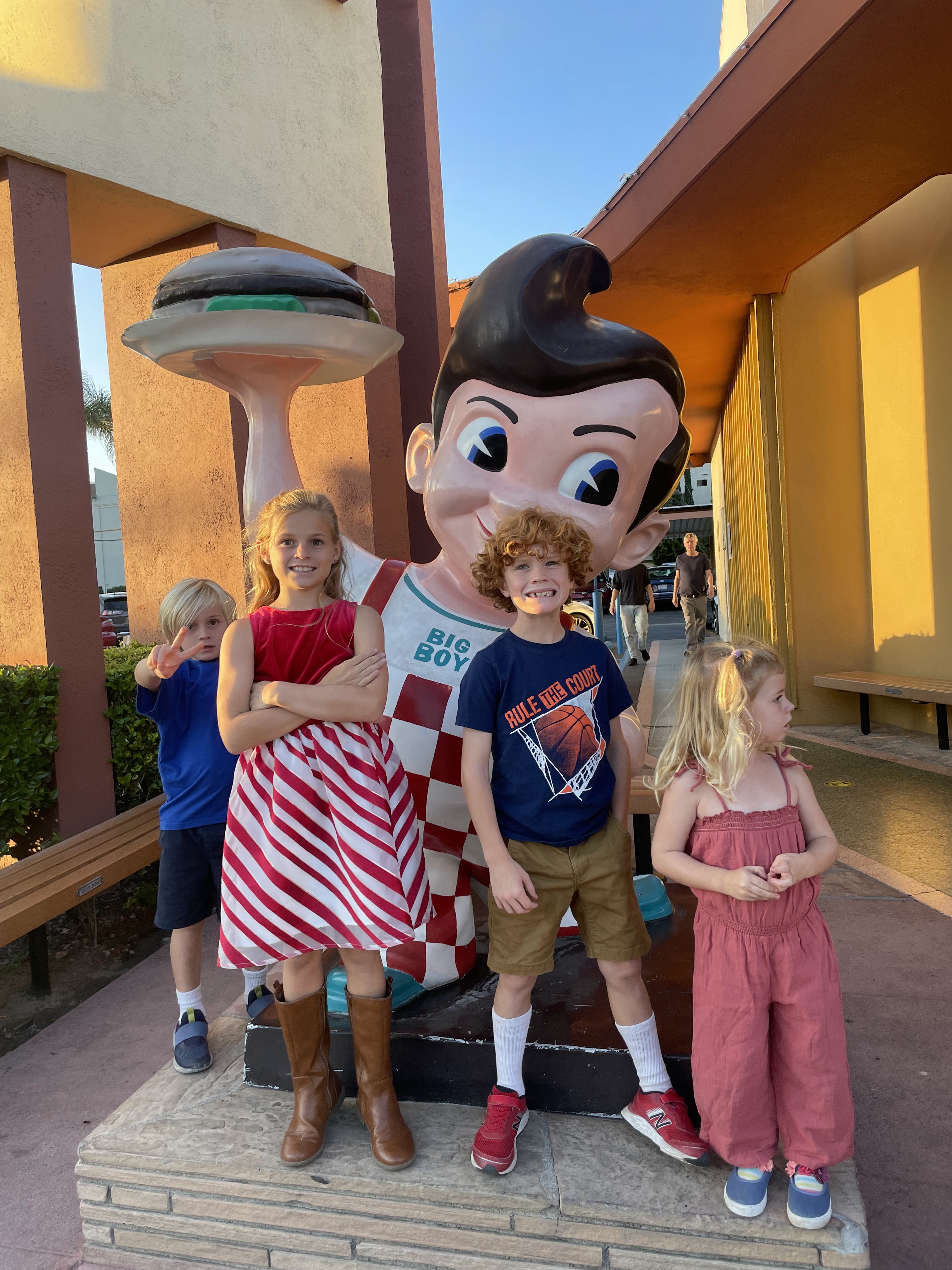
So you are now treated with a picture of the McAnoy Grandchildren; they are at one of the oldest still-operating Bob’s Bigboy Restaurant, in Burbank/Toluca Lake, California…
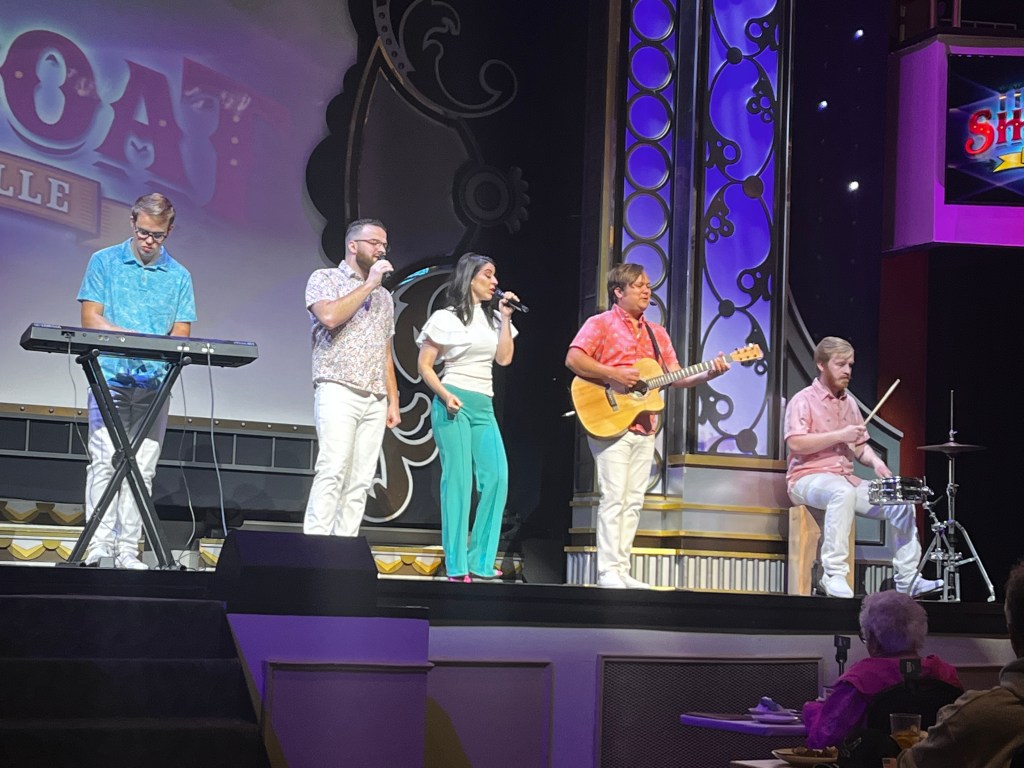
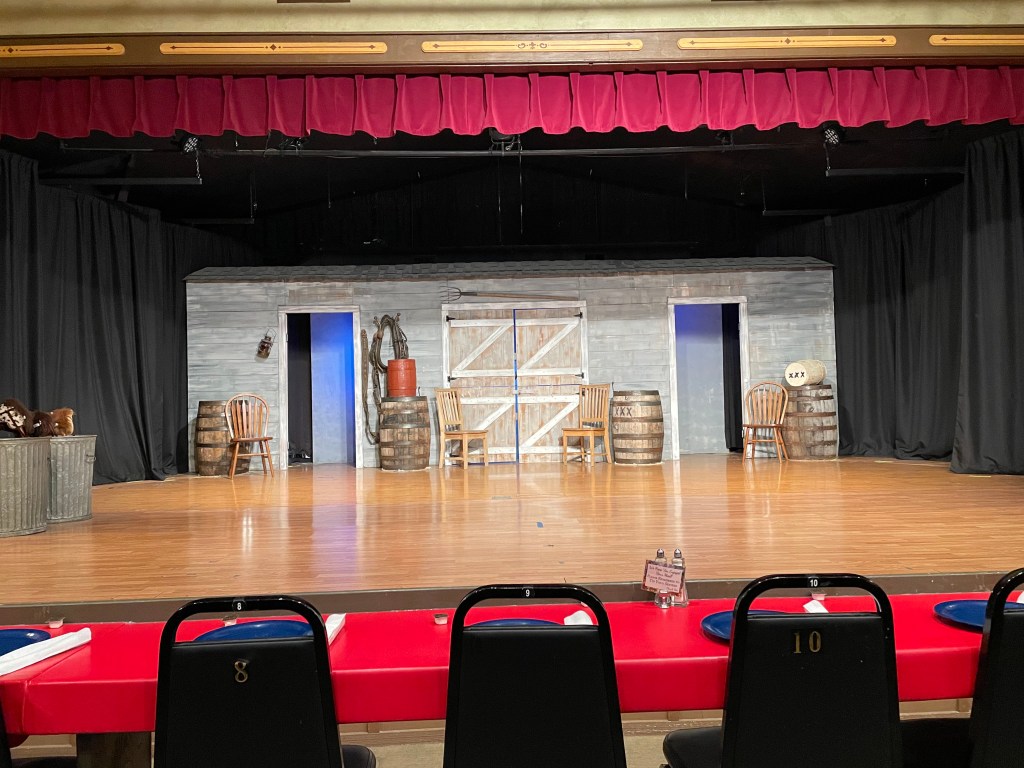
Tonight we see another show: O Happy Day, a show of Gospel music, at The Hamner Variety Theater…
It’s a grand place…
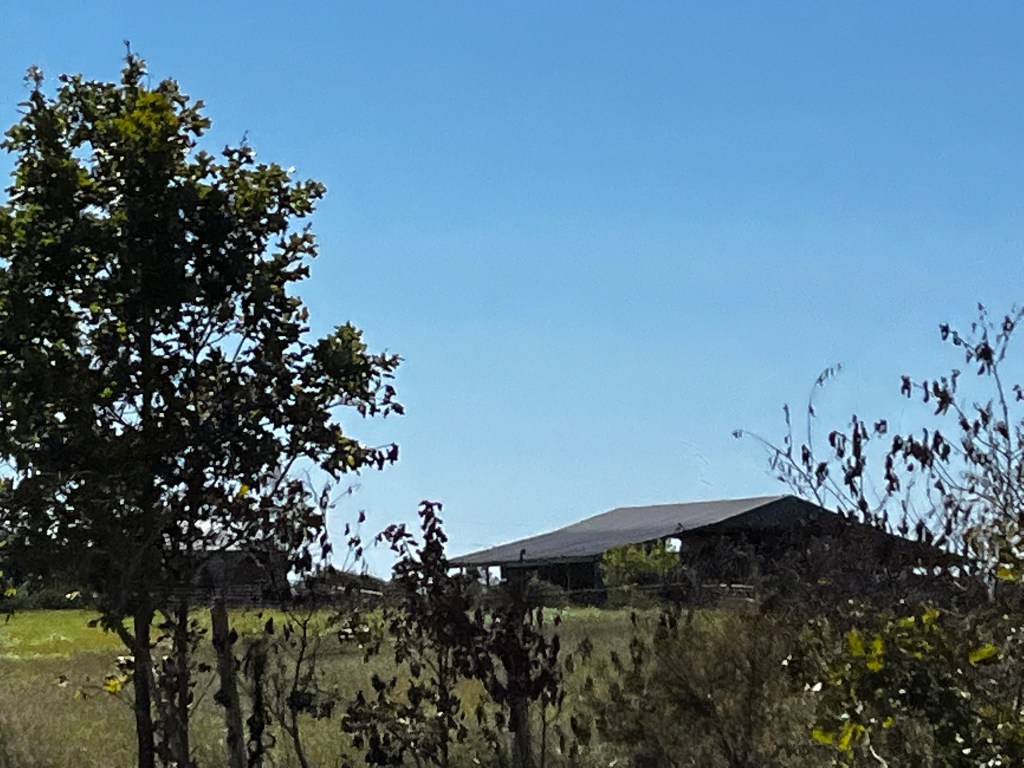
Oh! Wait… It’s just a metal industrial building with a fake façade
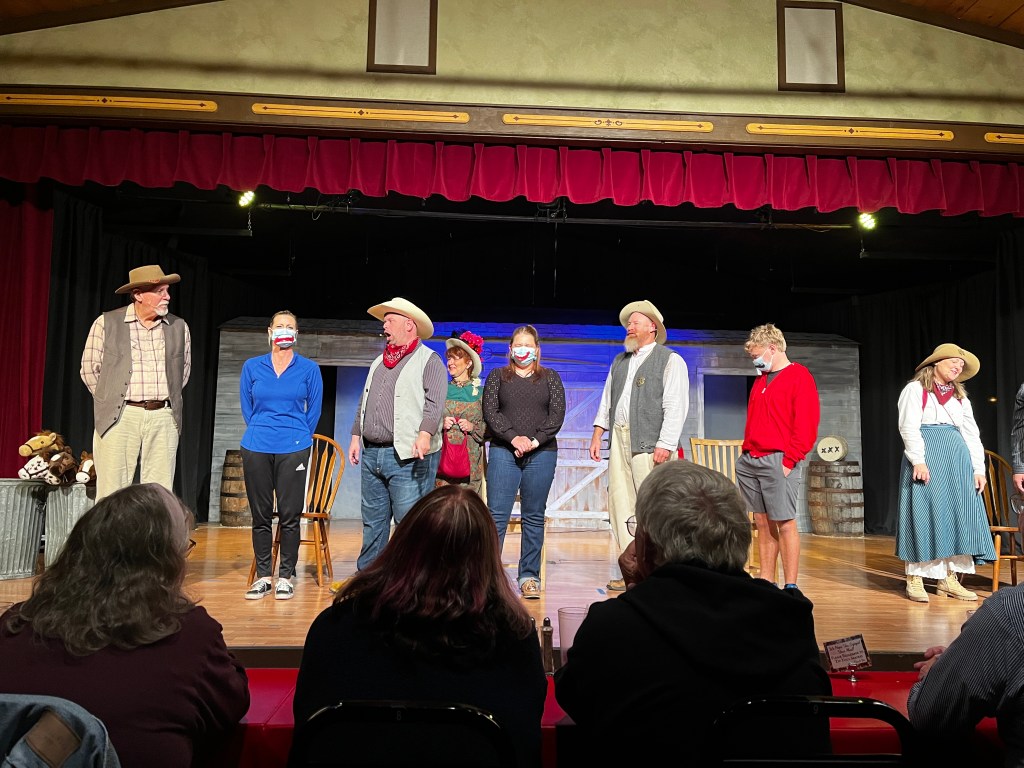
But the show was fun… Gospel music and Hymns! What’s not to like…
We enjoyed the show a lot! I even bought a CD! Now I need to figure out if I have a CD player…
We returned to the Villa, and an enjoyable time was had by all…
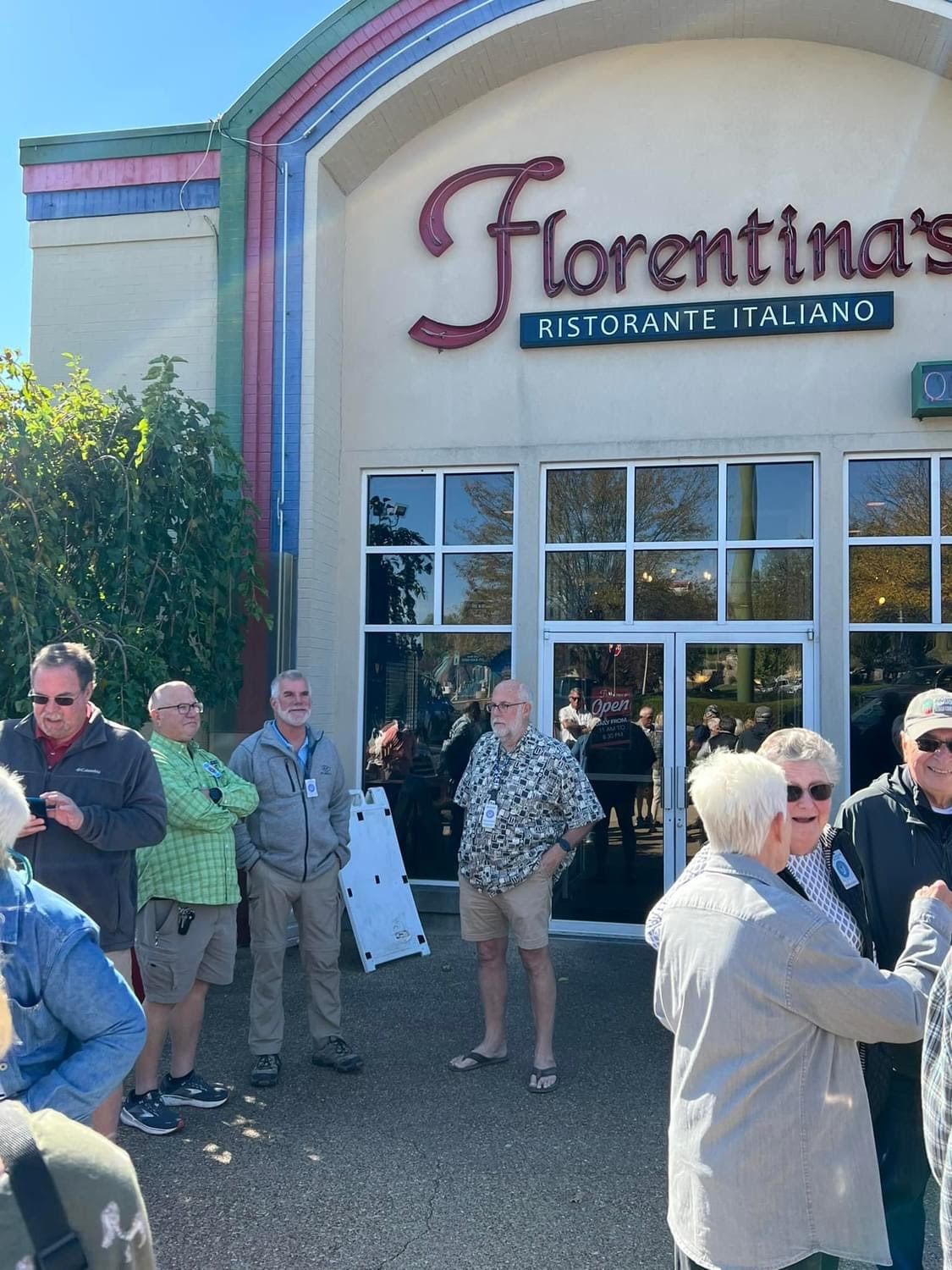
Lunch today was different! Florentina’s RistoranteItaliano. Plastic flowers and all… The food was decent, and a nice break from typical Southern fare… Even the Southerners enjoyed it…
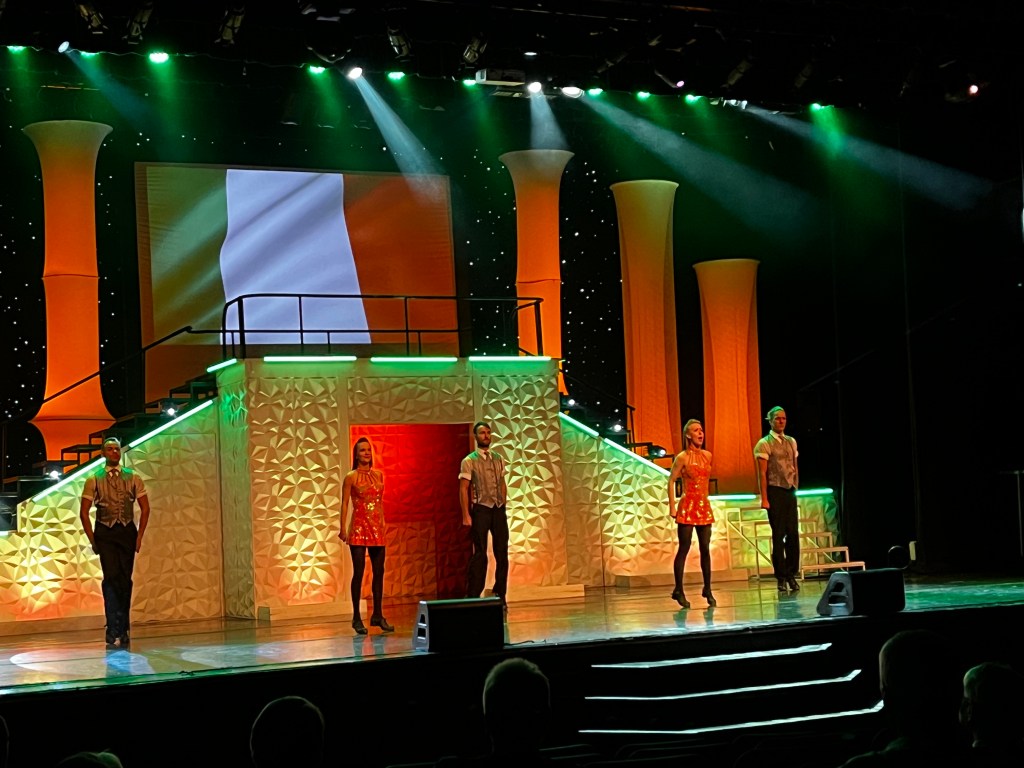
Our show was Irish Tenors and The Celtic Ladies and the Irish Dancers…
Intermission gave us a chance to stretch our legs and catch up on the college football…
More singers and dancers… It was a good show; I particularly enjoyed the dancers – they sort of reminded me of soccer players, jumping around without using their arms for anything important…
After the typical veterans’ tribute and patriotic songs we returned to the Villa..
Lynda turned in early and I watched football until the large hours…
We began by driving to Springfield, MO. It is about a one hour drive, mostly on good divided highways and the Interstate…
We arrived at the most foreign place I have even been in – a Bass Pro Shop. It’s all about hunting and fishing. I know my opinion is not popular, but I’ve never understood killing animals for fun…
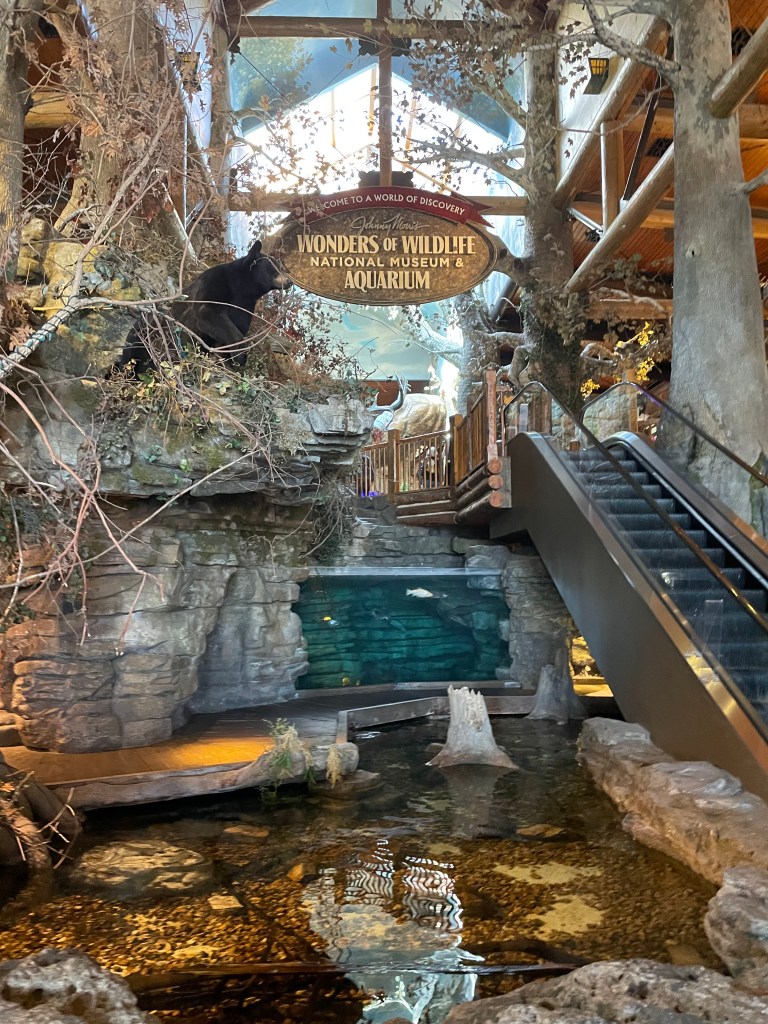
This particular Bass Pro Shop had it’s own “Worlds of Wonder” wildlife museum and aquarium – temple of glorifying killing animals for fun. They cloak it all in the name of “Conservation”…
Bass Pro Shops is owned by Johnny Morris and specializes in hunting, fishing, camping, and other related outdoor recreation merchandise. With headquarters in Springfield, Missouri, Bass Pro Shops has a workforce of about 40,000. Bass Pro also owns Cabela’s, another retailer that specializes in similar categories.
We spent most of the day in the wildlife museum and the aquarium. There were various exhibits, stuffed animals, replica animals, and stories of hunting and fishing. I am only posting a few interesting displays…
The Boone and Crockett Club is an American nonprofit organization that advocates fair chase hunting in support of habitat conservation. The club is North America’s oldest wildlife and habitat conservation organization, founded in the United States in 1887 by Theodore Roosevelt. They had a huge collection of “bones and skulls”, which eventually ended up here in this museum…
Mostly heads…
Mostly deer heads…
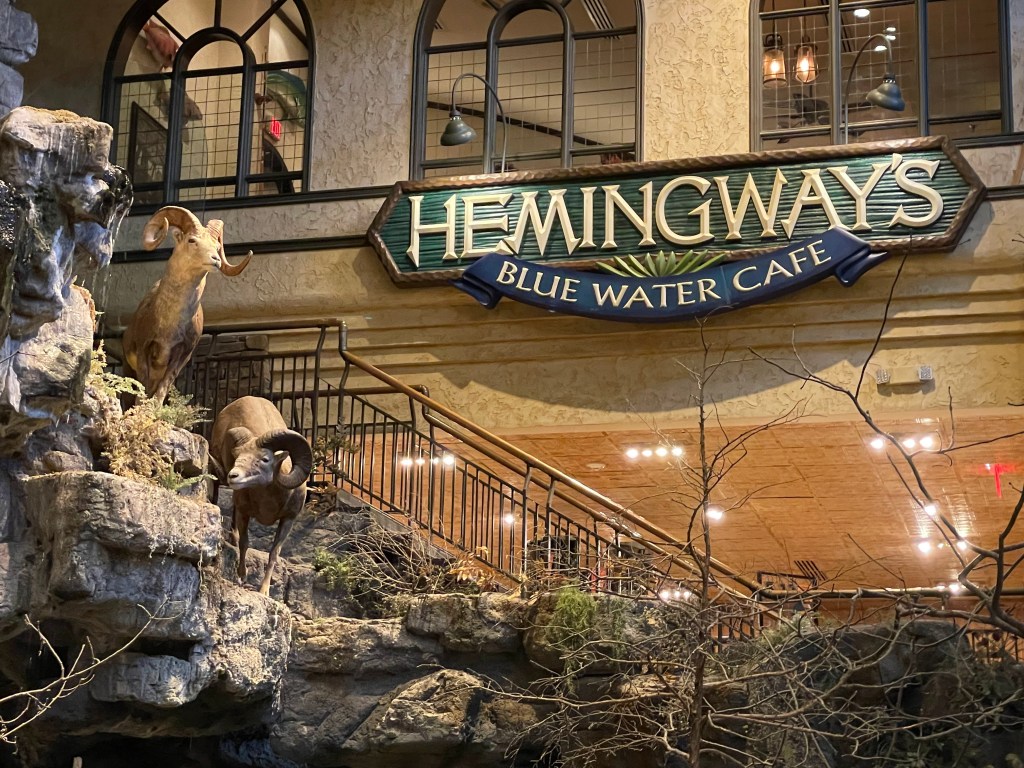
We took a break for lunch with the club at the restaurant in the Bass Pro Shop…
Again we had some sort of pork, some sort of chicken, green beans and mashed potatoes. They were not as bad as the previous night’s fare…
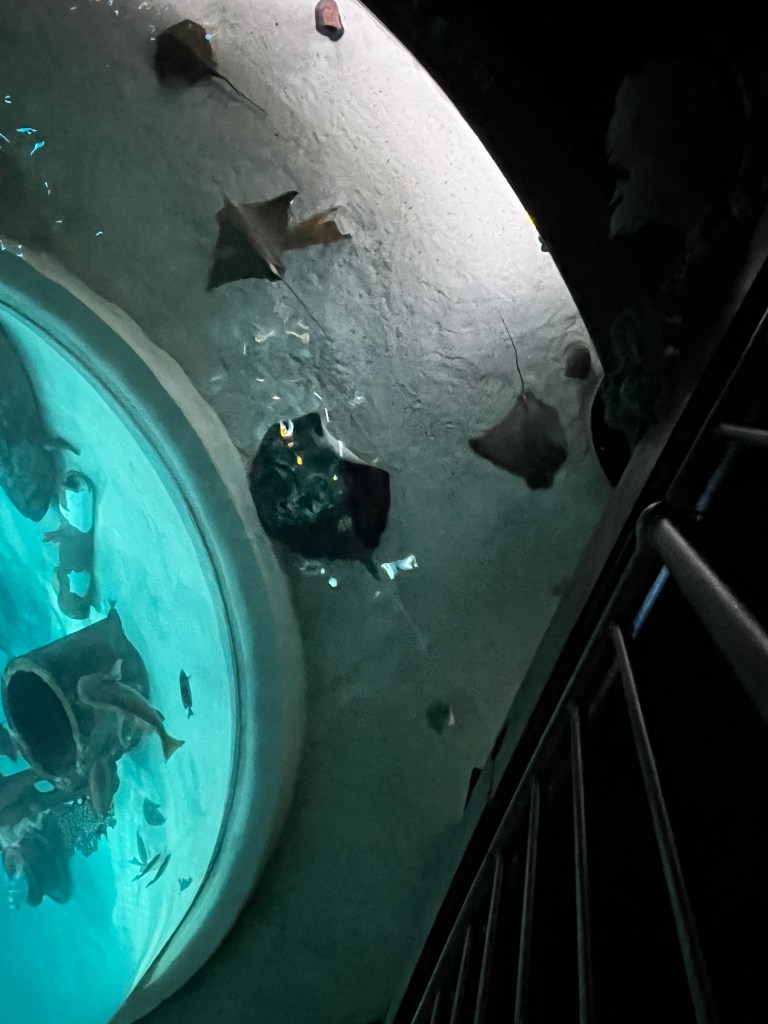
After lunch we returned to the museum and aquarium. The aquarium did have live exhibits. We particularly enjoyed the rays…
These live crabs looked like they might be delicious…
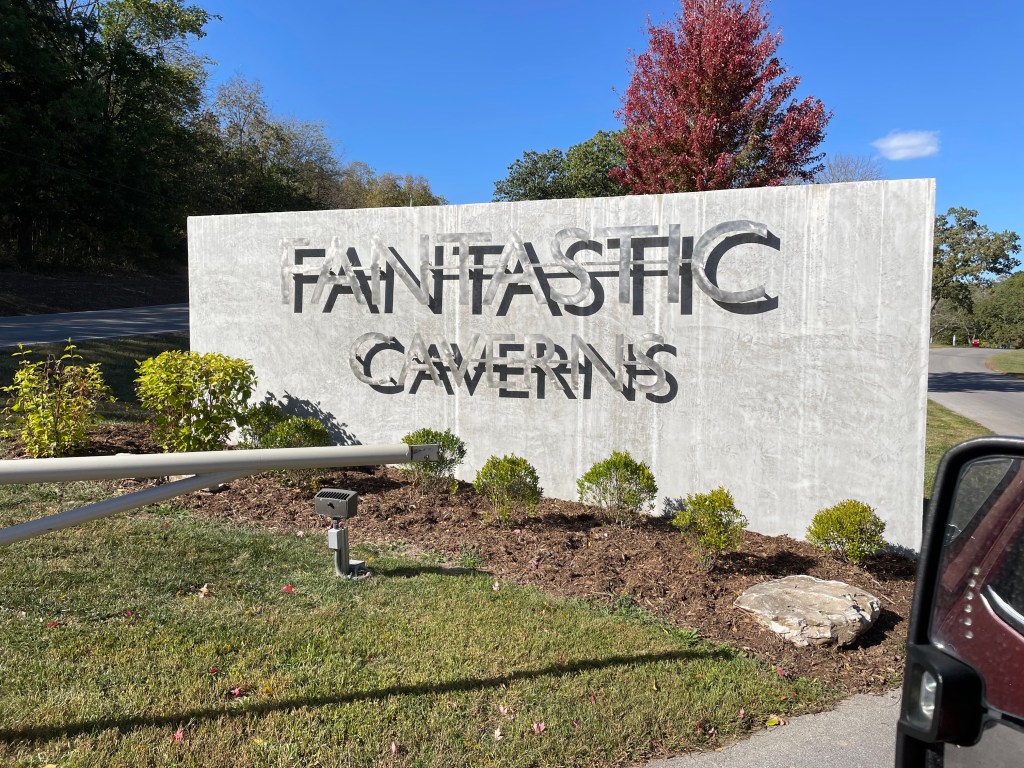
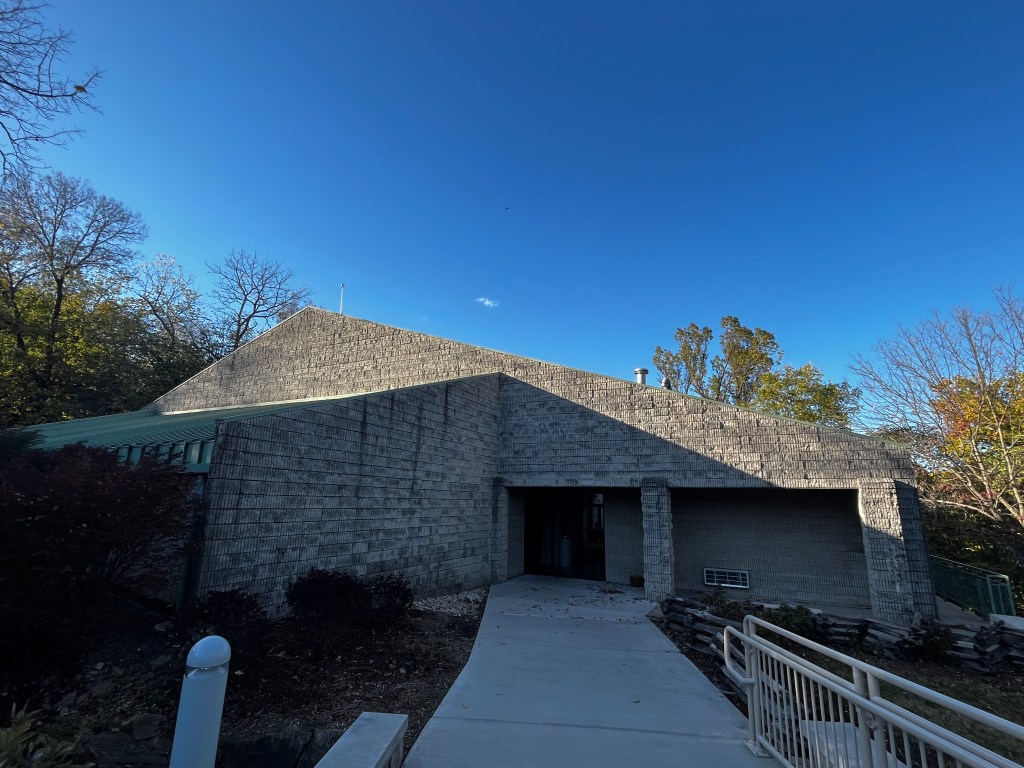
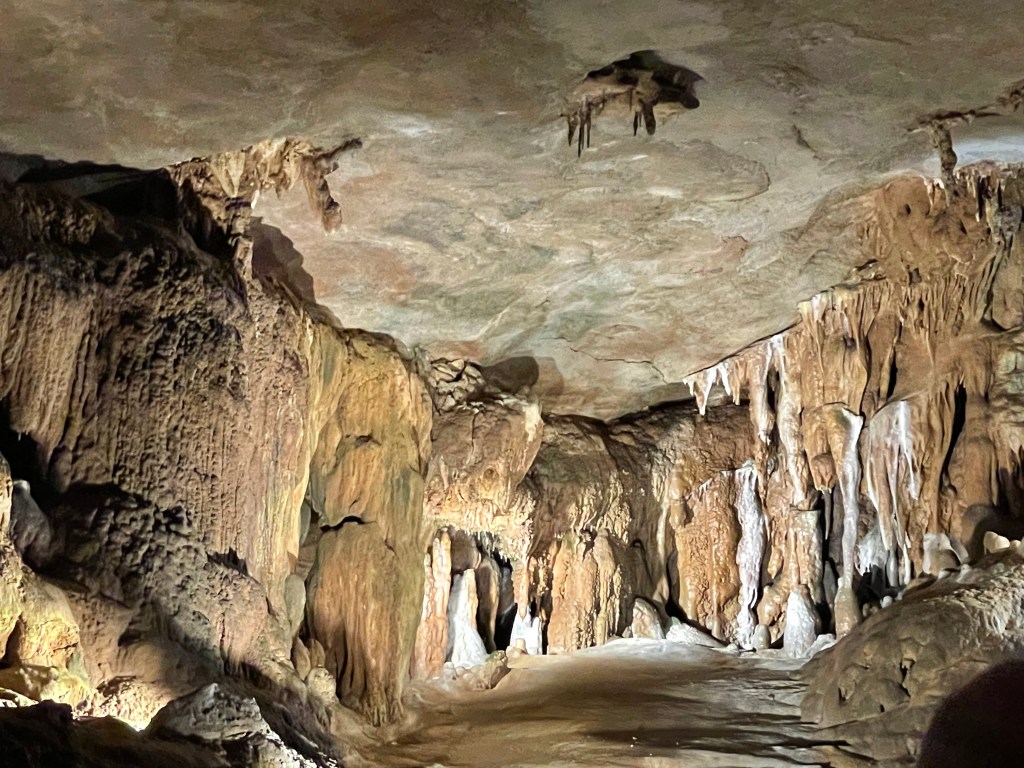
By mid-afternoon we moved on to our next excursion – The Fantastic Caverns.
The caves were discovered in 1862 by a local hunter and his dog. The dog chased a small animal into a small hole and did not return. The owner crawled in after him and soon realized he could stand… He found the dog, crawled out, and never told anyone about his discovery.
In 1862, during the Civil War (or The War of Northern Aggression, depending on your ancestors…) if an army (any army) discovered a cave it was confiscated, along with the surrounding land. The armies had discovered that a biproduct of bat quango is potassium nitrate, a key ingredient needed to produce gunpowder. Since he did not want to lose his home and his cave, he told no one…
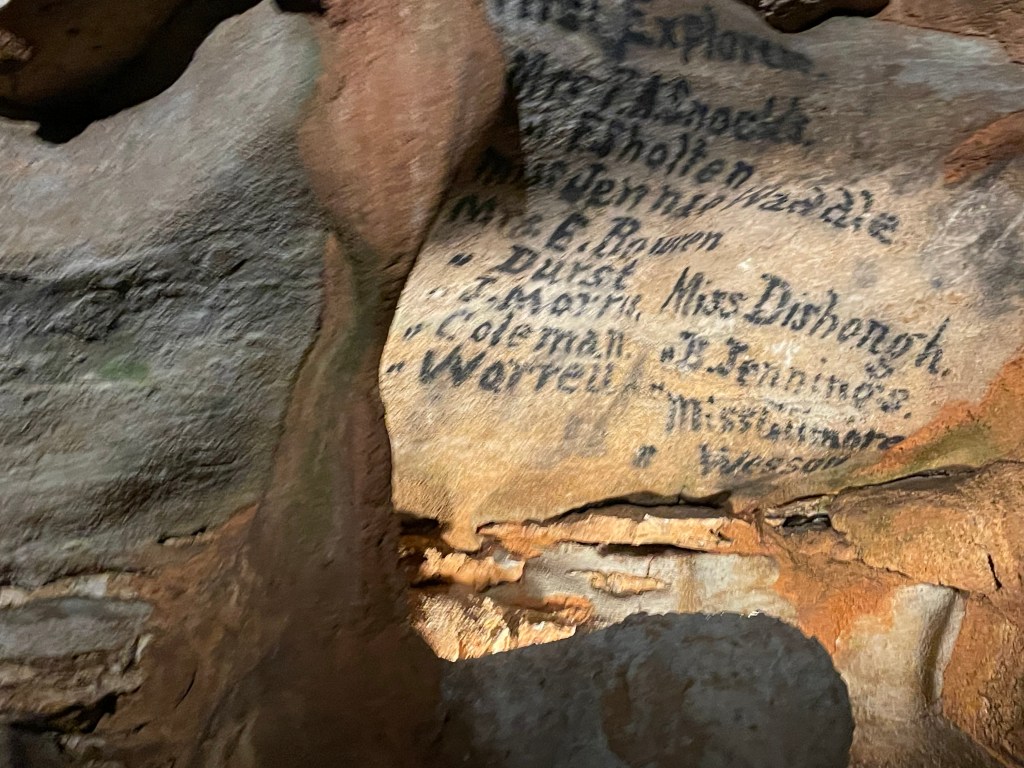
Finally, in 1867, he advertised for people to come explore his cave. He received one answer, and soon 12 locals showed to to tackle the cave – 12 women, aged 12-19. These young women crawled in, explored and documented the caves…
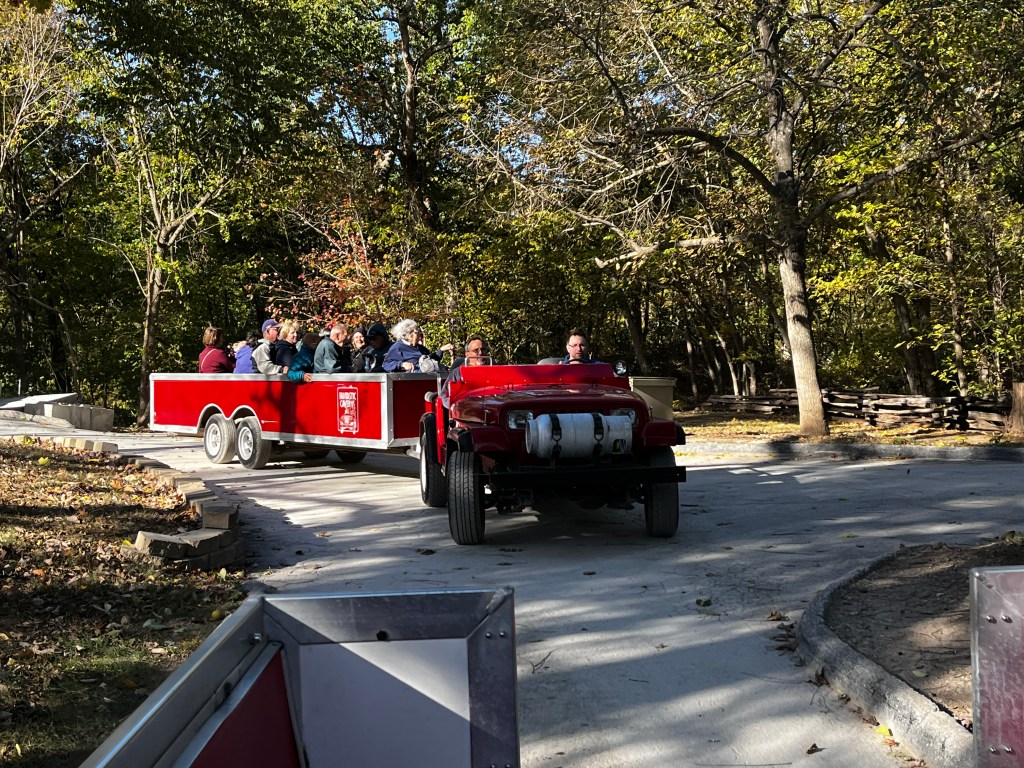
The main selling point of these caves is that you don’t have to walk through them – we get to ride…!
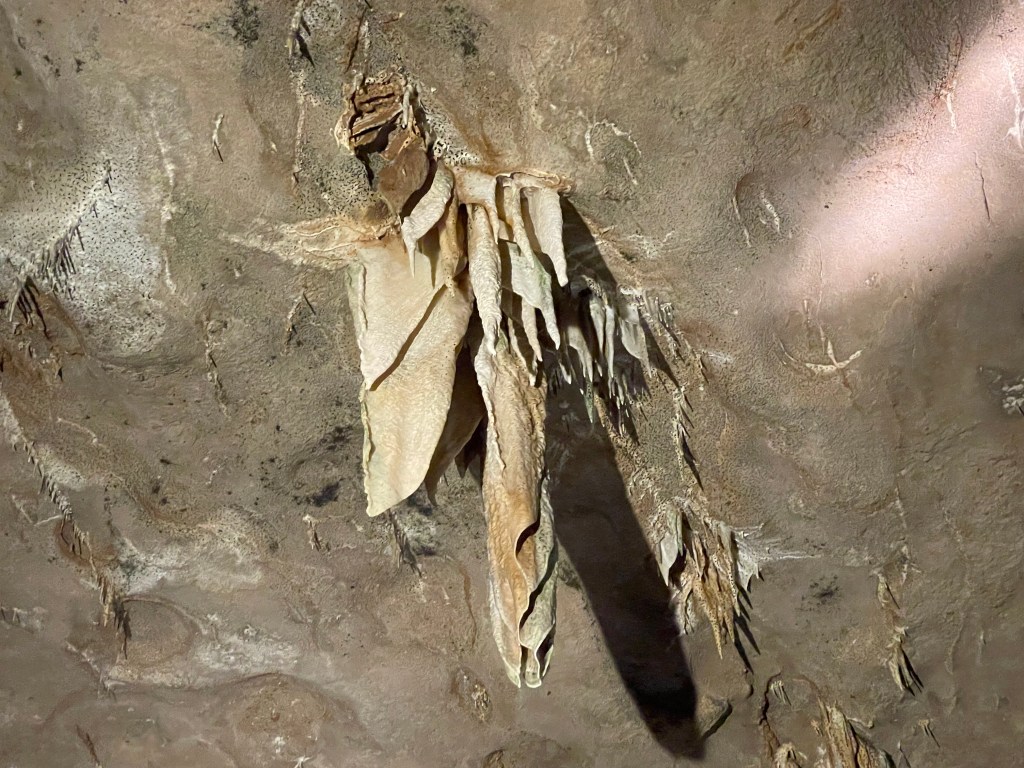
The caves are nowhere as large or as tall as other caverns we have seen…
The 12 young women did write their names on the wall…
This opening to the left is about where the 12 young women entered the caverns in 1867.
It had been a long day, but wait! There’s more!
We returned to the Villa, ate a quick bite, then headed out to the Mansion theater for our next show!
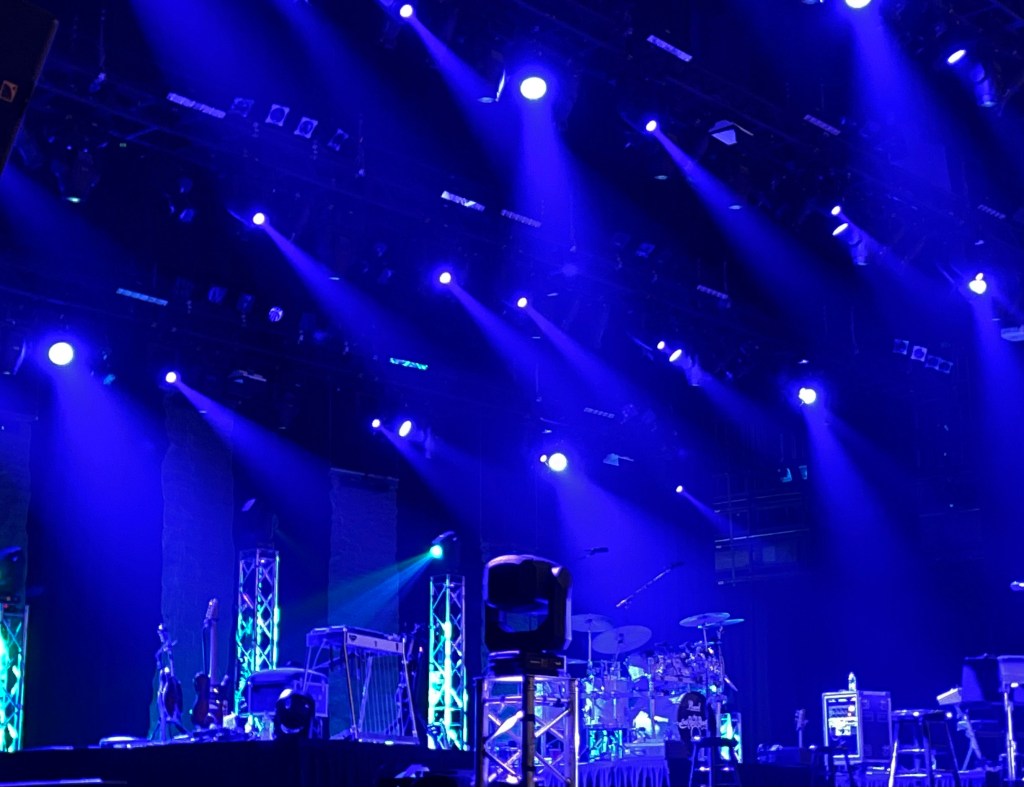
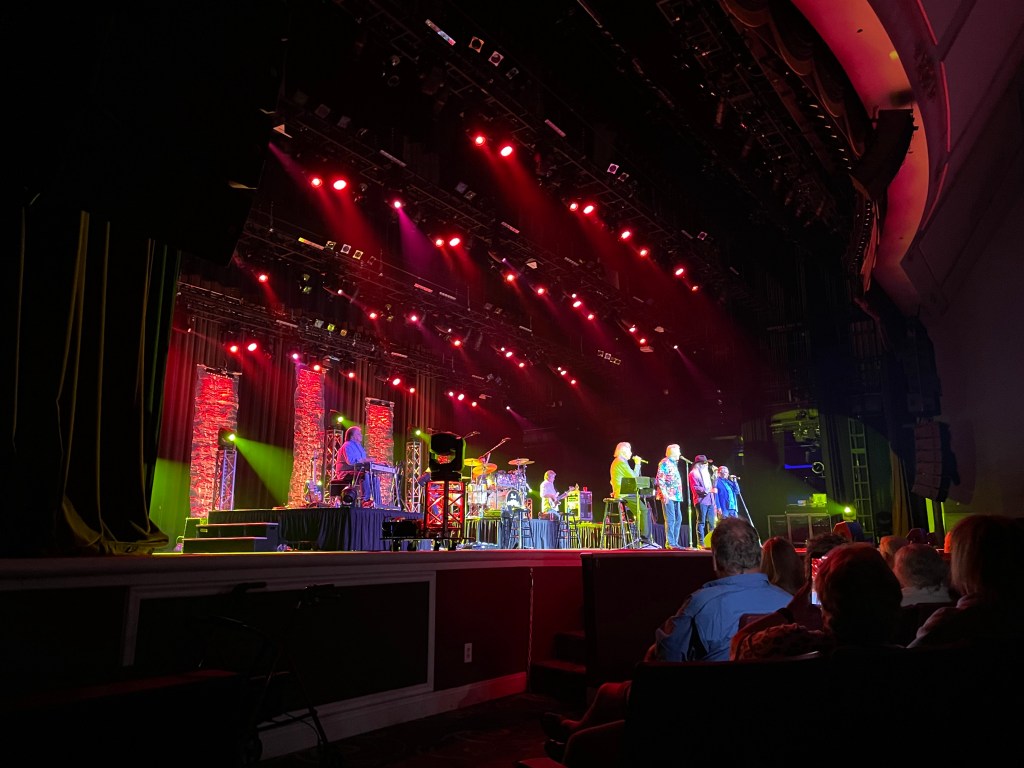
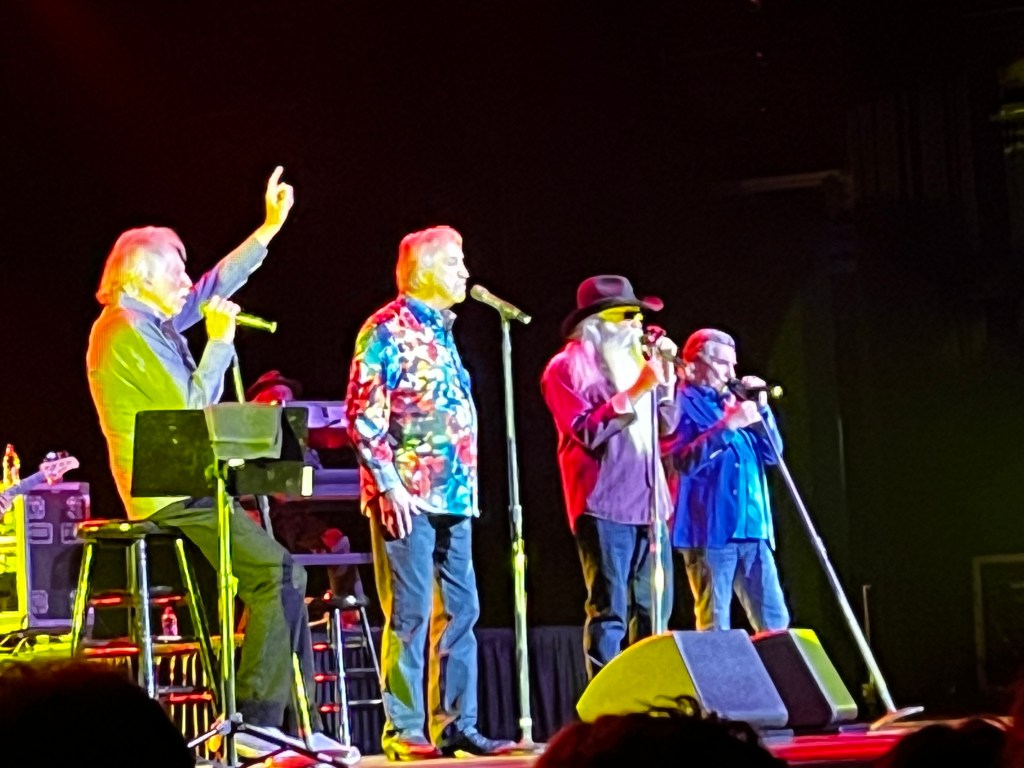
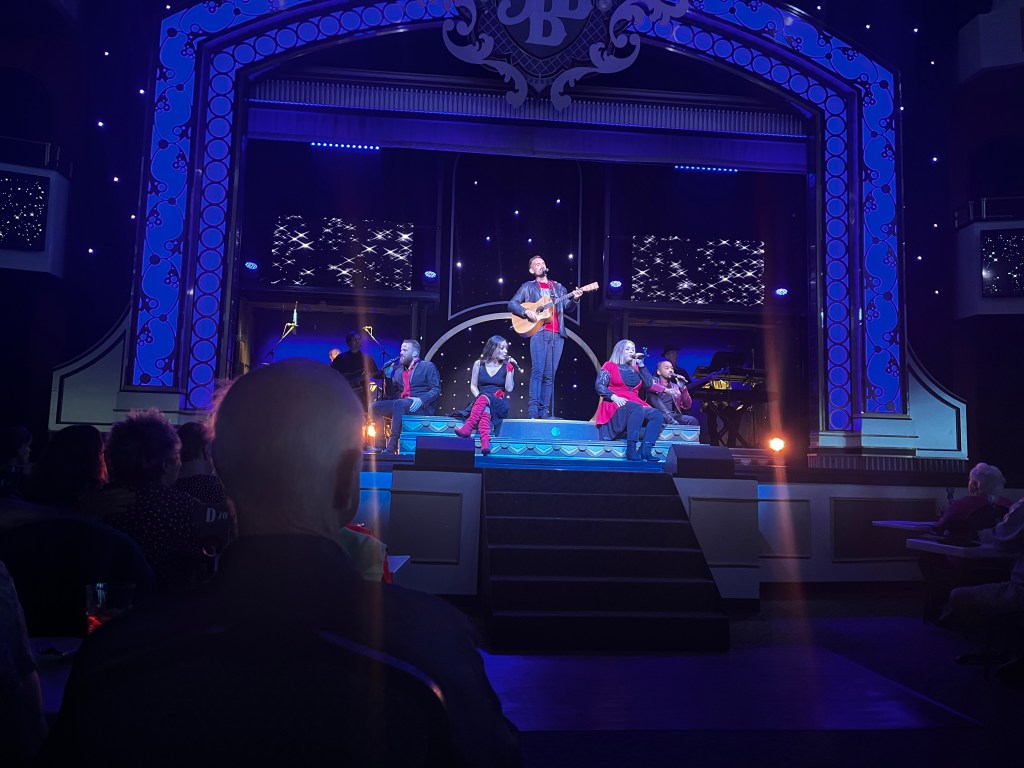
This is The Oakridge Boys!
The core group that would eventually lead to the Oak Ridge Boys was a country group called Wally Fowler and the Georgia Clodhoppers, formed in 1943 in Knoxville, Tennessee. At the time, the quartet was made up of Wally Fowler, Lon “Deacon” Freeman, Curly Kinsey, and Johnny New. This group began recording in 1947. Wally Fowler and the Oak Ridge Quartet were members of the Grand Ole Opry in the 1940s. In 1949, the other three men split from Fowler to form a new group, Curley Kinsey and the Tennessee Ridge Runners, so Fowler hired an existing group, the Calvary Quartet, to reform the Oak Ridge Quartet. Walt Cornell sang baritone for the Oak Ridge Quartet in the early 1950s. In 1961, they changed the group’s name to “the Oak Ridge Boys” because their producer, Bud Praeger, thought “Oak Ridge Quartet” sounded too old-fashioned for their contemporary sound.
They remained a gospel group until the mid-1970s, when they changed their image and concentrated on country music.
The lineup that produced their most well-known country and crossover hits ― such as “Elvira” (1981), “Bobbie Sue” (1982), and “American Made” (1983) ― consists of Duane Allen (lead vocals), Joe Bonsall (tenor), William Lee Golden (baritone), and Richard Sterban (bass). Golden and Allen joined the group in the mid-1960s, and Sterban and Bonsall joined in the early 1970s.
They are really old now – about our age… They put of a great show. The four singers are accompanied by four musicians and a drummer. There were two guitar players, a keyboard player, and a generalist who played steel slide guitar, bass guitar, and violin. The first half of the show was loud Country Rock. After a song or two they all seem to sound alike… After intermission they sang several gospel quartet type songs, which was much more enjoyable… Then they sang their famous “Elvira”…
When the fog machines come on we knew the end was near…
We returned to the Villa and enjoyed a glass of wine… An enjoyable time was had by all…
Table Rock Lake is an artificial lake or reservoir in the Ozarks of southwestern Missouri and northwestern Arkansas in the United States. Designed, built and operated by the U.S. Army Corps of Engineers, the lake is impounded by Table Rock Dam, which was constructed from 1954 to 1958 on the White River.
The lake is a popular attraction for the city of Branson, Missouri, and the nearby town of Shell Knob, Missouri. There are several commercial marinas along the lake, and Table Rock State Park is located on the east side, both north and south of Table Rock Dam. Downstream from the dam, the Missouri Department of Conservation operates a fish hatchery, which is used to stock trout in Lake Taneycomo, which begins immediately downstream from the Table Rock Dam. The cold water discharged from the dam creates a trout fishing environment in the lake.
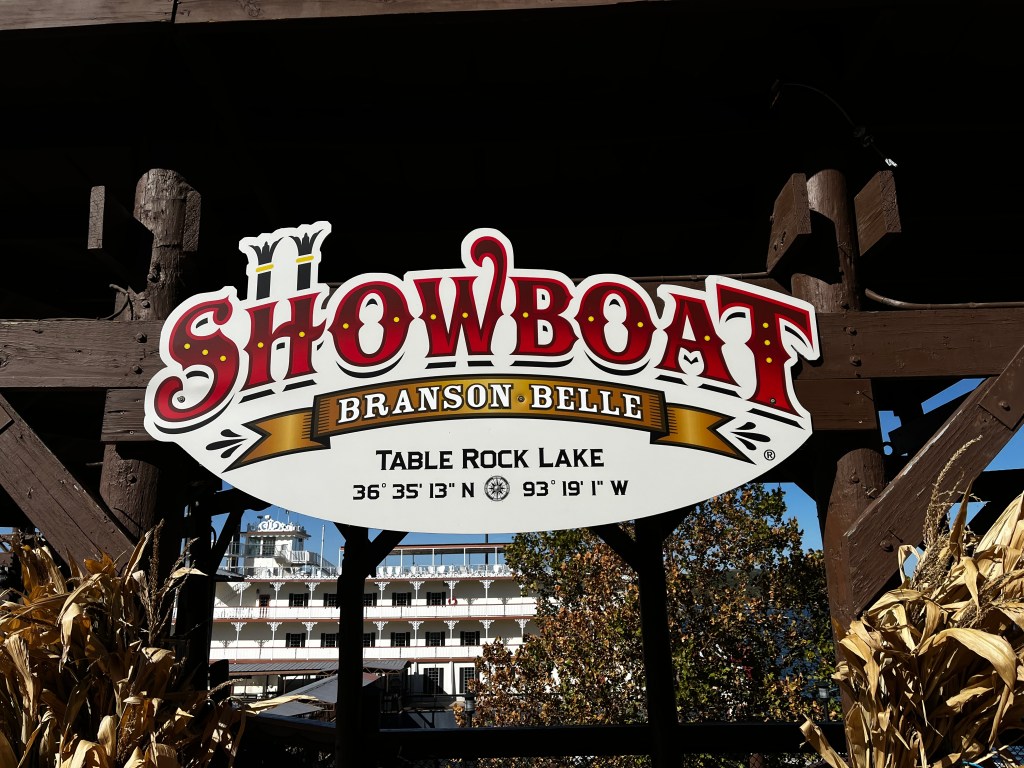
We are here to enjoy a lunch show on the Showboat Branson Bell…
The original plan, of course, was to have a cruise around the lake, whilst enjoying lunch and a show… However, the weather was not encouraging, so the boat never left the dock.
(Apparently river boats do not like 40 mph winds… On December 11, 2010, due to high winds that had come up suddenly, the Showboat Branson Belle ran aground while cruising on Table Rock Lake. The incident stranded 567 passengers and 76 crew members overnight.)
Showboat Branson Belle is a riverboat—more specifically, a showboat—on Table Rock Lake near Branson, Missouri. The lake is landlocked by the Table Rock Dam on one side and the Beaver Lake Dam on the other side. Being a showboat, it hosts lunch and dinner shows throughout the year.
The boat was constructed at its port at White River Landing and was launched on August 12, 1994. The boat was launched into Table Rock Lake at a speed of 14 knots (16 mph) on launching rails lubricated with two tons of bananas. The bananas were used for lubrication because they were biodegradable and would not have polluted Table Rock Lake as grease would have. The boat is claimed by its owner to be the largest ship on a landlocked lake in the United States. According to the plaque on the dock, the boat weighs 2,500,000 lbs.
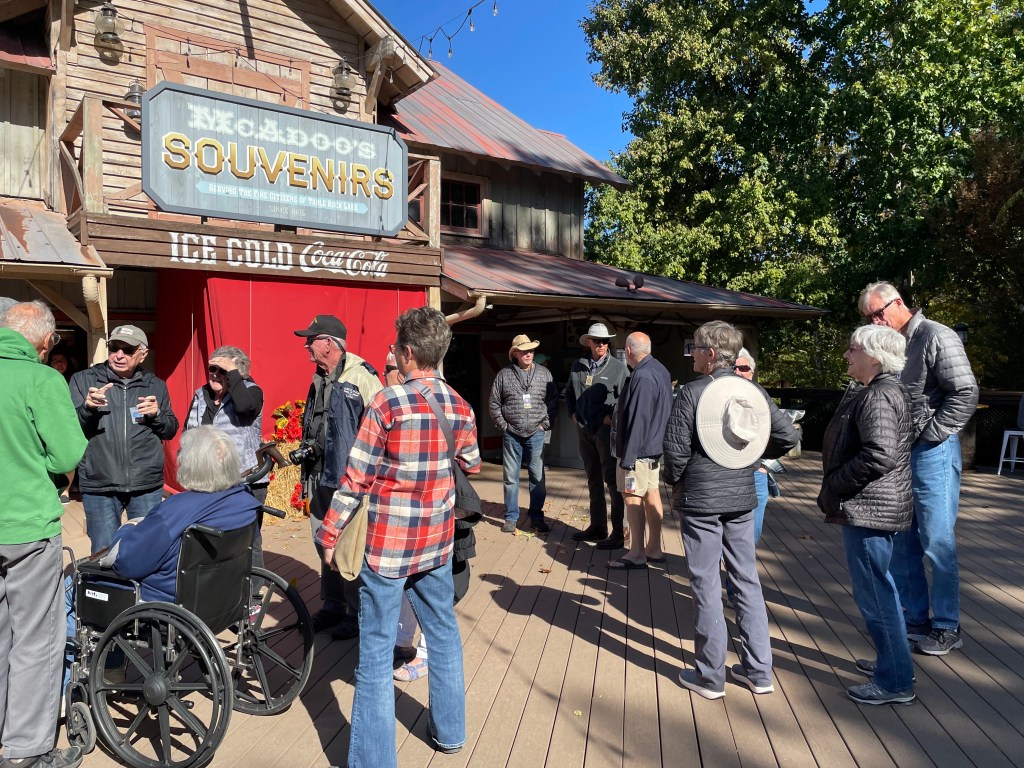
So we waited to board…
Once on board, we walked around and explored the boat…
While the showboat looks like a typical excursion riverboat, it really is a 2,100 seat theater and a large kitchen…
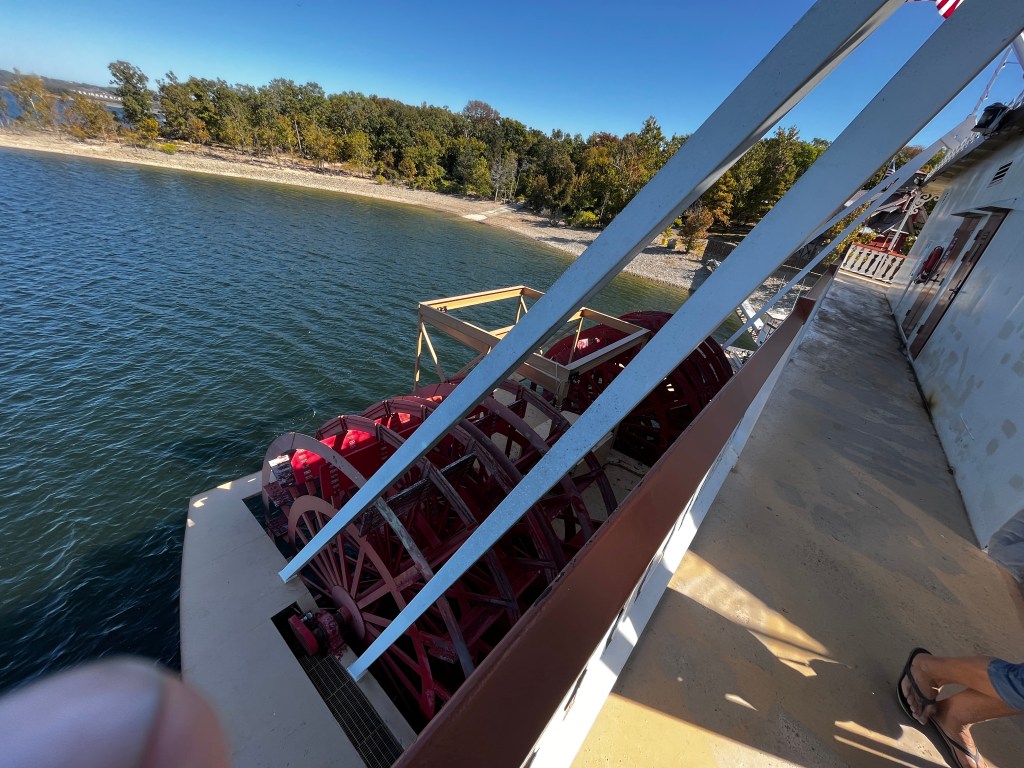
The showboat is powered by a diesel-electric power plant, much like modern train locomotives. It is actually propelled by the twin stern wheels…
One giant smokestack…
Two giant smokestacks…
Now, back to the show…
But first! Our lunch was served – pork, chicken, mashed potatoes and green beans… What is it with these Southerners? The good news is that the food was WAY better than at the Whodunnit Hoedown…
A little light entertainment before the real show…
The show was great – very up-beat and flashy. Dancers were great! It’s fun to watch tap dancers in person…
At intermission a magician performed some rope tricks, with one of our Airstreamers helping out… This was fun!
There must be a law or something that every show must include a tribute to veterans, with patriotic songs…
We enjoyed the show, and we then returned to the Villa. Happy hours ensued…
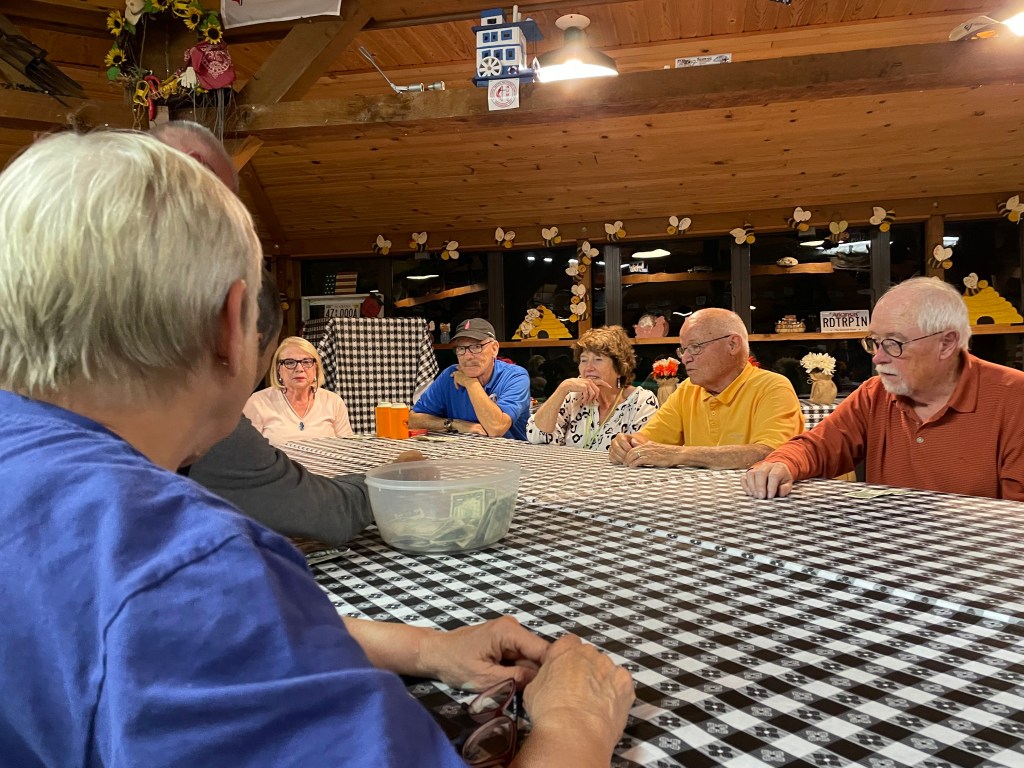
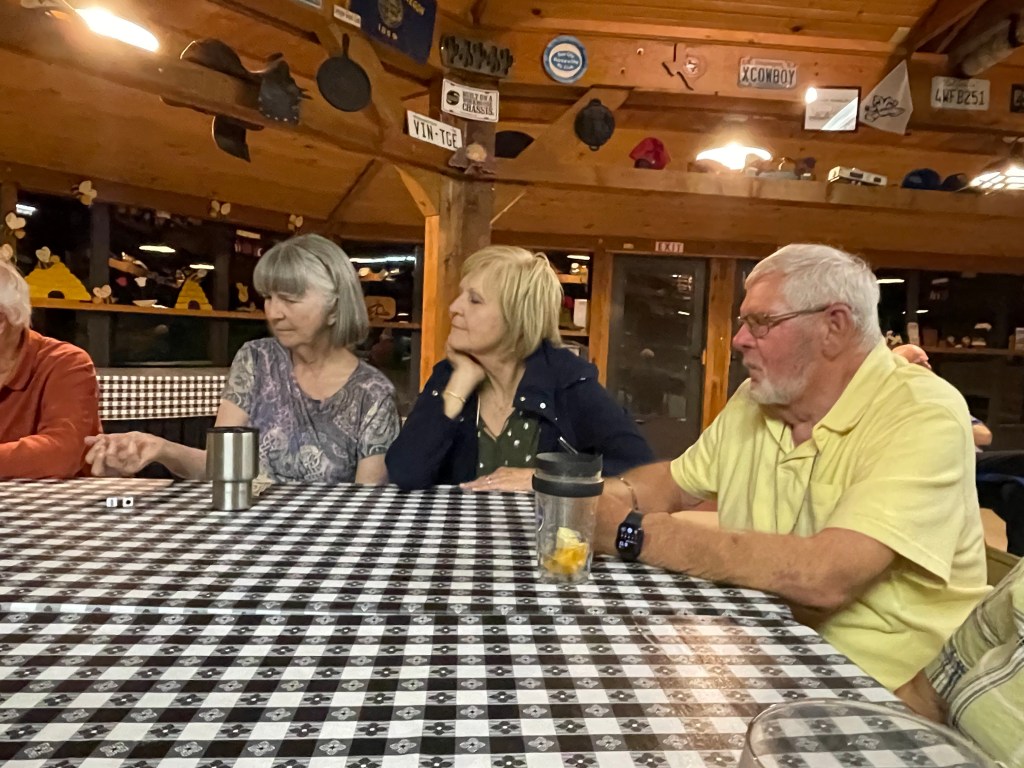
While I worked on the blog, Lynda went to the clubhouse for fun and games, Airstream style…
The day started with a nice sunrise reflected in our neighbor’s Airstream…
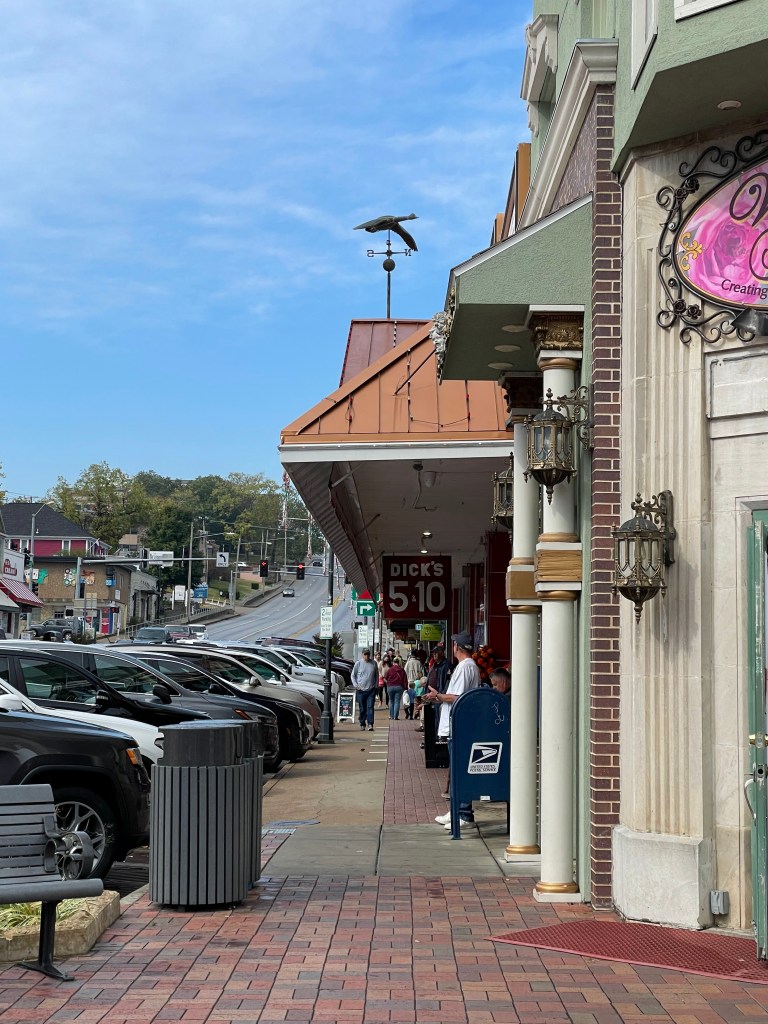
We wanted to check out souvenirs, so we drove to “historic” downtown Branson. Not surprisingly, it was very touristy, and we did not find what we were looking for… However, the store aisles were narrow and there are many, many, very large people here in Branson, most of whom use wheelchairs and walkers…
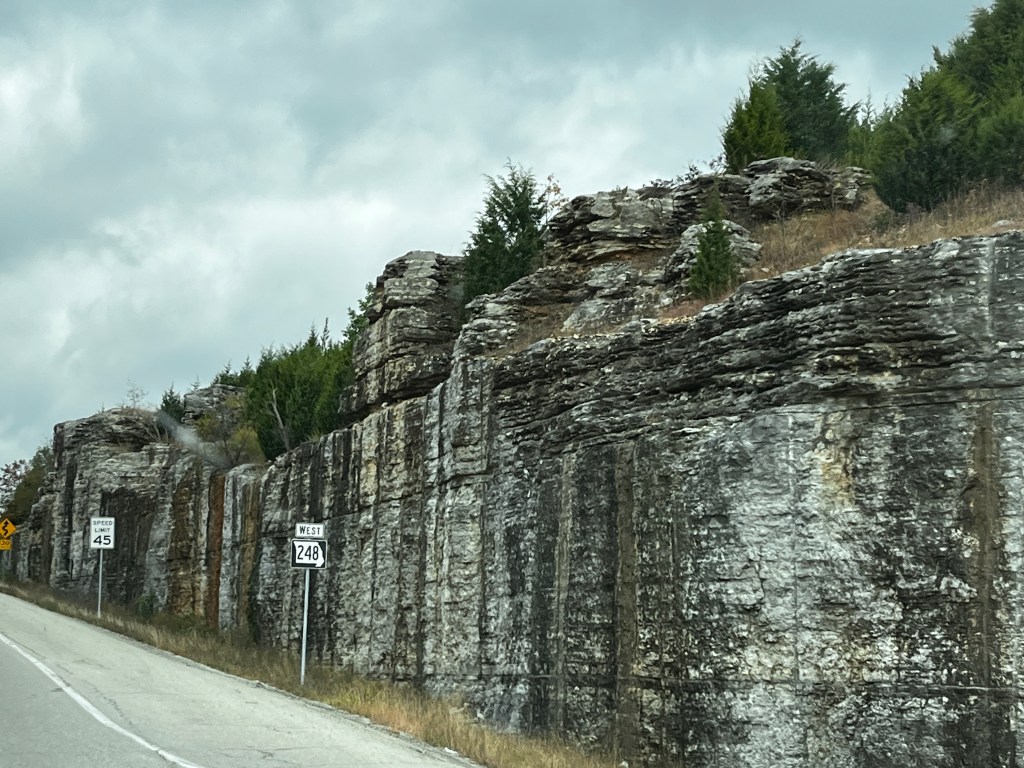
We moved on and took a short drive out into the “country” (as if Branson isn’t all country all the time…). We passed this granite wall along the road. There are many quarries in the area, and apparantly these hills are all solid granite. This tells us why they do so little grading when the build roads… roads go up and down and around the hills…
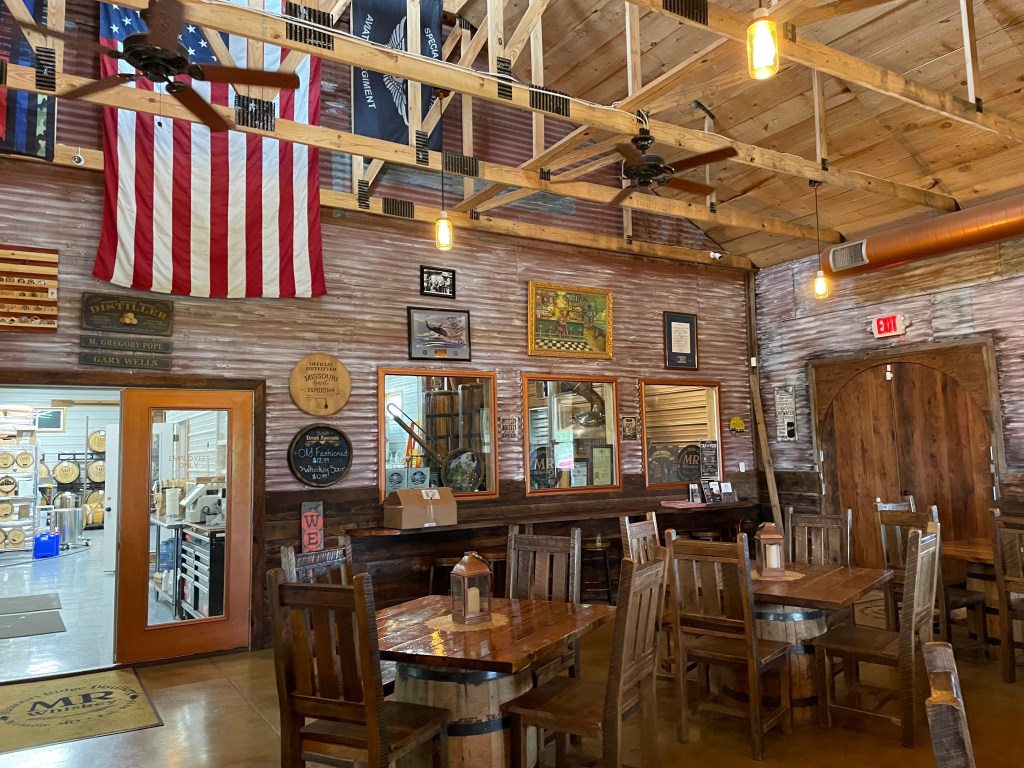
Our destination was the Missouri Ridge Distillery…
It was not busy, and we tasted some of their whiskey and “Scotch”… We treated ourselves to Old Fashioneds, sweetened with their own maple syrup that is aged in their used Bourbon barrels. Tasty!
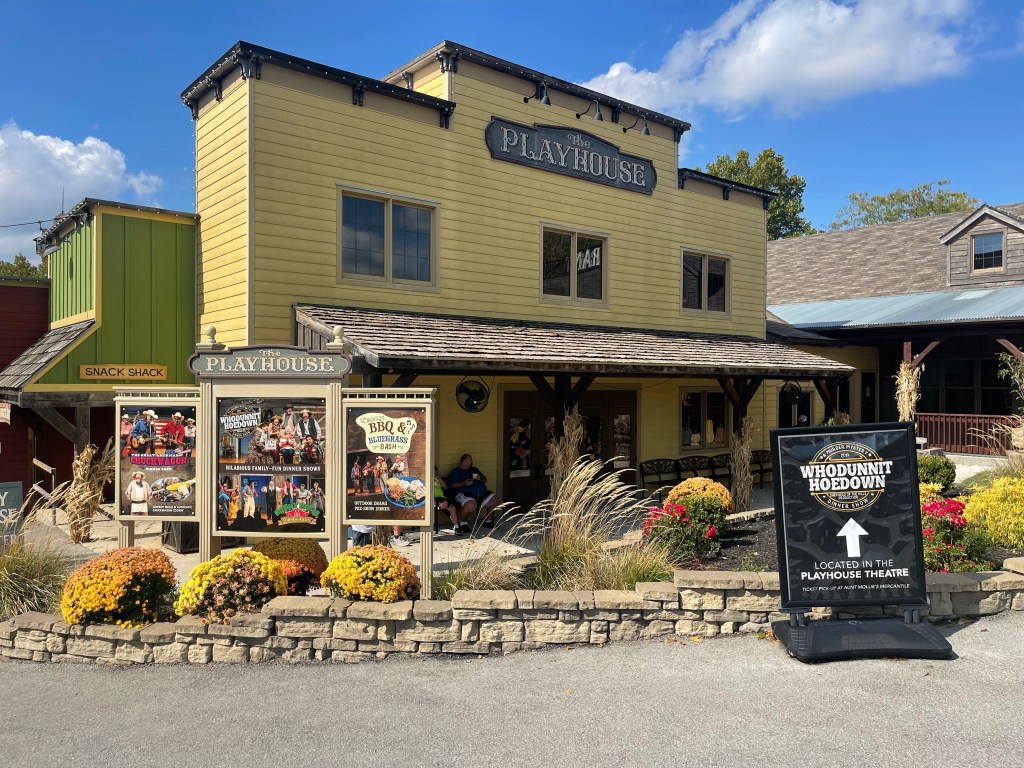
In the evening we experienced the first of many Branson shows; tonight is the Whodunnit Hoedown, a murder-mystery dinner show…
The theater complex has many forms of entertainment, with different shows rotating through the theater on different nights.
We had quite a wait outside, but we did enjoy a lovely sunset…
We had great seats, 2nd and 3rd rows…
The food was barely edible – dry chicken, bland green beans, sticky mashed potatoes, and some sort of sweet pork that looked like it had been through a blender. All of it was out of a can, I’m sure….
As bad as the food was, the show wasn’t much better… Silly corny jokes, no plot, no mystery…
We were happy when the “show” was over… We returned to the Villa and an enjoyable time was had by all…
There will be 24 rigs in the caravan. In case you are wondering, no, we don’t travel down the road all together… Maybe two-three rigs together, maximum. Typically Lynda and I travel by ourselves.
We will be exploring northern Arkansas and southern Missouri. Our itinerary is as follows:
Mountainview, AR; Cotter, AR; Eureka Springs, AR; Bella Vista and Bentonville, AR; Branson, MO; Mountain Grove, MO; Mountain View, MO.
Never heard of some of these places? Neither have we… (In 2019, we did visit Eureka Springs, Bella Vista, and Bentonville…)
We received our “Drivers Manuals” – a three ring binder containing everything we need to know about the entire caravan.
At dinner time we trekked about 1/4 mile to “The Skillet” restaurant, part of the Ozarks Folk Center, adjacent to our RV park…
Dinner was a huge buffet of Southern food… Soup, salad, turnip greens, chicken and dumplings, fried okra, fried chicken, meat loaf, and blackberry cobbler. The soup and cobbler were good…
The Mayor of Mountainview greeted us…
After dinner we walked back to the RV park, then we met again to review the drivers manual, job assignments, and other logistical things…
We returned to the Villa, drank the wine we had forgotten to bring to dinner, and turned in early…
We hitched up and left Eureka, MO today. We are heading out to Mountainview, AR to the rendezvous spot for the caravan.
We drove about 50 miles along the interstate, then we topped off fuel in Rolla, MO. We left the interstate and said goodbye to civilization…
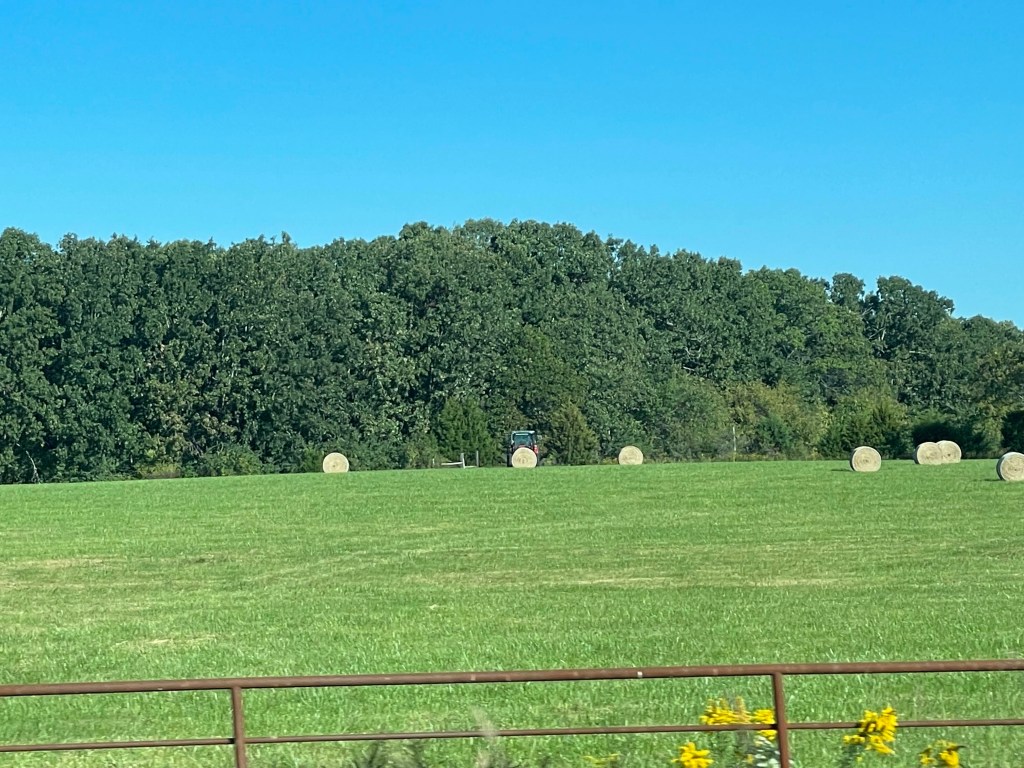
This is Missouri…
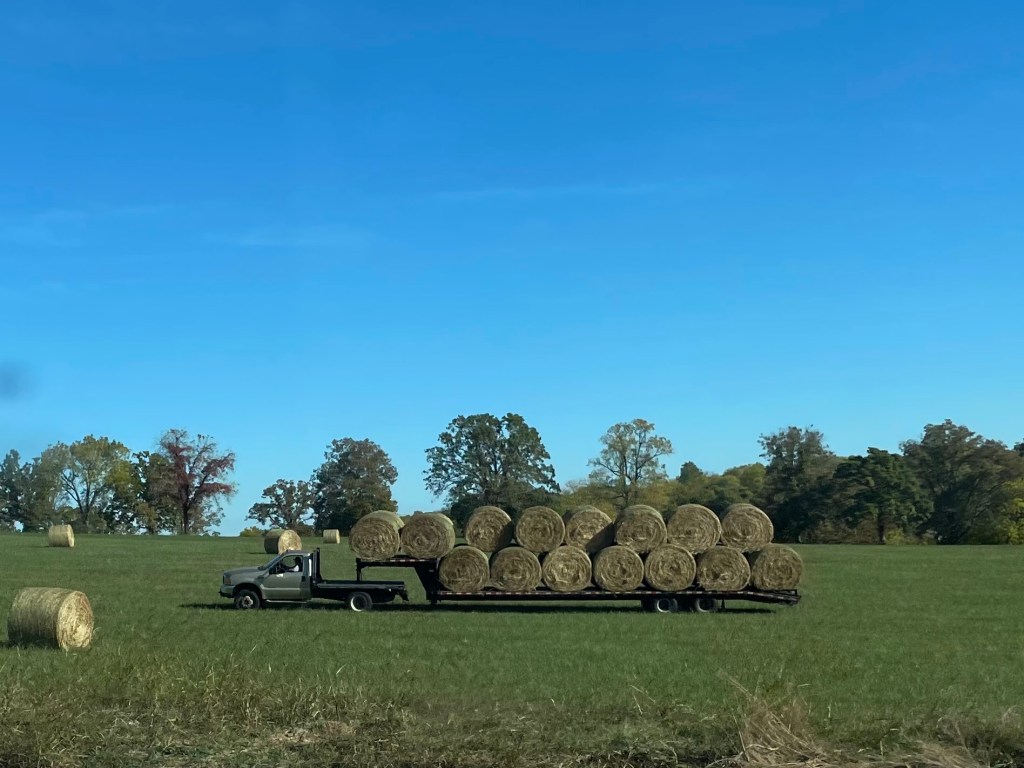
We no longer saw vast field of corn; here was more general farming and lots of rolling hills…
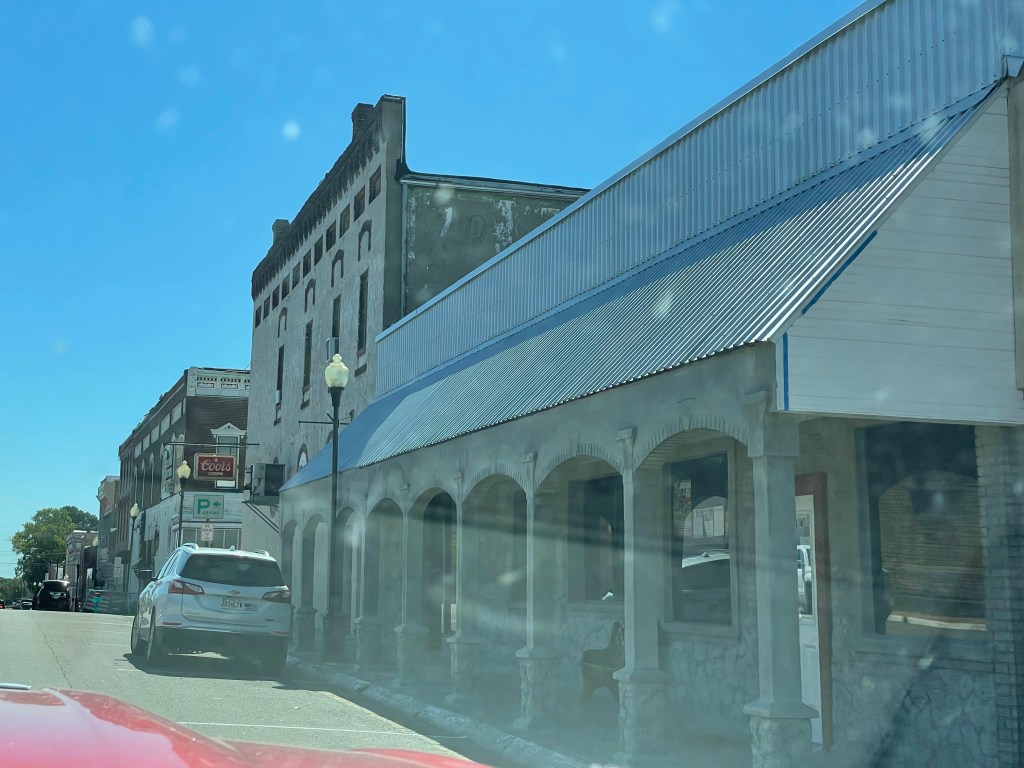
This is Willow Springs, MO, about halfway to the border…
We moved on…
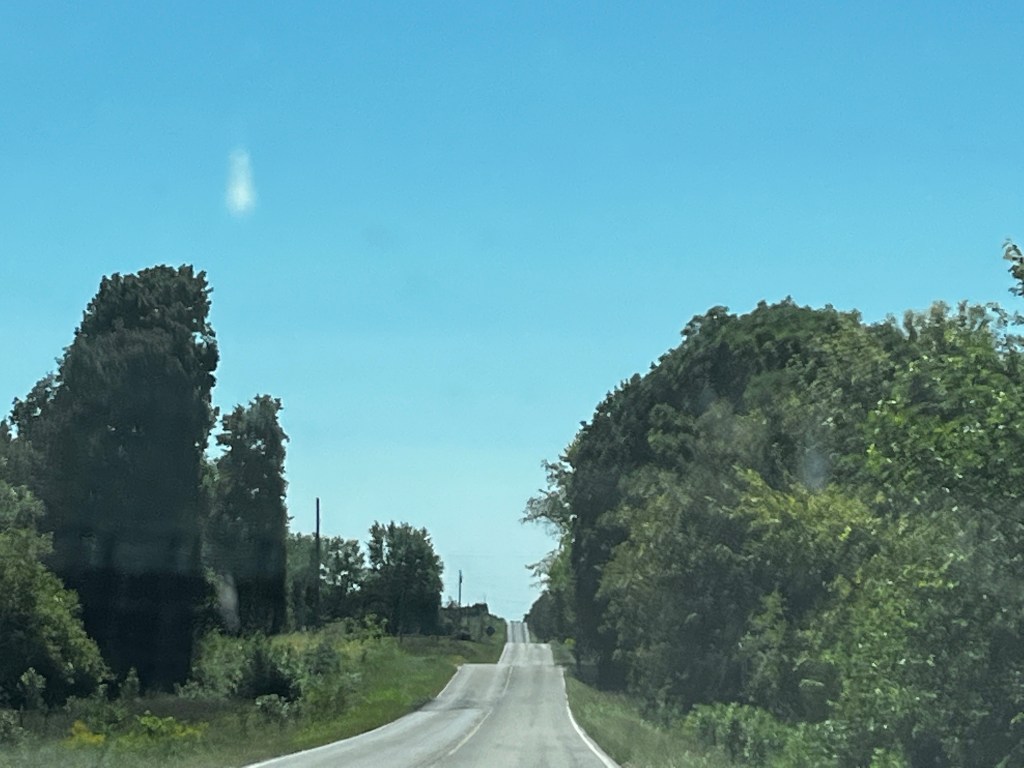
These roads are all marked 55 mph, but the entire way is all curves, uphill, and downhill. The entire way is signed as SLOW – 25 mph, 35 mph, 45 mph for the curves, so there is no way you can go 55 mph…
The Ozarks, also known as the Ozark Mountains or Ozark Plateau, is a physiographic region in the states of Missouri, Arkansas, Oklahoma and the extreme southeastern corner of Kansas. The Ozarks cover a significant portion of northern Arkansas and most of the southern half of Missouri, extending from Interstate 40 in central Arkansas to Interstate 70 in central Missouri.
There are two mountain ranges in the Ozarks: the Boston Mountains of Arkansas and the St. Francois Mountains of Missouri. Buffalo Lookout, the highest point in the Ozarks, is located in the Boston Mountains. Geologically, the area is a broad dome with the exposed core in the ancient St. Francois Mountains. The Ozarks cover nearly 47,000 square miles (120,000 km2), making it the most extensive highland region between the Appalachians and Rockies. Together with the Ouachita Mountains, the area is known as the U.S. Interior Highlands.
The Salem Plateau, named after Salem, Missouri, makes up the largest geologic area of the Ozarks. The second largest is the Springfield Plateau, named after Springfield, Missouri, nicknamed the “Queen City of the Ozarks”. On the northern Ozark border are the cities of St. Louis and Columbia, Missouri. Significant Ozark cities in Arkansas include Fayetteville, Bentonville, Springdale, Eureka Springs, and Fort Smith. Branson, just north of the Arkansas–Missouri border, is a tourist destination and popularizer of Ozark culture.
As we drove south we finally crossed over into Arkansas…
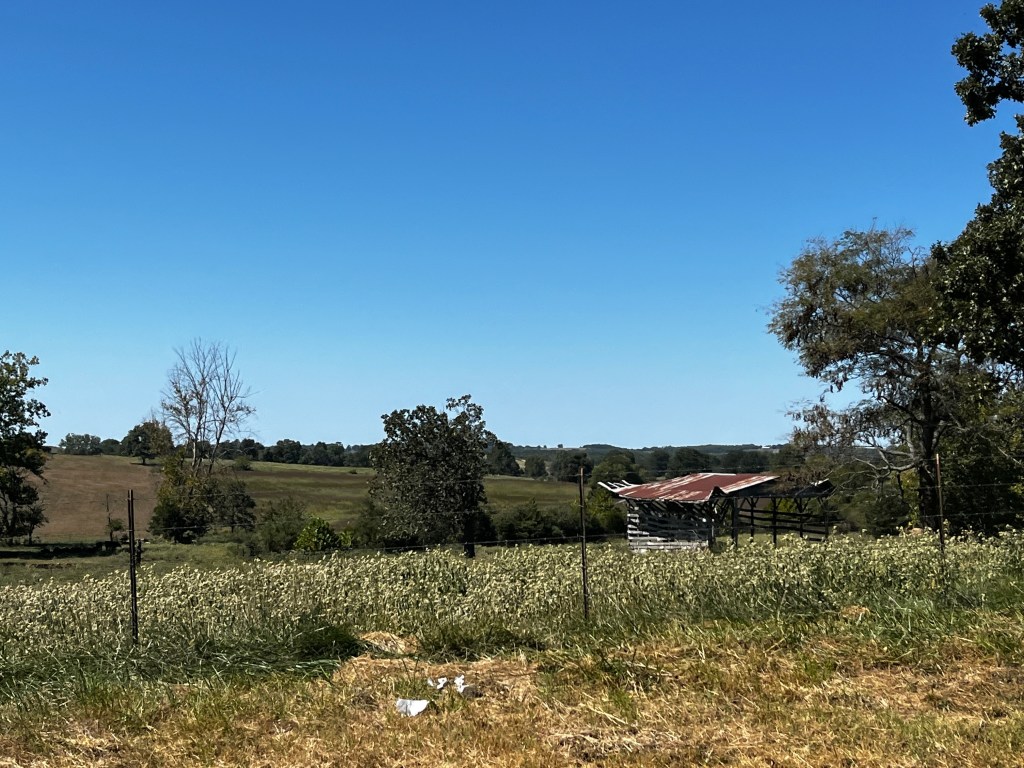
This is Arkansas – the countryside is not much different than southern Missouri…
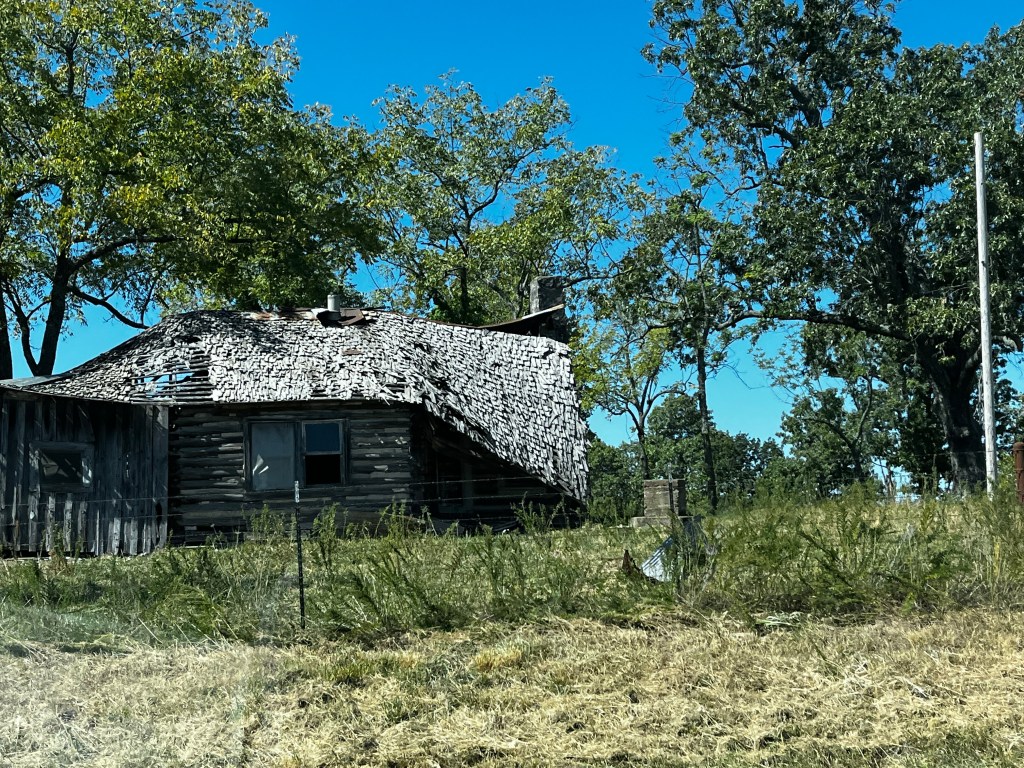
Some fixer-upper real estate is sometimes available…
We arrived at the Ozarks RV Park in Mountainview… Three other Airstreamers were already here – these are our leaders, co-leaders, and a friend who came in early to help out…
We set up the Villa, and met our new friends; soon we all headed out together to go to dinner. At 4:30! We went to The Wing Shack and Cheeseburger Grill, one of the finer attractions in town…
It is only about a two hour drive from Springfield, IL, to St. Louis, MO.
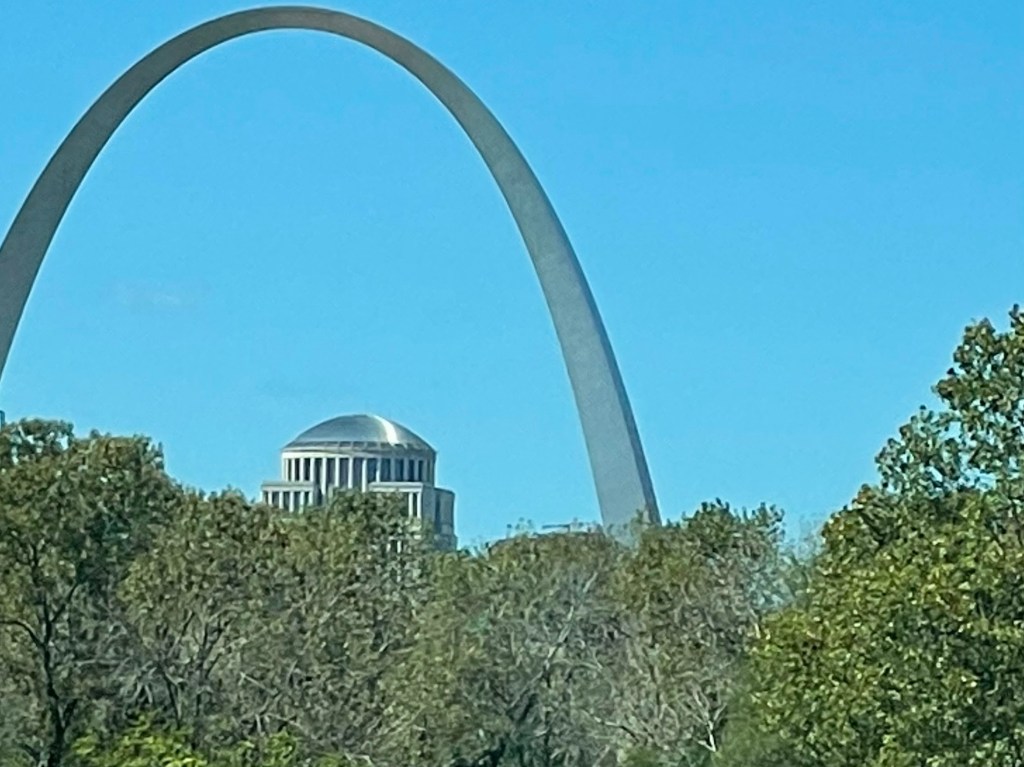
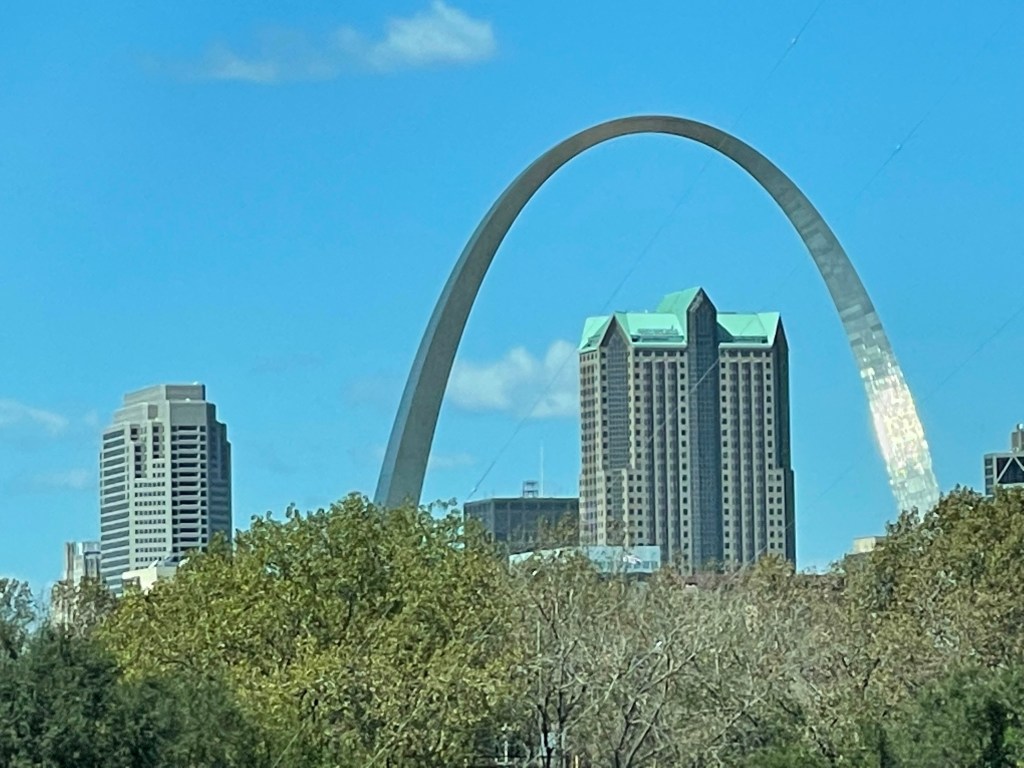
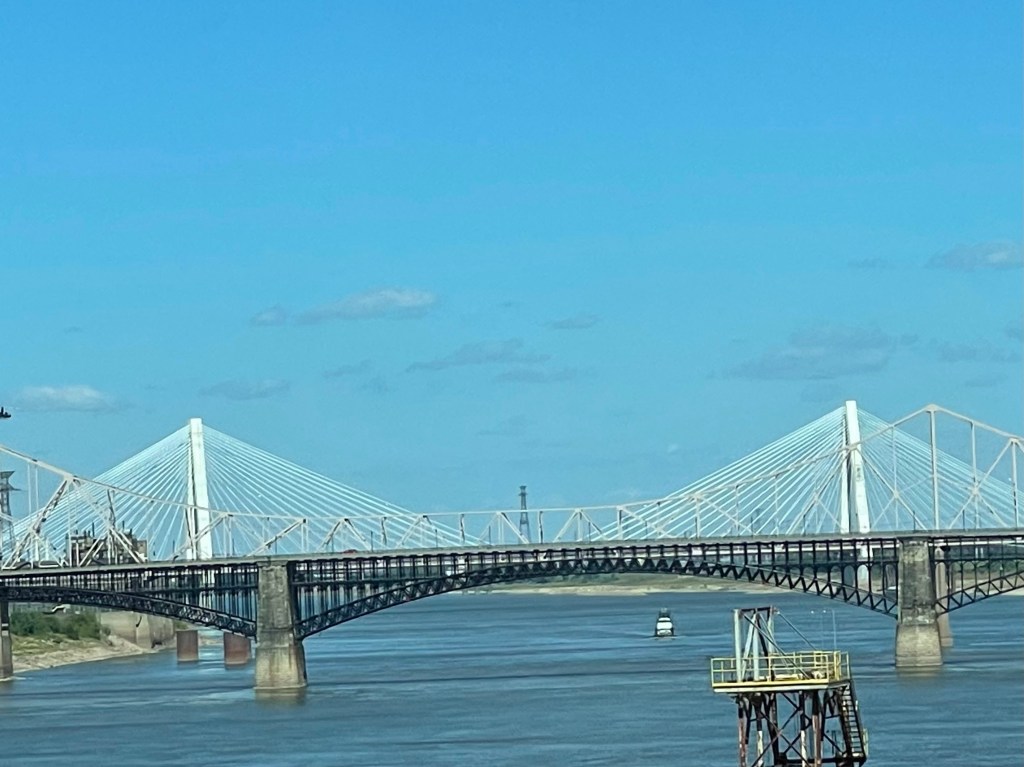
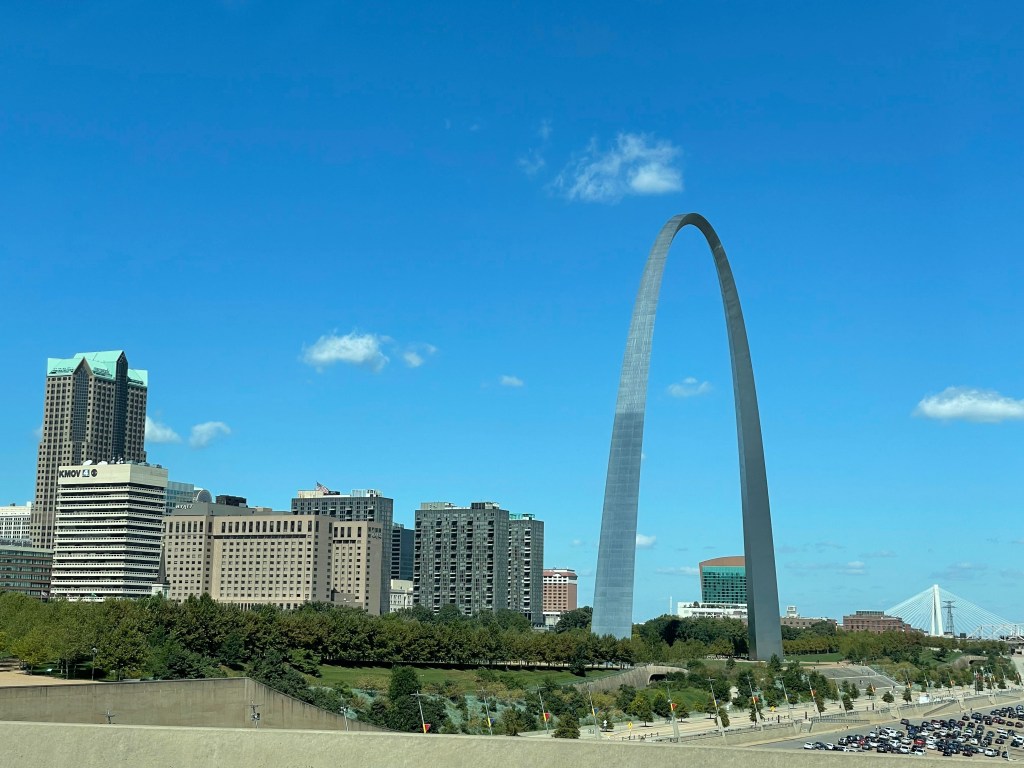
Coming into the city and crossing the Mississippi River again we were able to see the Gateway Arch. The architect was the talented Eero Saarinen. We were able to see it up close and ride the frightening “elevator” to the top in 2017… Today we can see it in context with the rest of downtown St. Louis…
Crossing the Mississippi River…
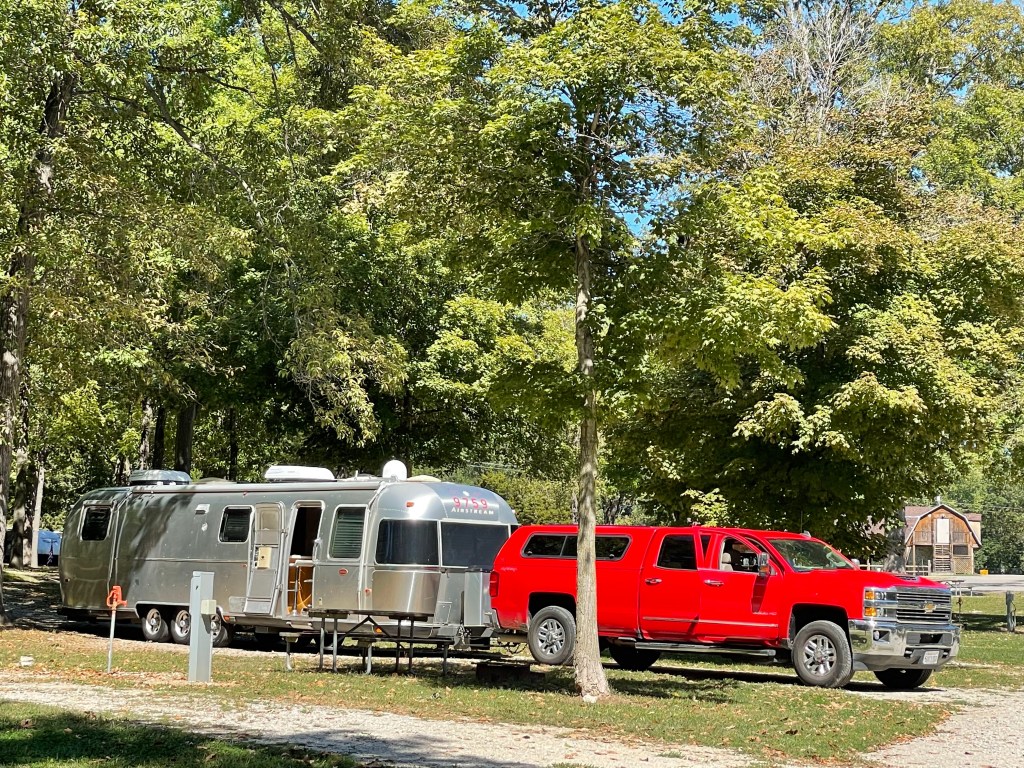
After several detours due to a closed interchange we finally arrived at our campsite…
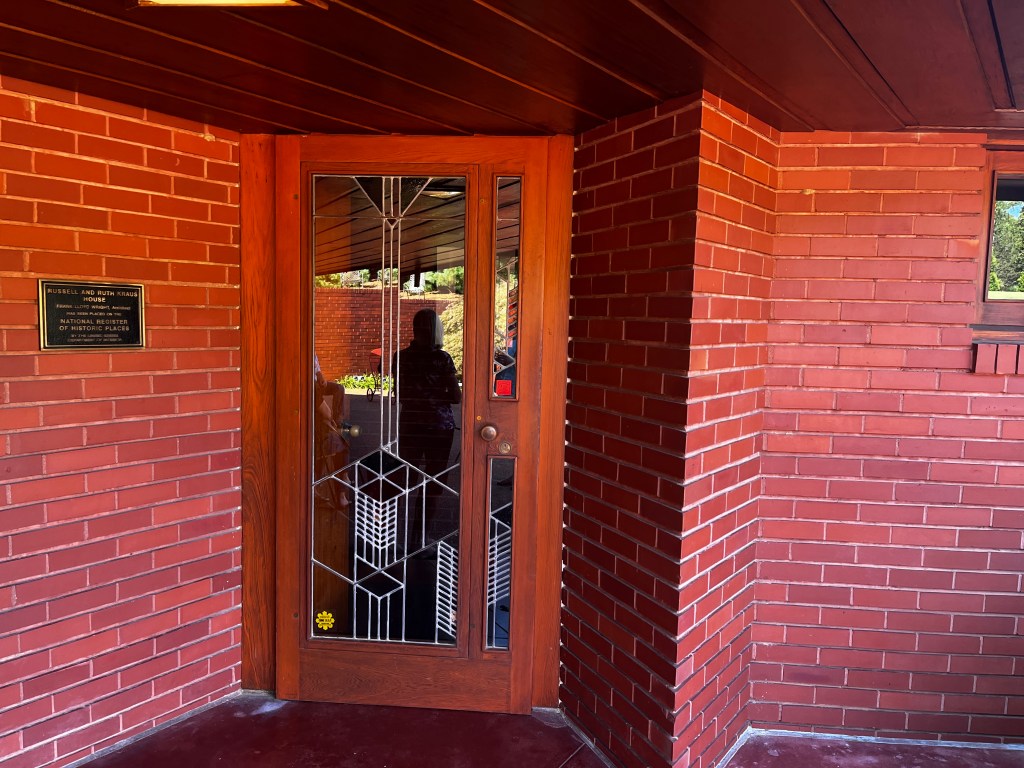
We quickly set up and then we were off again to see the Frank Lloyd Wright-designed Kruase House in the nearby city of Kirkwood…
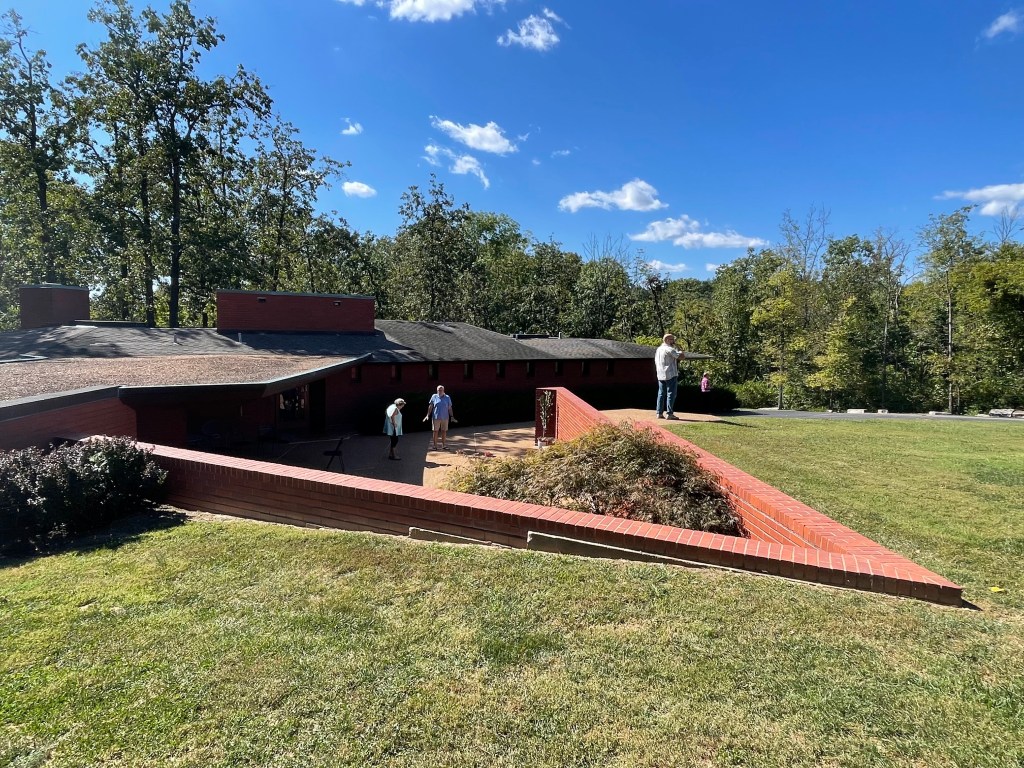
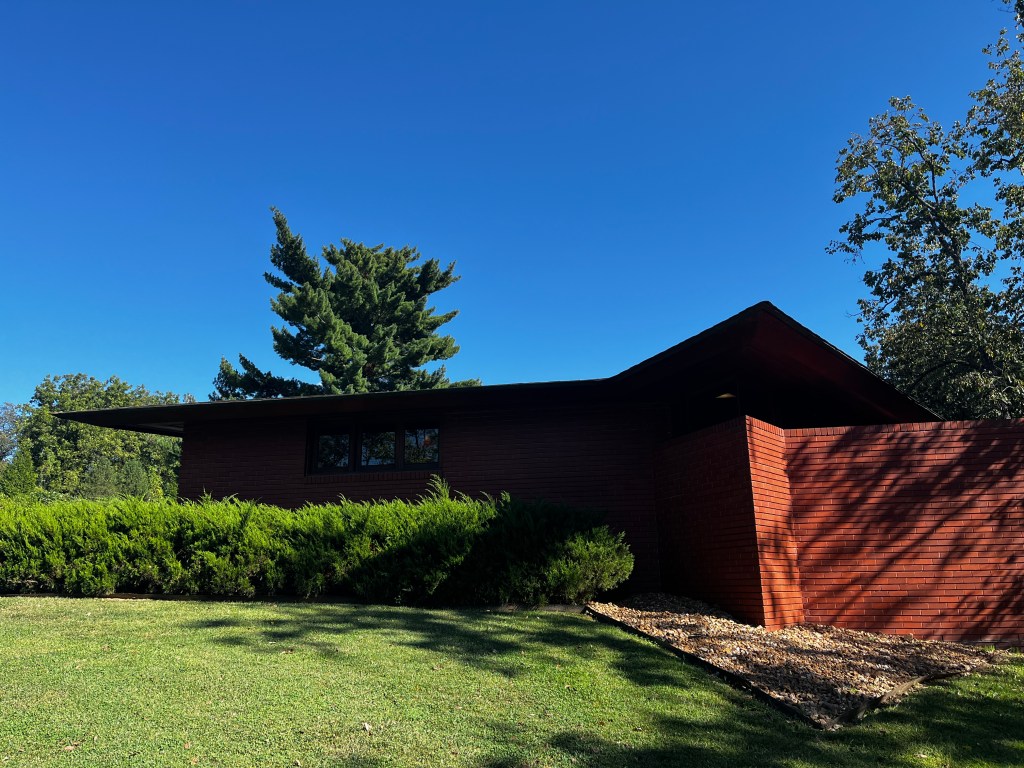
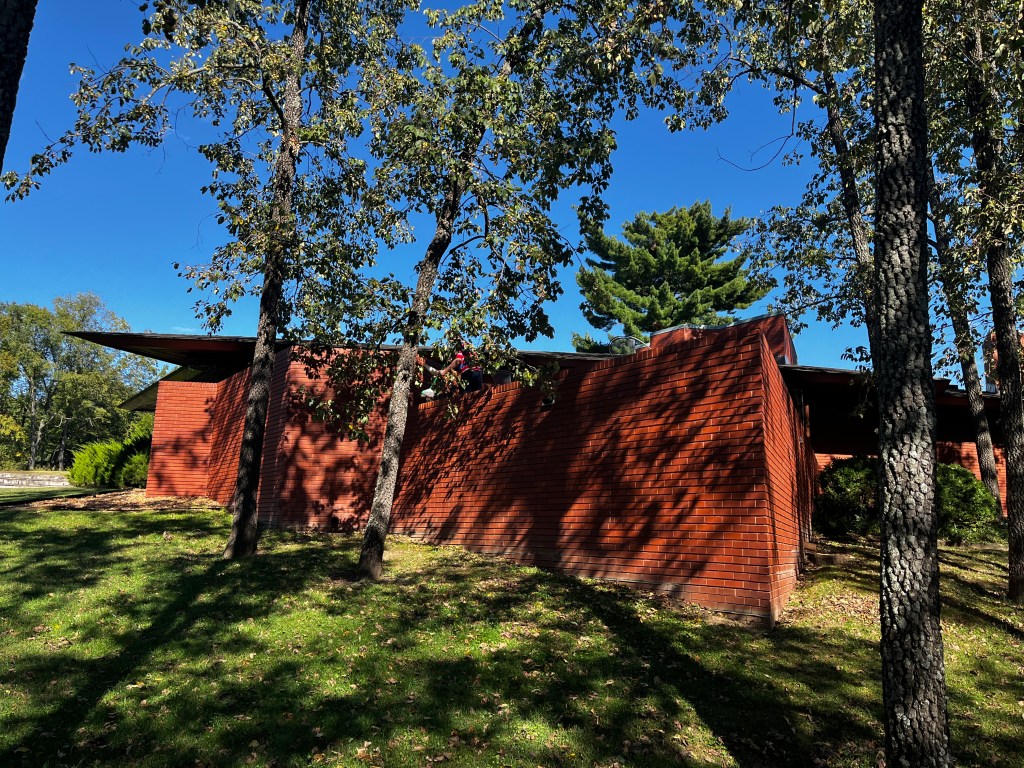
The Frank Lloyd Wright “Krause House”, in Ebsworth Park, was designed by Wright in 1950 at the request of Russell Kraus and his wife Ruth. Located in Kirkwood, Missouri, a suburb of St. Louis, the 1,900-square-foot house is sited in a grassy meadow beside a grove of persimmon trees. The house is an excellent example of Wright’s Usonian architecture, intended to provide middle-class Americans with beautiful design at moderate cost.
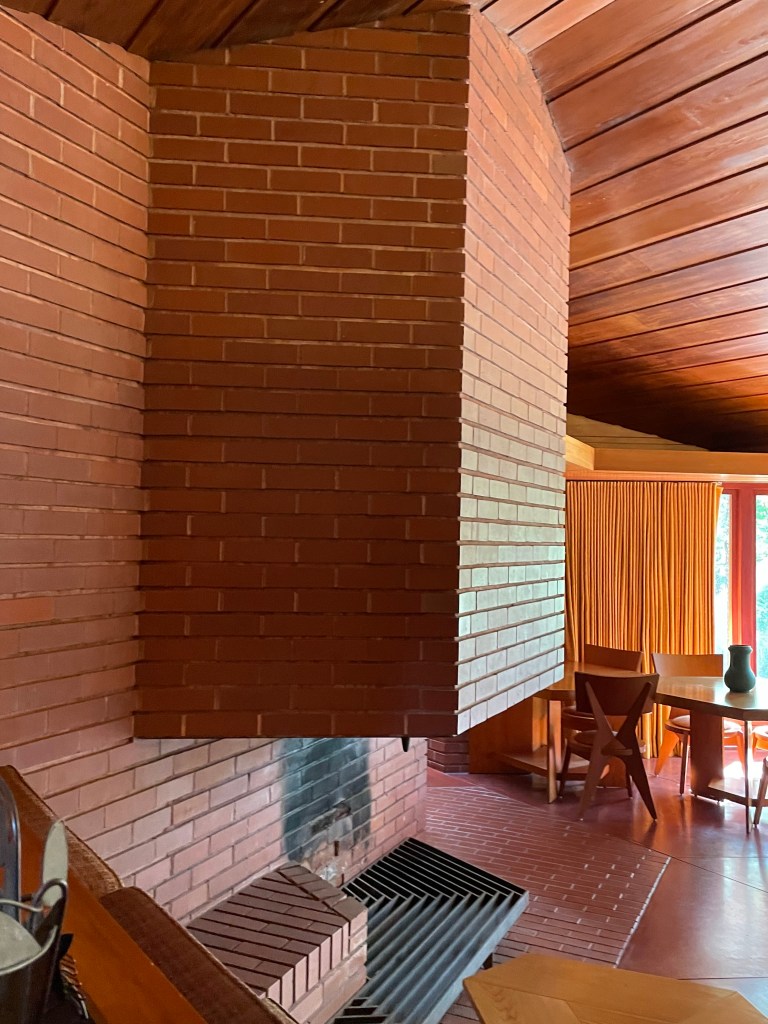
For his Usonian homes, Wright developed a “unit system” based on geometric shapes. The Kraus House is based on an equilateral parallelogram with a complex floor plan of intersecting parallelograms. Typical of Usonians, the house has an open living area, a central hearth, concrete slab floors with radiant heat, and a wall of glass doors that affords views of the landscape. The same materials are used both inside and out: brick, concrete, glass, and tidewater red cypress. The doors to the main terrace incorporate stained glass designed by Russell Kraus, a mosaic and stained glass artist.
The Krauses moved into their home in January 1956 and lived there together until Ruth’s death in 1992. In 2001 a non-profit organization, The Frank Lloyd Wright House in Ebsworth Park (FLWHEP), purchased the house and grounds from Russell and deeded the property to St. Louis County for the creation of a public park and house museum. Subsequently, the FLWHEP completed an extensive restoration of the brick, woodwork, furniture, and textiles in the home.
Today, the FLWHEP remains responsible for the preservation and operation of the house museum. The organization also serves as a focal point in the St. Louis region for educational programming on Wright’s legacy, as well as architecture and design in general. The St. Louis County Parks and Recreation Department maintains the grounds, known as Ebsworth Park. Due to a generous donation from Barney Ebsworth, the park was named in memory of his parents, Alec W. and Bernice W. Ebsworth.
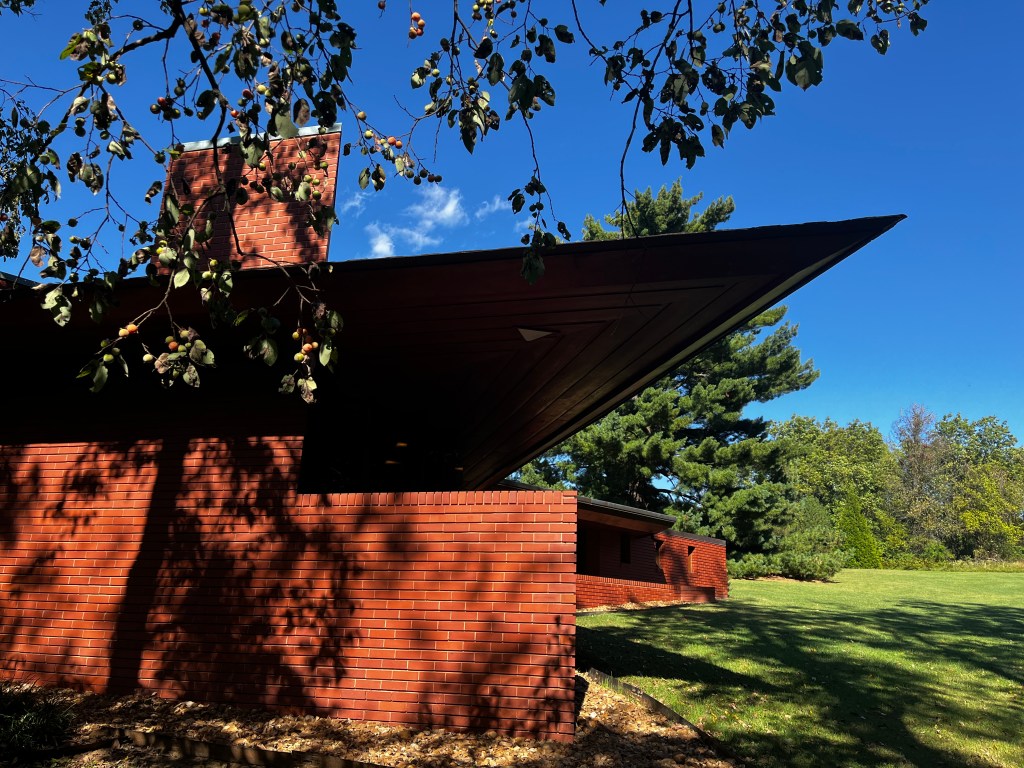
The design of the house is typical of most of the “Usonian” houses we’ve seen. (The Dana-Thomas house was “Prairie Style”…) Usonian houses still maintain the horizontal lines Wright was so fond of, and, of course, outrageous cantilevers. Usonian houses are generally one story, on a slab foundation, with similar materials used inside and out.
Arriving at the house we marveled at the entrance gate, clearly denoting that something special was ahead… We passed through the gate, drove up the hill, and around the house, and entered the motor court on the backside of the house…
The Krause house is one of the more complex houses, yet also one of the simplest. There are no right angles, nor rectangular or square rooms in the house. The house is arranged over a grid of equilateral parallelograms. You can see what results from this model:
We arrived at the motor court and carport…
The motor court follows the shape of the parallelogram as it cuts into the site. The house does not sit atop the site, but cuts into it…
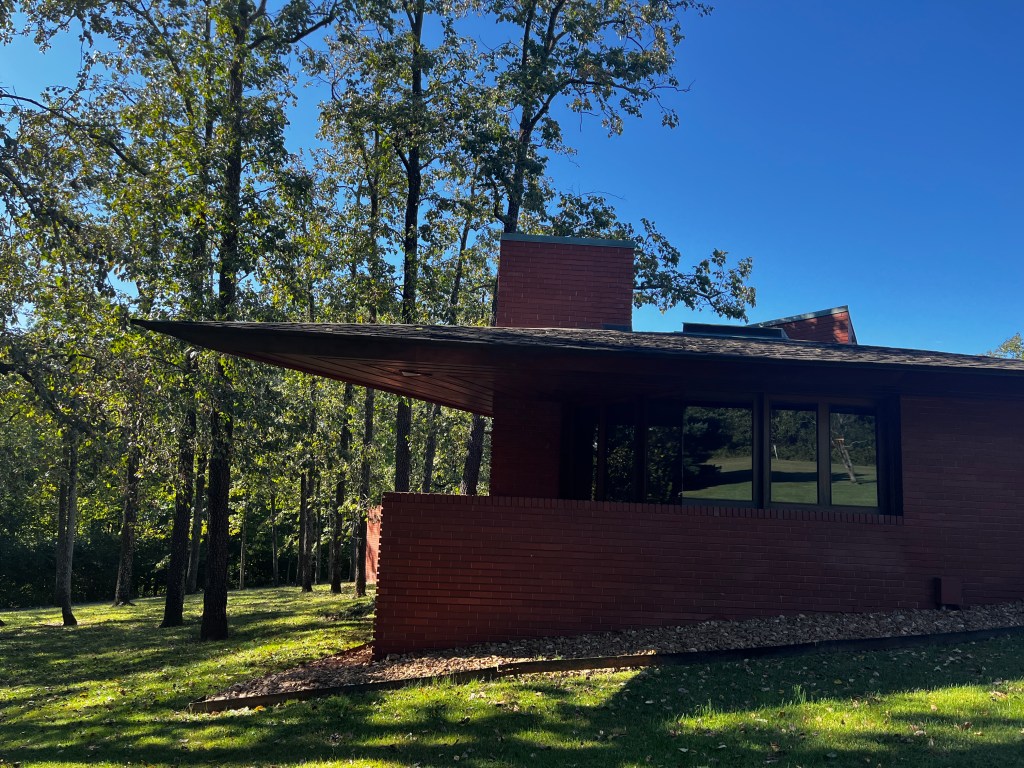
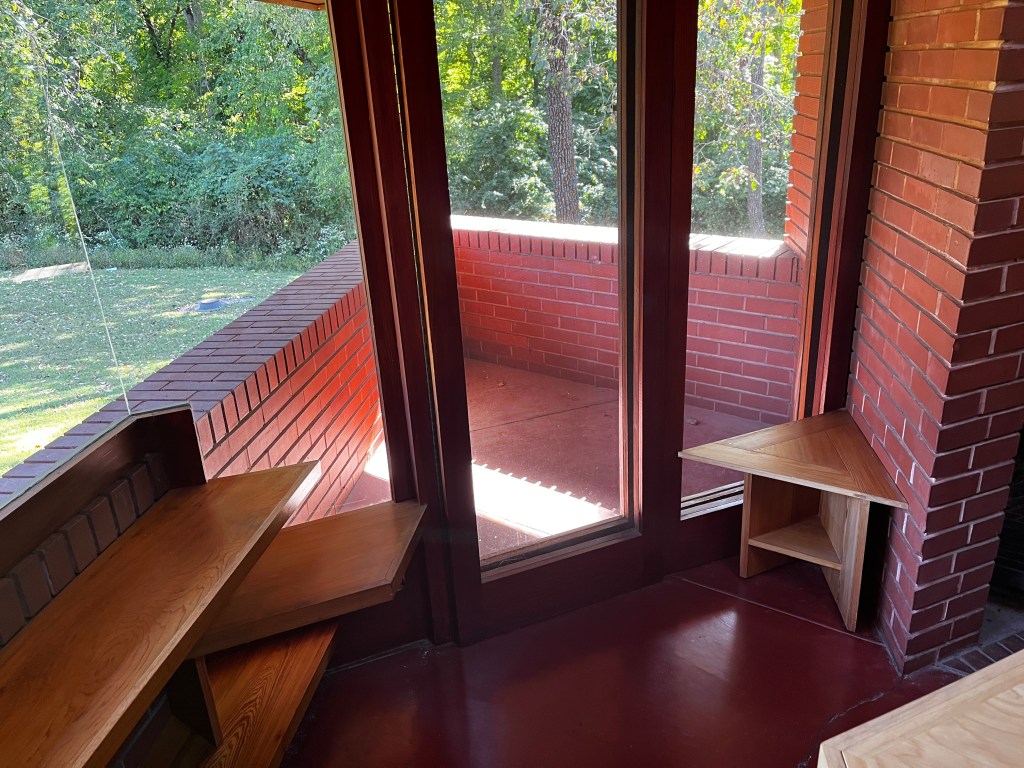
Walking around the house we see the cantilevers, the brick walls with the mortar joints emphsizing the horizontal, and the integration of the house into the site…
The front door is not at the “front” of the house, but is where it ought to be – in the motor court. The art glass windows were designed by Wright or by the owner, a great artist in his own right…
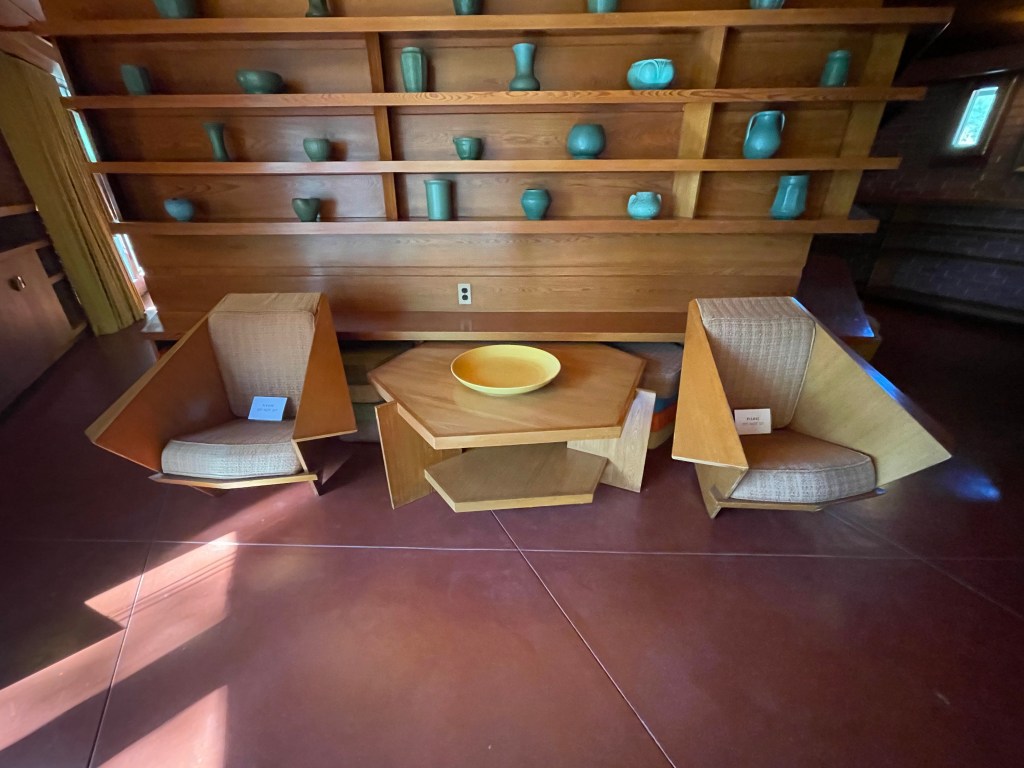
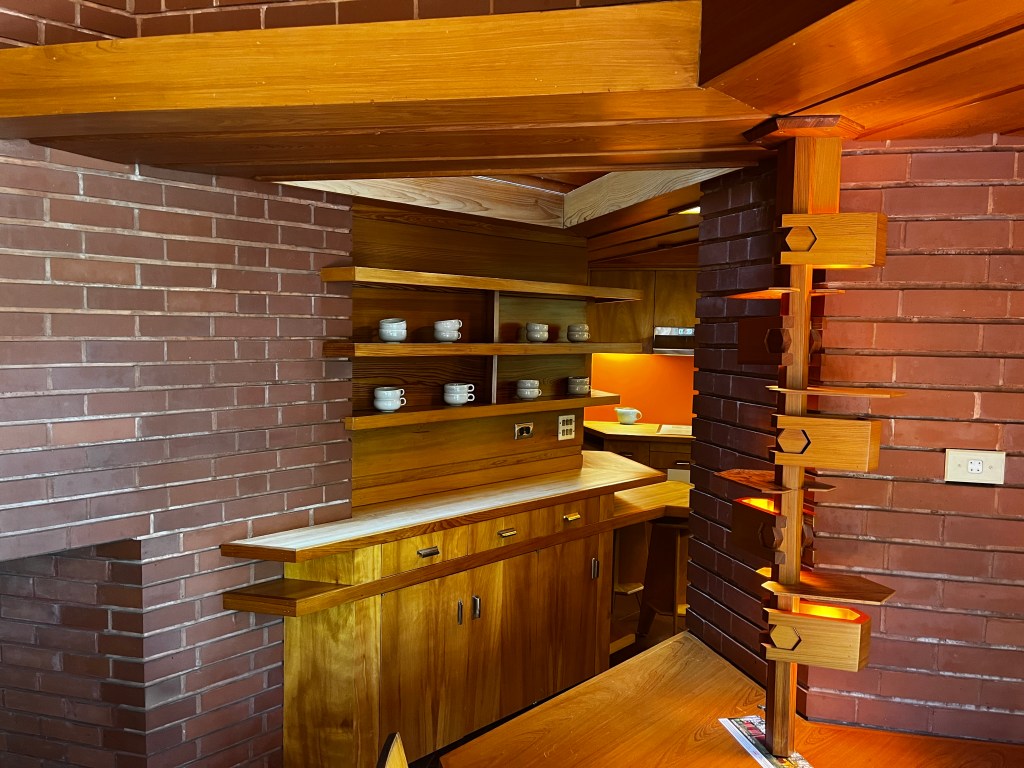
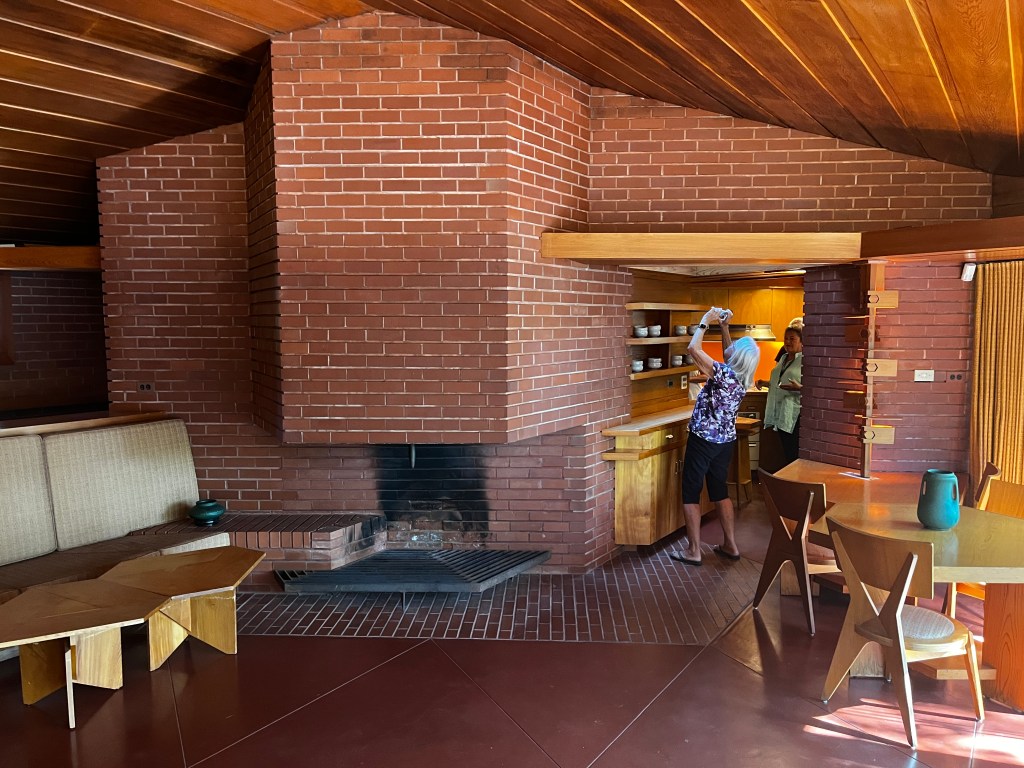
The interiors are all brick walls or wood board and batt walls. Most lighting is indirect and all the light fixtures and all the furniture was designed by Wright…
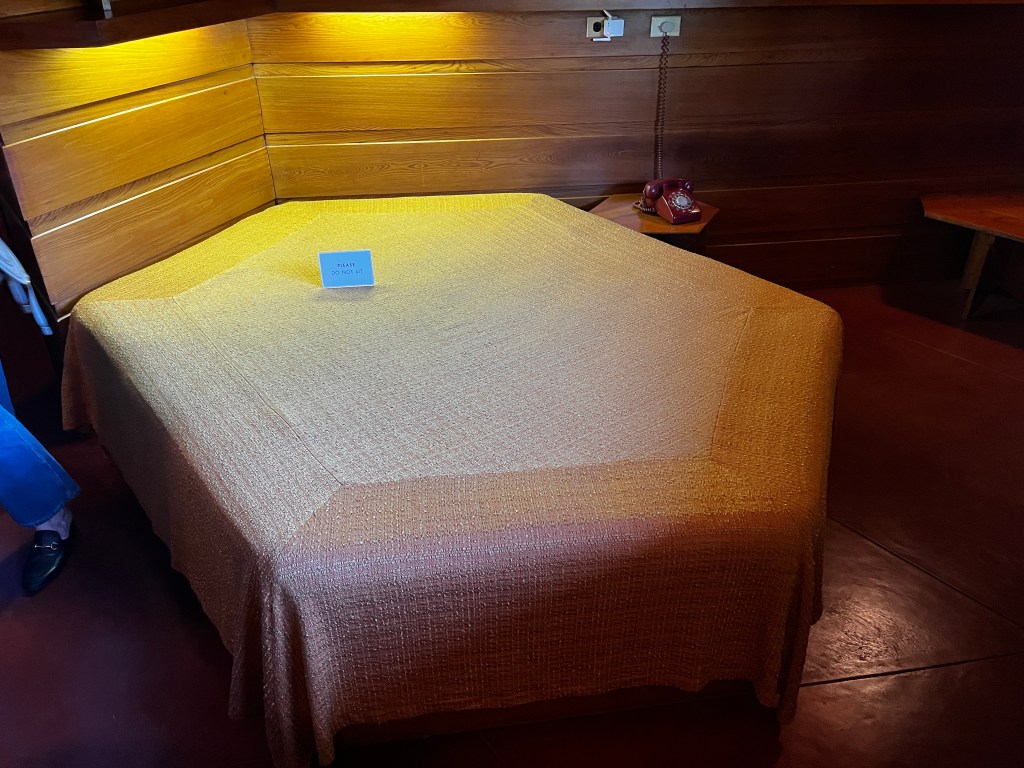
The telephones are custom colored as Wright’s “Cherokee Red”, as is the floor slab…
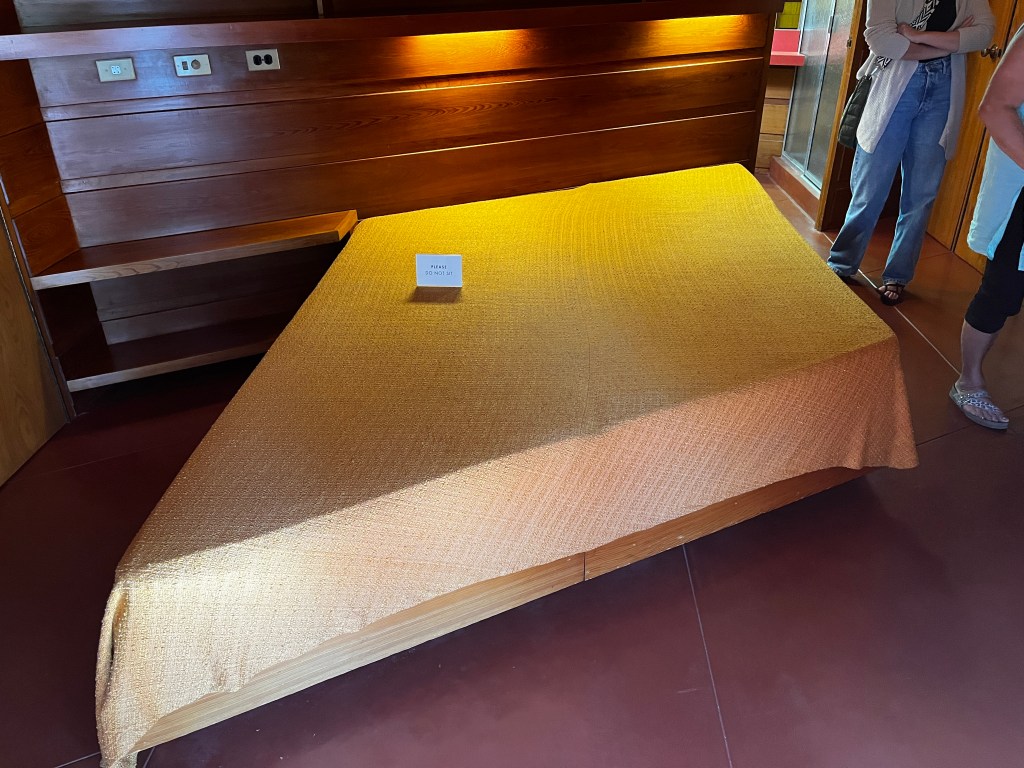
When you design a floor plan as parallelograms beds are required to be parallelograms, too…
Or a hexagon…
It was a delightful tour. It is a very exciting house…
We returned to the Villa. Happy Hours ensued; an enjoyable time was had by all…



































































 Adventures in the Villa