Search

Adventures in the Villa

2017-06-28 Back in the USA; All the Martin Houses by Frank Lloyd Wright

We left the campground in Niagara early in the morning – we have a long day ahead of us; first we need to cross the border, then get to a 10:00 am house tour in Buffalo, then on to another tour in Rochester, then on to our next campground for the night…

The border was quite busy as we approached; the RV lane was very slow. They eventually opened another lane, and the RVs were cruising through at a fast clip, but we were stuck in our slow lane… Finally we made it to the customs agent. No smiles, no conversation, but easy questions and we were quickly on our way. It had taken almost an hour… But now we were on to Buffalo.

I don’t know what you think about Buffalo, but I didn’t have high expectations. However, the “Parkview” neighborhood we found ourselves in was lovely. There was a huge Olmstead-designed park, and a lovely neighborhood of well-kept houses and tree lined streets. It is about 1 mile from downtown.

2017-06-28 Martin 75


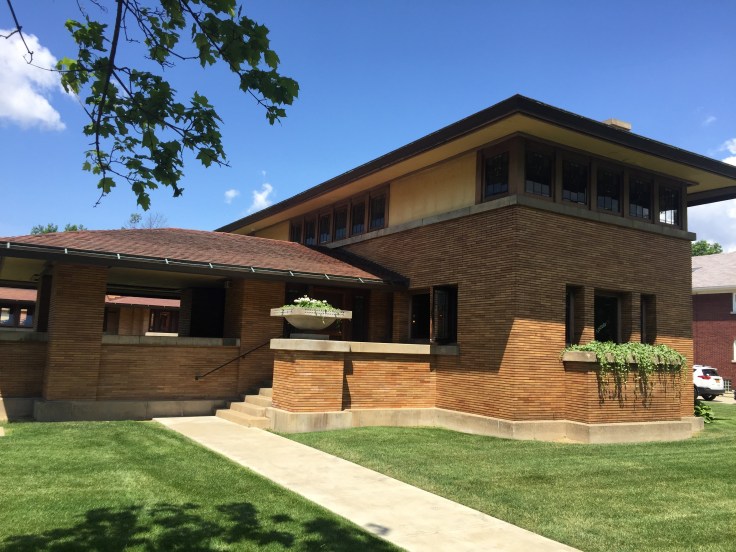
Here is the house Frank Lloyd Wright built for Mr. Martin in this neighborhood:

2017-06-28 Martin 02


Darwin Martin lived in this neighborhood in a Queen Ann style Victorian house. He was a rags-to-riches story, eventually rising to be a top executive with the Larkin Soap Company.  In the early  1900s, the Larkin company needed a new headquarters, and Mr. Martin’s brother lived in a Frank Lloyd Wright-designed house in Oak Park, IL. He suggested Larkin consider retaining FLW for their headquarters. FLW did not have much of a track record doing commercial buildings on his own, and Larkin was cautious. In the mean time, Martin was looking to build a new house for himself, and he had bought a lot in a prestigious neighborhood on the other side of Buffalo.

When FLW visited Martin, he saw a 1 1/2 acre parcel a few blocks from Martin’s house. He convinced Martin to sell his other lot and buy this parcel. FLW set out to design a family compound for Mr. Martin. The first house to be built was for Martin’s sister and her husband, Mr. and Mrs. Barton.  This proved to be successful, and as a result, Larkin retained FLW to design the new Larkins Headquarters.  This was FLW’s first substantial commercial commission, and it set the stage for many others. (The Larkin Building was demolished in 1950.)

After the Barton house was complete, the Martin house was built. It is the ultimate FLW “Prairie-style” house, similar to 60 other houses, but one of the first, and one of the largest. These houses are distinguished by horizontal lines: strips of windows, low and wide bricks, broad and low roof eaves, and a sprawling plan – nothing boxy like other houses of the era. (The more famous Robie house in Chicago has many of the same features…)

The Martin House Complex includes the main house, the Barton house, a Conservatory or greenhouse, a Pergola connecting the Conservatory to the main house, a carriage house with servants quarters above (and a steam generating plant below, to heat the complex), and a Gardener’s cottage.  Mr. Martin and FLW became best friends, mainly because Martin referred FLW to other commissions, and helped him financially on many occasions…

The Martins lived in the house from 1905 to the early 1930s. Mr. Martin was pretty much wiped out by the 1929 stock market crash; he only had enough money left to build another FLW-designed summer house on the shores of Lake Erie, about 30 miles away. Mr. Martin died in 1935 and the family abandoned the complex in 1937, with Mrs. Martin moving full time to the summer house. The complex fell into disrepair; in 1946 the City of Buffalo sold the house in a tax foreclosure auction. The Barton house and the Gardener’s cottage were sold off, and eventually the Pergola, the Carriage house, and the Conservatory were demolished and that parcel was sold; apartment buildings were build on the land.  Portions of the main house were turned into office space and several apartments.

In 1992 the restoration and rebuilding were begun. The parcels were re-purchased, the apartments were demolished, and the Pergola, the Carriage house, and the Conservatory were rebuilt to exacting standards. The upper floors of the buildings are still undergoing restoration, so we were not able to see them, and interior photos were not allowed.

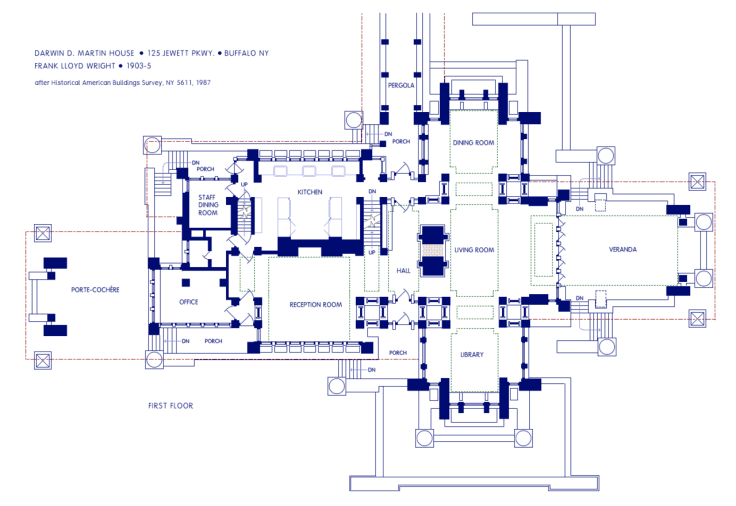
The main house was quite amazing, considering the kinds of houses wealthy people were building during this era.  The floor plan tells you a lot about how different this house was.  Note the large kitchen on the main floor (not in the basement), and note the “Great Room” – Dining, Living, and Library combined together and open to each other, yet each well defined by the architecture.2017-06-28 Martin Plan
Pictures don’t do the house justice; also, considering that the house has large, low roof overhangs, the facade is almost always in shade.

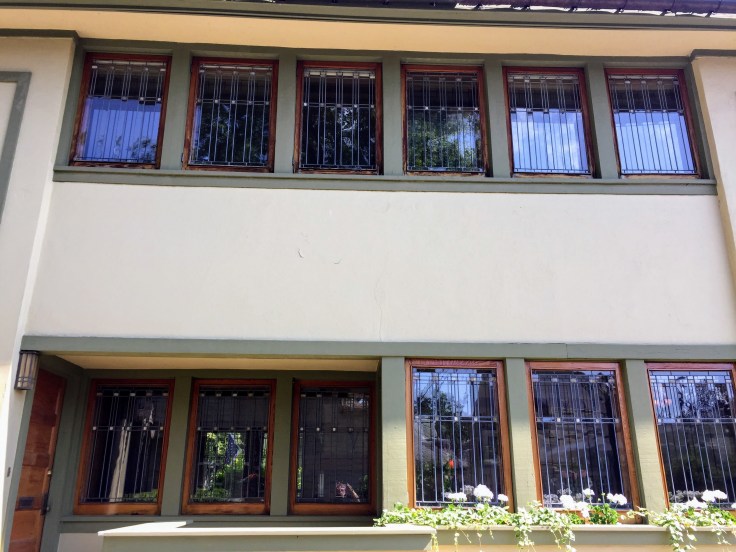
Horizontal strip windows:

2017-06-28 Martin 08


The Pergola and the rear of the house (note the horizontal lines of the bricks and the eaves):

2017-06-28 Martin 01


More circles within squares…


The Terrace:
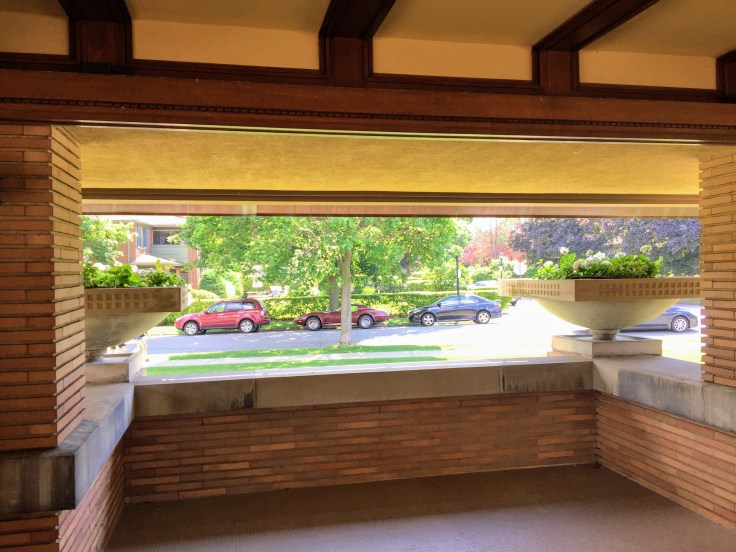
2017-06-28 Martin 04


The entrance – note the hidden front door…

2017-06-28 Martin 03


The Barton house…

2017-06-28 Martin 21


The Gardener’s cottage:

2017-06-28 Martin 31


The tour was very well done. We were welcomed at the visitor’s center by Frank himself:

2017-06-28 Martin 98


Our intentions for the rest of the day were immediately changed; we abandoned the idea of going to Rochester to see George Eastman’s house; instead, we headed west towards Lake Erie to see Greycliff, the Martins’ summer house.
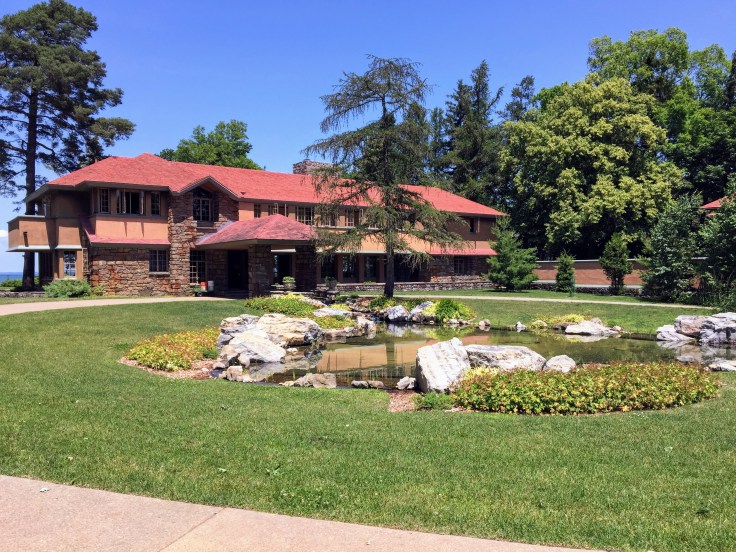
2017-06-28 Greycliff 01

This house is Mrs. Martin’s house. She never liked the main house in Buffalo because her eyesight was poor and the house was dark. This house is very light, with more windows, and with views to the lake. The house has terraces on two sides, overlooking the lake and away from the lake, protected from the lake’s sometimes harsh winds. The upstairs hallways are on the exterior of the house, with strip windows that could be opened on nice days.

The house sits atop a bluff about 65′ above the beach. A stair tower was built to the beach, connected to the bluff by a bridge. The bridge has been removed due to safety concerns, and is being restored. The stair tower is still here, and is structurally sound. They will be reunited soon.
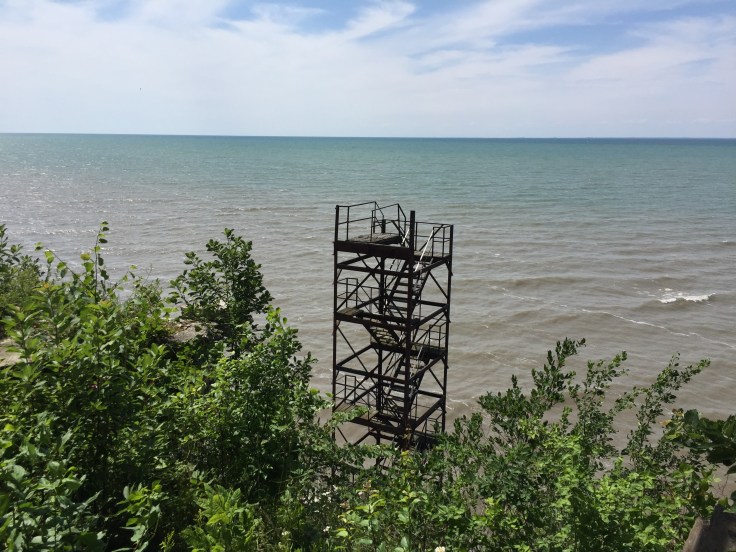
2017-06-28 Greycliff 80


The “see-thru” house…

2017-06-28 Greycliff 07


The lake side of the house:

2017-06-28 Greycliff 06


Frank was here, too:

2017-06-28 Greycliff 20


Mrs. Martin lived here until her death in 1943; the Martins’ daughter and her family lived here as well. The house was sold to a religious order, who kept up the estate until 1997, when it was purchased by the Conservancy and restoration was started. The house is still in pretty bad shape, but all the additions and changes installed by the religious order have been removed.

Again, we really enjoyed our tour here; but we had a long drive ahead. We set out for Canandaigua, a small town south of Rochester, just on the northern edge of the Finger Lake Region of New York.


An enjoyable time was had by all…


2017-06-27 Niagara Falls

Today we get to see Niagara Falls!  We drove to the city of Niagara Falls, Canada, and checked into Scott’s Tent and RV Campground.  It’s about 4 miles from the falls, so an easy walk for us.  The street, Lundy Lane, is chock full of motels, chain and local fast food places and restaurants, and other various and assorted tourist-oriented businesses.  But it does make for an interesting walk…

Just as we arrived at the riverside park before the falls it started to rain… But it had been a long walk and it was lunchtime, so we stopped into a cafe for lunch…

Our first view of the American falls:

2017-06-27 Niagara Falls 01


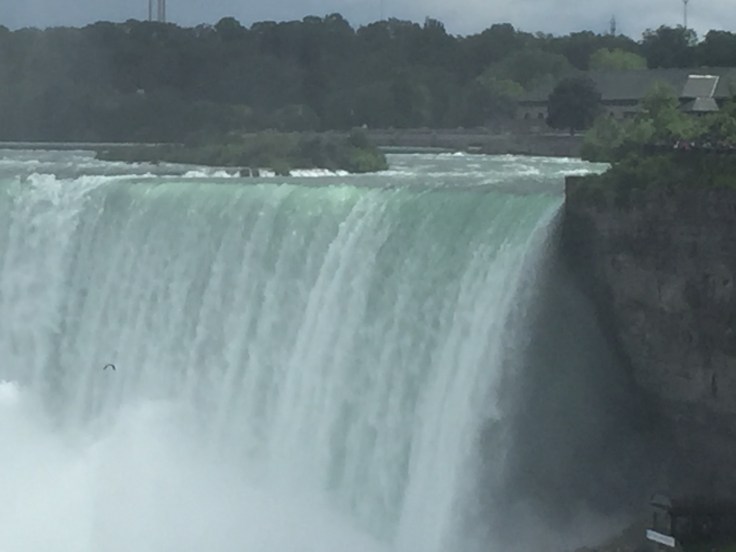
And the Canadian falls:

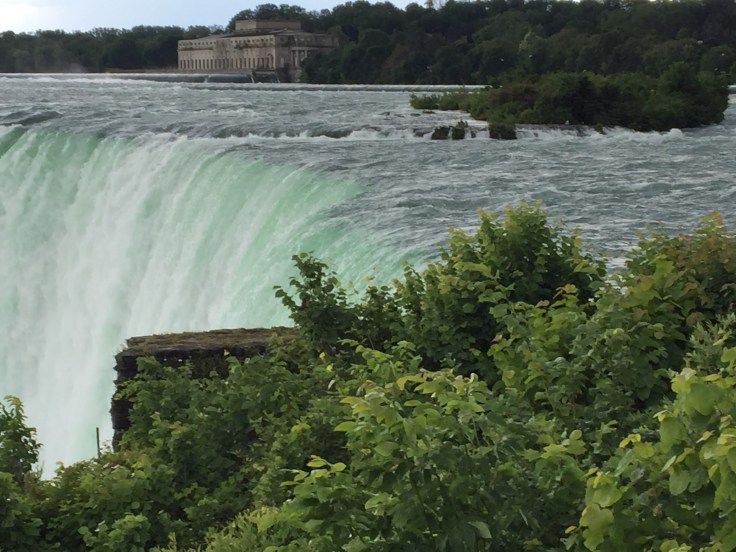
2017-06-27 Niagara Falls 02


Had to have a selfie:

2017-06-27 Niagara Falls 04


And a photo of Lynda:

2017-06-27 Niagara Falls 03


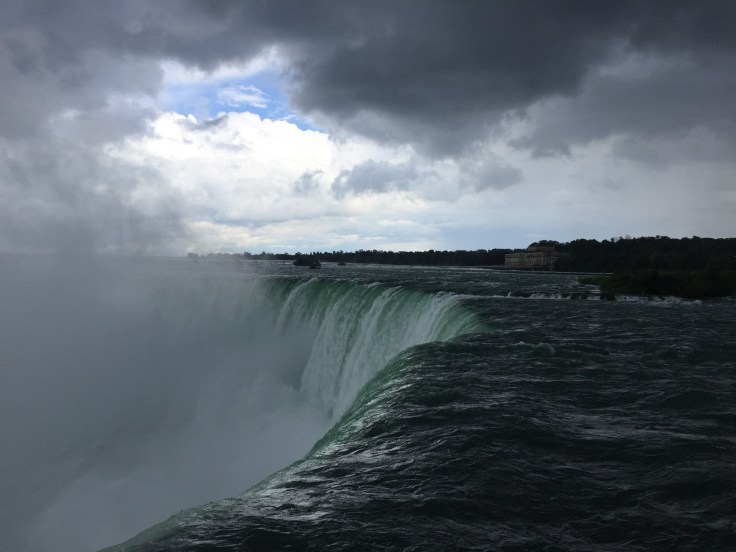
The skies were still threatening more rain, but it made for some spectacular views…

2017-06-27 Niagara Falls 08


The power of the water up close is amazing…

2017-06-27 Niagara Falls 07

2017-06-27 Niagara Falls 05

2017-06-27 Niagara Falls 06


As the rain began to fall again we caught a bus back to the campground. An enjoyable time was had by all…



2017-06-26 London and Can-Am Airstream

Finally our day of Airstream service at CanAm RV in London, ON, is here.  We check in with the service department, hand over the keys, and we wait…

CanAm has a nice lounge, and a very large store full of RV necessities and luxuries. The time went by quickly. We chatted with other Airstreamers from Florida, Texas, and Toronto. We went for a walk through the many, many trailers on their site.

Finally, we met with Andy Thompson, the hitch expert. They had determined that we could better handle the weight of my Airstream with a different hitch. The good news is that as he sold me the new hitch he bought back my old one, so the cost was minimal. Unfortunately, the rock guards that they had ordered for us had not yet arrived, so we will be back in August… Other repairs we promptly handled, we took one last test drive with the new hitch in place, the fiberglass AC cover was reinstalled, and all was well with our rig.

We shared Happy Hours with a few other RVers who were spending the night, Andy Thompson came by to check in, and an enjoyable time was had by all…

2017-06-26 CanAm

Tomorrow: Niagara Falls!


2017-06-25 Toronto and Grandchildren

We awoke Sunday morning to sunny skies.  I stepped outside and I immediately found the source of the strange sound during last night’s storm: The fiberglass cover over one of the roof-top air conditioners was lying on the lawn next to the Airstream!  Good news was that it didn’t blow away…! At least CanAm can re-install it tomorrow…

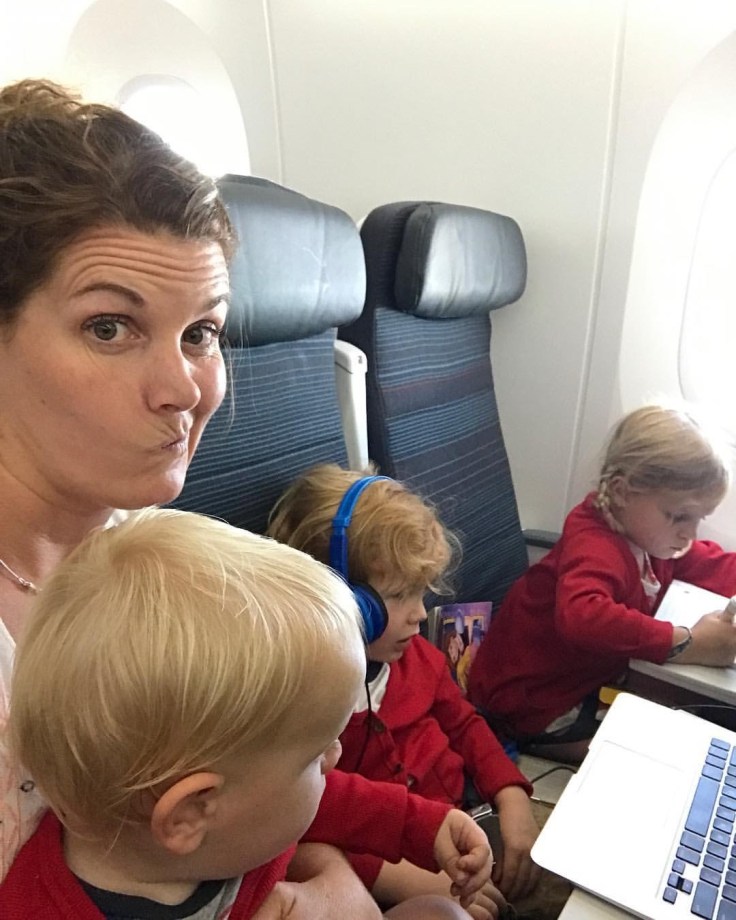
My daughter and her three children were nice enough to fly in to Toronto to see us:

2017-06-20 McAnoy 2

2017-06-20 McAnoy 1

They were also seeing Toronto Family and Friends…


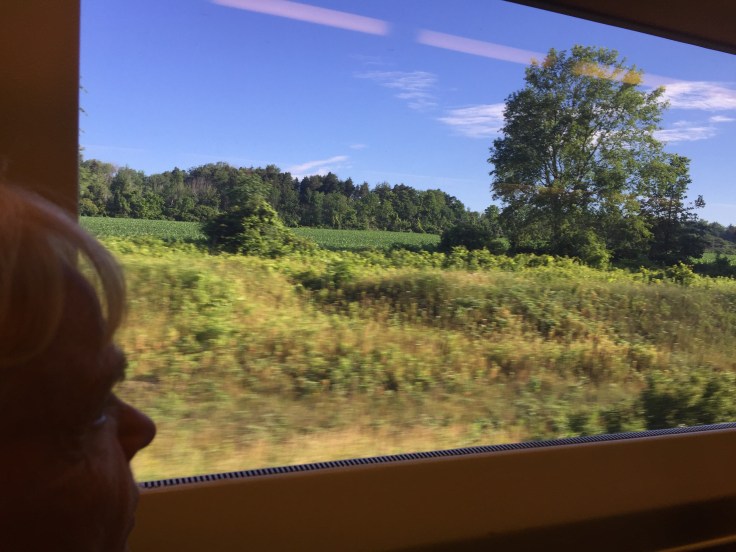
We took an Uber to the London train station, then took the express train to Toronto.

2017-06-25 Toronto 01

We all met up at the station, then walked through the streets of Toronto. We found a playground to keep the kids occupied and we caught up on our various happenings.

2017-06-25 Toronto 11

Erin, Kevin, and the kids had a lunch date with Kevin’s Toronto family, so we said our goodbyes and Lynda and I headed off to walk some more.  We found the “Distillery District”.  It’s an old industrial area converted to pubs, shops and restaurants. Unfortunately, we did not find a distillery.  But we did find a great French Bistro to escape to when it began to rain.

2017-06-25 Toronto 22

After lunch we headed out again. We did some window shopping, and when the rain started again we ducked in for coffee.  Then more walking.

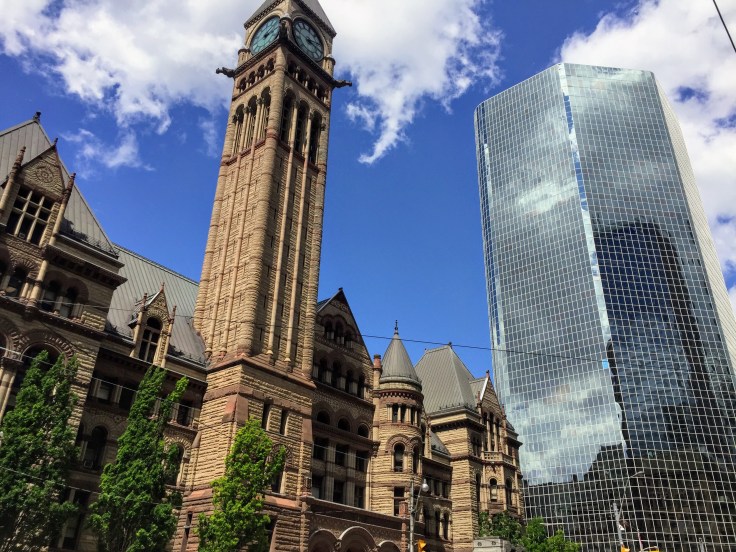
We found a great old church, and the old City Hall.

2017-06-25 Toronto 34

2017-06-25 Toronto 33


We saw Justin Trudeau drive by. But he didn’t stop to chat…

2017-06-25 Toronto 35

In the afternoon we met up with the kids again, but after a busy day the boys were a little sleepy…


Roisin enjoyed the Underpass Playground…

2017-06-25 Toronto 77

Finally it was time to go. We said our goodbyes and headed back to the train… An enjoyable time was had by all…
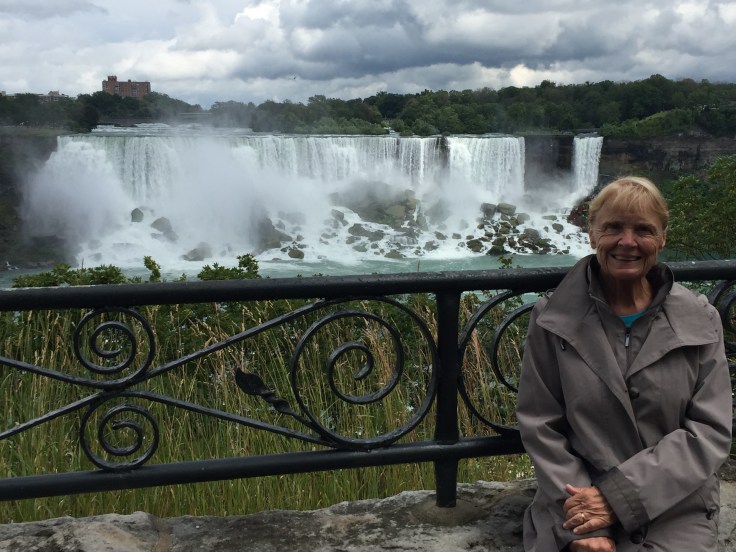


2017-06-24 The Villa crosses the Border…

Not much action today.  We left the KOA south of Pittsburgh and headed for Canada!  We were cruising along the Pennsylvania Turnpike on our way to Erie and Buffalo… And we found that this section of the turnpike was closed!  We were routed towards downtown Pittsburgh, towards a tunnel with giant signs stating, “No flammable liquids or explosives”.  If I had known all this, I would have researched what this meant (isn’t gasoline a flammable liquid?), but, thinking they were banning my on-board propane tanks, we just played it safe.  We exited and headed up a “little red line on the map”.  We had an interesting but rather nerve-wracking journey through the near suburbs of Pittsburgh – beautiful, with their abandoned old red brick buildings and rusted industrial plants. The roads were narrow and rough, with many stop lights.  Oh well; we were not in a hurry.  Eventually we rejoined the interstate and then we were back on the turnpike. We had a long day, but finally we crossed over into New York, and then entered Canada at the Peace Bridge outside Buffalo.

2017-06-24 Canada Welcome

The wait to drive through Customs was short, and the agent was smiling, conversational and all in all the stereotypical polite Canadian. She only asked one odd question: “Are you bringing anything in to Canada that will stay in Canada”?  What was I supposed to say?  Trash? Sewage?  Whiskey bottles (empty)?  Anyway, I said No, and off we went…

Our destination was London, ON, the home of CanAm RV.  We have an appointment for Monday, 6/26/17, to have them review my hitch set-up.  I’ve never been happy with the weight distribution of my current hitch, so either they can adjust it or modify it, or put a different hitch on for me.  Also, we hope they can fix the refrigerator, which runs only on propane, but not electricity as it should in RV parks.  Plus, if you recall, we lost one of our rock guards in Texas, and CanAm has ordered new ones for us.  Best of all, we can camp right there (free!) and not have to travel back and forth to an RV park.

So we found CanAm, parked where we were told, plugged into power, and we were set. The weather was beautiful: No heat, no rain, no humidity, no wind. We opened our windows and vents and settled into happy hour. We were just about to pull out our chairs and sit outside when WIND!  RAIN! THUNDER! LIGHTNING!  As we scrambled to close the roof vents, and close the windows, and close the door, we heard another sound that we couldn’t quite place…Sort of a crash, sort of a plastic banging sound… Oh well, we were safe inside, the Satellite TV was working, and Happy Hours continued.  The rain stopped after about an hour…

Tomorrow we head to Toronto!

2017-06-24 CanAm 2

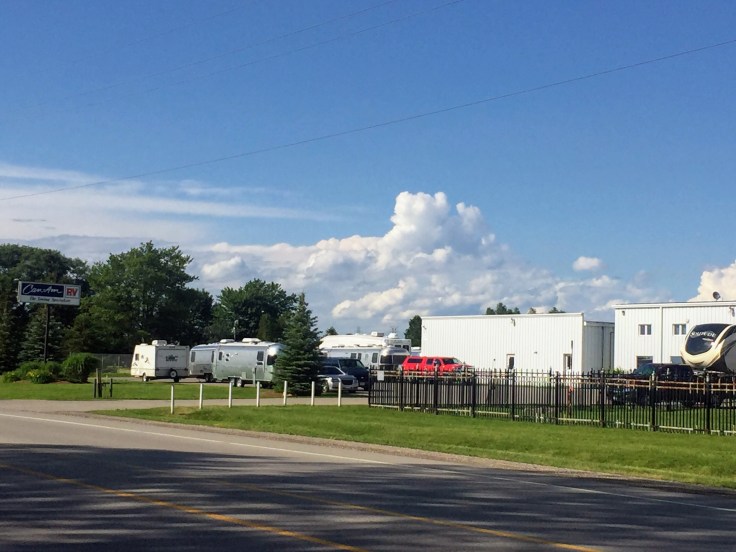
CanAm RV… Lots of Airstreams… (Some Other Brands, too…)


2017-06-24 CanAm 1

Tucked in for the night…


2017-06-24 CanAm 3

The calm before the storm…


2017-06-23 Frank Lloyd Wright and Peter Berndtson

Today we visit more architecture!  And a bit of history.  Three houses are on the agenda, but these are different than the two we saw yesterday; they are all within a park preserve not far from Fallingwater.

The site is called Polymath Park, and it is an 125-acre preserve dedicated to these significant houses.  The site is surrounded by private forest in the Allegheny Mountains and features three architectural landmarks: Frank Lloyd Wright’s Donald C. Duncan House and two others by Peter Berndtson (1909–1972), who was one of the original Wright associates at Taliesin.

In 1962, Berndtson master planned the 125 acre property for 24 dwellings, each sited in a circular clearing in the forest. Only two houses, however, were actually built: the Balter House in 1964 and the 1965 Blum House.  The development plan never progressed, and eventually the Blums and the Balters sold their houses.  Many years later, Thomas and Heather Papinchak purchased the property, and began a dream project to restore and preserve these two houses, plus more.

Frank Lloyd Wright developed a systems-built concept to bring his unique design ideas to modest, production-style houses. These “Usonian” houses were available as pre-cut kits, to be shipped to your site and assembled by local labor. FLW himself would site your house if you sent him a topographical survey of your property. The buyers of these kits were not allowed to communicate with FLW directly.

One of these Usonian kit houses was built in 1957 in Lisle, Illinois, for Donald and Elizabeth Duncan,  After the Duncans’ deaths the house fell into disrepair, and was constantly being damaged by the flooding of its site. The house was sold and deconstructed in 2004 and put into storage, waiting for a new site to be readied. When the deal for the new site fell through the fate of the Duncan house was in question.

However, when Thomas and Heather Papinchak heard about it, things started moving rapidly. The Duncan house was shipped to Polymath Park and reassembled in 2007. Today, the Duncan house, The Blum house, and the Balter house are all open for tours; in addition, a fourth FLW house is being moved to the site; foundations are currently under construction.

We began our day by driving in the rain to this remote location. However, unlike yesterday, the rain never let up. We met our tour guide in “Treetops”, the original house of Thomas and Heather Papinchak, adjacent to Polymath Park. Our tour guide drove our group in the little shuttle bus; first was the Duncan house., then Balter, then Blum; after our tour, as we drove back to Treetops for lunch, our guide told us a story:

At Fallingwater, the Kaufmans had a long-time cook. In fact, she is still alive today, at age 104. When the Kaufmans would put on a large party, additional help was needed. The cook asked her best friend to come assist, and this friend would also bring her small son, who would play around the kitchen and staff rooms of Fallingewater.  At one such event, Frank Lloyd Wright was in attendance, and FLW playfully interacted with the small boy for a few minutes.

This small boy was our guide’s grandfather… He told us that he only heard this story after he had started giving tours at Polymath Park… And now you know the rest of the story…

But back to the houses:  These were very modest, affordable, middle class, 1950s houses. But the design features, the settings, the details and the materials are artfully designed and integrated into simple and beautiful houses…


The Duncan House:

2017-06-23 Duncan 02

2017-06-23 Duncan 92


The Balter House:

2017-06-23 Balter 08

2017-06-23 Balter 03


The Blum House:

2017-06-23 Blum 04


All in all a very fun day, learning about more than just FLW houses.  We hope this neat little park will eventually be filled  with these great houses.


2017-06-22 Our 43rd Anniversary; more Frank Lloyd Wright: visiting Fallingwater and Kentuck Knob

What better way to celebrate a marriage than to see world class houses and world class architecture?

Five years ago we celebrated 38 years by seeing the Stahl House in the Hollywood Hills – sometimes known as Case Study House #22; it was designed by Pierre Koenig, built in 1959, and is the subject of probably the most famous house photograph in the world, shot as a double exposure by the photographic genius Julius Shulman.  I can’t post that photo here, but here is a similar shot when we visited in 2012:

house-50

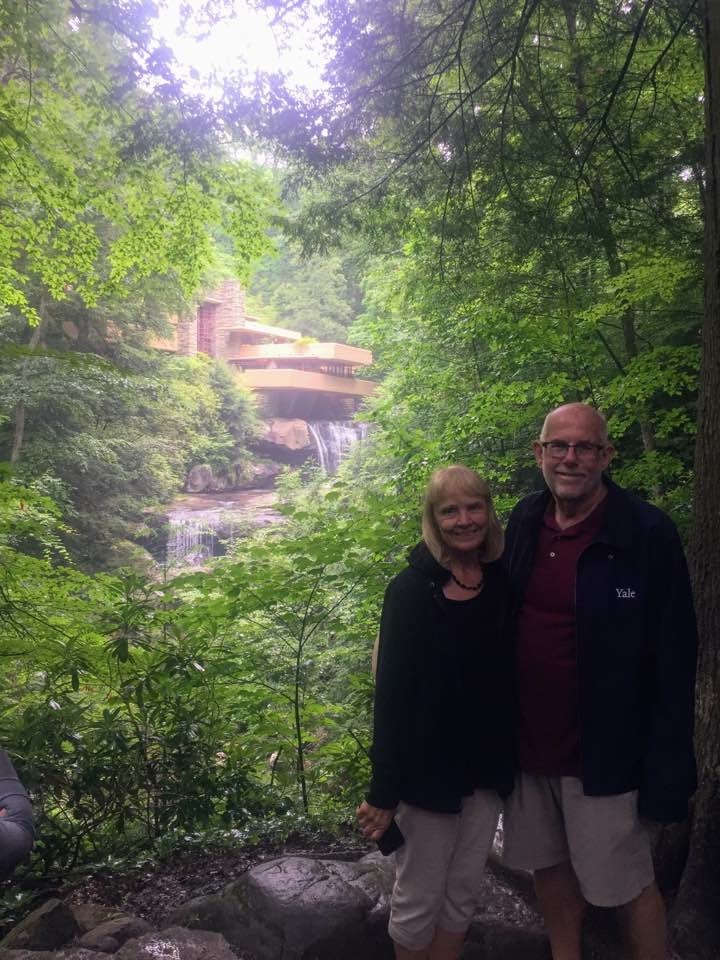
This year we are at the most famous and beloved house in the world:  Fallingwater. Lynda and I preyed upon some tourist to take our picture there…

2017-06-22 Fallingwater 020

Because it had been raining and the sun had just broken through, this photo looks surreal… a little like Shangri la…

Fallingwater was built as a weekend and summer house for the Kaufman family, owners of a large, successful furniture and department store in Pittsburgh.  If you think of Pittsburgh in the 1920s and 1930s – the air and water pollution were horrible – you can see why Mr. and Mrs. Kaufman wanted a weekend escape in the country, to enjoy fresh air and just being in nature.  Mr. Kaufman and Mr. Wright had a great love-hate relationship – they argued over money, design details, and just about everything else, but Mr. Kaufman kept giving Mr. Wright other commissions – his office interiors in Pittsburgh, and various other things around their Pittsburgh home and store.

The house is amazing.  I have read books and poured over photographs for years, but being there is impossible to replicate.  The major rooms of the house felt protecting and cave-like on one side, and wildly exuberant, thrusting you out onto cantilevered decks atop the waterfall on the other side.  The trees and rocks are ever-present, as is the sound of the waterfall. You cannot see the waterfall unless you walk to the edge of the balcony and look over the edge down below.

It was raining when we arrived, and we carried umbrellas with us as the tour started, but once we got inside the house the rain had stopped.  It was a small group, maybe 10 people, and this was the extended, or photography, tour – we were permitted to take photos inside the house, unlike many other house museums.  We spent 2 hours seeing the three floors of the house (plus a small utilitarian basement), plus the two-story guest house and servants quarters just up the hill from the main house.

Since I’ve already said that photographs don’t do this house justice, I won’t post all 129 pictures we took; but I will post a few that I find remarkable…

The approach is via the driveway, across the bridge, over the creek…

2017-06-22 Fallingwater 001d


Once you are on the bridge you see the house, with the stairway down to the creek; the house is literally perched on the stone bank of the creek, and tied back into the rock behind the house…

2017-06-22 Fallingwater 002

The original stair was suspended from the deck above. It was destroyed by the raging waters of the flooded creek in the early 1960s. The rebuilt stair you see here is supported on steel columns that extend down into the creek bed.

The driveway wraps around the rear of the house, between the house and the rock wall of the hill; a trellis ties the house structurally into the rock, and visually connects the house to the rock, providing a sense of protection as you approach the front door.

2017-06-22 Fallingwater 003a


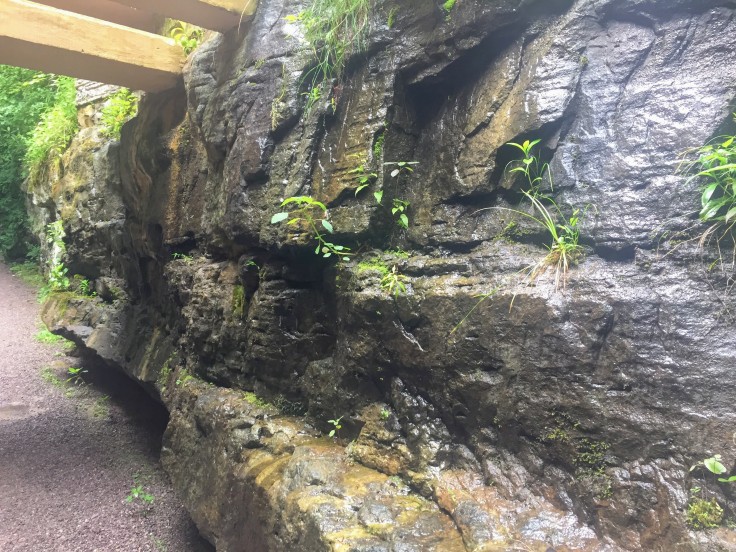
The rock seeps and drips water, in a reference to the much larger waterfall beneath the house…

2017-06-22 Fallingwater 003l


Where is the front door, you ask?  Here I am, looking for it…

2017-06-22 Fallingwater 003g


Yes, Frank Lloyd Wright always liked to hide the front door, and he always had a very low ceiling at the door, using his signature “compress and release” concept to bring you through the door and into the main space of the house.

2017-06-22 Fallingwater 003b

Note the concrete beam that curves around the tree…


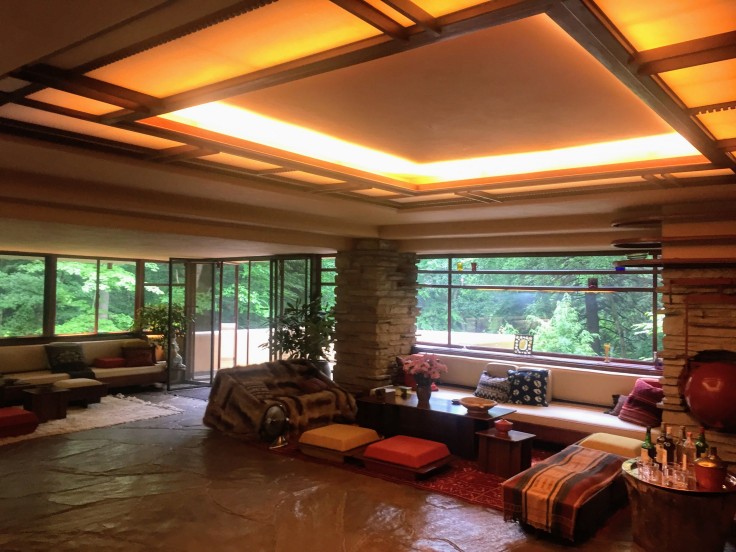
The main Living Room…

2017-06-22 Fallingwater 005

It is much more than just a living room – it includes not only the living space with two distinct sitting areas, but also includes dining space, study space, fireplace and hearth, access to the stair going down to the creek, plus the opportunity to see the view and walk out onto the terrace.


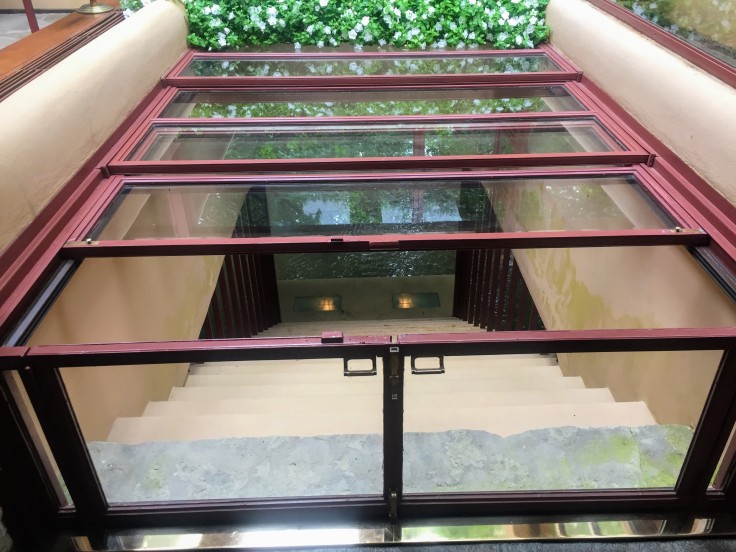
Here is the hatch to the stair that goes down to the creek…

2017-06-22 Fallingwater 005j


The Terrace, which cantilevers over the waterfall…

2017-06-22 Fallingwater 006gg


And the waterfall itself…

2017-06-22 Fallingwater 006d


Some of my favorite details:

2017-06-22 Fallingwater 008e

The desk in the master study has a cut-out to allow the window to open; FLW loved to put circles inside squares.


There is a small pool adjacent to the creek.

2017-06-22 Fallingwater 010d

There are also exterior stairs leading up from the pool to the bedroom level above…

The story goes that they would climb down to the pool in the morning, have a quick dip in the icy water, then run back upstairs, jump into bed, and ring for the maid, to be served breakfast in bed… While that story may not be true, it certainly might be apocryphal…


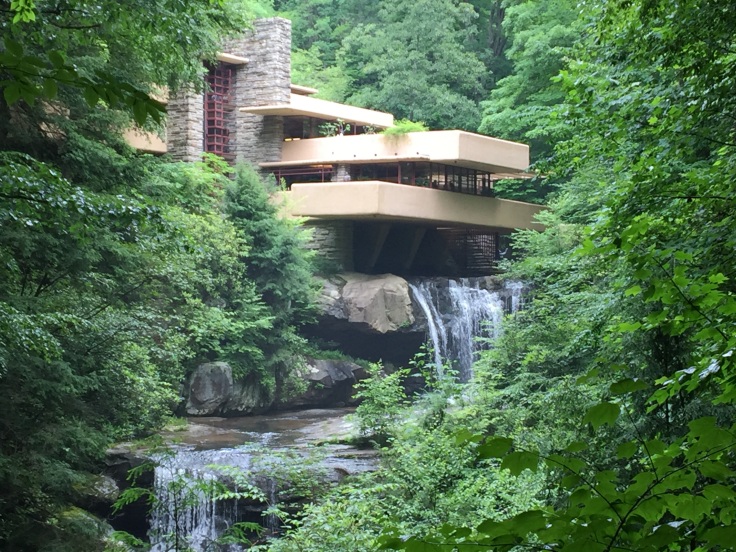
The typical shot of the house projecting over the waterfall.

2017-06-22 Fallingwater 020ww

The Kaufmans wanted a house near the falls so that they could view the falls from the house. Wright believed that having the falls constantly in sight would render them commonplace. So he placed the house atop the falls; you always know the falls are there, but you need to walk over to the edge to see them… The Kaufman family members enjoyed the house for 25 years before donating the house, the surround land, and an endowment, to have the house opened to the public in 1964.  It was the first FLW house opened to the public on a full time basis.

While we regretting leaving this spectacular place, we had appointments to keep…


Mr. and Mrs. Hagan ran in the same social circle as the Kaufmans; after seeing Fallingwater many times over many years, they decided they needed a FLW house of their own.  They bought 80 acres (Fallingwater is set on over 2,000 acres…) about seven miles from Fallingwater and retained Frank Lloyd Wright to design them a small, modest, full time house. (Fallingwater was a weekend house…) The house is named for the hill on which it sits: Kentuck Knob.

The house was completed in 1956, and the Hagans lived in it for over 30 years. It was sold to a British man who owns it today. He has brought in his large art collection, and the house is open for tours.

Kentuck Knob is not just more modest than Fallingwater; it is a 1950s house, to suit the more modern lifestyle of the Hagans. Mrs. Hagan loved to cook and entertain, so the kitchen is not relegated to a rear, closed-in space for the servants, but is a centerpiece of the house. It is a one-story house, a typical example of Wright’s Usonian houses.

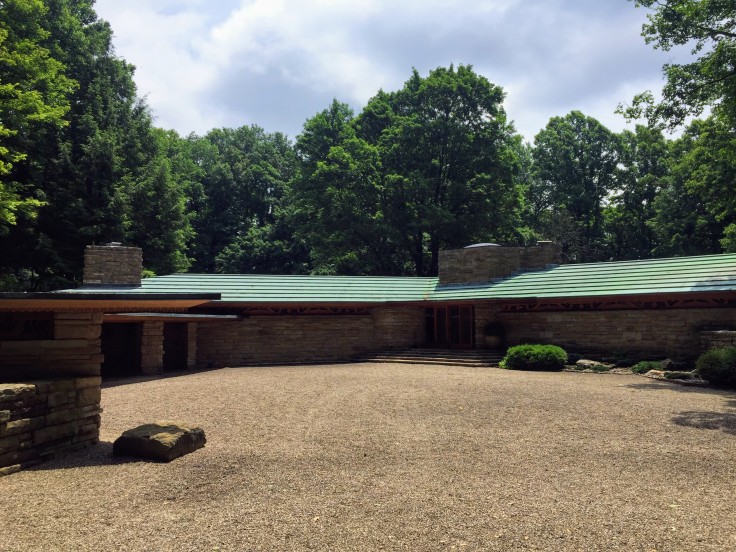
2017-06-22 Kentuck Knob 16

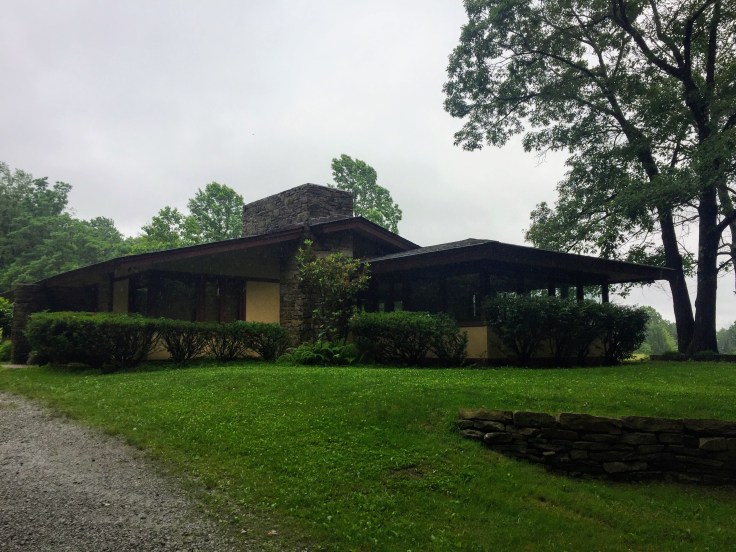
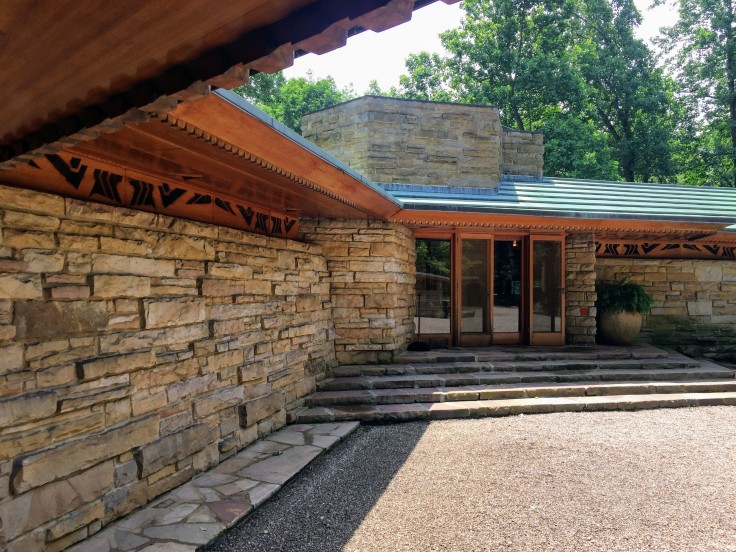
The house sprawls across its site, with the carport on the left, and the entry in the center. The wide roof overhangs keep the front in almost constant shade.


2017-06-22 Kentuck Knob 19

The entry door is again very short, allowing the experience of compress and release as you enter the much larger space inside.  The clerestory windows are filled with wood cut-outs of the various forms in the house to filter the light.  Unfortunately, we were not allowed to take interior photos…


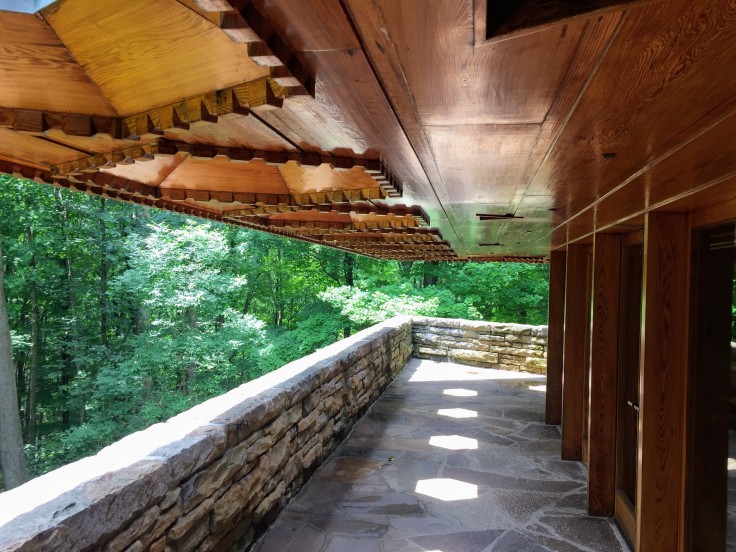
The terrace overlooking the forest wraps around the rear of the house. This was wide open land when the Hagans had the house built. They planted hundred of trees, so today the views are almost all obscured by forest…

2017-06-22 Kentuck Knob 21

Note the hexagonal “skylights” that cast a pattern of light that moves across the terrace as the day wears on…


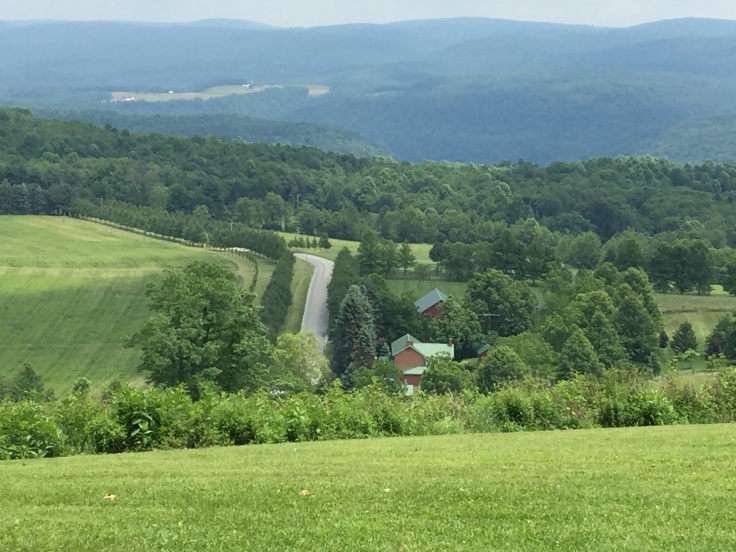
Here is the view that the Hagans had when the house was first built…

2017-06-22 Kentuck Knob 15

The kitchen is in the center of the house; it is hexagonal is shape and it has a huge skylight over the entire room. The hallways and doorways within the house are all very narrow, following the compress and release concept, but the house is very livable, and was certainly ahead of its time in the 1950s…


All in all, a wonderful day. We returned back to the Villa and enjoyed a marvelous home-made pizza and great wine. A perfect anniversary celebration!


Tomorrow: More houses!


2017-06-21 Pittsburgh, PA

Once again the Villa is on the move, this time heading into Pennsylvania. Surprise, surprise! You have to go through West Virginia to get to this southwest corner of Pennsylvania; to celebrate, we stopped for lunch…

2017-06-21 Welcome to West Virginia


Then it was on to our RV Park for the next 3 nights – KOA of Madison, about 35 miles SE of Pittsburgh. There were some amazing clouds overhead…


After settling in we drove to Pittsburgh to see what’s happening there. We found the “Cultural District”, right on the river, across from the Pirates’ Ballpark. We walked many blocks looking at wonderful old buildings, new apartment buildings and lofts, and checking out the many bars and restaurants. We’re always suckers for French food, so we opted for Le Lyonaise, and they didn’t disappoint.  We sat at a sidewalk table, had a few cocktails, shared three appetizers, and enjoyed the scene, then walked some more. On the drive back we stopped to refuel.  Another nice, easy day.  The exciting activities start tomorrow!


2017-06-20 Jackson Center, Ohio: The Airstream Mothership!

One of the main goals of our trip is to visit the Airstream Factory and take the factory tour to see Airstreams being made.

For a history of Airstream, click HERE.  Airstreams were originally made in different areas of Southern California, such as Van Nuys, Downtown LA, Sante Fe Springs, and, finally, Cerritos.  However, in the early 1950s, Wally Byam set out to find an eastern factory site, since so many Airstreams were being sold to owners who lived the Midwest and in the East.  In 1952, Wally Byam found an abandoned bazooka factory, left over from WWII, in a tiny hamlet in central Ohio called Jackson Center.  He bought it for $5,000, and in 1952 the first Ohio-made Airstream rolled out the factory doors.  In 1979 they closed the factory in Cerritos, and today Airstreams are only made here in Ohio.

Airstream provides a trailer park (they call it The Terraport) for use by visitors and people bringing their Airstreams in for service.  We parked the Villa, took a short walk through Jackson Center (a very short walk…), then waited for our 2:00 tour.  On the tour we learned that it takes about 4 days and 40 hours to build an Airstream. A brand new fully complete Airstream rolls out the doors at a rate of about 80 per week, about one every 30 minutes… Airstream has about 850 employees and will probably have 1,000 by year end.

The aluminum skins (exterior and interior) come in giant rolls from Alcoa.  They have a baked on finish similar to the paint on a car, except that it is clear to show the aluminum… These sheets are automatically cut and punched, but they are stretched over the ribs and riveted together by hand. The same is true about the cabinets and other furniture – The wood is cut precisely to fit, then it is assembled by hand. All the wiring and plumbing and ducting and insulation and doors and windows and everything else is connected, attached, and finished by hand. The finished shells are extensively tested for water-tightness before the interiors are installed. Everything inside an Airstream – cabinets, furniture, bathroom showers – fits through the door…

The building where Airstreams are made is over 100,000 square feet, and it is a hustling bustling place. We also saw the original bazooka factory across the street. We were not allowed into the R & D building, and we were not allowed to take pictures inside the plant.

It was a very interesting time to see this huge plant producing these iconic Airstreams…

This place is huge!


The original bazooka factory building:

2017-06-20 Airstream Jackson Center - 02


Wally Byam’s gold Airstream, used on the Capetown to Cairo Caravan in 1959-1960:

2017-06-20 Airstream Jackson Center - 13


Various shots of Airstreams; new and old…


Our spot in the Terraport:


And an enjoyable time was had by all…


Blog at WordPress.com.

Up ↑