Search

Adventures in the Villa

2017-07-07 Nor by Nor’east Caravan -Newport, Rhode Island

More rain today… But the caravan continues with a trolley tour of Newport, RI, and a harbor tour on the Amazing Grace…

2017-07-07 Newport 12 (2).JPG


Our convoy of caravanners arrived and parked at William Rogers High School in Newport. We were promptly picked up by two trolleys and we were given a nice overview of Newport. We saw the port and the fort.  We saw President Eisenhower’s summer White House (this was before the days of Camp David…).  We drove along and peeked behind the gates of the “Summer Cottages” of New York City’s elites.  We heard gossip and other stories about the cottages and their owners and their guests.  We heard about the servants and their lives.  It was a nice general backdrop for our future visits.

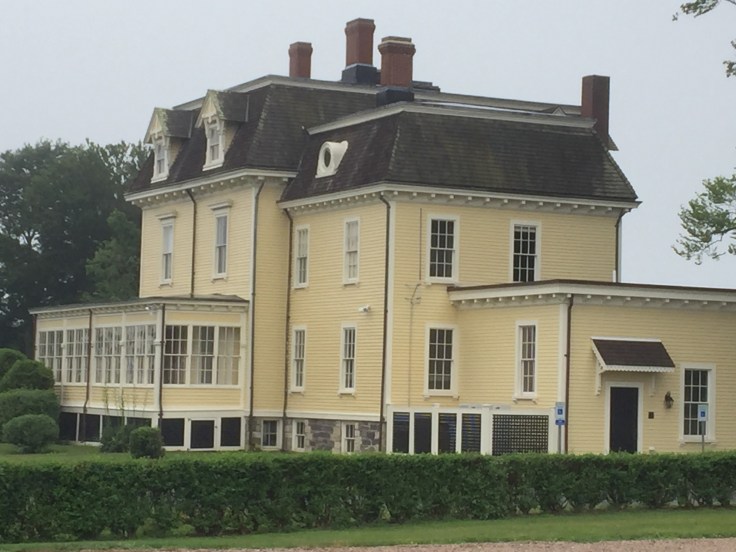
Eisenhower’s house, on the grounds of Fort Adams:

2017-07-07 Newport 01 Eisenhower


After the trolley ride we had lunch at the Brick Alley restaurant.  Lobster Bisque, stuffed quahogs, clam chowder, lobster rolls, steamers…

2017-07-07 Newport 14


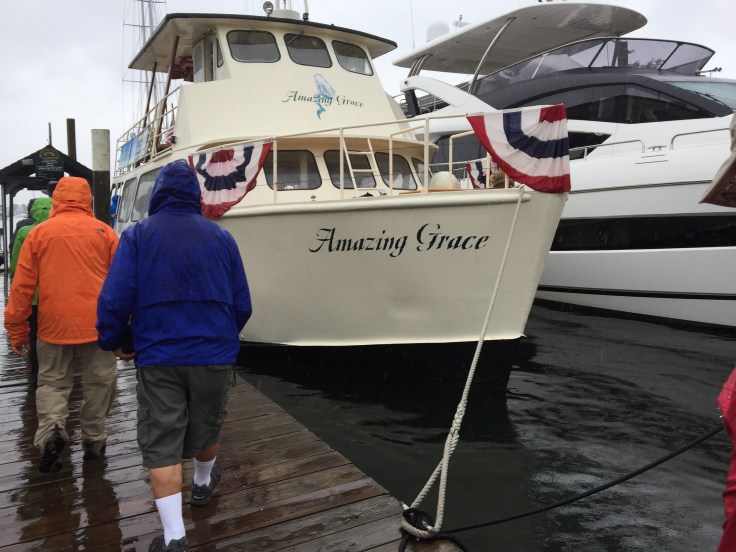
The trolleys took us to the docks where we boarded the Amazing Grace:

2017-07-07 Newport 05


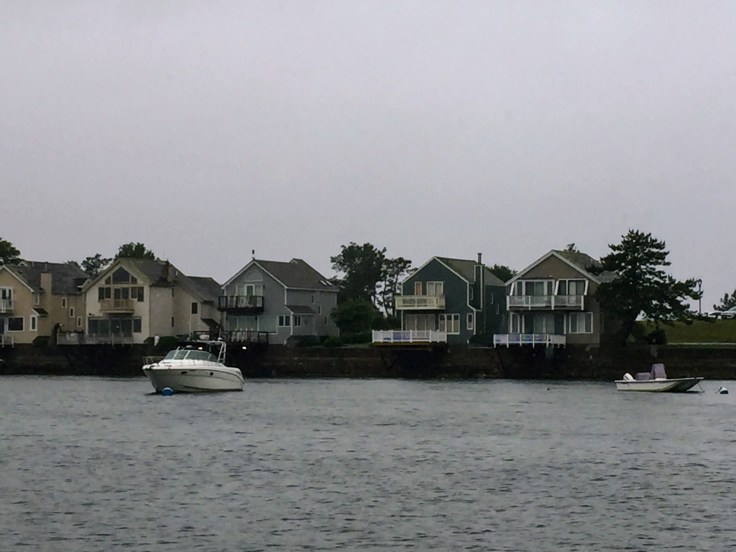
The harbor tour was great. If there is anything I like as much as houses it is boats.  And houses overlooking boats are about the best!

2017-07-07 Newport 11


There some pretty nice boats in the harbor, but it was not a very pleasant day to be boating:


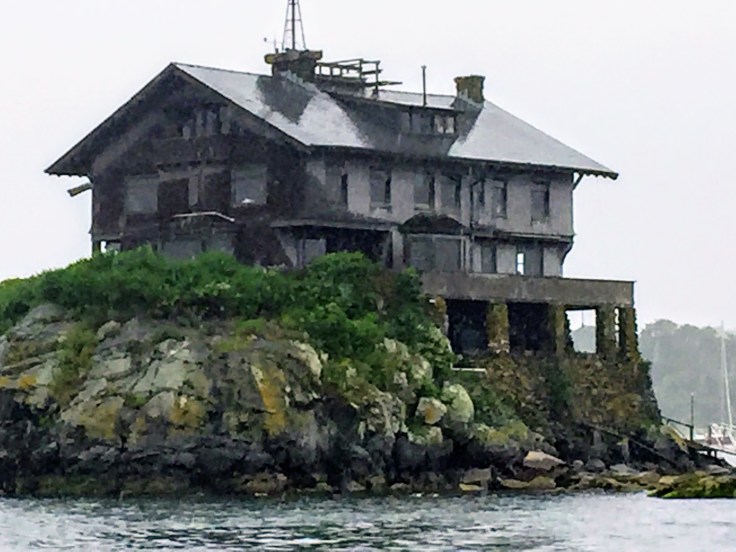
The house at the top of this post is called “Clingstone” by its owners, but the locals call it, “The House on the Rock.”  It was built in 1905, perched atop a small, rocky island in an island group called “The Dumplings” in Narragansett Bay, near Jamestown, Rhode Island.

The dwelling, designed by Philadelphia socialite J. S. Lovering Wharton and artist William Trost Richards, is a three-story 23-room 10,000-square-foot shingle-style cottage.  The structural system of heavy mill-type framing was designed to withstand hurricane force winds.

The original owner, relative of industrialist Joseph Wharton, built the house in response to the government condemning his earlier summer home in order to build Fort Wetherill.  Wharton summered here until his death in the 1930s. Heavily damaged by a hurricane in 1938, the residence was vacant from the time of his wife’s death in 1941 until it was purchased in 1961 by Boston architect Henry Wood.  Wood, a distant cousin of the Philadelphia Whartons, was able to purchase the property for $3,600, the amount owed in back taxes. It has been restored and is now available as a summer rental…


2017-07-07 Newport 10


After the harbor tour we were shuttled back to the high school. A few of us decided to stop in at a tavern in town.

2017-07-07 Newport 13

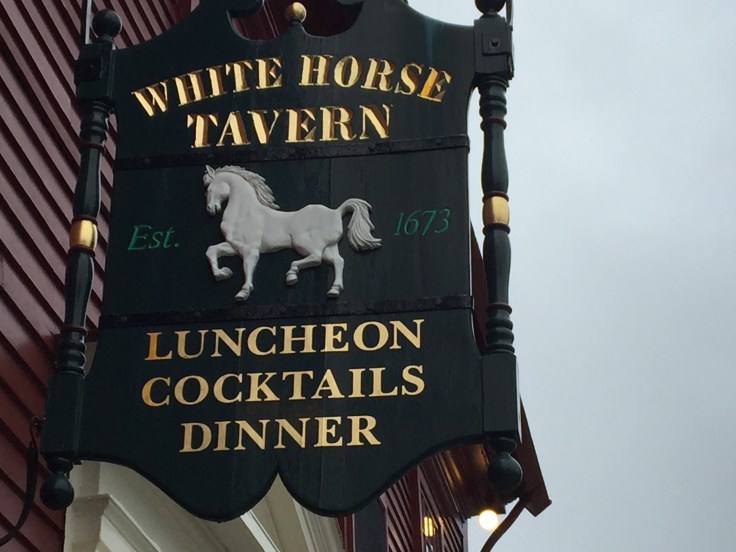
The White Horse Tavern, constructed in 1652 in Newport, Rhode Island, is believed to be the oldest tavern building in the United States.  Everyone in the place will tell you so… They will also tell you that they have documented that John Hancock, Paul Revere, and Samuel Adams all were here.  Jackie Kennedy Onassis often lunched here while spending time at her family’s summer cottage nearby…

Frances Brinley constructed the original building on the site.  In 1673, the lot was sold to William Mayes, and the building was enlarged to become a tavern. The building was also used for large meetings, including use as a Rhode Island General Assembly meeting place, a court house, and a city hall.  William Mayes, Sr., obtained a tavern license in 1687 and William Mayes, Jr., a well-known pirate, operated the tavern through the early eighteenth century.  The operation was named “The White Horse Tavern” in 1730 by owner Jonathan Nichols.  During the American Revolution, Tories and British troops were quartered there around the time of the British occupation and the Battle of Rhode Island.  After years of neglect as a boarding house, Newport’s Van Bueren family donated money to the private Preservation Society of Newport to restore the building in 1952. After the restoration, the building was sold and once again operated as a private tavern and restaurant.  Today it still remains a popular drinking and dining location.  

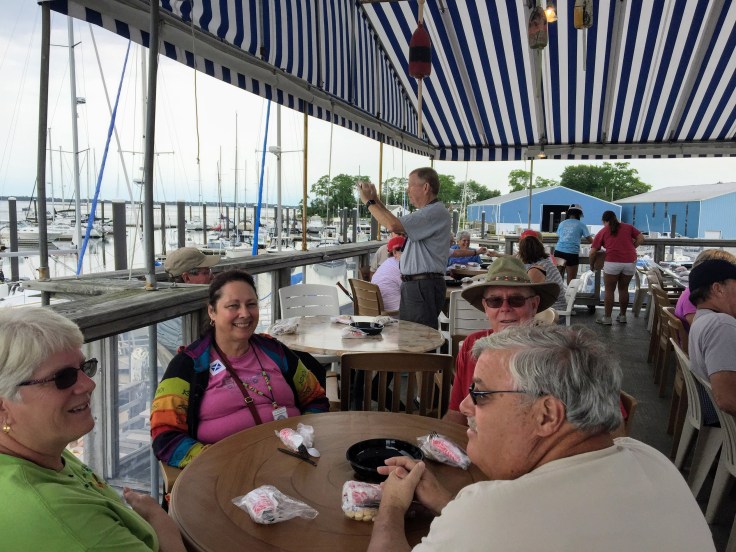
We had some drinks and snacks and enjoyed meeting a few other caravanners.  An enjoyable time was had by all…


2017-07-06 Nor by Nor’east Caravan -Mystic, CT; lunch at Abbot’s and Costello’s

Today was our first “tourism” day with the caravan; this will be the test.  We have about 30 of these days; if you know me, I’m not a big fan of tourist things.  But I will endure and hold off judgement until we are complete.  Today, we head to Mystic Seaport…


I mentioned how we convoyed into Ashaway with 4 Airstreams.  Tourism days on the caravan means a convoy of pick-up trucks and Suburbans… We do carpool, but even with 4 people per vehicle this still means 12 vehicles heading down the road together…

We hitched a ride with a neighbor, since we still had 8 cases of water and 3 cases of wine taking up all of our back seat area. (We need to drink this wine before we enter Canada…).

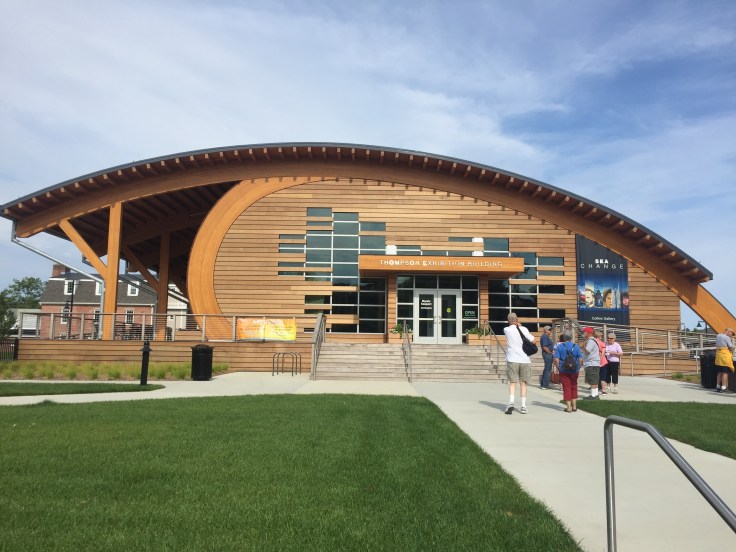
The visitor’s center is quite impressive – resembling an ocean wave, an homage to the seafaring nature of the Atlantic coast of New England…

2017-07-06 Mystic Seaport 14


Mystic Seaport is a delightful area of recreations of 17th and 18th century industry and craftsmanship.

There was a whaling ship, and we could tour the various decks seeing the caption’s quarters, the “tween decks”, where the crew lived, and the cargo level where the whale blubber was rendered into oil… There was a crew on-board who demonstrated raising and lowering the sails.

2017-07-06 Mystic Seaport 05


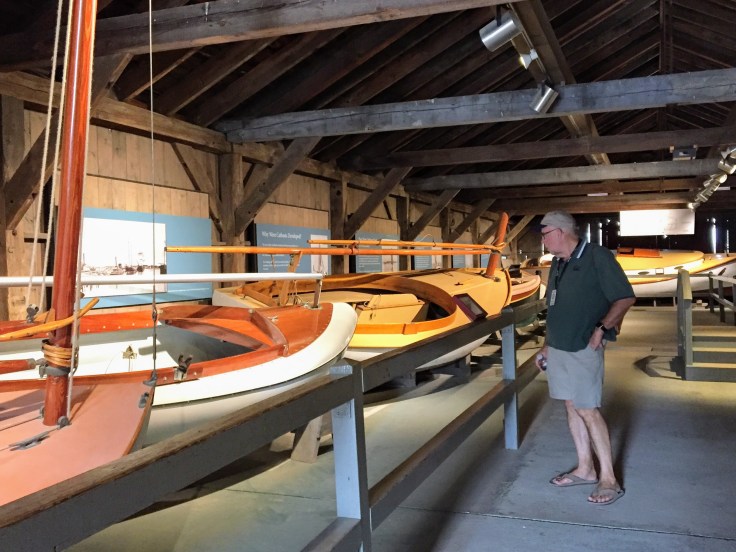
There was a building housing an exhibit of “Cat Boats”, small, simple boats used for various utilitarian purposes as well as for recreation and racing…

2017-07-06 Mystic Seaport 09


Back in 2004 we visited Plymouth, MA; we saw “the rock” and we saw “Mayflower II”. Today, “Mayflower II” is in Mystic, undergoing a full restoration in preparation of the 400th anniversary of the Pilgrims’ landing in 1620.  We could not see much of it, but here it is:

2017-07-06 Mystic Seaport 20


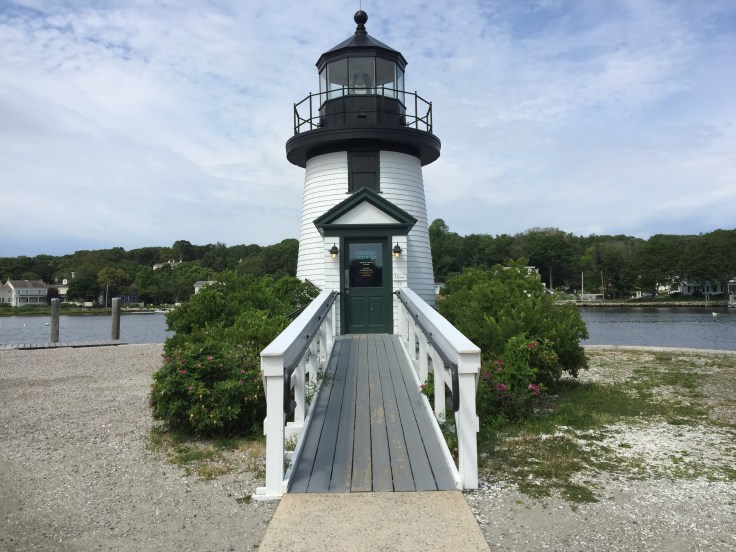
This lighthouse, in Mystic Seaport, is a reproduction of the light on Nantucket. It is claimed to be the shortest lighthouse in the USA, but, who knows?  I think tour guides just make things up. We saw lights in Newport and Plymouth and Provincetown that seem to be just as short…

2017-07-06 Mystic Seaport 10


After our time in Mystic it was time for lunch.  No, not Mystic Pizza… (I had been there in 2008…). We went to Noank, CT, to Costello’s Crab Shank. We were originally scheduled to have lunch at Abbot’s Lobster in the Rough, but four busloads of tourists had descended on the place, so we opted to go to Costello’s.  They are owned by the same people and our wait-staff were from Abbott’s.  The feature here was, of course, lobster.  We started with a nice clam soup (not chowder…) and a huge bowl of Steamers and Mussels.  The then lobsters – two 1-1/4 lb. lobsters…

2017-07-06 Costello's 03

2017-07-06 Costello's 02

2017-07-06 Costello's 01


We returned to the Villa, in the rain…  Tomorrow we head towards Newport… An enjoyable time was had by all…


2017-07-05 Caravan Rendezvous

Today we begin the Nor by Nor’east Caravan!  Today we join with 24 other Airstreams to spend 6 weeks exploring the Atlantic Coast from Rhode Island to Prince Edward Island.

2017-07-05 Ashaway RV Park 01

We left Croton Point in the Hudson Valley with our destination being Ashaway, Rhode Island.  We wanted to avoid driving the New York City area, as well as coastal Connecticut, so we headed straightaway for Danbury, CT.  After a short drive we found ourselves at the largest Trader Joe’s store we have ever seen.

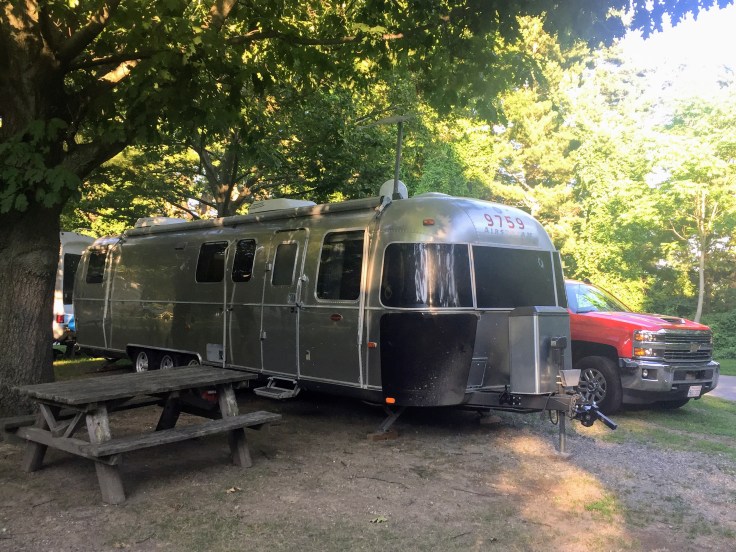
After replenishing our supplies we continued on our way.  Somewhere, on Highway 6, in the middle of Connecticut, we thought we spotted an Airstream far ahead of us.  Soon we confirmed that it was an Airstream, and we thought we could see another ahead of it.  I pushed the throttle ahead a bit, and, lo and behold, there were THREE Airstreams, all heading east, and all from Kentucky!  We soon passed them and we all made our way into Rhode Island and the Ashaway RV Park.  There we joined the others, many of whom had been there for two or three days already.  We parked the Villa, got set up, and met our leaders, Trevor and Gale Lake.

Connecticut and Rhode Island stickers:


Being the neighborly types, we invited our 2 neighbors to happy hour at our site.  I guess word spread, because 35 people showed up. An enjoyable time was had by all.

That evening we had an orientation meeting to discuss the general culture of the caravan and to confirm and explain tomorrow’s activities.

The group meeting:

2017-07-05 Ashaway RV Park 03


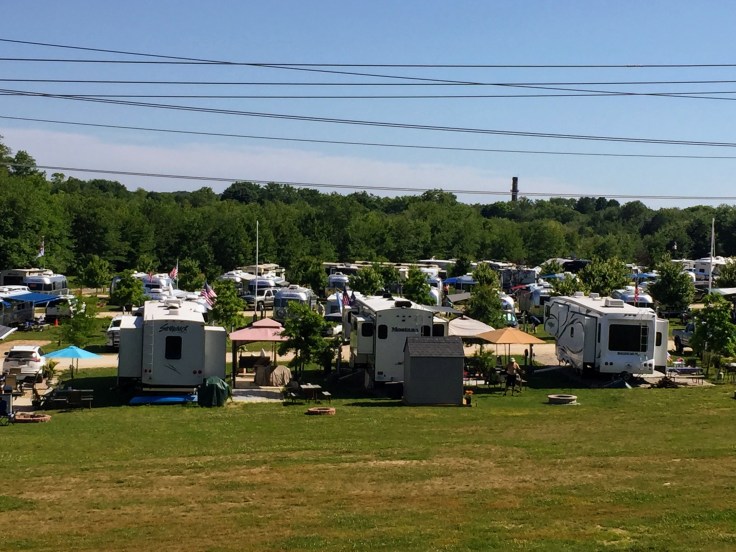
The campground:

2017-07-05 Ashaway RV Park 02


The caravan will last 41 days and we will camp at 11 places; we will travel about 1,000 miles, including side trips, detours, and excursions.  The weather today was warm and sunny; we won’t be so lucky tomorrow, when we head to Mystic Seaport…

2017-07-04 Hudson Valley, NY; Roosevelt’s many houses in Hyde Park, and the Great Estates of the Vanderbilts

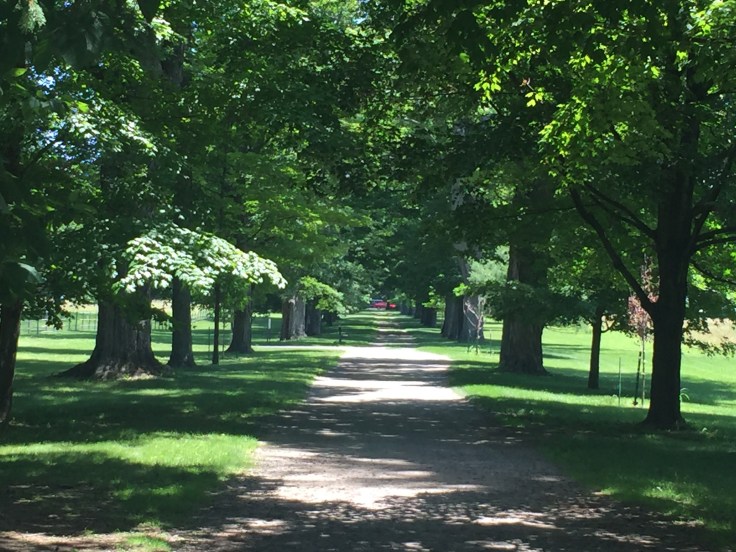
On 4th of July  we once again took to the train; this time going north, to Poughkeepsie.  At the train station we were shuttled to FDR’s Hyde Park estate, Springwood.  It has a nice driveway approach:

2017-07-04 Hyde Park FDR 31


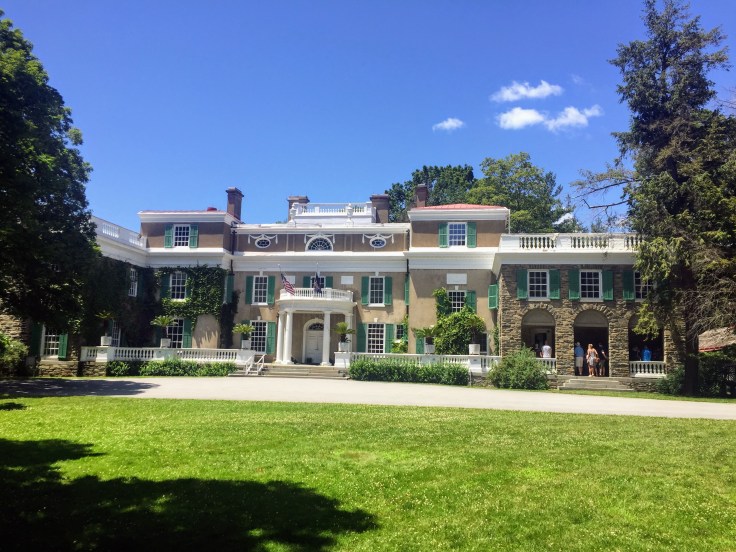
The house has a great presence as you approach:

2017-07-04 Hyde Park FDR 01

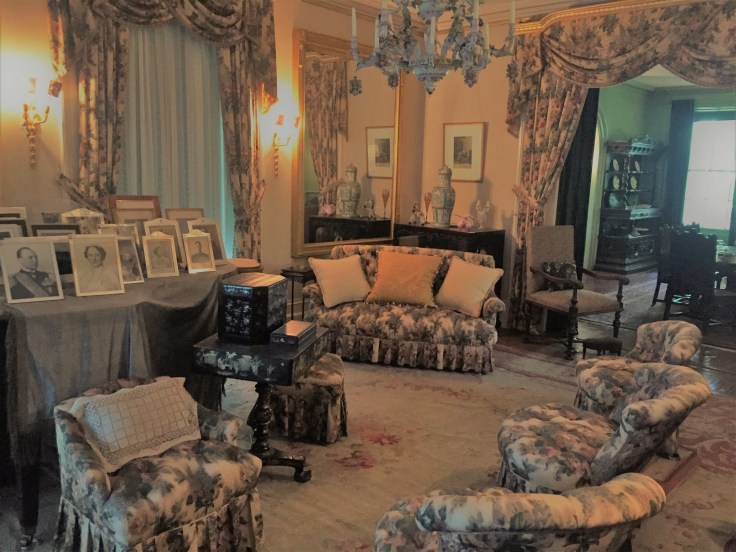
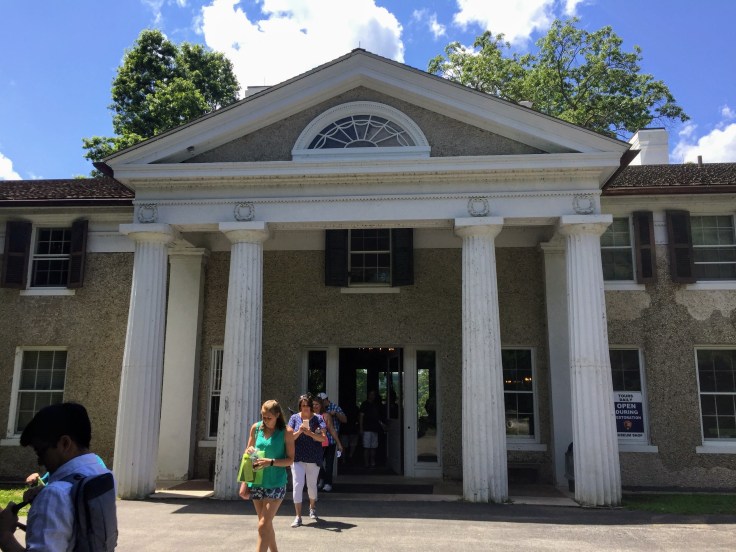
However, it is really a simple (yet large) farm house. Those columns you see aren’t marble, or even stone; they are wood, fashioned to imitate stone.  Inside, the rooms are quite plain, except for the Living Room; it is quite lovely:

2017-07-04 Hyde Park FDR 12


2017-07-04 Hyde Park FDR 11


The Sitting Room:

2017-07-04 Hyde Park FDR 13a


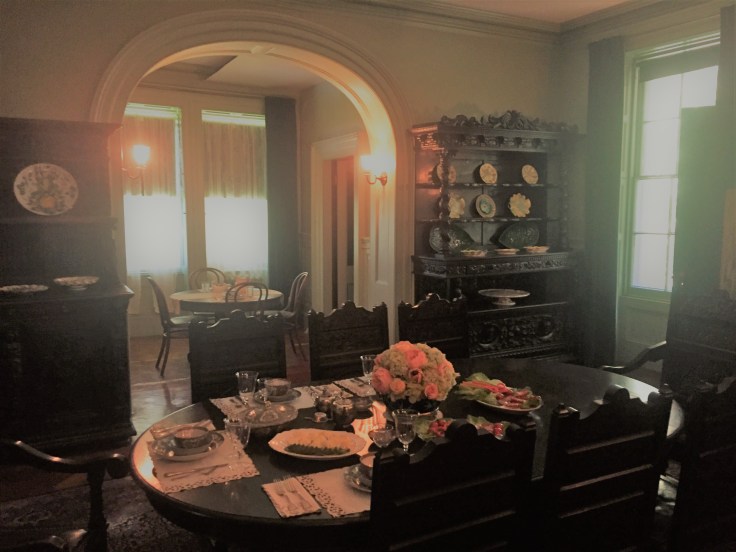
The Dining Room:

2017-07-04 Hyde Park FDR 13b


FDR was born in this house and lived here his entire life; for all but the last four years his mother lived here as well.  There are no permanent accommodations for the fact that he spent most of his waking hours in a wheelchair.  There is a ramp from the main level down to the Living Room, but when visitors were expected, he would transfer from the wheelchair to his desk chair in the Living Room, the ramp was removed and stored, and the wheelchair was hidden.  To access the upper level, he transferred himself into the dumbwaiter, and he hoisted himself up by using the ropes and pulleys.

As I said, FDR’s mother, Sara, lived here with FDR and his wife Eleanor.  FDR was a bit of a “Mama’s Boy” and Eleanor and Sara never got along well. Both Eleanor and FDR built separate, private houses for themselves on the estate, although FDR never slept in his…

Also on the grounds of the estate is the FDR Library; it was the first presidential library built, and it is the only presidential library that was actually used by a sitting president. It was built in about 1941, and expanded after his death.  There is a moving art installation in the garden: given by Winston Churchill’s grand-daughter, it is a sculpture made from pieces taken from the Berlin Wall.  It is entitled “Freedom of Speech”.  The western side is covered in graffiti; the east side is blank…

2017-07-04 Hyde Park FDR 22


In addition to being born here, and living here all his life, FDR is also buried here:

2017-07-04 Hyde Park FDR 07.jpg


Next we visited the Vanderbilt Estate, also in the city of Hyde Park.  Is is just one of many Vanderbilt mansions in America…

From the late 1870s to the 1920s, the Vanderbilt family employed some of the United States’s best Beaux-Arts architects and decorators to build an un-equalled string of New York townhouses and East Coast palaces.

The list of architects employed by the Vanderbilts is a “who’s who” of the New York-based firms that embodied the “eclectic” styles of the American Renaissance: Richard Morris HuntGeorge B. PostMcKim, Mead, and WhiteCharles B. AtwoodCarrère and HastingsWarren and WetmoreHorace TrumbauerJohn Russell Pope and Addison Mizner were all employed by the eight grandchildren of Cornelius “Commodore” Vanderbilt, who built only very modest houses for himself.

Commodore’s grandchildren inheritted about $200,000 from their father, and they treated it as play money to indulge their home-building passions;  I count 24 houses…

  1. Cornelius Vanderbilt II (1843–1899), built a townhouse, the “Cornelius Vanderbilt II House” (1883) at 1 West 57th Street, New York by George B. Post. Enlargements by George B. Post and Richard Morris Hunt. This mansion was, and remains, the largest private residence ever built in Manhattan. Demolished.  Also, “The Breakers” in Newport, Rhode Island, in 1892–95, which was also designed by Richard Morris Hunt.  Also, “Oakland Farm” (1893), mansion and stables on 150 acres in Portsmouth, Rhode Island. Demolished.
  2. Margaret Louisa Vanderbilt (1845–1924), built a townhouse (1882), part of the Triple Palace, at 2 West 52nd Street, provided to them by her father and shared with her sister Emily Thorn Vanderbilt and their families. Demolished.  Also,  Woodlea (1892–95), designed by McKim, Mead & White, a country estate in Scarborough, New York, now the Sleepy Hollow Country Club.
  3. William Kissam Vanderbilt (1849–1920) had three houses designed by Richard Morris Hunt.
    • Petit Chateau“, the New York City townhouse at 660 Fifth Avenue, built in 1882 with details drawn in part from the late-Gothic Hôtel de Cluny, Paris. Demolished in 1926.
    • “Idle Hour” country estate in Oakdale, Long Island, New York, was built in 1878–79 and destroyed by fire in 1899. A new “Idle Hour”, designed by Hunt’s son Richard Howland Hunt, was built on the same property from 1900–01 of brick and marble in the English Country Style and is now part of the Dowling College Campus.
    • Marble House” summer home in Newport, Rhode Island, in 1888–92.
  4. Emily Thorn Vanderbilt (1852–1946) built a townhouse, 642 Fifth Avenue, part of the Vanderbilt Triple Palace, provided to them by her father. Demolished. Also, “Elm Court” in Lenox, Massachusetts, in 1887. It is the largest shingle-style house in the United States.
  5. Florence Adele Vanderbilt (1854–1952) built a townhouse at 684 Fifth Avenue, New York (1883). Designed by John B. Snook,  Demolished.  Also, Florham” in Convent Station, New Jersey, in 1894–97. Designed by McKim, Mead and White as a summer estate, it is now used for classrooms, faculty offices, and administration at Fairleigh Dickinson University.  Also, “Vinland” in Newport, Rhode Island. Renovated by Ogden Codman, Jr.. Now part of the Salve Regina University.  Also, a townhouse, her second, a 70-room house at 1 East 71st Street, New York. Designed by Whitney Warren. Demolished.
  6. Frederick William Vanderbilt (1856–1938) built “Hyde Park” in Hyde Park, New York. Designed by McKim, Mead and White and built in 1896–99.  Also,  “Rough Point” in Newport, Rhode Island designed by Peabody and Stearns built in 1892. Also, “Pine Tree Point“, Adirondack Great Camp on Upper St. Regis Lake in 1901. Also, “Sonogee” (1903) in Bar Harbor, Maine purchased and renovated in 1915.
  7. Eliza Osgood Vanderbilt (1860–1936) built “Shelburne Farms” in Shelburne, Vermont, built in 1899.  Also, a townhouse (1883) at 680 Fifth Avenue, New York. The house was a wedding gift from William H. Vanderbilt to his daughter. Demolished.  Also, “NaHaSaNe” (1893), the 115,000 acre Great Camp located on Lake Lila in the Adirondacks.
  8. George Washington Vanderbilt II (1862–1914) built a townhouse (1887) at 9 West 53rd Street in New York City. Designed by Richard Morris Hunt. Demolished. Also, “Biltmore” in Asheville, North Carolina, in 1888–95. Designed by Hunt, it is the largest house in the United States.  Also, houses at 645 and 647 Fifth Avenue, New York, called the “Marble Twins”. 1902–05. Number 647 survives, a designated landmark, as the flagship store for Versace.  Also, “Pointe d’Acadie” (1869), the Bar Harbor, Maine cottage purchased and renovated in 1889. Demolished 1952

The Vanderbilts started the craze of building ostentatious mansions to showcase their wealth and to be a backdrop for their lavish parties. You will hear more about these houses in a few days when we visit the “Summer Cottages” in Newport, Rhode Island.

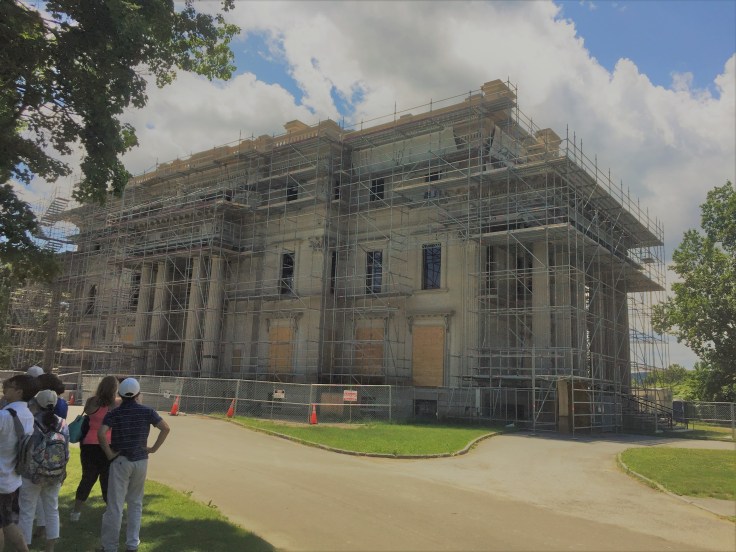
The Frederick Vanderbilt house in Hyde Park is arguably the smallest of the grand houses, a mere 55,000 square feet.  Unfortunately, it is undergoing restoration and thus is covered in scaffolding and slipcovers.

Today’s visitors center was originally built as a cottage for the Vanderbilts to view the ongoing construction:2017-07-04 Vanderbilt Hyde Park 01


The mansion as it looks today:

2017-07-04 Vanderbilt Hyde Park 02

2017-07-04 Vanderbilt Hyde Park 02a


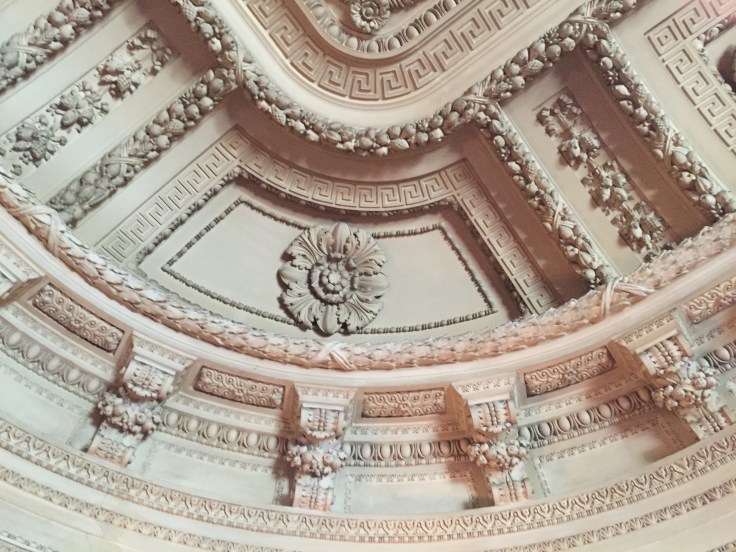
We were allowed to take interior photos, but the interiors are in a state of disarray:

2017-07-04 Vanderbilt Hyde Park 03

2017-07-04 Vanderbilt Hyde Park 04

2017-07-04 Vanderbilt Hyde Park 05

2017-07-04 Vanderbilt Hyde Park 07

As you can see, this house, like others I will show you in Newport, is simply an ostentatious display of excess;  these people were not patrons of artists who benefited their development; they simply bought castles and palaces in Europe, dismantled them, and reassembled them here in America. Don’t forget, this is one on the smallest, simplest Vanderbilt house; we will see more…

We returned on the train back to the Villa; this being the 4th of July, the Park was packed with thousands of people, crowding the beaches and lawns.  It was quite a madhouse. Luckily the RV park is about 1/2 mile beyond all the partying, so we were not affected by the crowds once we were finally able to drive by them. W spent the evening cleaning and packing. Today marks the final day of Part 1 of this Odyssey; tomorrow we rendezvous with the Nor by Nor’east caravan in Ashaway, Rhode Island.


2017-07-03 Hudson Valley, NY; Marchese Chevrolet, FedEx, and a Blow Dryer

The day in Croton Point dawned beautifully again. Today was another utilitarian day. We started by driving to Marchese Chevrolet in Fort Montgomory, NY, about a 1/2 hour drive.

We were finally able to get a photo of the Bear Mountain Bridge:

2017-07-03 Hudson River Bridge 02

We needed a basic 7,500 mile service, and we needed to top off the DEF.  While the happy merry workers went about their duties we walked the neighborhood. Simple and grand houses, in the woods and overlooking the Hudson Bay.  Beautiful.

The truck was done after about one hour, and we set out to drive one hour in the opposite direction, passing by Croton Point on the way. We headed inland, east of Sleepy Hollow, to the local FedEx facility. My brother, Paul, who has taken over our duties in Irvine, had sent a package of important mail to the Croton Point campgrand. Apparently, the driver couldn’t find the office to deliver it, so we simply asked that they hold it at their facility.  We found FedEx easily, but when they asked for an ID with the local New York address on it we were stumped.  They eventually gave us the package, and shortly thereafter I found an email showing our campground reservation with the address on it. Crisis averted; we drove on…

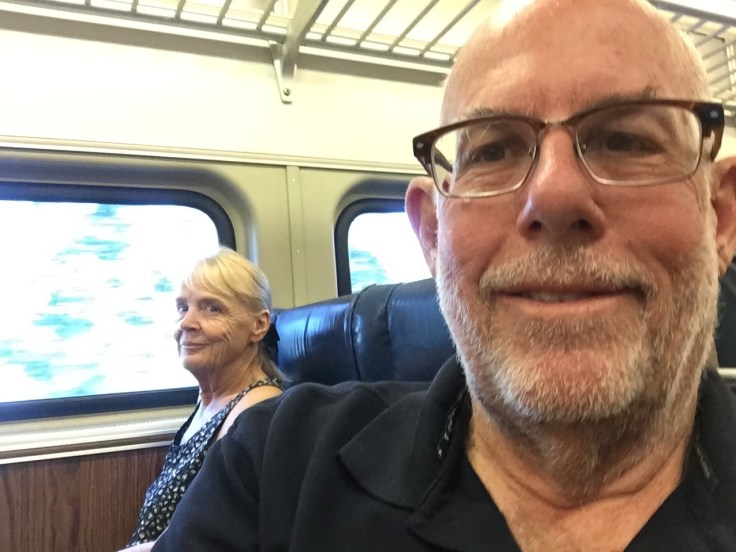
We found a local drug store; Lynda was able to purchase a small, travel-size blow dryer to replace her old one that, well, blew.  Success! We were done for the day. Back at the Villa we walked, wrote, cleaned, and had a relaxing day. Adult beverages were on the menu for the evening.  An enjoyable time was had by all.  Lynda experimented with selfies…

2017-07-02 New York, NY; Frank Lloyd Wright, Vincent Van Gogh, St. Patrick’s Cathedral, The High Line, and John Williams Campbell

Before I start today’s post I would remiss if I didn’t wish you all a belated Happy Canada Day with a photo of my favorite Canadamericans:

2017-07-01 McAnoy


Sunday dawned quite nicely, and we drove the 1.9 miles through the park to the local train station. We bought our tickets for a round trip to New York City; it is about a 55 minute ride.  I find it quite amazing that we are less than 1 hour from NYC, yet we are far out into the country. This is the same timing as the train from Irvine to downtown Los Angeles, yet Irvine is not even close to being “in the country”…

The train trip was uneventful. We did notice a lot of barbed wire fences when passing through the city of Ossining. A quick Google search found this:

“Sing Sing Correctional Facility is a maximum security prison operated by the New York State Department of Corrections and Community Supervision in the village of Ossining, in the U.S. state of New York. It is located about 30 miles (50 km) north of New York City on the east bank of the Hudson River…

The prison property is bisected by the Metro-North Railroad’s four-track Hudson Line.”

2017-07-02 NYC Train 01

After arriving at Grand Central Terminal, and exiting onto the street, we gawked at the beautiful buildings:


Then we walked to Un Deux Trois Cafe for breakfast. It is a big place, not exactly a mom-and-pop operation, but it is very French, the food was good, and it was a fun time.

2017-07-02 NYC 123 01


As we walked towards MOMA, our main reason for this trip, we passed through Rockefeller Center. I had learned from my reading that it was developed during the Great Depression by John D. Rockefeller, Jr. on land owned by and leased from Columbia University. It was a major effort of “Urban Renewal” in the 1930s; however, Jr. never made any money from the development due to onerous terms imposed by Columbia. Finally, after Jr.’s death in 1960, when the center was falling into disrepair due to lack of capital for improvements, Jr.’s sons were able to renegotiate the deal and gain financial backing for improvements. It is a marvelous complex, the grounds teaming with people on this sunny Sunday morning.  It is no longer owned by the Rockefellers…

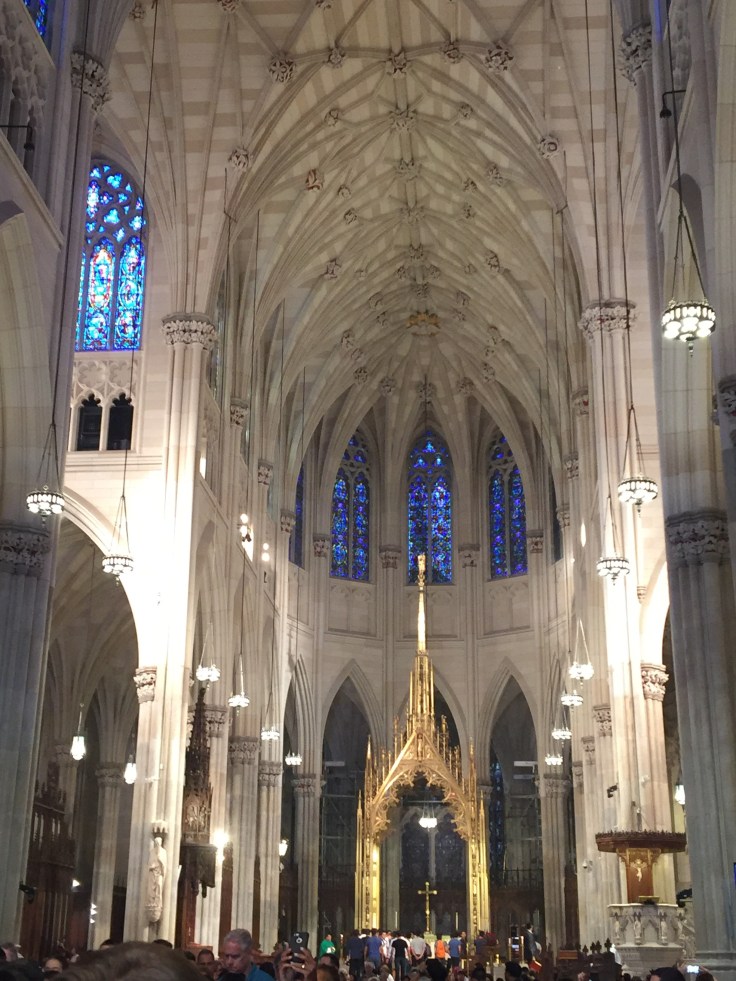
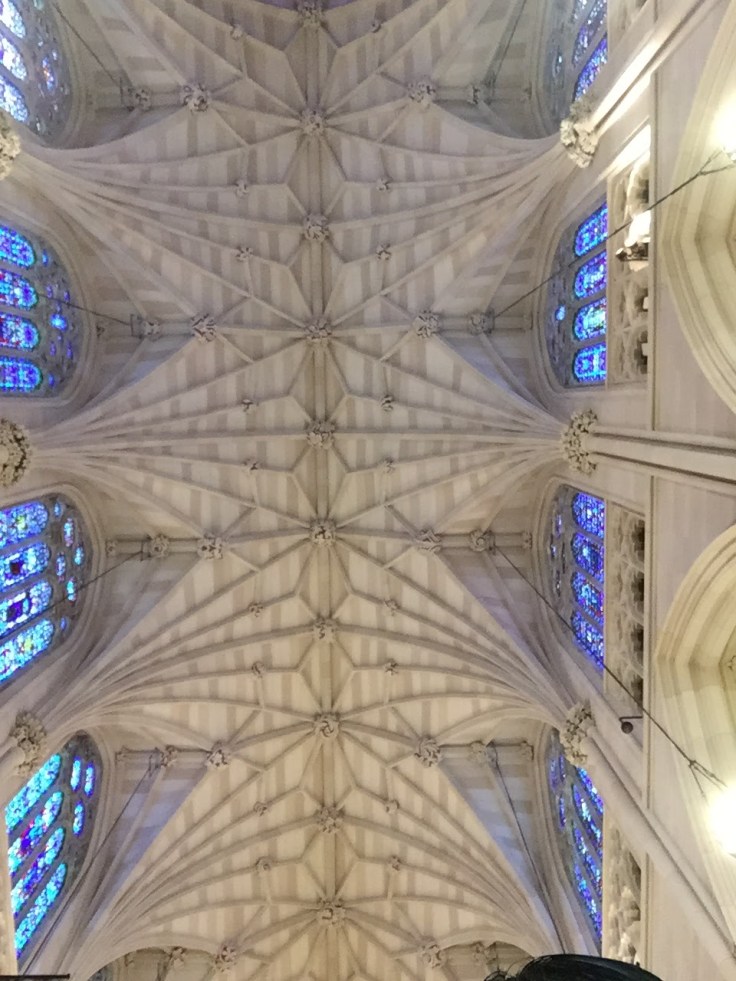
Across the street we found St. Patrick’s Cathedral.  Being Sunday morning, we stopped in for the 10:15 am services.  In celebration of Independence Day the great organ played “Stars and Stripes Forever”, and our final hymn was “America the Beautiful”…

2017-07-02 NYC St Patrick Cathedral 08

2017-07-02 NYC St Patrick Cathedral 062017-07-02 NYC St Patrick Cathedral 01

2017-07-02 NYC St Patrick Cathedral 04


Then  we were off to MOMA.  The Museum of Modern Art was a true grassroots effort, started by three ladies on their kitchen table, with nothing except a few hundred million dollars of Rockefeller money.  The main driver was Abby Aldrich Rockefeller, wife of Jr. (Jr. himself hated modern art…)  If fact, when MOMA needed land for a sculpture garden, Abby and Jr. donated their 9 story house next door, which was promptly demolished.

We were there for an exhibit of Frank Lloyd Wright drawings and models, in celebration of FLW’s 150th birthday:  Unpacking the Archive

It was a delightful exhibit. FLW used his drawings as working papers, to be scribbled on, torn in half, and reassembled; they were teaching tools, not precious objects d’art. There were models, too: The Price Tower in Bartlesville, OK. (See my blog post onJune 14, 2017), as well as the previously designed skyscraper that FLW designed for NYC, but which was never built.

After the FLW exhibit we took a quick detour upstairs to see Van Gogh’s The Starry Night. Wonderful…

So, with the afternoon still free, we headed downtown on the subway to see the 911 Memorial. It was mobbed with tourists, and it was quite hot.

2017-07-02 NYC World Trade Center 02

2017-07-02 NYC 911 Memorial 02

We saw one of the beautiful fountains, then headed back north to experience the High Line.  The High line is a linear park located on an abandoned railroad viaduct, about 1 1/2 miles long, on NYC’s west side. It is a delightful walk, and it was crowded with locals and tourists, alike.  We had lunch in its shadow, which was also nice…

2017-07-02 NYC Lunch 03

2017-07-02 NYC High Line

2017-07-02 NYC Lunch 01

2017-07-02 NYC High Line 01


Then we walked back to Grand Central Terminal and had afternoon drinks in the Campbell Apartment.  For 30 years this space was the private office and apartment of John Campbell, one of the Directors of the Grand Central Railway. After Campbell’s death in 1957 the space was underused, and its glory faded. It was reopened as a bar recently and it was a lot of fun. Drinks and food were good, and it was fun being in this “secret” space.

We caught a return train back to Croton Point, had a short drive back to the Villa; this is what camping is all about for us: cities and country, highways, subways, and railways, beaches, waterfalls, houses, museums, and cathedrals; an enjoyable time was had by all.


2017-07-01 Hudson Valley, NY; the Rockefellers and Kykuit, the Union Church, Marc Chagall, and Henri Matisse;

Before our trip I had read a biography by Ron Chernow: “Titan – The Life of John D. Rockefeller.”  Shortly after, about two months ago, I read “Memoirs“, by David Rockefeller, JDR’s youngest grandson.  The first told the story of how JDR made his money (your opinion may vary…) and built his estate here in the Hudson Valley, and the second told of growing up in his grandfather’s house and eventually turning it into a museum and art gallery for all to enjoy.  Both also contained much information about the life of John D. Rockefeller, Jr (whom I refer to here as Jr.), David’s father. (David died in March, 2017 at the age of 101…)

We set out today to visit Kykuit, home to 4 generations of the Rockefeller family.  It is located a few miles from the Hudson River, east of Sleepy Hollow and Tarrytown, about 25 miles north of New York City.

Kykuit sits amid the vast family estate, known as Pocantico or Pocantico Hills; it occupies an area of  over 3,400 acres. During much of the 20th century, the estate featured a resident workforce of security guards, gardeners and laborers, and had its own farming, cattle and food supplies. It has a nine-hole, reversible golf course, and at one time had seventy-five houses and seventy private roads, most designed by JDR and Jr. A longstanding witticism about the estate quips: ‘It’s what God would have built, if only He had the money’.

(In 1946, the family considered donating a portion of the estate as a home for the newly formed United Nations.  Instead, they bought the 17 acre site in New York City and donated it to the UN…)

When JDR originally bought the estate in the late 1890s, he moved the family into an existing farm house.  He had no need for an elaborate mansion, unlike his wealthy contemporaries like the Vanderbilts, the Astors, or J. P. Morgan.  What he did want, and soon built, was a carriage house and stables for his prized horses, and a golf course for his personal use.

After the original house burned down, JDR wanted to move into another existing modest dwelling on the estate.  Instead, Jr. convinced him that he needed a grand house more befitting his status as the wealthiest man in America.  JDR finally agreed.  A new house was promptly built; it was found to be inadequate and faulty in both design and construction, and a new house was rebuilt in its place.  It was completed in 1913. It has four stories and two basements; however…

Unlike the monumental size and the display of vast wealth seen in other museum-like Gilded Age mansions, Kykuit’s cozy rooms are a reflection of the conservative and family-oriented lifestyle of the Rockefeller family.  The devout John D. Rockefeller’s puritan values dictated that there be no ballroom, no card room, no billiard room, and no place for drinking or other activities deemed to be inappropriate.  The house had only 40 rooms – very modest by the gilded age standards of the day… There are 11 family and guest bedrooms.

In fact, JDR and Jr. spent more money on the grounds then they did on the house; the last resident, Nelson, used the estate as a giant art gallery, displaying his huge collection of modern art.  To preserve the view, JDR moved an entire village, including the train station and miles of tracks, a few thousand yards further away. To keep down the noise of constant service deliveries he built tunnels so that all deliveries and service access to the house were underground.  Jr. and his wife built a “Playhouse” to keep their 6 children occupied.  It is larger than the main house, and includes indoor and outdoor tennis courts, indoor and outdoor swimming pools, a bowling alley, billiards, a soda fountain, a theater, and assorted other amenities.  About 86 acres were enclosed into the “Park”, which contained the main house, the Playhouse, a reversible 9 hole golf course, plus many other houses for various other family members over the years. All the rest of the land has always been left open for the public to use. It was all donated to the National Trust in the 1980s, and the house and some of the “Park” is now also open to the public.  (Some portions of the estate are still private, because family members still live in some of the houses…) The majority of the original 3,400 acres are now a New York State Park.

At the time of the donation, except for family events, the 11-bedroom house had been unoccupied since Nelson Rockefeller, a grandson of JDR, died in 1979. The National Trust acquired a quarter interest in the 600-acre Rockefeller property in Pocantico Hills in 1979 under his will. In 1983, the Rockefeller Brothers Fund and the National Trust determined the boundaries of the new 86-acre Pocantico Historic Area, which includes the property and Nelson Rockefeller’s art collections at Kykuit.

Throughout the house, priceless East Asian pottery that the family avidly collected and cherished anchors each room. The main floors and basement (the latter was turned into a vast art gallery) boast modern art by the likes of Pablo Picasso, Alexander Calder, Andy Warhol and Henry Moore collected by modern art enthusiast Abby A. Rockefeller Jr.’s wife) and Nelson Rockefeller

Again, interior photographs are not allowed on the tour. The house has only two rooms that visitors would ever see – the office and a small parlor. There is no grand staircase, no Ballroom, no Grand Hall. This house was not designed for ostentation and the display of wealth.  Most of the house was reserved for the family.  Life for the family revolved around a “family” room in the center of the house, which contained a massive pipe organ (removed by Nelson). There is a large dining room for family meals, and a quieter sitting room. The terrace to the west boasts a view over the treetops to the Hudson River. No other buildings are visible between the house and the river.

On the second floor are two complete 3 room master suites; one or the other was occupied by JDR and his wife Cetti, then Jr. and his wife Abby, and finally Nelson and his wife Happy. The other Master suite was used for honored guests.  More family bedrooms are on the third floor and servant bedrooms are on the fourth floor.

Our tour started in the town of Sleepy Hollow at the Visitor Center. We took a shuttle up to the Park, where we drove along the original carriage roads, then up to the entrance court of Kykuit.  The front of the house is relatively narrow, but the view to the East is fabulous.


Entrance – East Facade:

2017-07-01 Kykuit 06


Side facing the lawns and gardens:

2017-07-01 Kykuit 08


West views towards the Hudson:


The original family swimming pool:

2017-07-01 Kykuit 43


The Teahouse; Nelson had swimming pools built where the sunken lawns were (and are), and he converted the Teahouse into a soda fountain…

2017-07-01 Kykuit 29


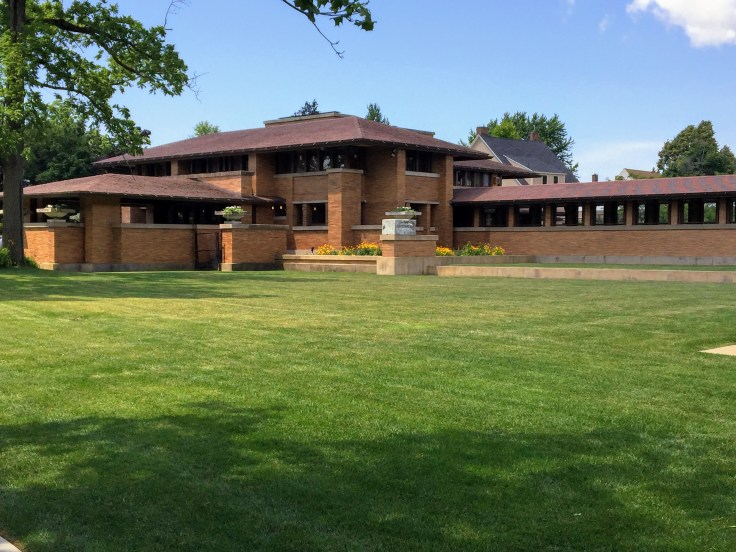
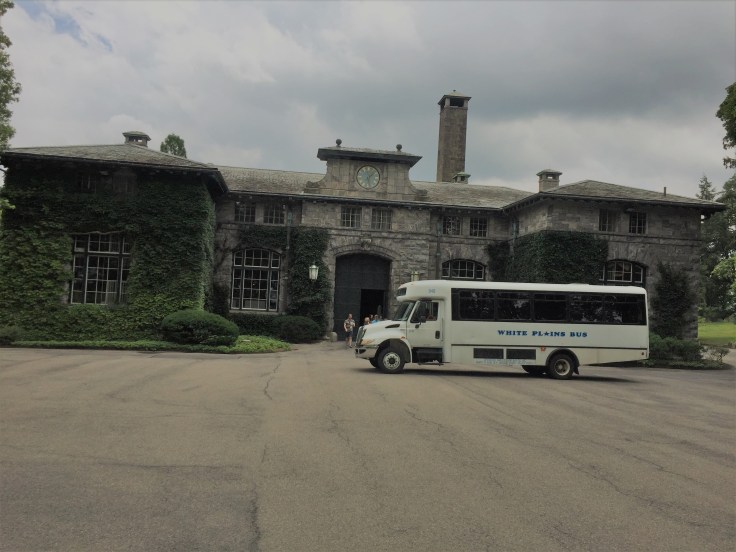
While there are obviously many differences between Kykuit and other neo-classic great houses of this era, there is one striking thing that we noted:  These houses were all built about the same time as the Martin House, which we saw in Buffalo. (See my June 28 2017 blog post…)  As these piles of excess were being assembled, Frank Lloyd Wright was rethinking the whole idea of what a house is, and what 20th century architecture is.

Compare:

Kykuit…

2017-07-01 Kykuit 01.jpg

Martin…

2017-06-28 Martin 05.jpg


As I said above, JDR loved horses and carriage racing. His first act upon buying the estate property was to build a Carriage House.  Today it contains historic carriages and cars owned by the family.  The basement and upper stories have been converted to a conference center for the use of the family’s business and charitable interests.
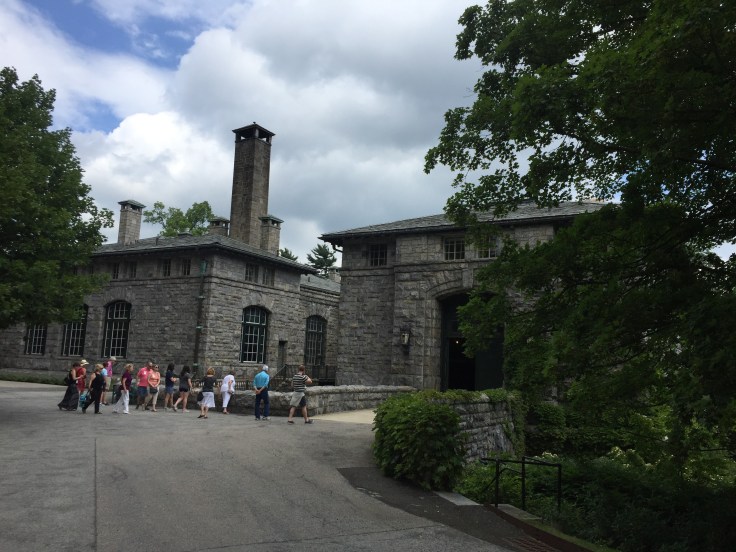
2017-07-01 Kykuit 67a

2017-07-01 Kykuit 63

2017-07-01 Kykuit 65

2017-07-01 Kykuit 66

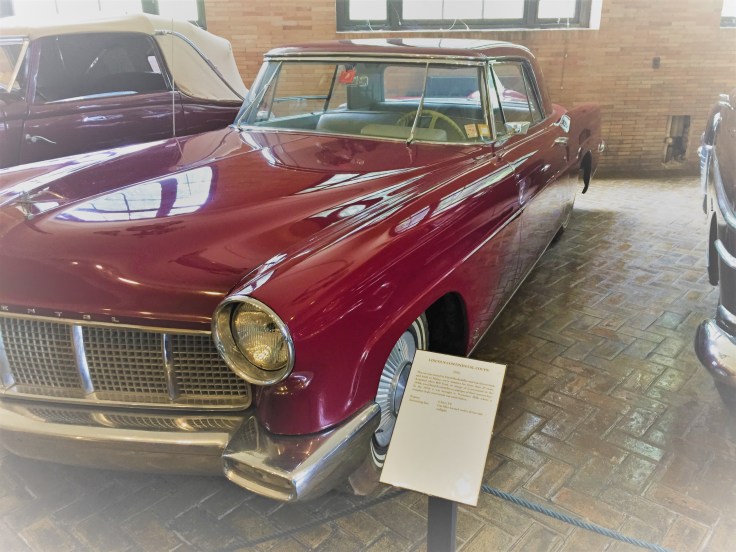
This is David Rockefeller’s Continental.  The joke here is that, as any Continental lover knows, this car is NOT a Lincoln; Continental was a separate division of Ford when this car was built…


After the tour we were shuttled back to Sleepy Hollow; we grabbed a quick lunch in a local pub, then drove to The Union Church of Pocantico Hills.  This tiny country church has a stained glass rose window by Henri Matisse, and 9 stained glass windows by Marc Chagall… After all, when some of your parishioners are the Rockefeller family, things get done.

The church was built by John D. Rockefeller, Jr. in 1921, as part of his plans to develop the town of Pocantico Hills, which was below his estate Kykuit.   It is a one story neo-Gothic style building with fieldstone foundation and walls and a slate covered, highly pitched gable roof. In 1930-1931, a parish hall was added to the east end of the church.

Upon the death of Jr.’s wife, Abby Aldrich Rockefeller, in 1948, their son Nelson Rockefeller had Henri Matisse design the church’s rose window in honor of her memory shortly before the artist’s own death in 1954.  When Jr. died in 1960, his children, led by their son, David Rockefeller,  had artist Marc Chagall design a Good Samaritan window in his honor.   This commission later expanded to include all eight windows in the nave of the church. They memorialize, among others, Michael Clark Rockefeller, Governor Nelson A. Rockefeller, Peggy Rockefeller (Mrs. David Rockefeller), and Mary Rockefeller (Mrs. Laurance Rockefeller). Chagall and members of the Rockefeller family carefully selected the subject matter for the windows from Biblical texts.

David Rockefeller, members of the Rockefeller family, and members of the church commissioned organ-builder Sebastian M. Glück to design and build the Laurance Spelman Rockefeller Memorial Pipe Organ in 2006.  It is used for public recitals as well as for church services.
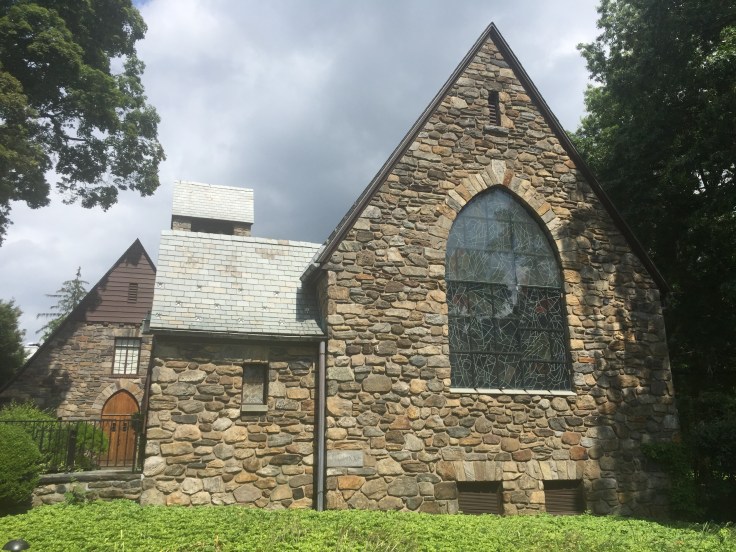
2017-07-01 Union Church.jpg


We returned to the Villa and had a quiet evening in the Villa.  At least we were quiet. The weather was not.  We were treated to a huge thunderstorm that raged for what seemed like hours.  Thunder and lightning and heavy rain, things all so unfamiliar to us…  We were parked under a large tree, and, being unaccustomed to lightning, we were not sure whether this is a good thing or a bad thing… However, all ended well and we survived…
 

2017-06-30 Hudson Valley, NY

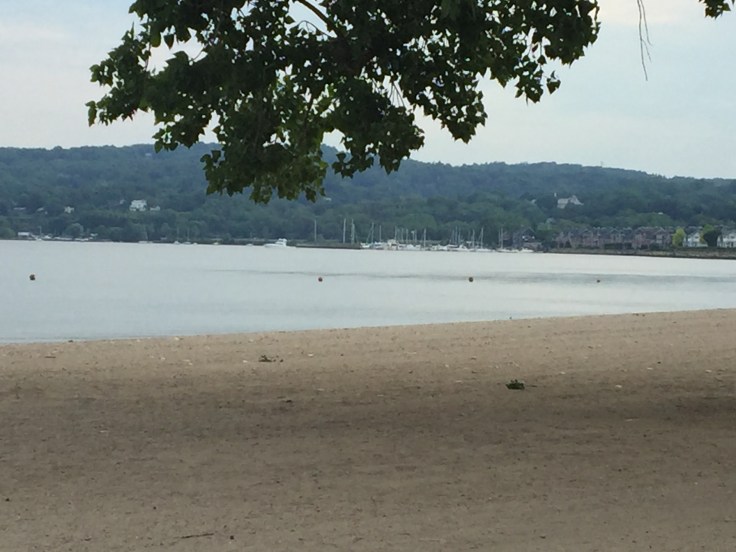
After our visit to Watkins Glen we checked into Croton Point Park, a county park in Westchester County, adjacent to the town of Croton-on-Hudson, in the lower Hudson Valley, about 30 miles north of New York City.  It is a large park on a penninsula projecting out into the Hudson River. There are beaches, sports fields, picnic areas, forests, open grasslands, plus the RV Park, tenting campgrounds, and vacation rental cabins.

2017-06-30 Croton Point 3


2017-06-30 Croton Point 2


2017-06-30 Croton Point 1


This first day in the park we settled in, did laundry, shopped for groceries, and refueled the truck. It was a relaxing and productive day.

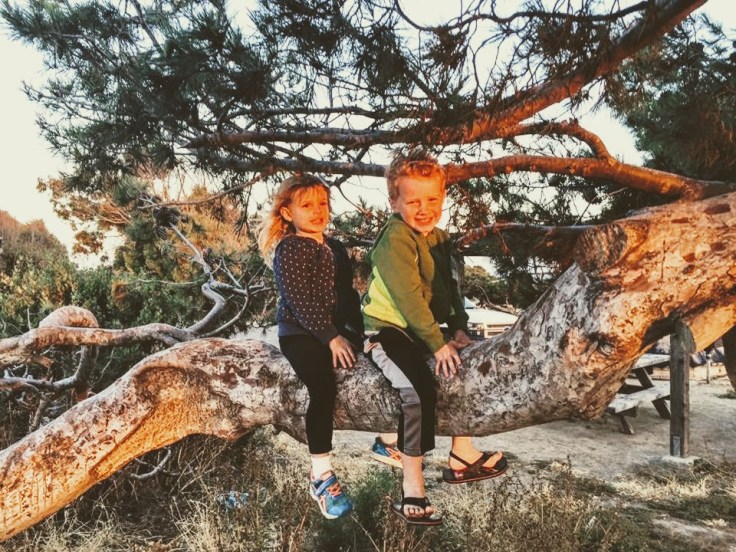
Since nobody wants to see pictures of us doing laundry and shopping, I thought I would show you the latest pictures of our grandchildren…


George:

2017-06-30 George


Ian (and his father):

2017-06-30 Ian


Roisin (and her friend James):

2017-06-30 Roisin


Tomorrow we start our house tours here in the Hudson Valley, as we visit the Rockefellers, the Roosevelts, and the Vanderbilts…


2017-06-29 Watkins Glen and The Finger Lakes

After one night in Canandaigua, we headed to our final destination of Part 1 of this Odyssey.  But on our way we stopped by Watkins Glen State Park, at the south end of Lake Seneca, one of the Finger Lakes…

We didn’t know quite what to expect, but we were told, and we had read, that it was quite beautiful. The reality is that the park has a gorge with a stream that runs for about 1 1/2 miles, and drops over 400 feet in elevation.   It was opened to the public in 1863 and was privately run as a tourist resort until 1906, when it was purchased by New York State.

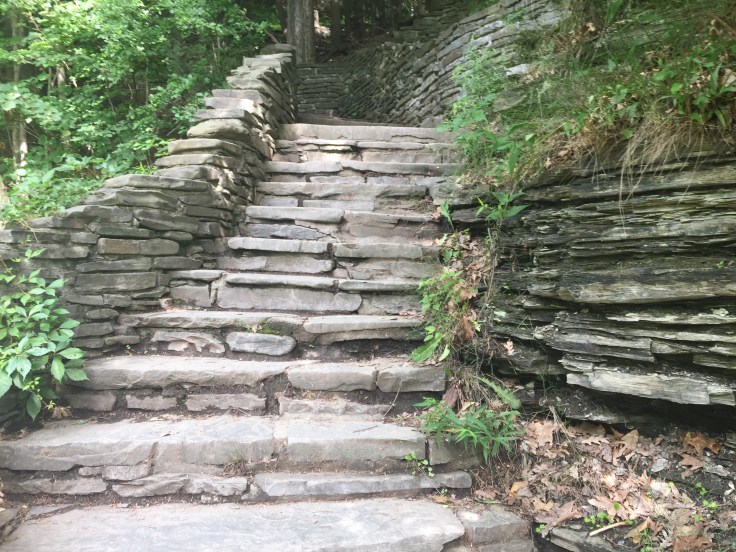
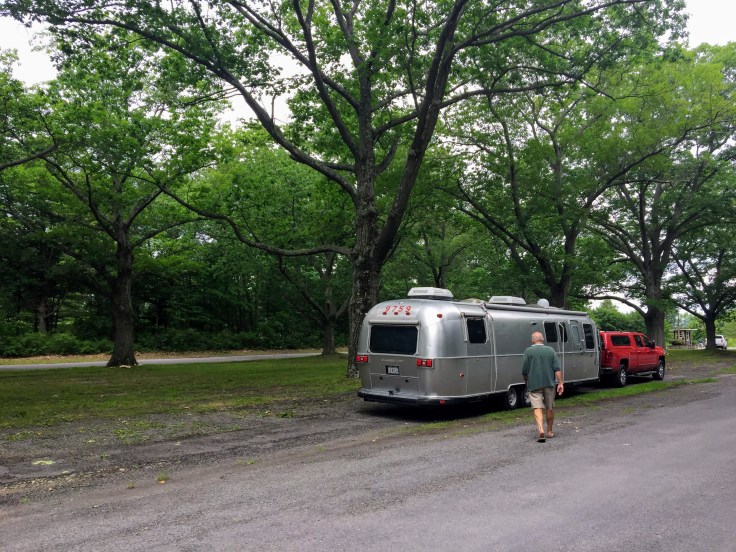
For simplicity we drove to the top of the park, away from the city center. We parked the Villa and looked for the trail head. What we found were about 135 steps, paved in stone, leading down into the gorge. Then the fun began…

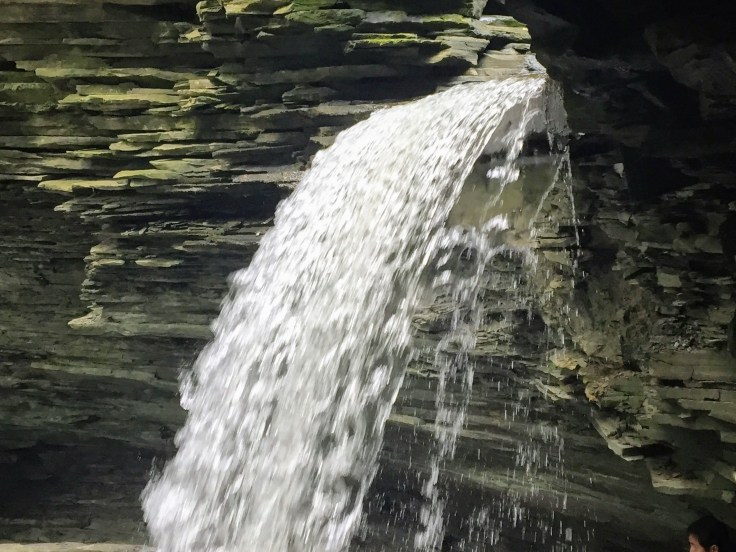
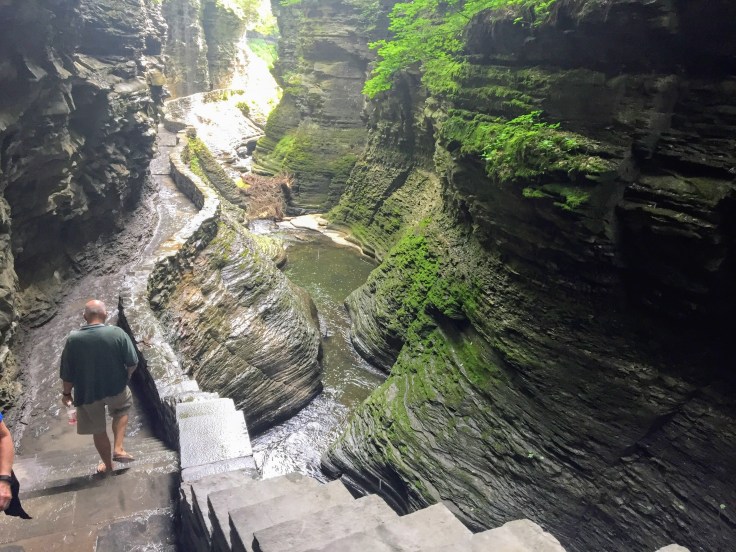
I really don’t know what to say about walking down this gorge. The creek has carved out a route through this stone, variously soft and hard, over umpteen thousand years. There are quiet ponds on flat flagstone, and roaring waterfalls over vertical drops. Again, these pictures don’t really do it justice… Every turn of the path revealed another spectacular view of stone, water, bridges, and paths.

The steps at the top of the gorge…

2017-06-29 Watkins Glen 01


The quiet ponds…


One of the many water falls…

2017-06-29 Watkins Glen 14


The path and steps carved into the sides of the canyon…

2017-06-29 Watkins Glen 06


Many more water falls…


And bridges, walkways, and water falls…


At the bottom of the gorge the stream runs into Lake Seneca at the town of Watkins Glen…

2017-06-29 Watkins Glen 50


Once we were at the bottom, we had to walk back to the top, again. Over 400′ in elevation over about 1 1/2 miles each way. The equivalent of climbing to the top of a 40 story apartment building…

Finally we were back at the top and back to the Villa. We headed out to our final campground of our east-bound journey.

2017-06-29 Watkins Glen 59


And an enjoyable time was had by all…


Blog at WordPress.com.

Up ↑