Search

Adventures in the Villa

Category

Church

2018-08-19 – WBCCI 2018 Southwest Adventure Caravan – Day 1 – Albuquerque

Today we begin the Southwest Adventure Caravan.  Our itinerary is roughly this:

New Mexico:  Albuquerque, Santa Fe

Colorado:  Durango, Silverton, Mesa Verde

Utah:  Bluff (Natural Bridges, Monument Valley), Moab, Torrey, Bryce Canyon

Arizona:  Fredonia (Zion), Grand Canyon North Rim, Page (Lake Powell)

New Mexico:  Gallop, Acoma, Zuni, Albuquerque Balloon Fiesta


But first we have a free day.  We have met some of the other caravaners, and we took several walks arounf the RV park.  I checked out the generators to make sure they were still in good order, and I shifted a bit of out cargo in the back of the truck.

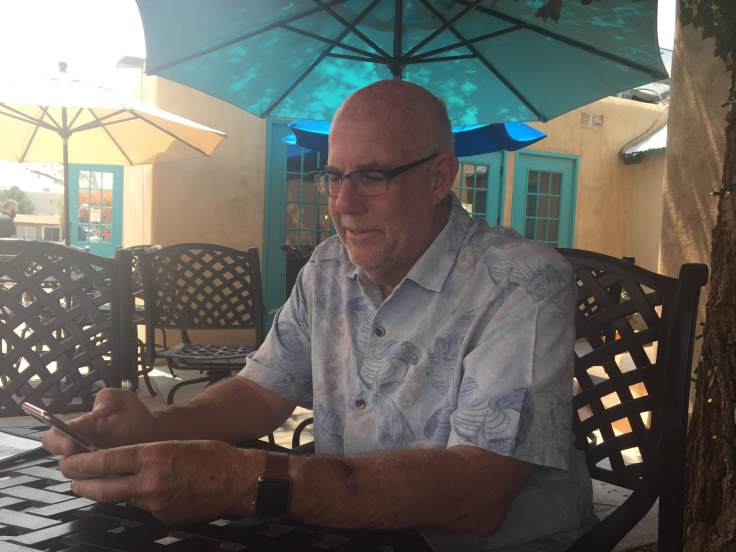
By noon we were ready for a little adventure… We drove down the original Route 66 and made our way to “Old Town” Albuquerque and strolled around the plaza.  There is a 200 year old church, a band playing in the band stand in the plaza, and hundreds of trinket shops that spread around the plaza and throughout the blocks all around.  While we have no use for trinket shops, we did admire the architecture – most buildings have deep verandas facing the streets, providing much needed shade.  Most building have courtyards, again with the shaded areas that made walking around and “shopping” very pleasant, despite the 90+ degrees heat.

img_6520

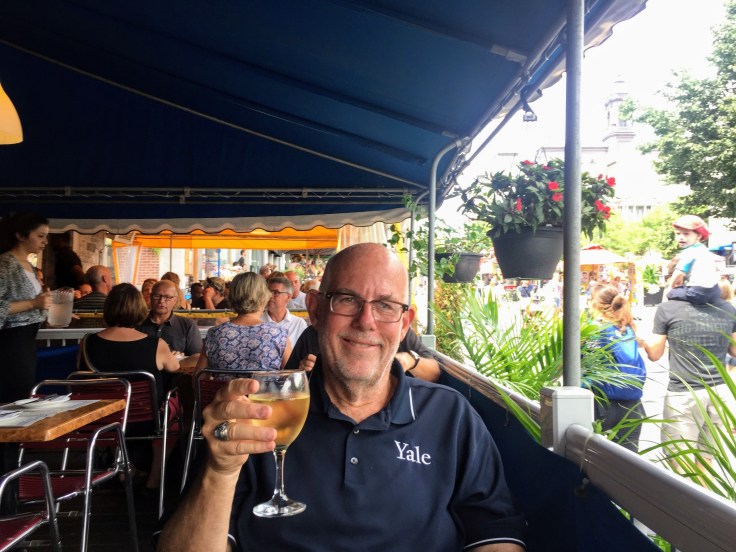
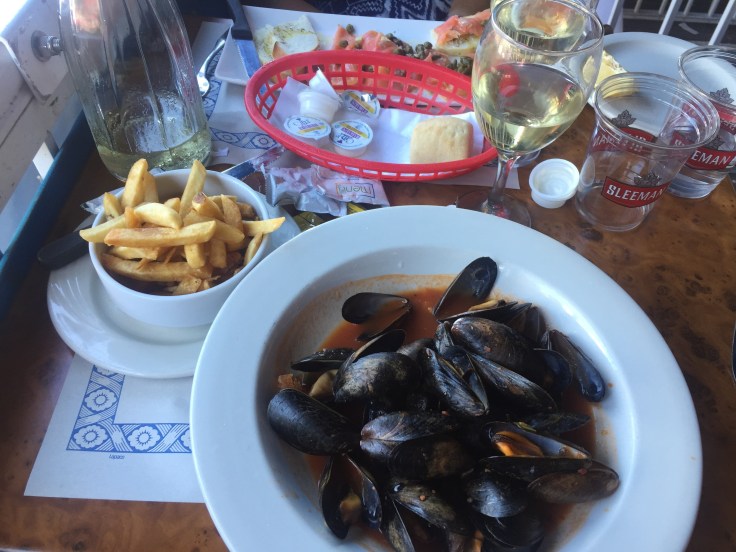
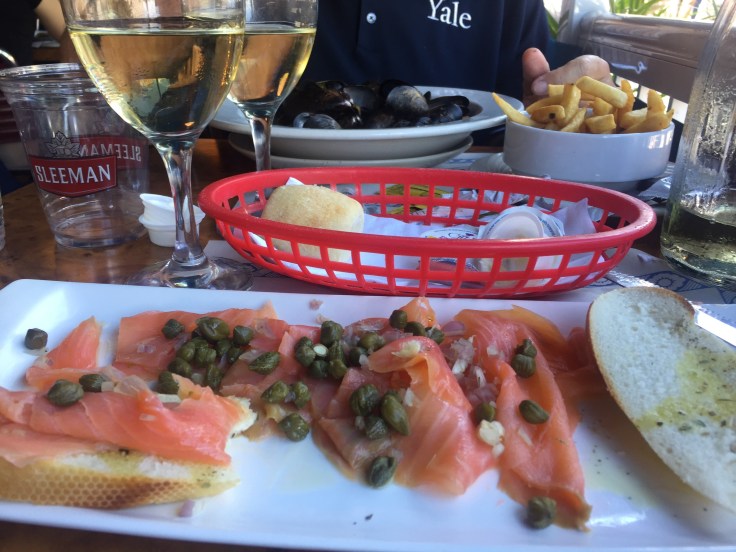
We stopped for a small lunch at the Back Street Grill…

img_4491

And we returned to The Villa, ready for a nap…

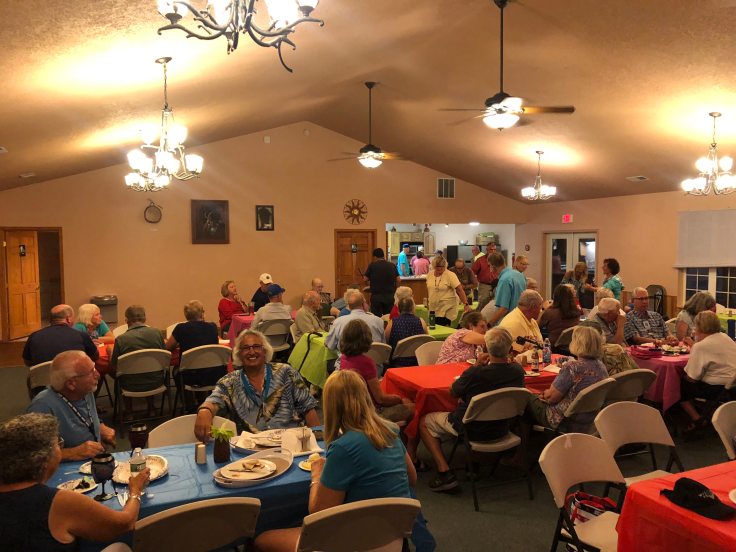
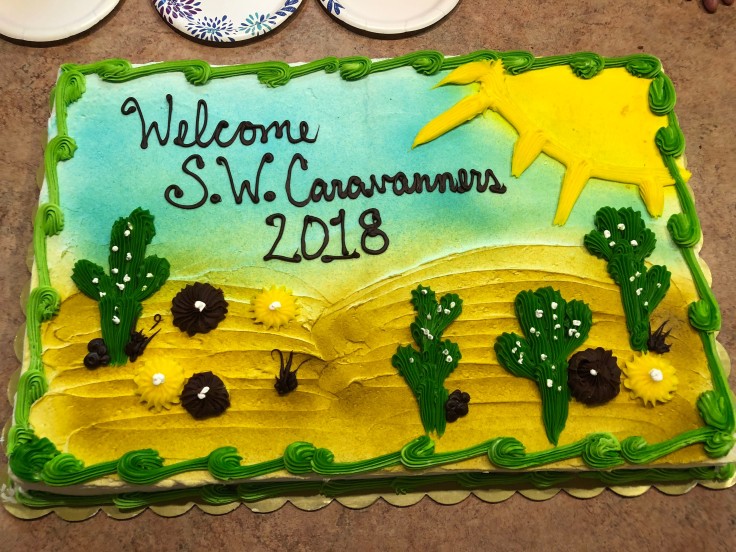
We had our first orientation meeting where we reviewed the “rules and traditions” of the caravan and went over the drivers manual.  We took a break for happy hours with some of our neighbor caravaners.  At 7:30 we reconvened for dinner and a celebratory cake for dessert…

img_6523

img_65221

And an enjoyable time was had by all…


2017-09-14 Westbound; New Refrigerator and Minnesota…

We were up at 5:00 am to get the Villa ready to be moved into the service bay here at Shorewood RV, just outside Minneapolis.  All went well, and by 6:15 the Villa was in the Service Bay and we were on the road to the town of Elk River, about 6 miles down the road…

2017-09-14 Elk River 01

Elk River is a delightful town along the banks of the Mississippi River.  The town has been around a long time, but recent developments have nicely enhanced the town and the feel of the downtown business district.  As you see in the photo above, the historic buildings are on the left and a new apartment building is on the right.  The new building fits the scale of the street, contains retail spaces at the street level, and provide a very human scaled space.  The same thing is going on around the corner:

2017-09-14 Elk River 02

We walked about the town, then had breakfast at the Olde Main Eatery.  It is what a small town diner should be:  friendly people, regulars sitting at their regular tables, with olde time photographs on the wall.  We enjoyed a nice breakfast and looked at maps to better understand the Black Hills and Mount Rushmore.  We hope to be there the day after tomorrow (Saturday).

After breakfast we walked down to the Mississippi River; it was very quiet in the early morning light:

2017-09-14 Elk River 04 Mississippi River

2017-09-14 Elk River 03 Mississippi River

The town has developed a nice waterfront park with an informal amphitheater for community events.  All in all, it is a very nice town!

We returned to Shorewood RV to find out thet there was a small snag in the parts that had been delivered, so it was going to take a little longer to complete the new refrigerator installation.. We spent the morning in their lounge, planning our stays for the next few days…

By 11:30 the refer was done and we were hitching up.  We were underway just before noon.  We are heading west, across most of Minnesota, but first we had to get out of Minneapolis.   We even encountered our first detour of our trip; we were led off the southbound freeway and re-routed back north again for five miles, then west and south again.  Hopefully, we won’t see this type of thing again any time soon.

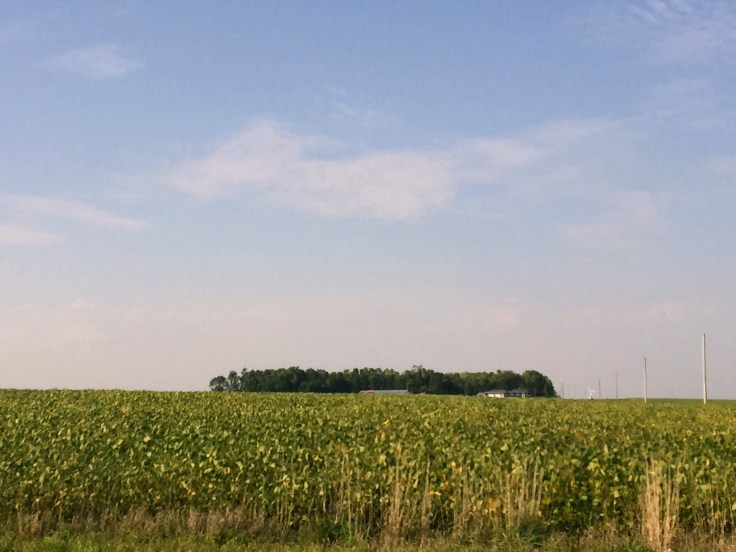
Once we were out of the city we traveled easily along two lane roads through endless farmland.  While it was quite beautiful, it was not as lush as Wisconsin.  On the other hand, it is one week later and fall is clearly on its way.

These photos show what we saw all day:

2017-09-13 Minnesota Farms 03

2017-09-13 Minnesota Farms 04

2017-09-13 Minnesota Farms 02


2017-09-13 Minnesota Farms 05

2017-09-13 Minnesota Farms 01

We did see a little Minnesota humor adjacent to one gas station:

2017-09-13 Minnesota Humor

And then, out of the blue, the road was closed.  We had to head back east about 15 miles before we could go south and then west again.. These detours are maddening!  Why can’t they put up better signs and prior warnings?

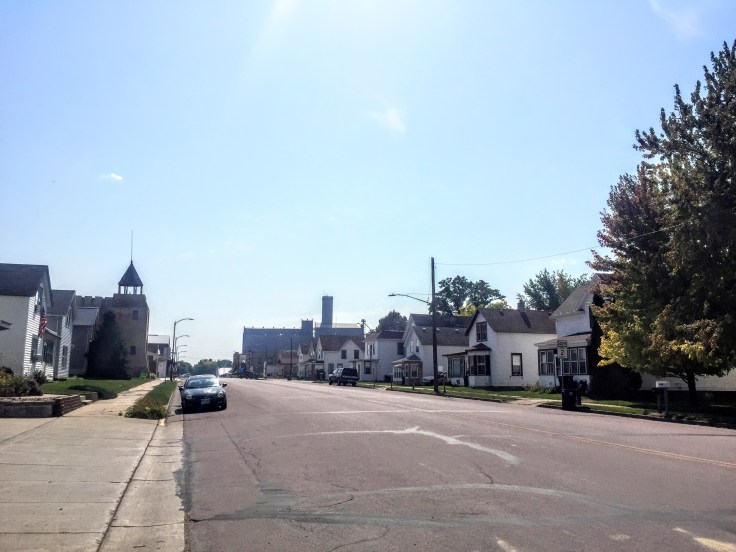
There are also some small towns that we passed through.  Some are really tiny; this is Gibbon.  It is a little more substantial than many:

2017-09-13 Minnesota Town 01

2017-09-13 Minnesota Town 02

2017-09-13 Minnesota Town 03

2017-09-13 Minnesota Town 04

And churches.  Lots of churches:

2017-09-13 Minnesota Town 05

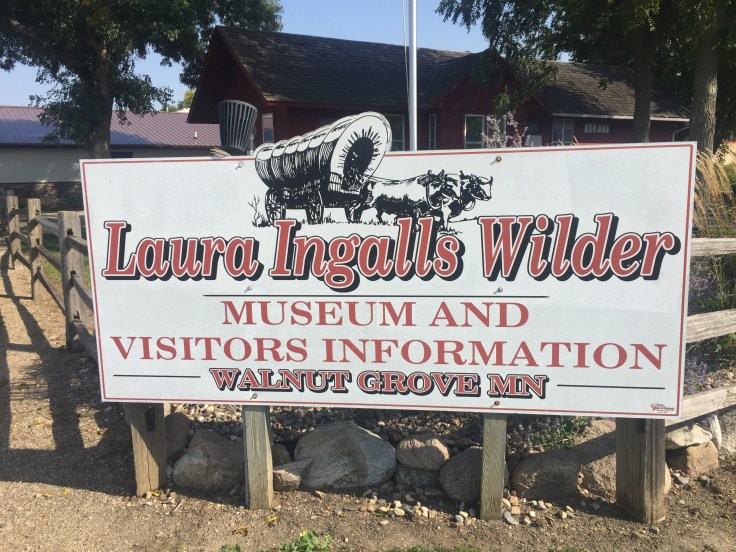
Our mid-day break was to stop and see the town of Walnut Grove and the Laura Ingalls Wilder Museum:

2017-09-14 Walnut Grove LIW 01

The Ingalls family lived in Walnut Grove in two increments of two years each.  In between, they moved to Iowa and managed a hotel for two years.  In contrast to the Little House on the Prairie TV Show, they had a miserable time here.  They lived in a dug-out, and their wheat crops were wiped out two years in a row by grasshoppers; they pretty much lost everything and moved to Iowa. Also, Mary had a stroke (not scarlet fever) that left her blind, and a newborn baby boy died.  After their years in Iowa they returned to Walnut Grove, and “Pa” opened a butcher shoppe, while Laura worked as a housekeeper in the local hotel.  But I digress…

The museum has very little memorabilia that is actually from the Ingalls family.  There are lots of historical references, photos, book excerpts, and antiques gathered from many sources that attempt to show what life was like on the prairie.  It was interesting in a modest way.  But, in general, a giant waste of time…

2017-09-14 Walnut Grove LIW 02

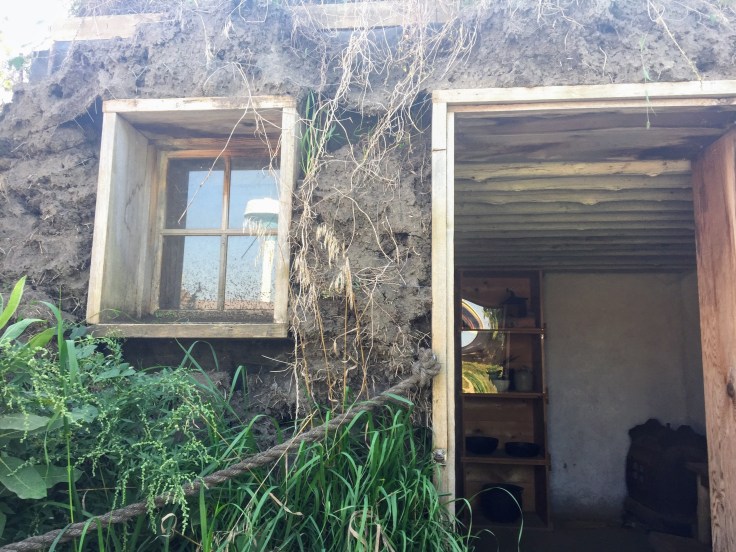
They have a re-creation of a typical dugout, but it is made from reinforced concrete…

2017-09-14 Walnut Grove LIW 03

They have a recreation of a typical school house from the 1880s; Laura taught school for two years, starting when she was 15 years old, but it was not here:

2017-09-14 Walnut Grove LIW 04

To prove to you readers just how old I am, I actually did attend a two-room school, and we had desks exactly like this… (We never could figure out what those holes in the desk-tops were for…)

So we moved on; tomorrow we visit De Smet, the actual “Little Town on the Prairie”…

We drove to our RV park for the night, in Pinestone, MN.  We have full hook-ups (water, sewer, power), plus good internet access and satellite TV.  We had a quiet night, with Happy Hours and burritos for dinner.  Tomorrow we can shop to re-stock the refrigerator.

An an enjoyable time was had by all…


2017-09-10 Westbound; Stranded in Thunder Bay, Day 10…

2017-09-01 GMC 03

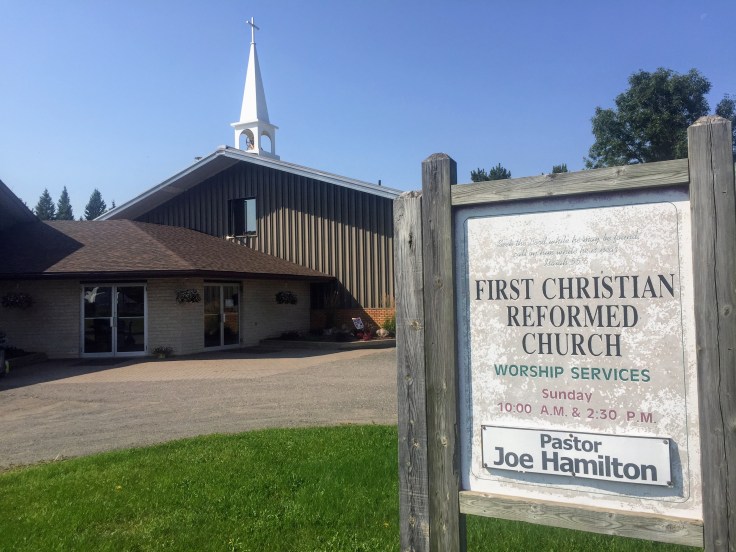
Sunday in Thunder Bay; we attend another Christian Reformed Church; in fact, there are three CRCs in Thunder Bay, a town of only about 108,000 people.  Today we went to the suburban church, about 15 miles out of town…  (Around the corner, within 1/2 mile, is a United Reformed Church, an ultra-conservative spin-off of the CRC.)

2017-09-10 First CRC 01

2017-09-10 First CRC

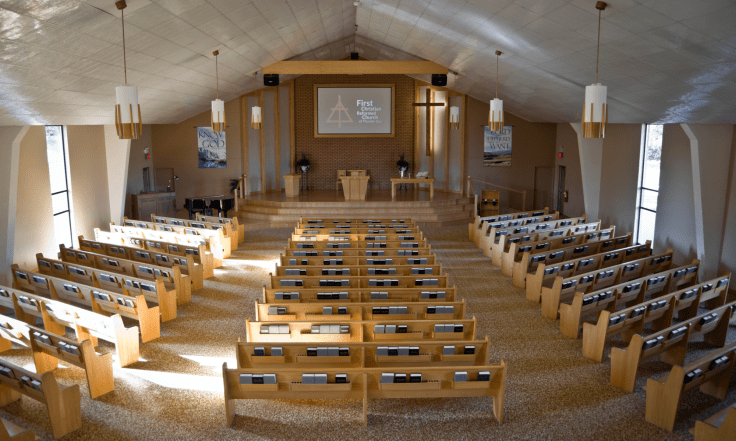
It appears to be a fairly new building; it looks like it was built in conjunction with Thunder Bay Christian School.

It was the most conservative, traditional CRC we’ve ever been to… An old CRC tradition was for the members of the Council or Consistory (The governing body of Elders) to walk into the church together, along with the minister.  I remember that tradition from days of my youth.  I just haven’t seen it in 30 years or so.  But another even older tradition was for the President of the Council to shake hands in front of church with the minister before and after the service. I have never seen that… until today.

Every song sung here was from one of the Hymnals.  No repetitive, upbeat praise songs here.  On the other hand, unlike the Bethleham CRC  last week, there were many families, lots of kids, and a good size congregation – I’d estimate 200 people.

But it was a nice service; the minister is the same one who had pre-recordrd the video sermon we heard last week.  (Same minister, different sermon…)

One more CRC tradition: They hold two services on Sunday, and they expect you to be at BOTH!  (We were oncers…)

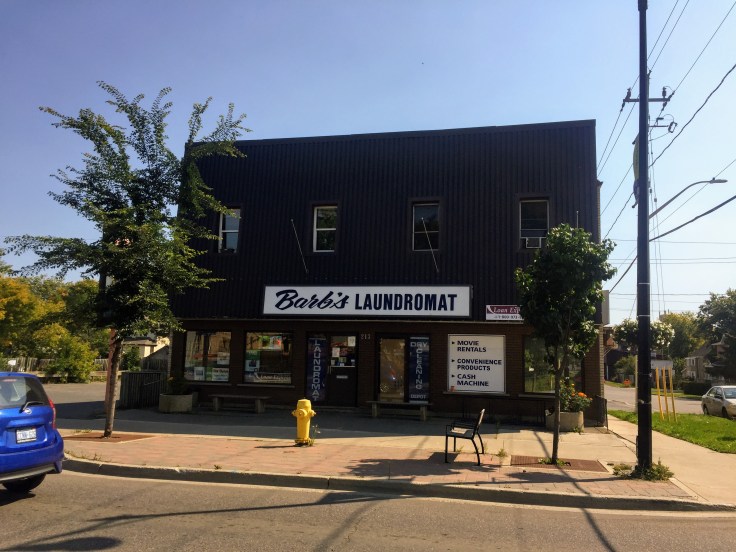
After Church we had a restful day, catching up after our trip to Wisconsin.  We needed to do laundry, and find some internet; we found both within one block in downtown Thunder Bay:

2017-09-10 Laundromat

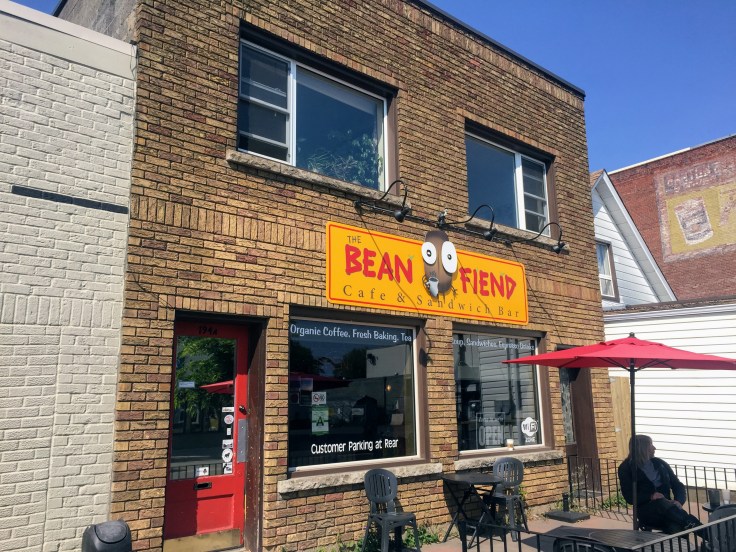
2017-09-10 Bean Fiend

Once we were back in the Villa we relaxed until dinner time; tonight we tried Caribou:

2017-09-09 Carribou

We walked to and from the restaurant; it was nice to get out after all the driving we have done over the past several days.  The weather was nice.  An enjoyabe time was had by all…


2017-09-08 Westbound; Stranded, but escaped from, Thunder Bay, Day 8…

Today we move to Racine, WI.  We left early again, in the dark, traveling down small, dark, country roads; the only light was the occasional milk truck stopping by a dairy to pick up its load…

We reached Racine in time for a quick Starbucks, then we were at the headquarters of the SC Johnson Company – the Johnson Wax people…

At the 1967 World’s Fair they constructed a pavilion they called the Golden Rondelle; after the fair they moved it to their Headquarters in Racine; it is used as the Visitor Center, and as a conference center and theater:
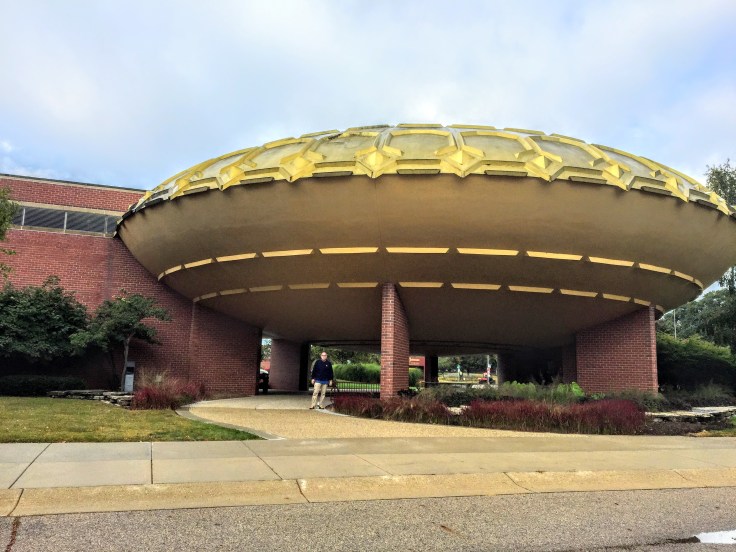
2017-09-08 S C Johnson 01

Our tour is of the Research Tower and the Administration Building.  Unfortunately, interior photography is strictly forbidden… The Administration Building interiors are spectacular.  I was able to steal some images off the internet…

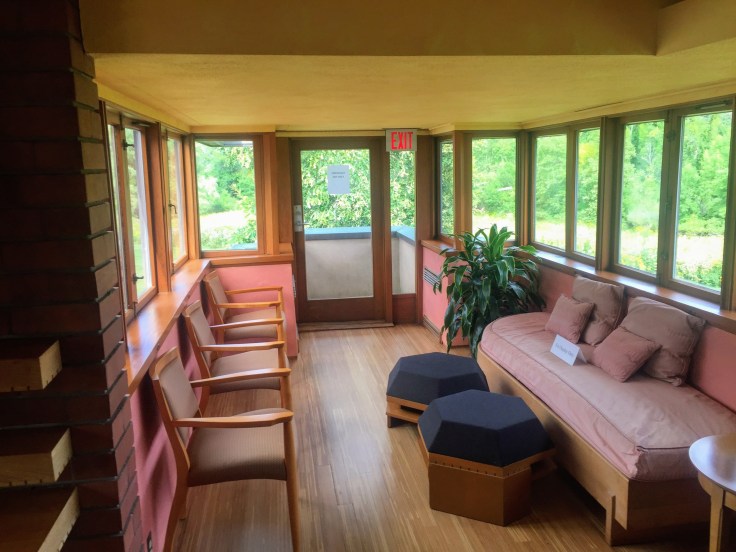
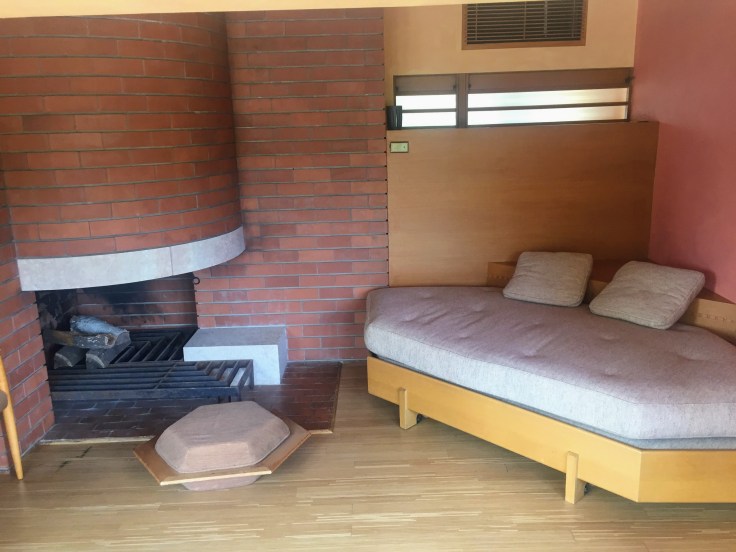
The Johnson Wax Headquarters, completed in 1939, was set in an industrial zone; Frank Lloyd Wright wanted to relocate the headquarters out to the countryside to give all the employees more contact with nature.  Johnson say, “No way.”  So Wright decided to create a sealed environment lit from above, as he had done with the Larkin Administration Building.  (See my earlier blog about the Martin House.)   The building features FLW’s interpretation of the streamlined Art Moderne style popular in the 1930s. In a break with FLW’s earlier Prairie School structures, the building features many curvilinear forms and subsequently required over 200 different curved “Cherokee red” bricks to create the sweeping curves of the interior and exterior.  The mortar between the bricks is raked  to accentuate the horizontality of the building (like he did at the Martin House).  The warm, reddish hue of the bricks was used in the polished concrete floor slab as well; the white stone trim and white “lily pad” columns create a subtle yet striking contrast.  All of the furniture, manufactured by Steelcase, was designed for the building by FLW and it mirrored many of the building’s unique design features – see photos and story below…

The entrance is within the structure, penetrating the building on one side with a covered carport on the other.  The carport is supported by short versions of the steel-reinforced lily-pad concrete columns that appear in the “Great Workroom”.  The low carport ceiling creates a compression of space that later expands when entering the main building where the lily-pad columns rise over two stories tall.  This rise in height as one enters the administration building creates a release of spatial compression making the space seem much larger than it is. Compression and release of space were concepts that Wright used in many of his designs, as I have noted in my earlier blogs.

Throughout the Great Workroom, a series of the thin, white lily-pad columns rise to spread out at the top, forming a ceiling, the spaces in between the circles are set with skylights made of Pyrex glass tubing (see below for more of the story of the glass tubes…) At the corners, where the walls usually meet the ceiling, the glass tubes continue up, over and connect to the skylights creating a clerestory effect and letting in a pleasant soft light. The Great Workroom is the largest expanse of space in the Johnson Wax Building, and it features no internal walls.  It was designed for the secretaries of the Johnson Wax company.  The Great Workroom is intended to celebrate the work of these important people and the work they do.  A mezzanine holds the offices of the administrators.  We did not get to see the mezzanine.

The Great Workroom:

2017-09-08 S C Johnson 26

The desks:

2017-09-08 S C Johnson 30

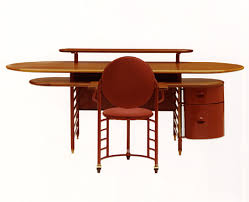
The desk with the three-legged chair:
2017-09-08 S C Johnson 31

The construction of the Johnson Wax Administration building created controversies for the architect.  In the Great Workroom, the lily pad columns are 9 inches in diameter at the bottom and 18 feet in diameter at the top.  This difference in diameter between the bottom and top of the column did not sit well with building officials in Racine; they deemed the pillar’s dimensions too slender at the base to support the weight.  Building officials were also not impressed that FLW held no license as an Architect…  So they required that a test column be built and loaded with twelve tons of material. The test column, once it was built, was not only tough enough to support the requested weight but FLW insisted that it be loaded with five-fold the weight. It took sixty tons of materials before the “calyx,” the part of the column that meets the lily pad, cracked.  The crashing of the 60 tons of materials to the ground damaged a water main 30 feet underground. After this demonstration, a vindicated FLW was given his building permit. (But not a license…)

Additionally, it was very difficult to properly seal the glass tubing of the clerestories and roof, thus causing leaks.  This problem was not solved until the company replaced the top layers of tubes with skylights of angled sheets of fiberglass and specially molded sheets of Plexiglas with painted dark lines to resemble in a ‘trompe l’oeil‘ of the original joints when viewed from the ground.  The glass tubes are still performing well today as “windows”, both in the Administration Building and in the Research Tower.

Finally, FLW’s chair design for Johnson Wax originally had only three legs, supposedly to encourage better posture (because one would have to keep both feet on the ground at all times to sit in it).  However, the chair design proved too unstable, tipping very easily. Herbert Johnson, wanting to keep the secretaries from falling out of their chairs, purportedly asked FLW to sit in one of the three-legged chairs and, after FLW fell from the chair, the architect agreed to design new chairs for with four legs; these chairs, and the other office furniture designed by Wright, are still in use to this day.

We were able to sit in the chairs, both the three- and four-legged versions.  We could also see the eight different versions of the desks, including swinging (not sliding) drawers, and built-in trash cans.

The ceiling between the lily pad columns are amazing, illuminating the space beautifully. The glass tubes are also used as “windows”, diffusing the light and offering a wonderful texture.  The caulking between the tubes failed early on, and it took 20 years of experimenting before they finally found a water-tight solution:  silicon sealants.

The curved glass tube “windows”:

2017-09-08 S C Johnson 03

2017-09-08 S C Johnson 02

Next on the tour is the Research Tower:

2017-09-08 S C Johnson 06

The Research Tower was a later addition to the complex, completed in 1950, and provides a vertical counterpoint to the horizontal administration building.  It is one of only 2 existing high rise buildings by Frank Lloyd Wright.  Cantilevered from a deep foundation and a small central core, the tower’s floor slabs spread out like tree branches, providing for the segmentation of departments vertically.  Elevator and stairway channels run up the core of the building.  The single reinforced central core, termed by Wright as a tap root, was based on an idea proposed by Wright for the (unbuilt) St. Mark’s Tower in 1929.  Wright recycled the tap root foundation in the Price Tower in Bartlesville, Oklahoma in 1952 (see my blog on the Price Tower).  Freed from peripheral supporting elements, the tower rises gracefully from a garden and three fountain pools that surround its base, while a spacious court on three sides provides ample parking for employees.

The tower has twice as many floors as it appears; every other floor in the square tower is circular, and these are mezzanines that do not contact the exterior walls.  You can see it in this photo during construction, and you can see the mezzanine levels through the glass tube “windows”.
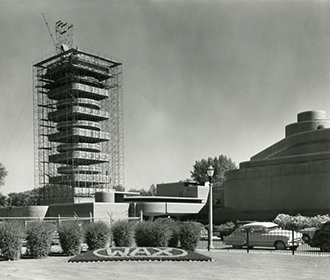
2017-09-08 S C Johnson 23

2017-09-08 S C Johnson 04

The Research Tower is no longer in use because of the change in fire safety codes (it has only one 29-inch wide twisting staircase), although the company is committed to preserving the tower as a symbol of its history.  In 2013, an extensive 12-month restoration was completed.  The research labs shown on the tour have been set up to appear frozen in time, including beakers, scales, centrifuges, archival photographs and letters about the building.

The final building on the tour was the Fortaleza Hall:

2017-09-08 S C Johnson 21

Fortaleza Hall’s construction marked the first major new construction at the company’s international headquarters since Frank Lloyd Wright first designed and developed the Administration Building and Great Workroom which opened in 1939 and the Research Tower which opened in 1950.  (The last new building to be brought to the campus was the Golden Rondelle in 1967.)

The new building offers visitors a chance to come together to learn more about the SC Johnson company and provides employees with a central place for company amenities.  The 60,000 square foot facility, which broke ground in September 2007, has two distinct sections: Fortaleza Hall, which provides historical context for the company and the advances that continue to take place through displays, memorabilia, and the Frank Lloyd Wright Library and Legacy Gallery; and a second part, The Commons, which offers employee services like dining, concierge services, company store, bank and fitness center in a comfortable environment.  Fortaleza Hall houses a full-size twin-engine S-38 amphibious plane suspended to simulate it in flight which can be viewed by all passers-by.

The building is a nice counterpoint to the FLW buildings. The brick matches the color of the grout in the bricks in the Research Tower and Administration Building.  The curves pay homage as well:

2017-09-08 S C Johnson 22

Inside are galleries telling of the five generations of Johnson family Presidents, the history of many of the Johnson Wax products, and, of special interest to us, a gallery full of models of FLW buildings.

It was a great experience to see these icons of 20th century architecture.  An interesting side note:  The “Great Workroom” contains restrooms only for women; the upper levels contain restrooms primarily for men, with a few small token restrooms for women.  The Research Tower has restrooms only for men…

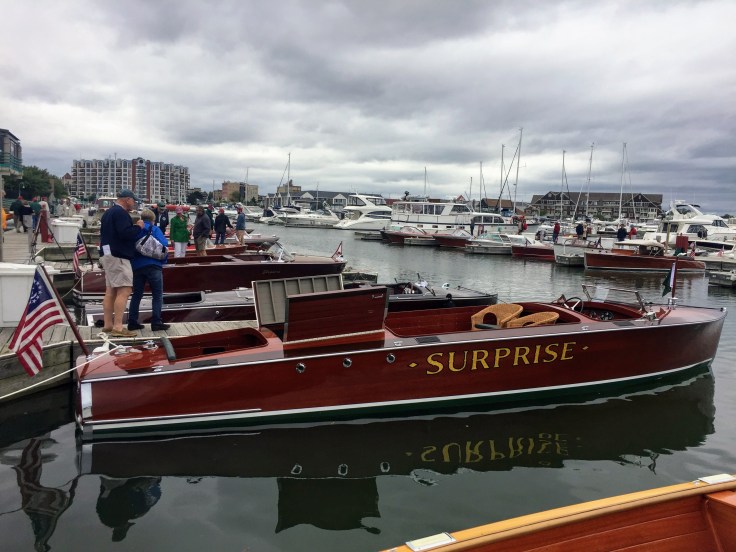
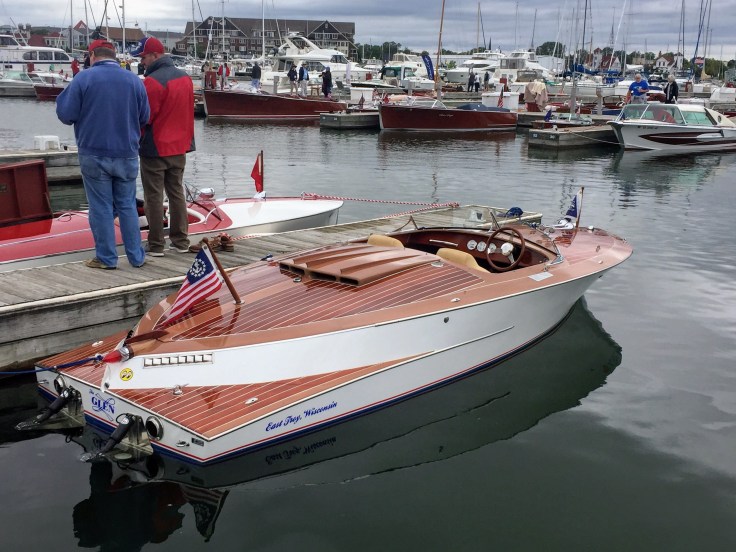
So we move on: Lunch!  We drove to downtown Racine and parked near the marina; we headed to the Reef Point Brew House.  But wait!  There is a Classic and Antique Boat Show going on!  We love old boats:
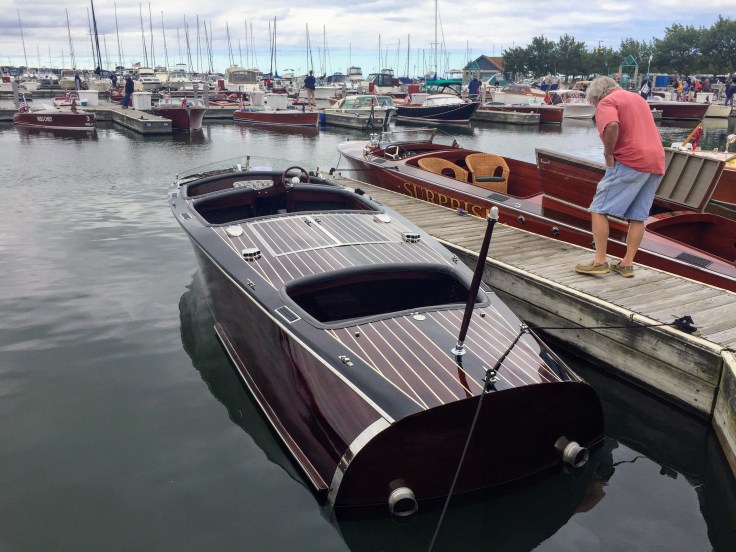
2017-09-08 Racine Boats 02

2017-09-08 Racine Boats 06

2017-09-08 Racine Boats 03

2017-09-08 Racine Boats 01

2017-09-08 Racine Boats 04

2017-09-08 Racine Boats 05

We saw several boats displaying this symbol for Glen L.  Glen L was a Naval Architect and small boat designer who, for over 60 years, operated from a really cool mid-century modern building in Bellflower, CA, where we used to live.  In fact, it is located directly behind out favorite Airstream Service Center, C&G.

I spoke with a man who was sitting on his Glen L boat.  He spoke highly of his designs; the Glen L boat pictured above was Glen’s last design; Glen died a few months ago, and his wife and daughter currently run the business.

When I was a kid, I loved Glen L boats, and I poured through his catalogs of plans and kits for hours on end.  I still have some of those catalogs today.  This is the boat I always wanted to build and own:

2017-09-08 Glen L

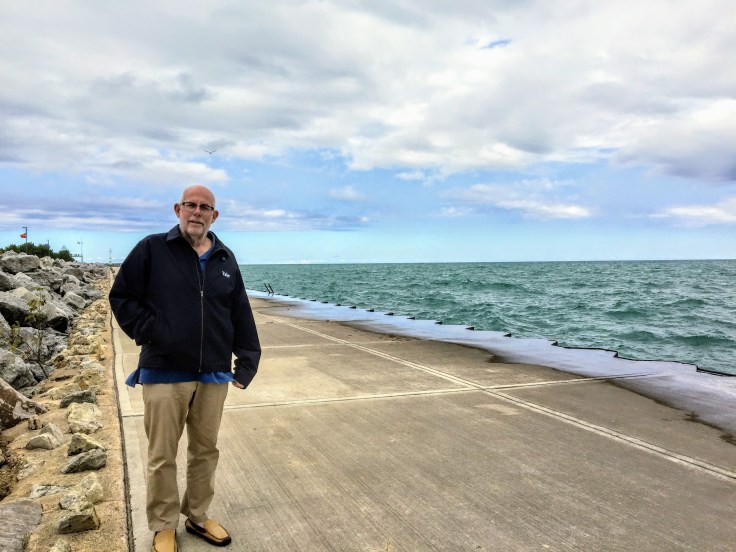
After lunch we checked out the views of Lake Michigan; we now have seen all five Great Lakes on this Odyssey!

2017-09-08 Racine Lake Michigan 02

2017-09-08 Racine Lake Michigan 01

2017-09-08 Racine Lake Michigan 03

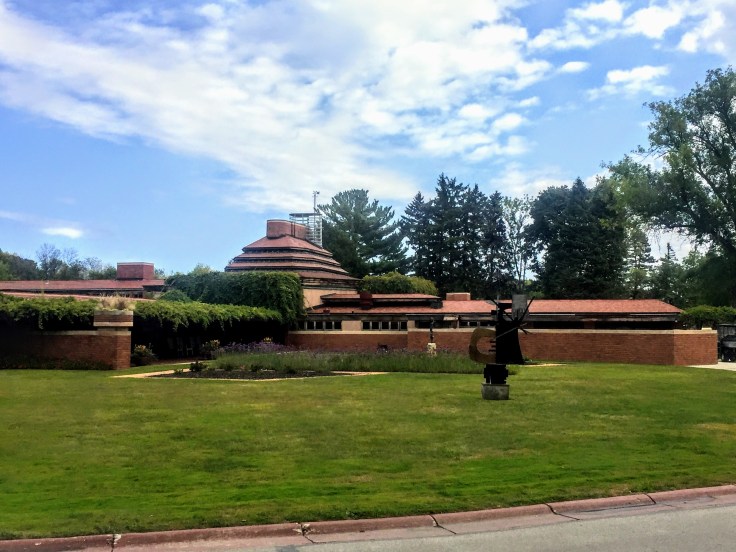
We continued on our journey; we drove a few miles north to see Wingspread:
2017-09-08 Wingspread 08

Wingspread was built in 1939 and was designed by, of course, Frank Lloyd Wright for Herbert Fisk Johnson Jr., then the president of S.C. Johnson.  It was considered by FLK to be one of his most elaborate house designs. If fact, it is the largest home designed by FLW.  The property is now a conference center operated by The Johnson Foundation.  Note that it was designed and built at the same time as Fallingwater.

Wingspread is located near the center of the Wind Point peninsula, a triangular protrusion into Lake Michigan north of the city of Racine.  The approximately 12 acres of landscaped grounds form an integral part of the architectural experience, having a landscaping plan also developed by FLW in emulation of a prairie setting.  The house is approached from the north by a long winding drive.  The house consists of a central hub, from which four long arms radiate.  Each of the wings house a different function: parents’ wing, children’s wing, service wing, and guest wing, with the public spaces in the center.  The hub appears as a domed structure, with clerestory windows on the sides, and a viewing platform (“Crow’s Nest”) at the top.

The tour was mostly self-directed; we were given a floor plan and we were free to wander at will.  (We were not allowed into the kitchen area or into the guest and servants’ wings…)

The approach to the entry:

2017-09-08 Wingspread 01

The entry:

2017-09-08 Wingspread 33

2017-09-08 Wingspread 29

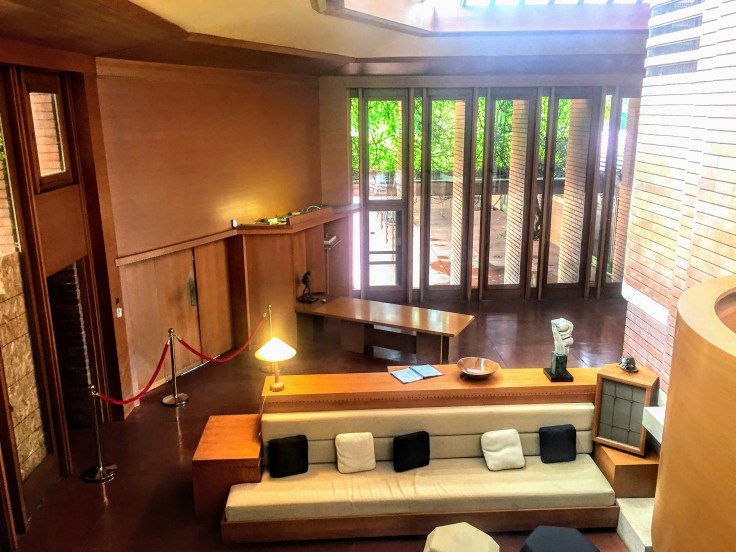
The central core contains lounging areas, office areas, and the dining area:
2017-09-08 Wingspread 16

See the dining table above: it was designed to slide back into the butler pantry, so that dishes could be cleared and new courses of food could be placed, then it would slide back out to where the people were sitting… They used it this way once.  Apparently it was was awkward for the dinner guests to be sitting there in their chairs without the dining table between them…

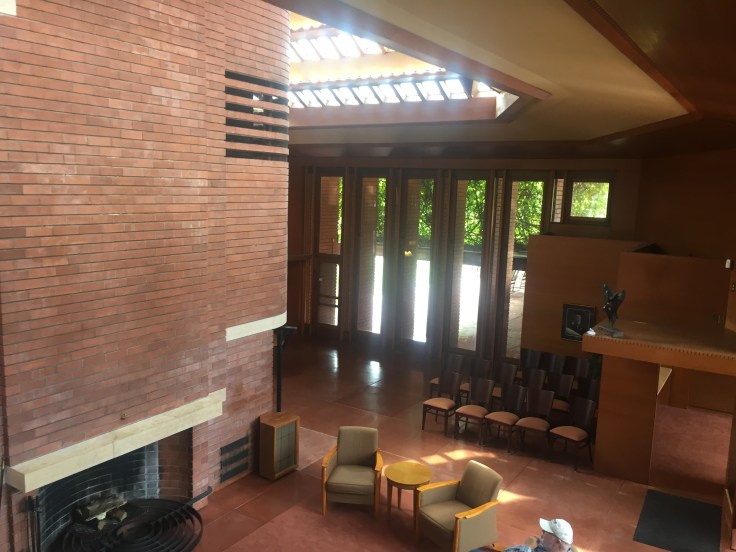
More living spaces:
2017-09-08 Wingspread 20

2017-09-08 Wingspread 04

2017-09-08 Wingspread 02

The Study:

2017-09-08 Wingspread 14

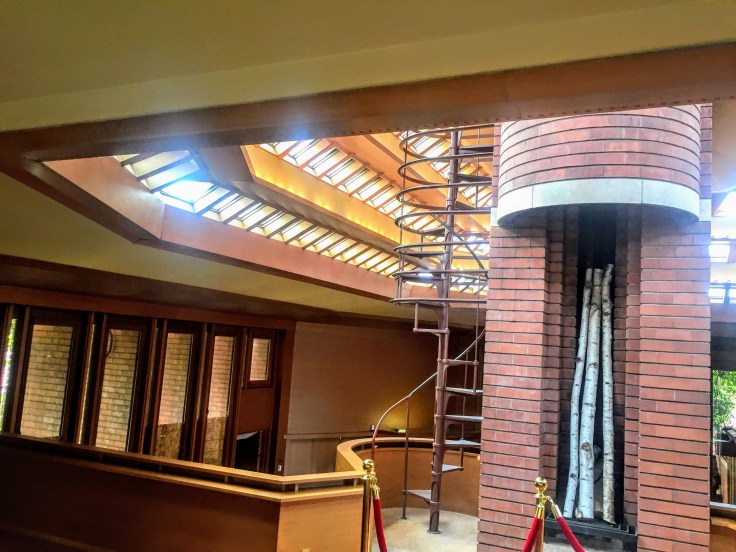
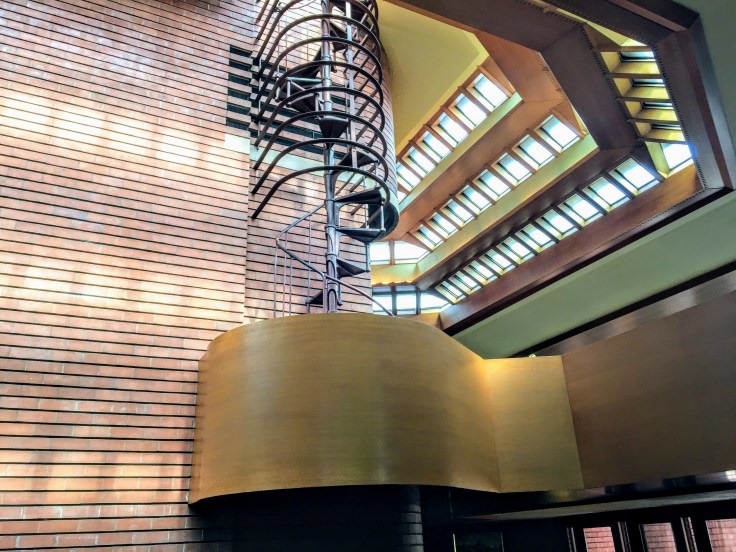
The spiral staircase to the “Crow’s Nest”:
2017-09-08 Wingspread 03

2017-09-08 Wingspread 13

I was able to climb to the top:

Lynda took a picture from below:

2017-09-08 Wingspread 07

The Master Bedroom wing:

2017-09-08 Wingspread 25

2017-09-08 Wingspread 23

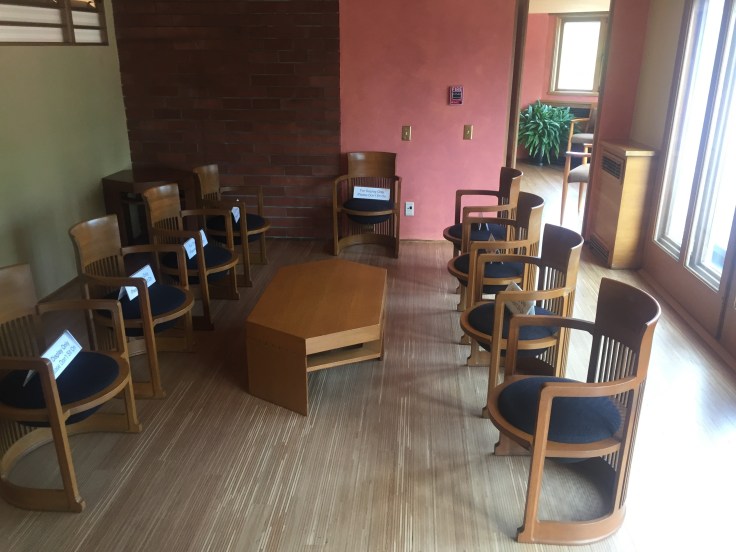
More FLW barrel chairs:

2017-09-08 Wingspread 21

The mezzanine:

2017-09-08 Wingspread 15

The vertical fireplace (above) is a neat feature; apparently, when these 8′ logs burn, and the bottom ends burn away, the burning logs fall into the room.  It was used once…

Looking down at the staircase:

2017-09-08 Wingspread 28

The pergola and terrace:

2017-09-08 Wingspread 34

The wood on the exterior is cypress; it was left unfinished to age naturally.  It has. Maybe it is time to reconsider that decision…

The construction was overseen by a young John Lautner.  John Lautner subsequently moved to southern California and built many extraordinary houses there.  The house was the last of Wright’s Prairie School inspired designs.

There are several interesting stories about this house.  Sadly, Mrs. Johnson died unexpectedly during the early stages of construction.  Mr. Johnson, however, did carry forward and complete the house.  Mr. Johnson subsequently remarried and the new wife did not like the house.  She added floral draperies throughout the house, and removed the FLW-designed furniture and brought in her own overstuffed furniture. She removed the modern art and brought in her own traditional artworks.

OA few years later, Frank Lloyd Wright was an overnight guest.  Always an early riser, he removed all of the offending furniture, draperies, and artwork, and re-installed his own, which he found in the storage rooms of the house.  When Mrs. Johnson came down and saw what he had done, she ordered him to leave the house, which he did in a haughty manner.  He never returned.

The Johnsons built a new house on the property more to Mrs Johnson’s liking:

2017-09-08 Wingspread 41

The other story, which, while it may be apocryphal, just might not be true:  The skylights leaked.  From day one.  (This part is true…)  One evening, when the Johnsons were entertaining several influential people from the area, it started to rain.  The skylights leaked.  The water dripped directly onto Mr. Johnson’s bald head.  Obviously annoyed, he asked the maid to bring the telephone to the table.  He called FLW at Taliesin.  He said, “Mr. Wright, your skylights are leaking again, right on top of me where I sit at dinner. What do you propose I do?”  FLW is purported to have said, “Well, why don’t you move your chair?”

The Johnson family donated the property to The Johnson Foundation in 1959 as an international educational conference facility.

It is quite a house, but obviously it has its flaws.  It is certainly a glimpse of how the upper classes lived in those days, at least the upper classes who did not want to live in a gilded age mansion…

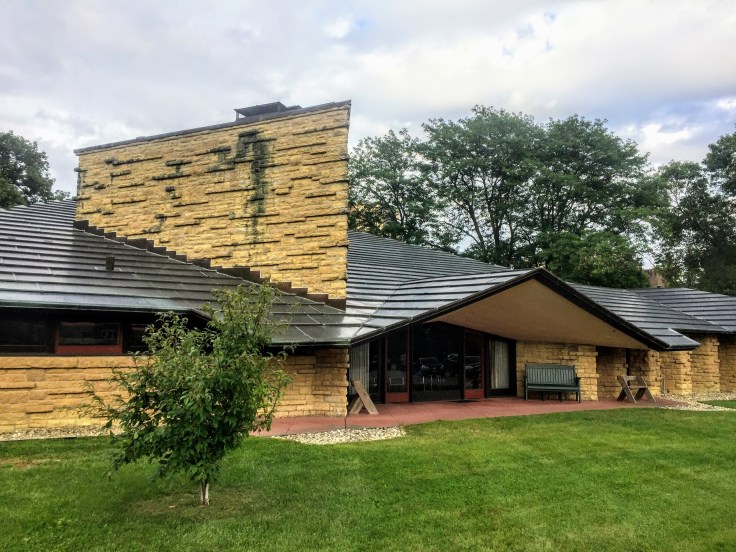
We headed back towards Madison, with one more FLW building to see:  The Unity Temple (officially known as the First Unitarian Meeting House.

We were unable to see inside; but the outside is pretty impressive:
2017-09-08 Unity Temple 05

2017-09-08 Unity Temple 01

2017-09-08 Unity Temple 04

2017-09-08 Unity Temple 02

2017-09-08 Unity Temple 03

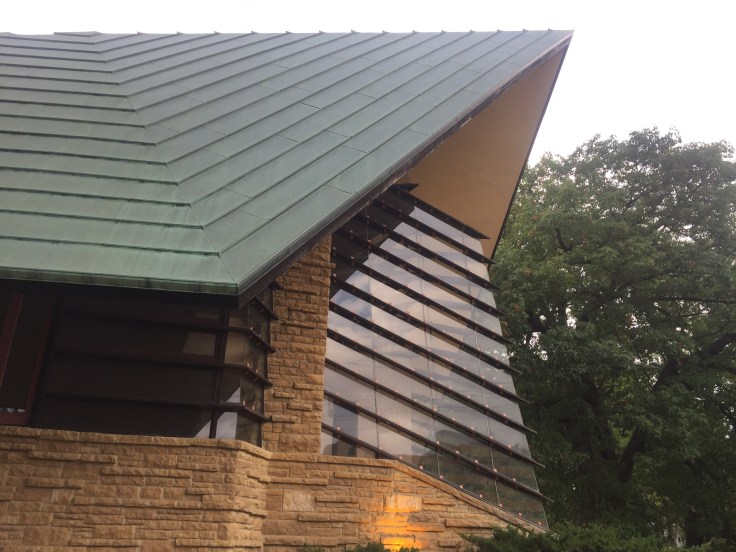
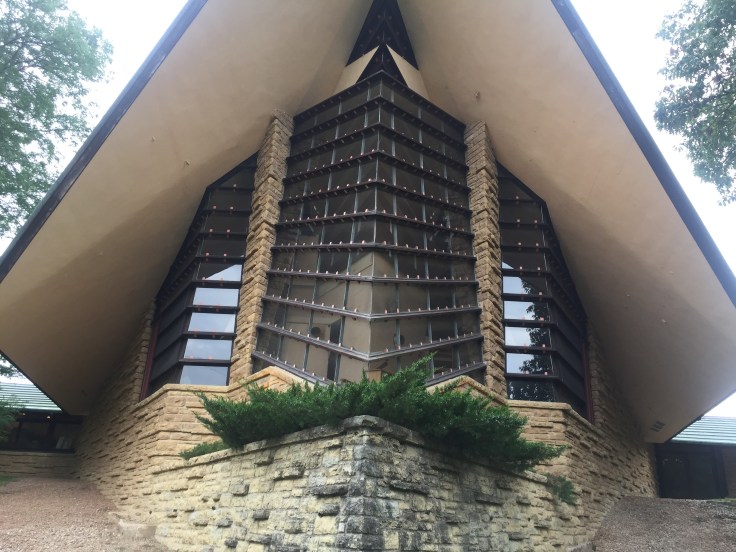
The First Unitarian Meeting House was designed by Frank Lloyd Wright, one of its members and the son of two of its founders.  FLW was commissioned to design the Meeting House in 1946.  Construction began in 1949 and was completed in 1951.  The FLW design is characterized by its prow-like roof, covered with a blue-green standing seam copper, set with a combination of vertical and horizontal seams to emphasize the roof’s shape. 

The church building is recognized as one of the most innovative examples of church architecture.  In 1960, the American Institute of Architects designated it one of 17 buildings to be retained as an example of FLW’s contribution to American culture.  The Meeting House was placed on the National Register of Historic Places in 1973, before the traditional 50-year minimum age for historic buildings. 

So we were sated, for the day.  We stay in a cheap motel tonight, and head back “home” to Thunder Bay tomorrow.  An enjoyable time was had by all…


2017-09-07 Westbound; Stranded, but escaped from, Thunder Bay, Day 7…

We relaxed a bit this morning… We ate breakfast in the hotel restaurant, the Break of Day.  We readied ourselves for a day of the ridiculous and the sublime: we will see House on the Rock and Taliesin.  The House on the Rock is an absurd tourist attraction; Taliesin is the home and studio and school of Frank Lloyd Wright.

The House on the Rock’s “Infinity Room”, as seen from the road:

2017-09-07 House on the Rock 05

The House on the Rock was the first on our schedule.  It was started in 1945 as a house built atop a 70′ x 200′ rock that was 60′ tall, set in the Wisconsin countryside.  The house was the idea of one man, Alex Jordan, who clearly had a mind of his own.  The house contains many extremely awkward spaces, with bad lighting, too low ceilings, and uneven floors and steps.  It is not so much a house as it is a series of spaces left over after he built stone walls, windows, and doors.  Later, Jordan added a Gate House and a Mill House.  Then he added a giant cantilevered “Infinity Room” for no apparent reason.  The Infinity Room spans about 60′ to the adjacent rock, then cantilevers another 140′, all about 250 feet above the forest floor below…   After that things got weird.  Today there is a HUGE metal box of a warehouse that contains acres and acres of crap, plus a few interesting antiques and music machines.  It is an absurd collection of collections that serve no purpose whatsoever.  Spending three hours here was a giant waste of time.

The Infinity Room:

2017-09-07 House on the Rock 01

2017-09-07 House on the Rock 02

The “Glass Coffee table” at the end of the Infinity Room:

2017-09-07 House on the Rock 03

2017-09-07 House on the Rock 04

The Infinity Room creaks and groans when two – three people walk out there; I would not want to be there with 200 people…

There were a few things that were of moderate interest…

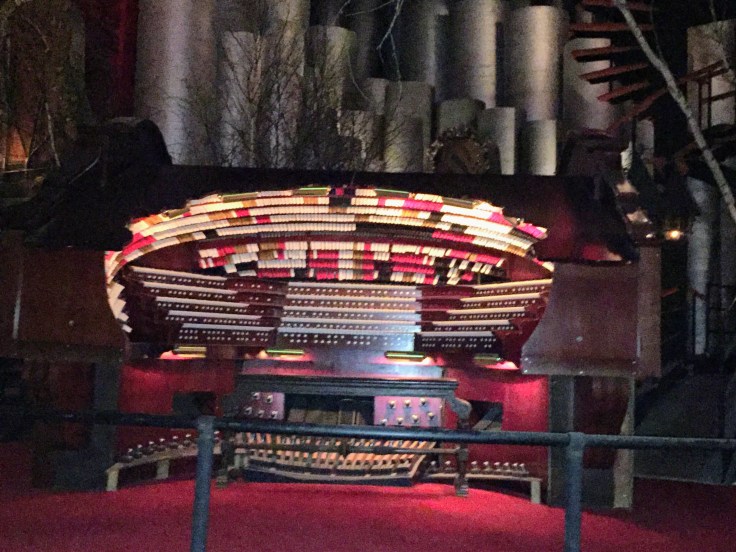
A beautiful pipe organ console:

2017-09-07 House on the Rock 08

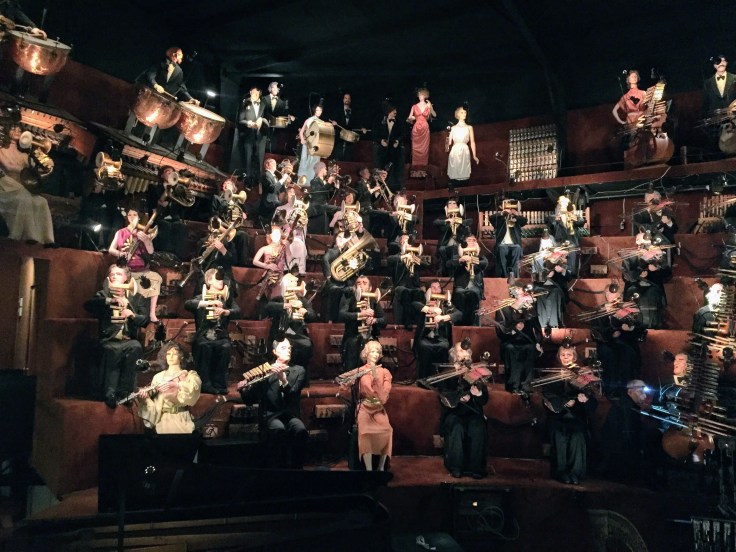
A music machine:

2017-09-07 House on the Rock 09

There are several (many?) music machines, some large, like this one, and some smaller. These are mechanical devises that play musical instruments much like a player piano. This one is a complete orchestra.  It is amazing to watch and listen to, but I have to ask, “Why?”

There was even a Rockefeller moment:  In one of the maritime displays there is a note about this whaling ship, the Charles W. Morgan.  As you can see by reading the notes, the whaling industry was put out of business by John D. Rockefeller and the petroleum industry…

2017-09-07 House on the Rock 07

By the time we left the House on the Rock my eyes hurt.  The green countryside of Wisconsin was very soothing.  We found the Wyoming Valley Cultural Center, designed by Frank Lloyd Wright as a memorial to his mother:

2017-09-07 FLW Wyoming Valley Cultural Center 02

2017-09-07 FLW Wyoming Valley Cultural Center 01

We eventually found “downtown” Spring Green and we found a lovely bookstore with its own cafe.  After lunch we walked through the town; note that I am standing in the middle of the street at about 1:00 pm:

2017-09-07 Spring Green

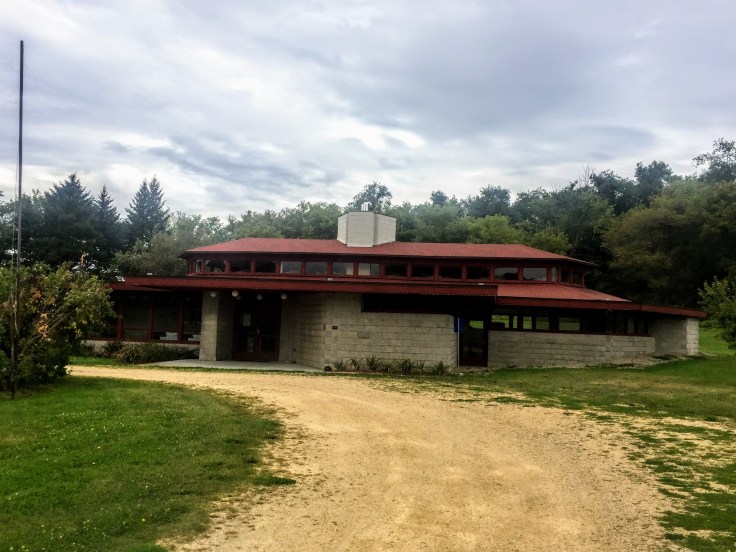
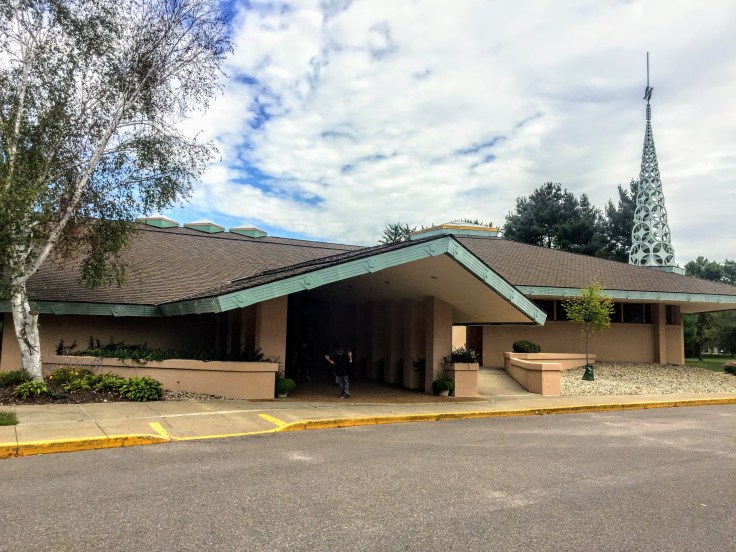
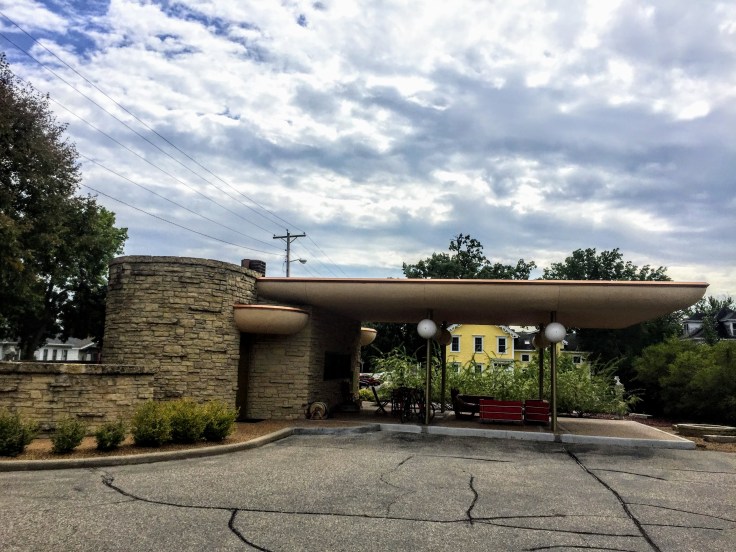
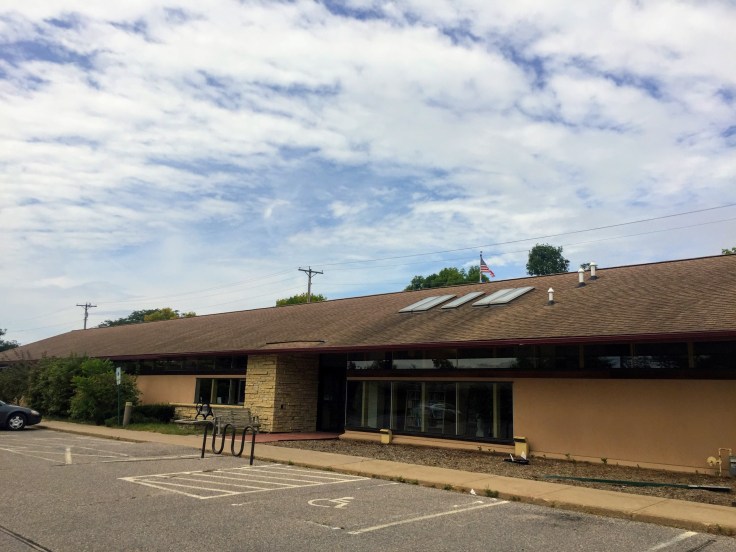
We walked around and found several buildings that had been designed by William Wesley Peters, a Taliesin associate and past student of FLW.  They were very interesting:

St. John the Evangelist Catholic Church:

2017-09-07 Cathlic Church 01

2017-09-07 Cathlic Church 02

2017-09-07 Cathlic Church 03

Originally a drive-through bank, this is now a private residence:

2017-09-07 Bank-turned Residence 102

2017-09-07 Bank-turned Residence 101

BMO Bank Building:

2017-09-07 BMO

Originally a medical office, this is now a private residence:

2017-09-07 Medical Office-turned Residence 01

Another Taliesin Associate, James Charles Montooth, designed the Spring Green Community Library:

2017-09-07 Library

After this fun walk it was time for the main event; we drove to the Taliesin Visitors Center:

2017-09-07 FLW Taliesin Visitors Center 02

2017-09-07 FLW Taliesin Visitors Center 03

2017-09-07 FLW Taliesin Visitors Center 01

This building was originally designed by FLW as a restaurant and conference center. Today it is the visitor’s center, but it still includes the restaurant, plus the offices of the Frank Lloyd Wright Foundation, which owns the building and Taliesin itself.

Taliesin has quite a storied past.  FLW’s maternal grandparents and many aunts and uncles farmed in this valley near Spring Green; FLW spent most of the summers of his youth here, working along side his cousins on the various farms.  So it was only natural that he kept returning to this area throughout his life.

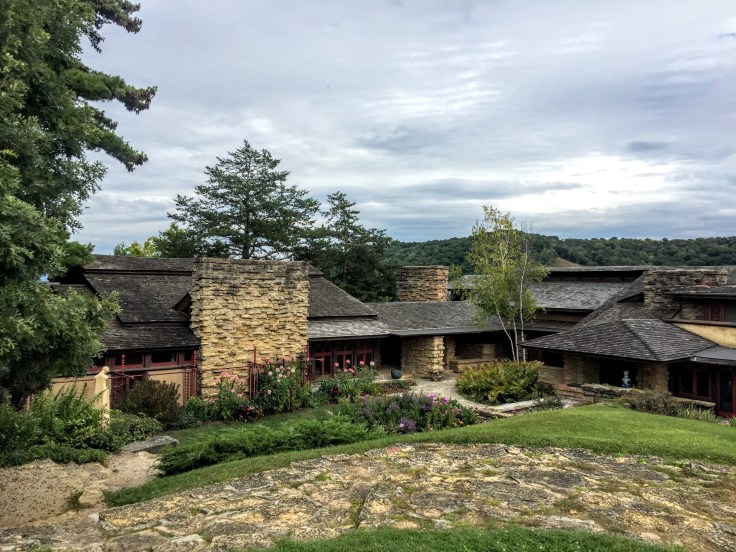
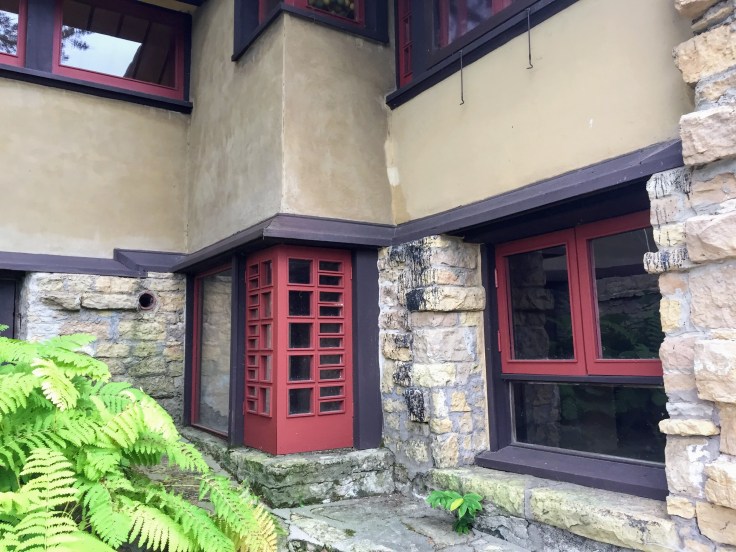
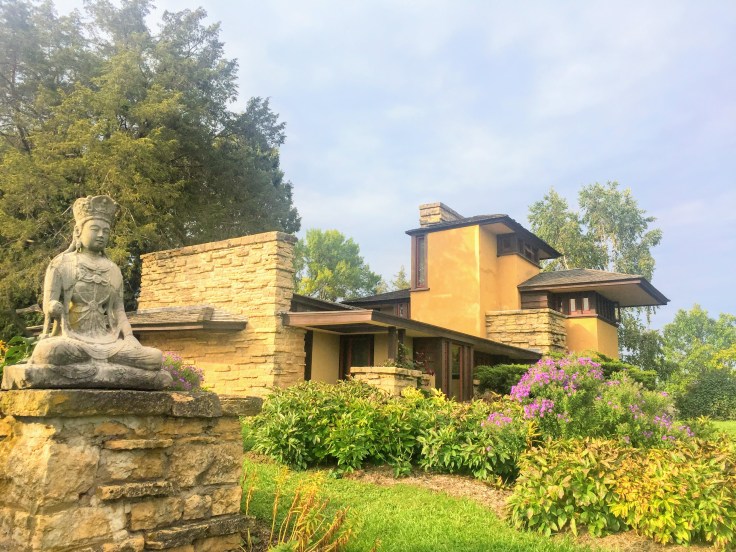
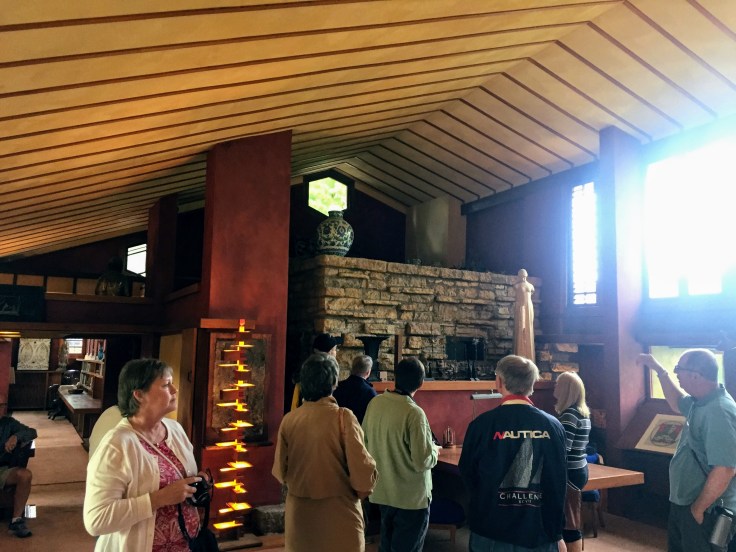
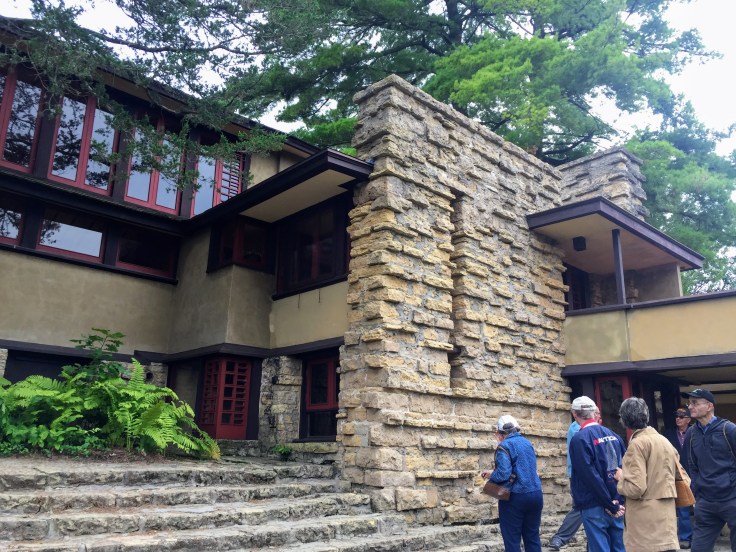
FLW had a successful and thriving practice in Oak Park, IL, having built over 50 buildings there.  But in 1909 he abandoned his wife and six children and fled with his mistress to Germany.  When he returned two years later he found he was not welcomed back to Oak Park, so he retreated to the family property near Spring Green.  Here FLW designed and built Taliesin I.  The design of the original building was consistent with the design principles of the Prairie School, emulating the flatness of the plains and the natural limestone outcroppings of Wisconsin’s Driftless Area.  The structure included his home, an agricultural wing containing stables, chicken coops, and a pig shelter, plus his architectural studio.

In 1914, while FLW was away, a disgruntled employee set fire to the living quarters and murdered FLW’s mistress, her two children, and three others.  FLW rebuilt the residential wing  and remodeled the other areas.

Taliesin II was used only sparingly by FLW as he worked on projects abroad.  He returned to the house in 1922 following completion of the Imperial Hotel in Tokyo.  A fire caused by electrical problems destroyed the living quarters again in April, 1925. Taliesin III was constructed by Wright by late 1925.  During the late 1920s and the 1930s FLW turned the agricultural wing into studios, a large drafting room, and dormitories, as he began the Taliesin School of Architecture.

Taliesin III was FLW’s home for the rest of his life, although he began to winter at Taliesin West in Scottsdale, Arizona, upon its completion in 1937. Many of Wright’s acclaimed buildings were designed here, including Fallingwater“Jacobs I”  the Johnson Wax Headquarters, and the Solomon R. Guggenheim Museum.  Wright was also an avid collector of Asian art and used Taliesin as a storehouse and private museum.

So it is Taliesin III that we tour today.  A shuttle bus takes us from the visitor’s center. We follow roughly the path taken by horse-drawn carriages when the house was first built. We walk through the meadow, past the orchard and the vineyards and arrive at the courtyard surrounded by the residence, the studio, and the former agricultural wing.

As seen from the highway below:

2017-09-07 FLW Taliesin 34

From the top of the hill, into which the house is nestled:

2017-09-07 FLW Taliesin 02

The prominent hip-roofed wing seen above was originally the porte cochere in the days of horses and carriages… In Taliesin III the entry was moved to the opposite side of the house to accommodate automobiles, and the porte cochere was enclosed:

2017-09-07 FLW Taliesin 32

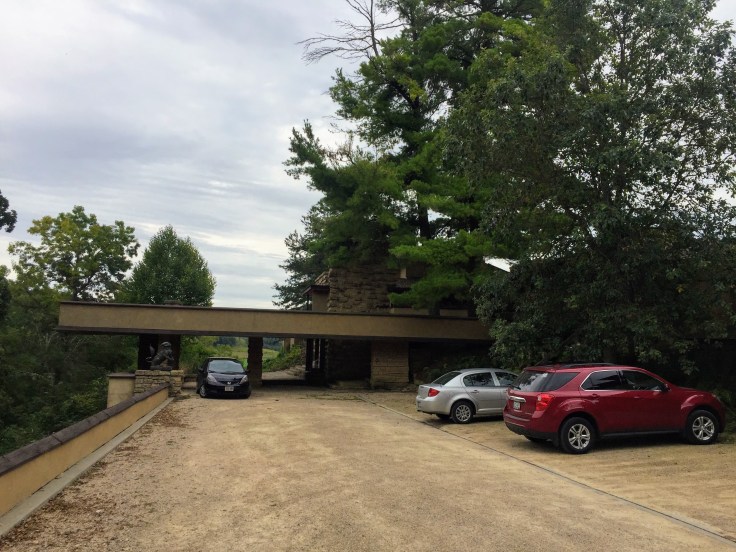
The carports – formerly horse stalls:

2017-09-07 FLW Taliesin 05

Courtyard and path to the agricultural wings, now used by the school:

2017-09-07 FLW Taliesin 29

2017-09-07 FLW Taliesin 31

2017-09-07 FLW Taliesin 30

Part of the agricultural wing:

2017-09-07 FLW Taliesin 25

Conference Room in the Studio:

2017-09-07 FLW Taliesin 27

2017-09-07 FLW Taliesin 14

Architectural Studio:

2017-09-07 FLW Taliesin 12

My favorite floor lamp:

2017-09-07 FLW Taliesin 13

Automobile approach to the house today:

2017-09-07 FLW Taliesin 08

Approach to the hidden front door:

2017-09-07 FLW Taliesin 09

2017-09-07 FLW Taliesin 10

2017-09-07 FLW Taliesin 11

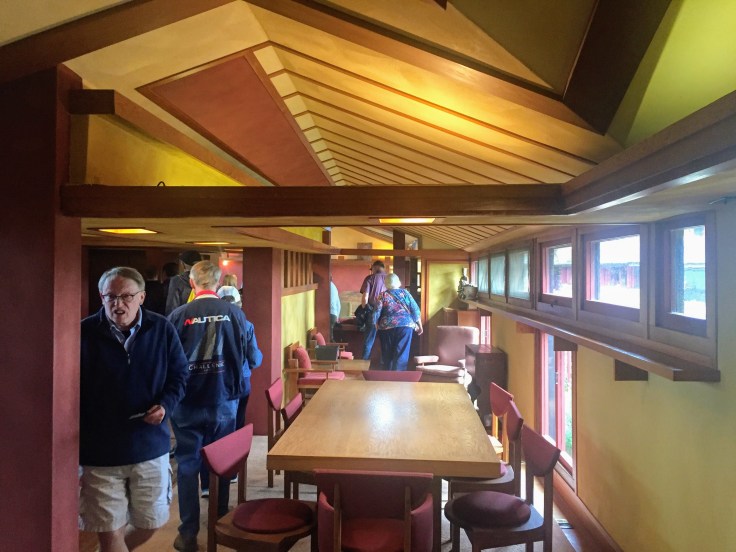
Dining Room, with the famous barrel chairs:

2017-09-07 FLW Taliesin 26

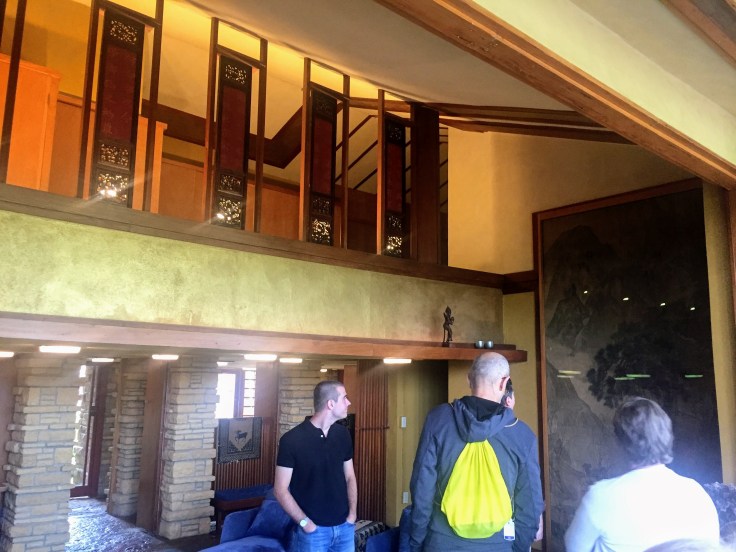
Informal Living Room:

2017-09-07 FLW Taliesin 18

X-back chair FLW designed for his son, David:

2017-09-07 FLW Taliesin 19

The “Bird Walk”, added for FLW’s 3rd wife:

2017-09-07 FLW Taliesin 15

2017-09-07 FLW Taliesin 17

2017-09-07 FLW Taliesin 16

Master Bedroom Suite:

2017-09-07 FLW Taliesin 20

FLW’s study:

2017-09-07 FLW Taliesin 23

FLW’s bed, in his study; like many creative geniuses, FLK only slept about 4 hours per night and often worked late and arose early and went back to work again:

2017-09-07 FLW Taliesin 21

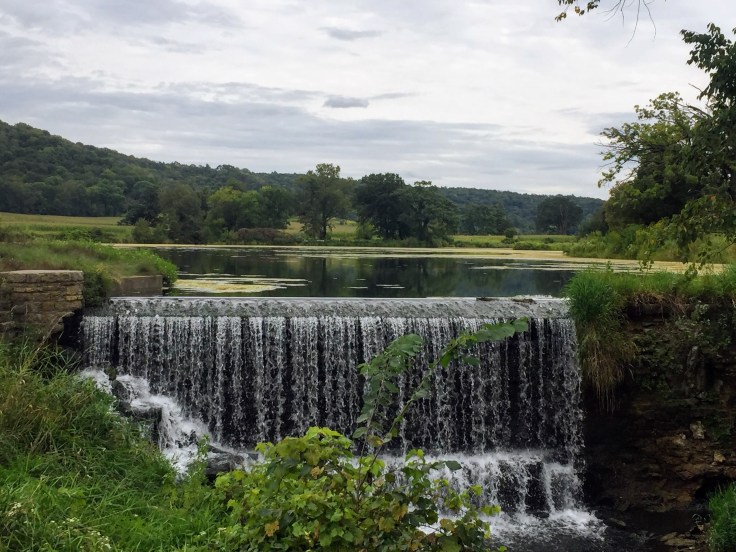
The waterfall at the approach to the house, below the hill; I was here in March about 10 years ago.  Of course, Taliesin was closed for the winter – everyone goes to Scottsdale to Taliesin West in the winter.  It was about 15 degrees, everything was covered with snow, and the lake and the waterfall were frozen solid.  But, back about 15′ from the edge of the waterfall, there was a guy sitting on a chair, on the ice, fishing…

2017-09-07 FLW Taliesin 01

The property today appears to be in need of major repairs.  However, the design and detailing and thought that FLW put into these rooms and spaces is awe inspiring.  FLW never thought of Taliesin as a permanent structure, but a “sketch” for his ideas.  Keeping the house “pristine” is a monumental task, because it wasn’t built perfectly in the first place.  FLW would get an idea, say, to enclose a covered porch into a sun room, and he would call his students, tell them what he wanted, send a few sketches, and they would build it.  It was not built to museum standards, and will probably always suffer for it.

After the tour we drove to the nearby Lloyd-Jones family chapel and cemetery. The chapel was not designed by FLW, but by his early employer,  Joseph Lyman Silsbee.  FLW was assigned to “supervise” the construction as part of his duties for Silsbee.

2017-09-07 FLW Cemetary 03

There is a gravestone for FLW and his six children from his first marriage, although none of them is buried here…

2017-09-07 FLW Cemetary 02

2017-09-07 FLW Cemetary 01

Lloyd Wright, actually Frank Lloyd Wright, Jr. became an architect and was a fine architect in his own “Wright”… (A little architectural humor…)  I met him at his house in 1972 in West Hollywood.  His son, Eric Wright, is also an architect in SoCal; he tends to specialize in historic structures and environmental issues…

John Wright invented Lincoln Logs.  ‘Nuff said…

David was the recipient of FLW’s design of the X-back chair, seen above…

Catherine was the mother of the actress Anne Baxter…

So after a long day we headed back to the Red Barn Lodge for a short rest, then we went into Spring Green again for dinner at Freddy Valentines.

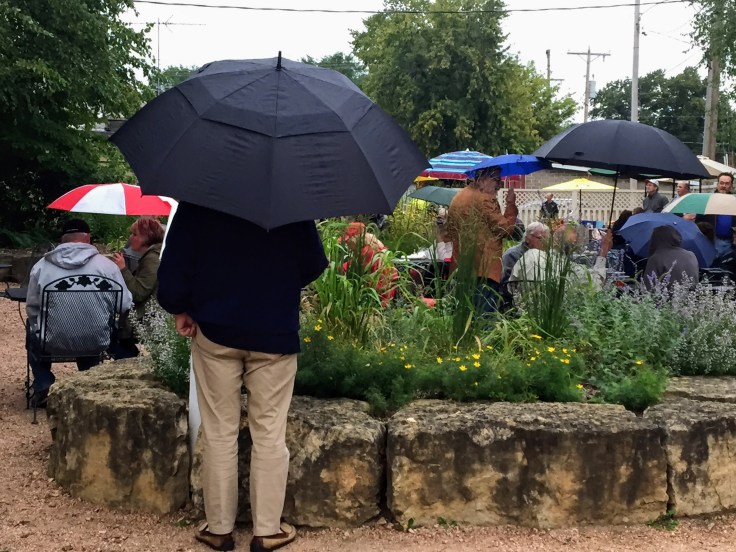
It’s a good thing we opted NOT to go to The Shed: They have live music in their courtyard on Thursdays… but tonight it rained…

2017-09-07 Spring Green The Shed 01

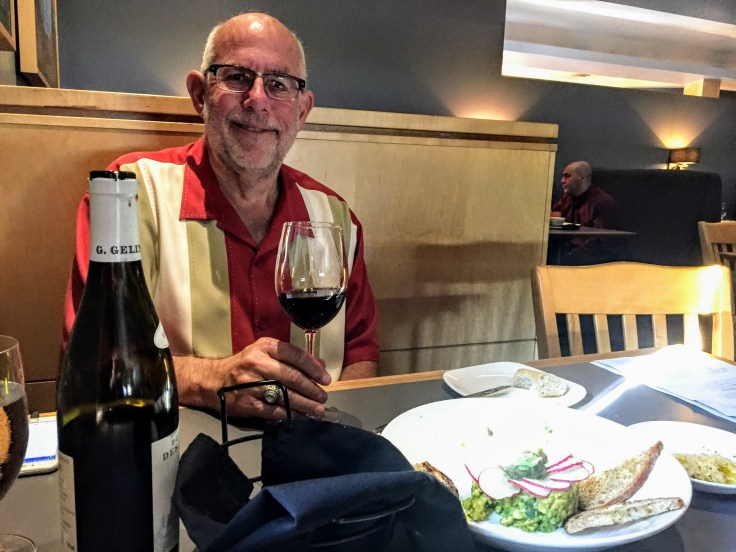
We love to try local foods and wines; we’ve had Maine wine, Nova Scotia wine, Prince Edward Island wine, Niagara Falls wine, and Ontario wine.  But tonight we spotted a California Pinot Noir from the Russian River Valley on the menu.  We were in heaven!

And an enjoyable time was had by all.


2017-09-03 Westbound; Stranded in Thunder Bay, Day 3…

It is Sunday… Guess what Thunder Bay has that most other cities in North America do not?

2017-09-03 Thunder Bay CRC 02

Yes! A Christian Reformed Church!

2017-09-03 Thunder Bay CRC 01

Lynda and I were raised in the Christian Reformed Church. We went to a CRC High School and we were married in a CRC church, and our children were baptized in a CRC church.  (There is no CRC church in Irvine, so we are now Presbyterians…)

So it was fun to attend a CRC church while on our trip.  This church is tiny.  Maybe 35 people in attendance.  They did have a good piano player, but the power-point operator could not find the file for today’s service, which, of course, contained the words to all the songs we were to sing.  So we had a good old-fashioned “hymn-sing”.  We pulled out the gray 1987 Psalter Hymnal (which we all hated when it replaced the “old” blue Psalter Hymnal, which we all hated when it replaced the old red Psalter Hymnal…) and people called out the number of their favorite hymn.  Some of these songs we haven’t sung in years, and most churches we have attended over the past 25 years have not used the Hymnals, projecting the lyrics onto a screen instead…

Also, this church has no pastor.  So the sermon was a video pre-recorded, maybe by the pastor from the other CRC here in Thunder Bay…

Anyway, it was a good service.  We had coffee in the fellowship hall after and met a few locals.  Then it was time to go.

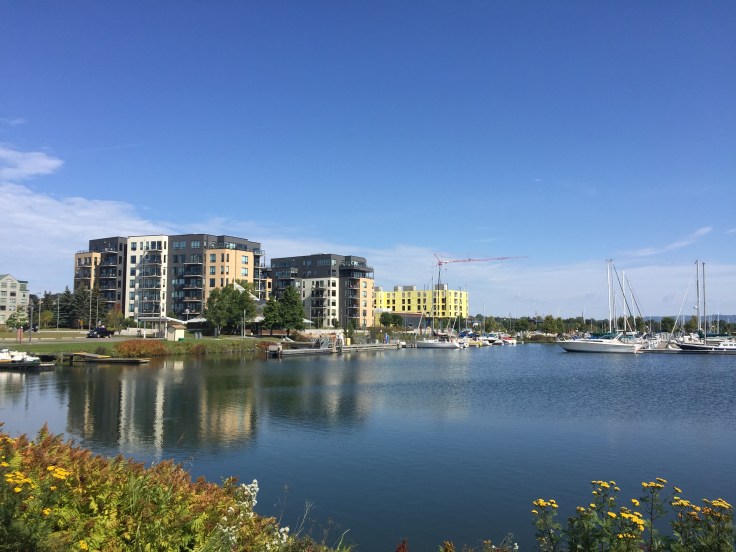
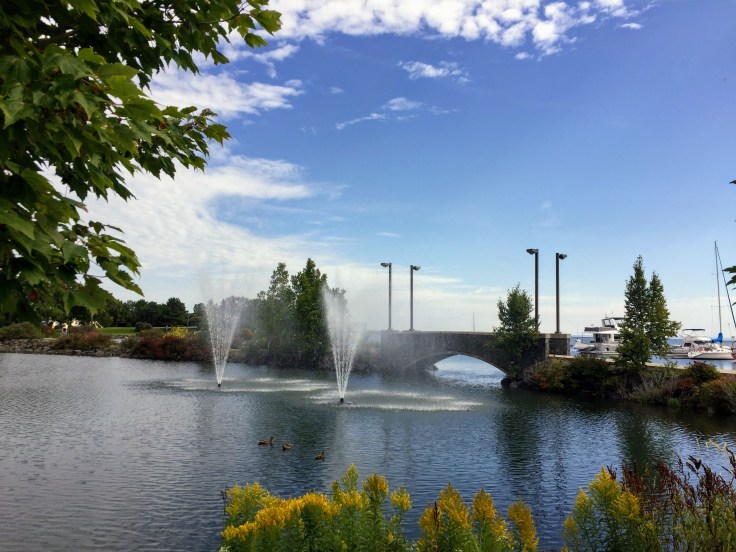
We took the advice of the staff at Bistro One and drove over to the marina. Thunder Bay is remaking their formerly industrial waterfront into a very pleasant people-friendly place.  There is a pedestrian bridge spanning the railroad tracks, connecting the waterfront to the historic downtown; there are two new apartment/condo towers, a hotel and retail center is under construction, a new restaurant is open, the marina is bustling, and there is a very large park with walking trails along the water.  We had a pleasant walk, enjoying the clear skies and sunny weather.

2017-09-03 Marina 01

2017-09-03 Marina 04

We had lunch at Bight, a very nice contemporary restaurant, again, recommended by the staff at Bistro One.  Steak Tatare!  Need I say more?

2017-09-03 Bight 02

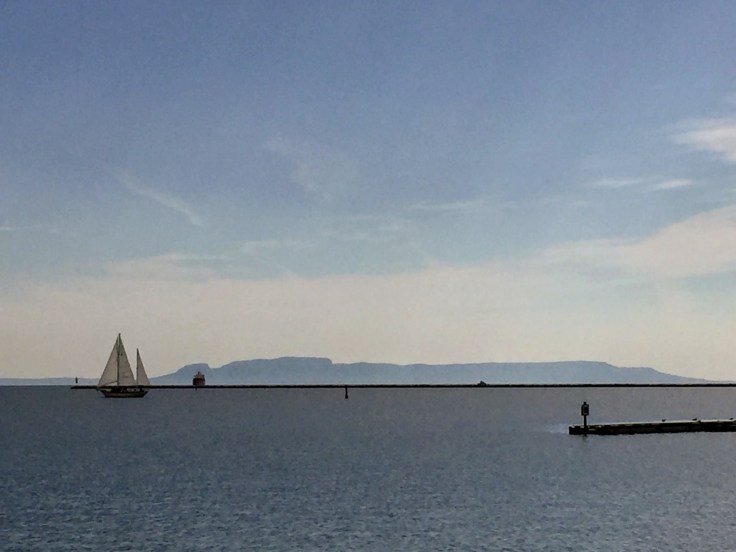
We also had another view of the Sleeping Giant:

2017-09-03 Marina 05

We returned to the Villa and had a quiet afternoon.  The weather was nice. We walked around the dealership, but after 1 1/2 laps it started to sprinkle and the wind started to blow; we made it back to the Villa just as the thunderstorm hit, dumping huge amounts of rain amid much thunder and lightning.  It lasted about 45 minutes…

The weather was nice. We walked around the dealership, but after 1 1/2 laps it started to sprinkle and the wind started to blow; we made it back to the Villa just as the thunderstorm hit, dumping huge amounts of rain amid much thunder and lightning.  It lasted about 45 minutes…

No, I didn’t type this paragraph twice by mistake – it really did happen twice, just like this… They didn’t name this place Thunder Bay by accident.

Happy Hours ensued.  Just because we are stranded doesn’t mean we don’t need happy hours…

A not-too-awful time was had by all…


2017-08-19 Westbound; Montreal Old City

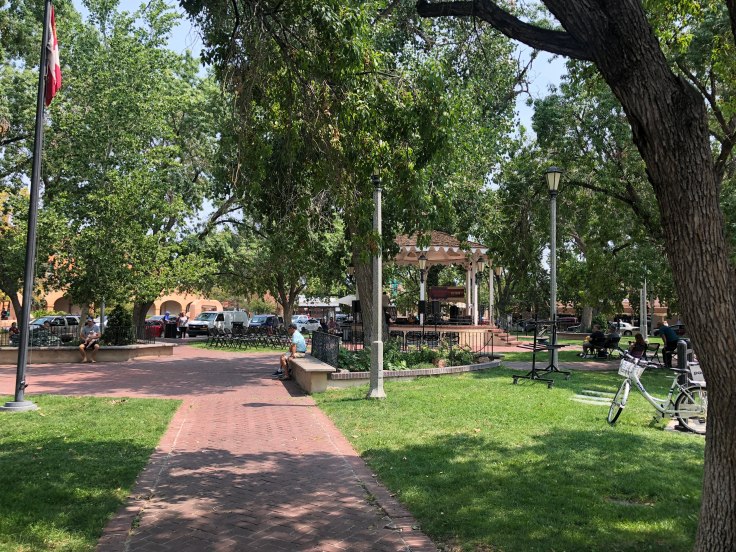
Today we go in to see the old city of Montreal. While this RV park did not offer a shuttle into the city, they did tell us how to take a city bus. The station was about a two mile drive from the RV park; we then boarded a bus and 20 minutes later we were in Montreal.

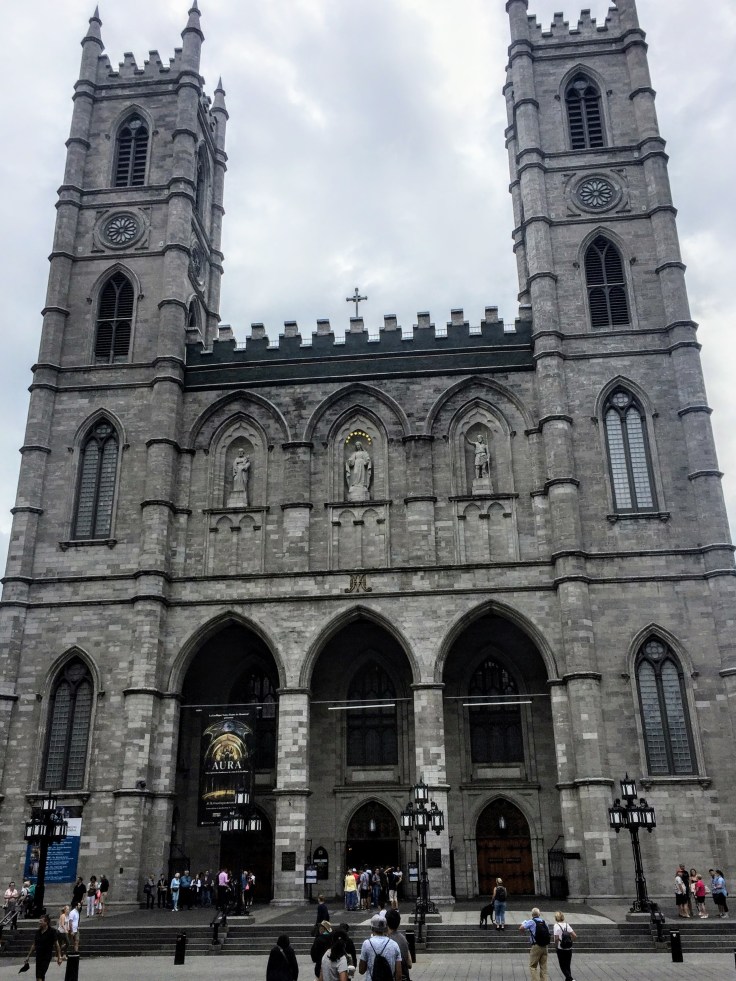
After a short walk we were in the old city and were at the plaza in front of the Basilica de Notre Dame:


2017-08-19 Montreal 18 Bassilica

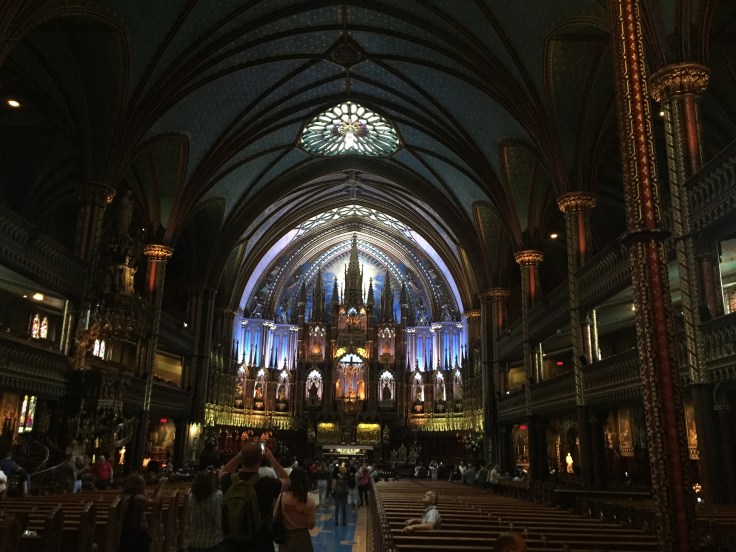
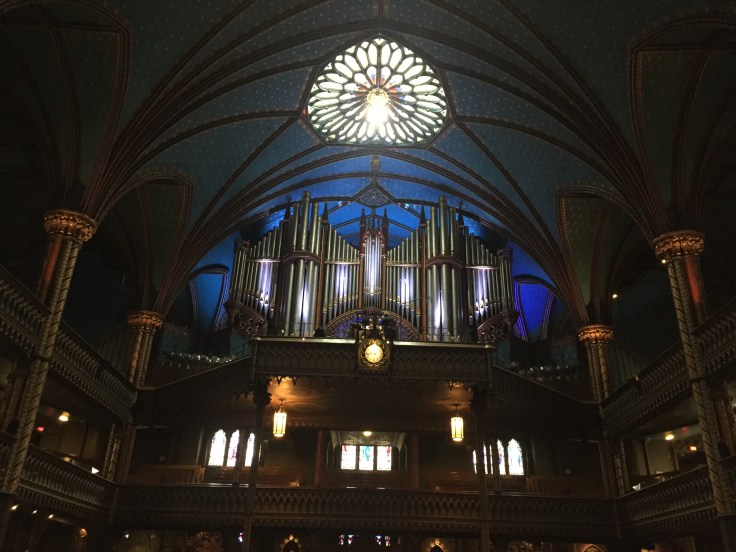
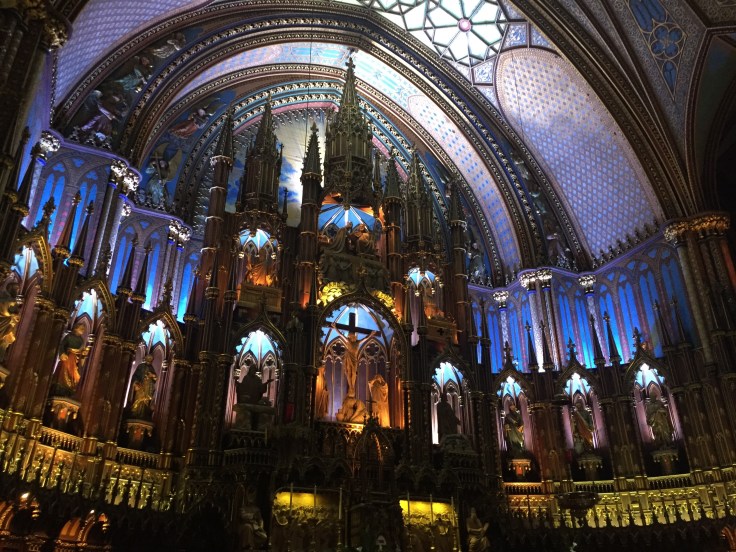
As majestic as this facade was, it didn’t prepare us for the interior!

2017-08-19 Montreal 17 Bassilica

2017-08-19 Montreal 16 Bassilica

2017-08-19 Montreal 15 Bassilica

Obviously, much of the impressiveness comes from the well-designed lighting, but still, it is breathtaking!

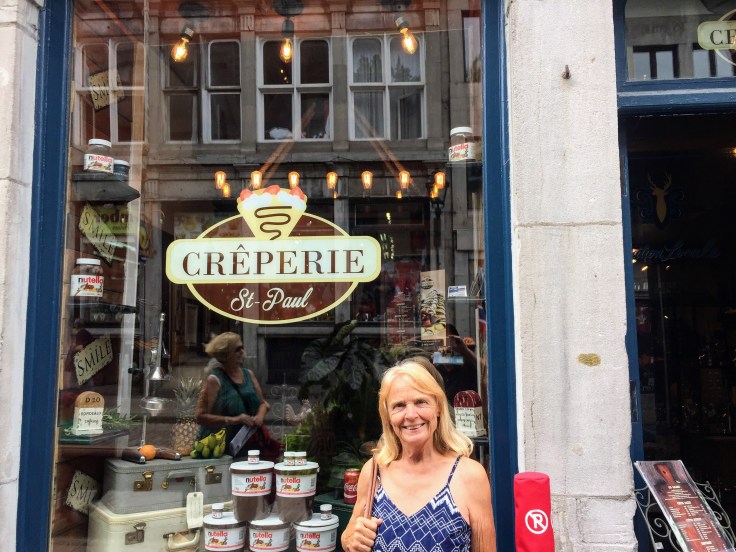
Then we started walking the town. We HAD to stop for a late breakfast of crepes:

2017-08-19 Montreal 13

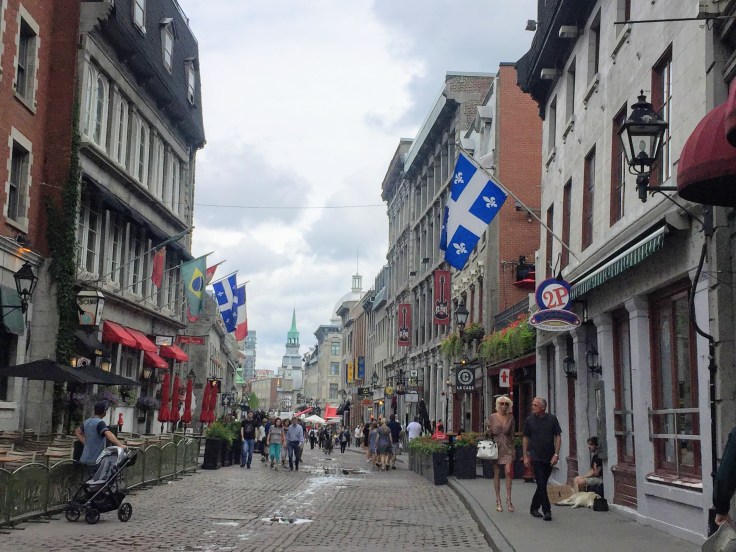
The old city is a lot of fun. We were there early, so it was not crowded, and streets reserved for pedestrians later in the day are bustling with delivery trucks..

We walked down to the waterfront; they had a lot of amusement park type places, and was not really interesting, but it was a nice stroll among the trees…

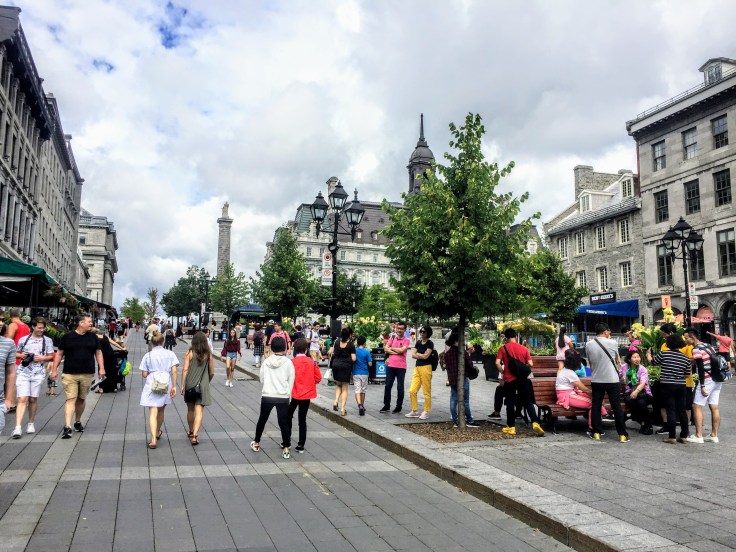
Then we walked back up to the Old City. Things had changed! The streets were packed with people. Restaurants were putting tables and chairs out onto the sidewalks.  Throngs of people were everywhere!  It was marvelous!

2017-08-19 Montreal 10

2017-08-19 Montreal 06

2017-08-19 Montreal 12

2017-08-19 Montreal 07

We found that Montreal has many lovely french-style cafes:

2017-08-19 Montreal 19

And then they also have this:

2017-08-19 Montreal 14

And soon it was time for lunch:

2017-08-19 Montreal 05 Lunch


2017-08-19 Montreal 04 Lunch


2017-08-19 Montreal 03 Lunch

After our late lunch we headed back towards the bus station. Along the way we found a brave soul pulling an Airstream through old Montreal…

2017-08-19 Montreal 02 Airstream

Upon arriving at the bus station, we found that, of course! Doesn’t every bus station have an ice skating rink?

2017-08-19 Montreal 01

We caught our bus and soon were back at the Villa.  We took a swim and had more Happy Hours. And an enjoyable time was had by all…


2017-08-17 Westbound; Quebec Old City

The KOA outside Quebec offers a shuttle service to take us into Quebec; as we waited, I noticed this truck parked across the street:

2017-08-17 Quebec - Big Truck

They grow them big here in Canada…

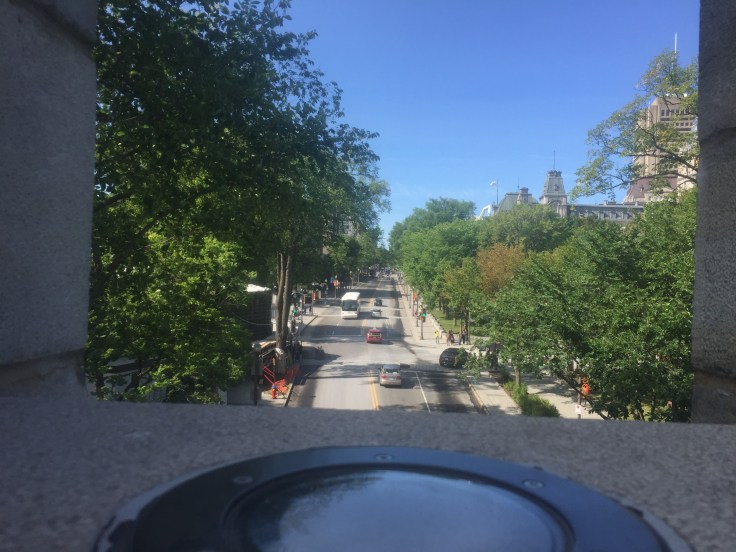
The bus arrived promptly on time, and by 9:00 am we were in vieux cite Quebec.  First, of course, is the fortress!

2017-08-17 Quebec City 33

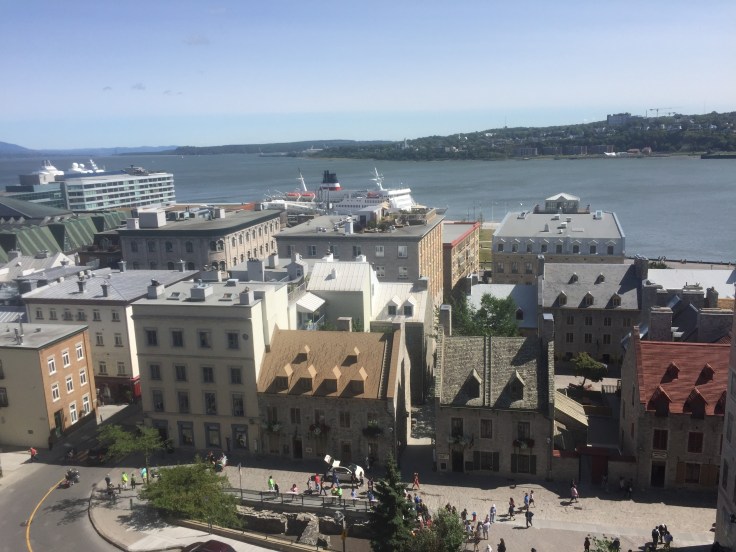
The walls around the fortress provide wonderful views of the old city (vieux cite)…

2017-08-17 Quebec City 20


2017-08-17 Quebec City 19


2017-08-17 Quebec City 18


The city plaza is dominated by a huge, old, hotel: The Frontenac. (It is now a Fairmont…)


2017-08-17 Quebec 43


2017-08-17 Quebec 44

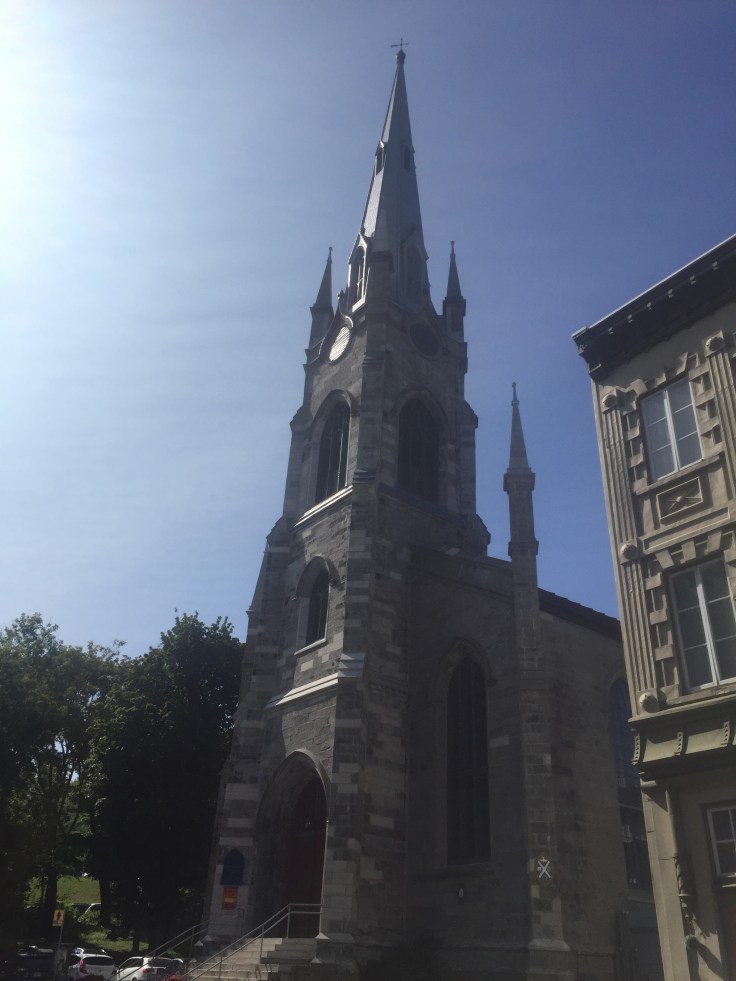
As we love to do in cities we walked the streets. We love finding the quaint, beautiful, historic, and charming sites…

2017-08-17 Quebec 41


2017-08-17 Quebec City 35


2017-08-17 Quebec City 46


2017-08-17 Quebec City 34


2017-08-17 Quebec City 36


2017-08-17 Quebec City 39


2017-08-17 Quebec City 45


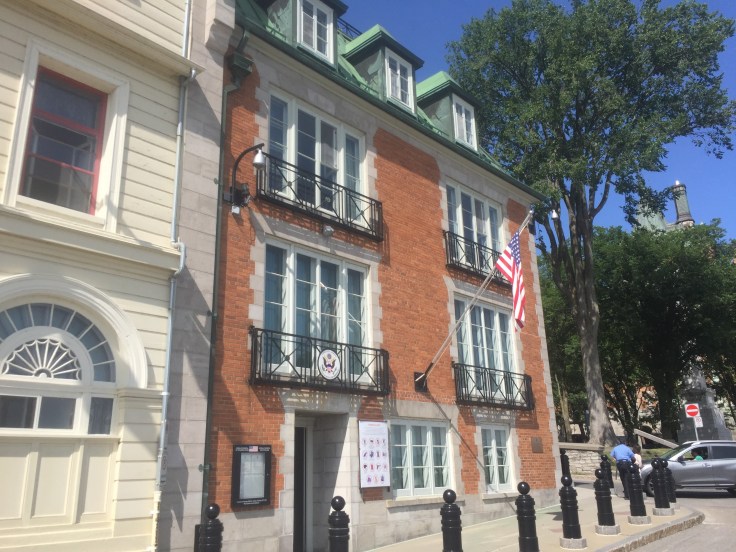
We even found the American Consulate, in case we got into trouble…

2017-08-17 Quebec 42

We also found that Quebecois like to have fun in the winter: on the town square is a sledding slide:

2017-08-17 Quebec 21


And, of course, what we also like to do is find a charming sidewalk cafe to enjoy lunch:


2017-08-17 Quebec City 38

We ordered a bottle of wine…

2017-08-17 Quebec City 37

Finally the duck confit arrived

2017-08-17 Quebec - Lunch 01

After lunch we walked some more, but then we needed to stop for some espresso while we waited for the shuttle to take us back to the Villa.

Back in the RV park, we met two other Airstreamers: one was from Connecticut; they were enjoying their 3rd new Airstream in the past year (16′, 22′ and now 25′).  I’m sure their Airstream dealer is driving a new car, too… The other Airstream was being pulled by a nice Mercedes GL350, that looked vaguely familiar. Once we got to talking, we realized that we had seen them in Lunenburg, NS, and they had met some of our fellow caravanners whilst they were there…!

So Happy Hours ensued; an enjoyable time was had by all…


2017-08-03 Nor by Nor’east Caravan – Nova Scotia Wine Country!

Yes, there really is Wine Country in Nova Scotia, and, like all Wine Countries, it is beautiful:

2017-08-02 Rose Bay 02

Today we explore the Nova Scotia Wine Country. Or I should say: “Wine” Country. We will be exploring and enjoying the countryside, not so much the “Wine”.  From what we hear, grapes are pretty scarce in Nova Scotia “Wine”…

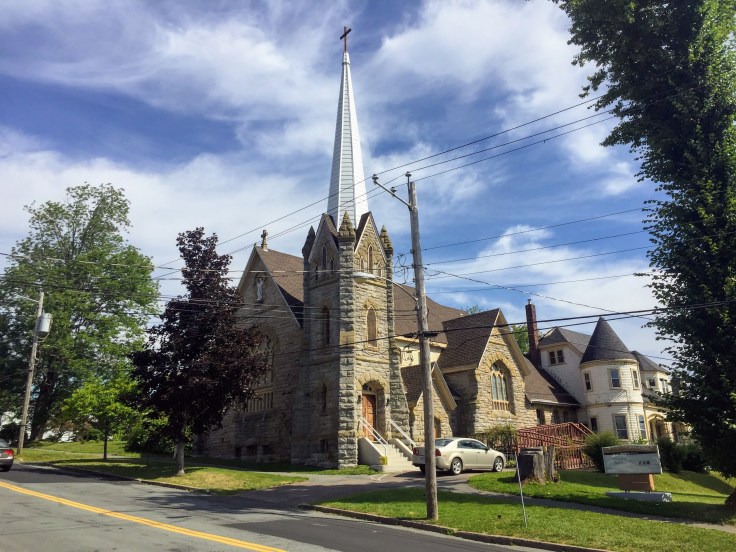
But first, we stopped off in the town of Windsor. As usual, there was a great church:

2017-08-03 Windsor, NS 3

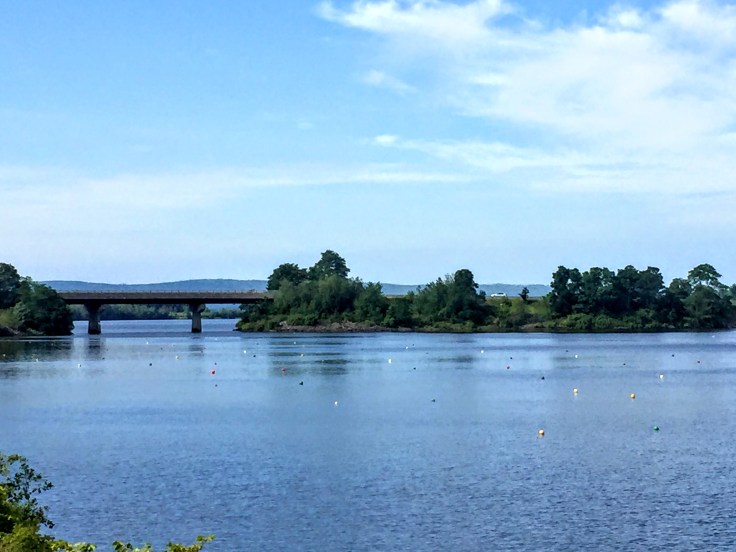
We walked around the lake adjacent to the town. It was a good path and the views were great:

2017-08-03 Windsor, NS 1

2017-08-03 Windsor, NS 2

Our wine destination for today is Luckett Vineyards.  We did the wine tasting, avoiding the wines that were made from something other than grapes. I know – this is a little narrow minded of me, but I’m sort of picky this way…

They have something here called Tidal Bay. It is a wine unique to Nova Scotia.  Many wineries make Tidal Bay, but it must be approved by the “wine police” before it can be sold under the name Tidal Bay.  It is a white wine, good with seafood, sort of like a Pinot Gris or Sauvignon Blanc.  There are rules about what goes into it, and it is limited to no more than 11% alcohol.  It was probably the best wine they had… We also somewhat liked their Triumphe – a red wine made of 100% Triumphe grapes, whatever they are.

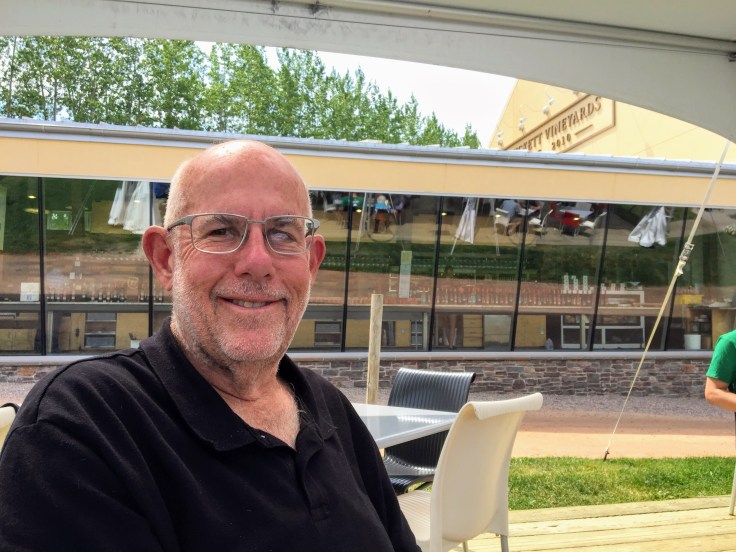
After our tasting we quickly made our way to their outdoor restaurant.  We had heard that they fill up quickly, even though it is a very large area, under a big white tent.  We ordered a glass each of the Tidal Bay and the Triumphe, and we were pleasantly surprised that they tasted better at lunch than in the tasting room. The restaurant was packed withing 10 minutes of our seating, and when we left there were 50 people waiting for tables.

2017-08-03 Luckett Winery 4

We had been invited by our tasting server to spend some time “frolicking about” in the vineyards. So we frolicked:

2017-08-03 Luckett Winery 3

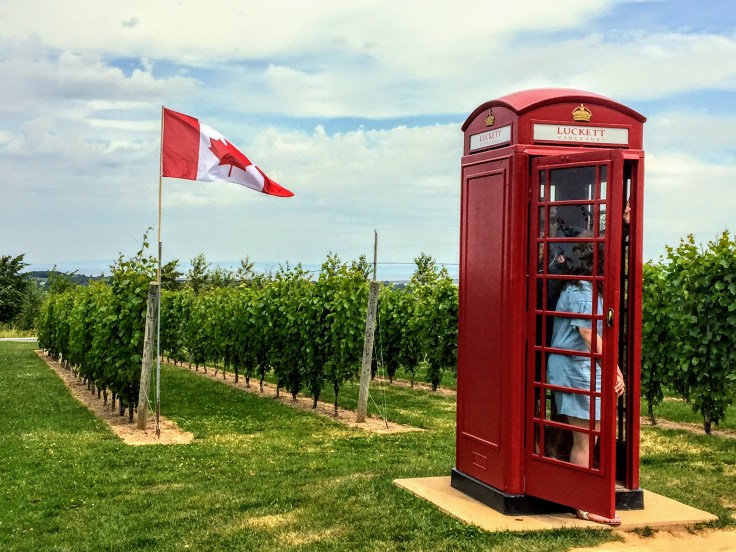
We came upon a red, London phone booth.  We were invited to make a free call to anywhere in North America; unfortunately, the booth was occupied, or I would have called YOU!

2017-08-03 Luckett Winery 2

Our next stop was the town of Wolfville; this turned out to be another wonderful town, with many restaurants and coffee shops. This must be the tourist center of the North Shore, because no small town like this could possibly support this many restaurants… We walked the streets, and stopped for coffee; we returned to the Villa, and prepared for Happy Hours. We had a Drivers’ Meeting to discuss tomorrow’s move to Cape Breton Island.

And an enjoyable time was had by all…


Blog at WordPress.com.

Up ↑